PART 6 (THE END): The Card He Begged Me to Hide 008
Part 6 – The Place We Come Back To
I read Owen’s message again, then showed it to Melissa.
“He wants to tell the judge himself,” I said.
“Then we make sure he can,” she replied. “The advocate can arrange it, and no one should ask him to explain anything before he’s ready.”
I wrote back to Owen, You can tell the judge what you want her to know. You don’t have to protect me or Dad. I love you, and I’m listening.
His reply came after a few minutes.
Okay. I want to tell her the truth.
The next morning, the advocate arranged a private meeting with Owen and the judge.
Grant and I waited in separate rooms while the conversation took place.
The minutes stretched strangely, each one bringing no news and every kind of possibility.
I tried not to imagine Owen sitting alone in a room with adults and papers, but I knew the advocate would be beside him, and that the judge had promised not to ask him to choose sides.
Melissa sat with me in a small waiting room, her hands folded over a closed folder.
“You’ve done everything you can to make this about his safety rather than winning,” she said.
“I hope he knows that.”
“He knows you love him. The rest will take time.”
When the advocate finally came out, she did not tell me what Owen had said.
She only said he had spoken freely and that the judge would meet with both parents afterward.
I thanked her, though my voice sounded far away.
Grant arrived a little later with his attorney.
He looked pale beneath the courtroom lights, but when our eyes met, he didn’t look away.
The judge called us into her chambers.
Owen was not there.
She began by saying she would not share the details of his private conversation, but she would summarize the concerns relevant to the temporary custody arrangement.
Owen had described being afraid that his father might lose the family home and that he might be sent away if the business failed.
He had believed that living with Grant, delivering the trust papers, and helping secure the account could keep them together.
He had also said that his mother had never asked him to take sides and that he wanted to come home to Virginia.
I lowered my eyes for a moment, steadying myself against the words I had wanted to hear and the cost that had brought them.
The judge continued.
She said Owen had not described the card as a way to take money from either parent.
He had taken it because he thought it was connected to the trust and wanted to make sure the account remained protected for his future.
The card, she said, was an old administrative card with no independent authority to transfer or withdraw funds.
It had been harmless in one sense, but it had become a symbol of a burden Owen had believed he must carry alone.
I felt my shoulders loosen.
For weeks, that little piece of black plastic had seemed like a secret door into a danger I could not see.
Now it was only what Owen had feared it might be: a child’s attempt to guard something that belonged to him.
The judge turned to Grant.
“Mr. Whitaker, do you agree that Owen should return to Virginia under a revised temporary arrangement?”
Grant sat very still.
“Yes,” he said. “I do.”
The answer was not immediate, and I could see what it cost him to say it.
He looked toward me, then back at the judge.
“I want him to come home,” he continued. “I want him to understand that my financial problems are not his responsibility, and that he does not have to choose me to keep me safe.”
The judge nodded.
She said Owen would return to Virginia with me, with a transition plan that preserved his regular contact with Grant.
There would be a supervised review of the trust, counseling for Owen and family sessions for the adults, clear rules for international travel, and shared decision-making on major matters.
No parent would use the trust, travel arrangements, or the child’s statements as leverage in future disagreements.
The trust would remain under independent oversight for Owen’s benefit.
Grant’s request to change its terms would be withdrawn, and no new request could be made without review by the trustee and proper notice to the court.
The ruling did not erase what had happened.
It gave us a way to move forward without pretending it hadn’t.
When the judge finished, Grant’s attorney began discussing schedules with Melissa.
I heard the practical details, but my attention had gone to one word.
Home.
Owen would come home.
Grant and I were given a short chance to speak after the meeting.
He stood by the tall window in the corridor, where the winter light fell in long, pale bars across the floor.
“I’m glad he told the judge what he needed to say,” he said.
“So am I.”
“I don’t know how to make this right.”
“You can start by making sure he never has to wonder whether your problems are his to solve.”
He nodded.
“I will.”
There was no grand apology, and I didn’t need one.
What mattered was what he did after saying the words.
“Can you tell him I’m proud of him?” Grant asked.
“I’ll tell him you love him.”
He seemed to consider that, then nodded.
“Yes. Tell him that.”
I thought of the first time I had seen Grant after the custody order, standing at the airport with his boarding pass and his phone, looking as though the whole goodbye had been an inconvenience.
Now he looked tired in a less polished way, a father trying to understand how the choices he had made had settled into his child’s heart.
“Grant,” I said, “he loves you. That didn’t disappear.”
“I know.”
“But you have to let him love you without asking him to carry you.”
His eyes lowered.
“I understand.”
The words were only a beginning, but beginnings were what we had.
The travel arrangements took several days to finalize.
Grant stayed with Owen until the return flight, then accompanied him back to Virginia, as the revised plan required.
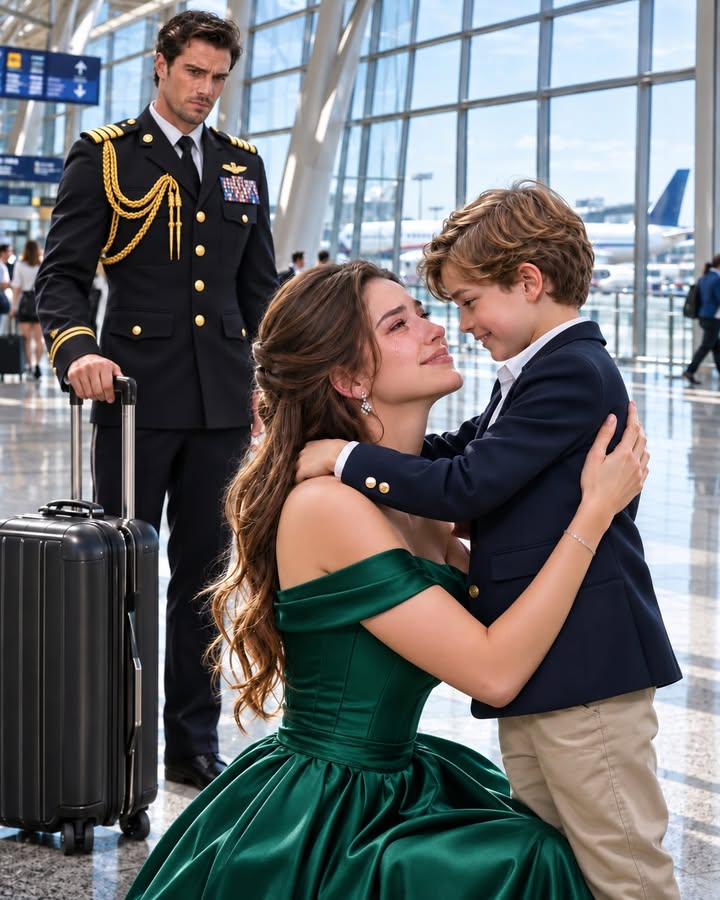
I met them at Dulles.
The airport looked just as it had the day they left: rows of passengers, suitcases rolling over polished floors, the same distant announcements echoing above the crowd.
But I was not the same person standing there.
I no longer held a secret in my pocket or feared that one wrong question might send Owen farther away.
I stood by the arrivals doors with my hands clasped, repeating to myself that he was coming home.
When he appeared, he was carrying his backpack and walking beside Grant.
His eyes found mine before anything else.
For a moment he stopped.
Then he ran.
I dropped to my knees and opened my arms.
He collided with me, wrapping both arms around my neck, and I held him as tightly as I could without making him feel trapped.
“You’re home,” I whispered.
“I’m home.”
His voice broke on the second word.
I pressed my cheek to his hair and closed my eyes.
The airport sounds moved around us: a suitcase rolling past, an announcement about a delayed flight, someone laughing near the café.
They seemed distant, as if we had stepped into a quiet place no one else could enter.
After a while, Owen pulled back.
“Did you keep the card safe?”
“I did.”
“Did you use it?”
“No.”
He nodded, relieved.
“Good.”
“It’s going to the trustee now,” I said. “They’ll make sure the account stays protected for your future.”
“Not for the business?”
“Not for the business.”
“Not for you?”
“Not for me.”
“And not for Dad?”
“Not for your dad either.”
Owen thought about that, then seemed to settle.
“It’s mine, but I don’t have to look after it.”
“That’s right,” I said. “It belongs to your future. The grown-ups are responsible for protecting it.”
Grant had remained a few steps away while we spoke.
When Owen looked over at him, Grant came closer.
“Can I hug you?” he asked.
Owen glanced at me, then back to his father.
“Yes.”
Grant bent down, and Owen stepped into his arms.
I watched them hold each other without trying to decide what the moment meant.
No one asked Owen to reassure his father.
No one asked him to choose where the hug should end.
When Grant released him, his eyes were wet.
“I love you,” he said. “And I’m sorry I let you think you had to solve things for me.”
Owen looked at the floor, then lifted his gaze again.
“Are you still worried?”
“Yes,” Grant said. “I am.”
Owen’s face tightened.
“But I’m handling it,” Grant added. “The adults and the professionals are handling it. You don’t need to.”
“Okay.”
“I’ll keep talking with you, and I’ll come to the counseling sessions. We’ll follow the travel rules, and you’ll know before any plans change.”
Owen nodded.
“I’d like that.”
Grant crouched so they were at the same height.
“I know I can’t ask you to trust me all at once.”
Owen was quiet.
“I’ll have to show you,” Grant said.
“That sounds right,” Owen replied.
A small, uncertain smile appeared on Grant’s face.
“Yes,” he said. “It does.”
He told Owen he would call the next evening, then headed toward the parking area with his attorney.
Before he left, he looked back at us.
I gave him a small nod.
It was not forgiveness, and it was not a promise that the past no longer mattered.
It was simply an acknowledgment that he had taken the first step toward doing what he had said he would do.
On the drive home, Owen rested his head against the window.
He watched the familiar roads pass, then turned to me.
“Does my room still have my blanket?”
“It does.”
“And my spaceship drawing?”
“Still on the table.”
“Did you color the windows?”
“No. I saved them for you.”
He smiled faintly.
“I thought you might.”
At home, he stepped into the townhouse and stopped just inside the doorway.
His sneakers still sat where he had left them, one turned on its side.
The colored pencils were beside the spaceship, and his blue blanket lay folded at the foot of his bed.
He touched the blanket, then looked back at me.
“It smells like home.”
I felt my eyes sting.
“I’m glad.”
That evening, I made the familiar pancakes.
Owen stood beside me on a chair at the kitchen counter, adding flour while I measured the milk.
He spilled a little near the mixing bowl and looked at me quickly, waiting to see whether the ordinary mistake might become something more.
I handed him the spoon.
“Your job is to stir.”
He stirred carefully, then added the cinnamon.
“Did I put in too much?”
“Not possible.”
He laughed, and the sound loosened something inside me that had been tightly wound for weeks.
When the first pancake was ready, he placed it on a plate and dusted it with sugar.
Then he carried the plate to the table and sat down in his old place.
The spaceship drawing rested beside him.
He took a bite, chewed thoughtfully, and gave a solemn nod.
“Still the same.”
“Some things are.”
He looked at the blue pencils.
“Mom, I’m sorry I said you couldn’t give me a future.”
I set my own plate down and sat across from him.
“You don’t have to apologize for trying to help someone you love.”
“But I hurt you.”
“Yes,” I said. “And we talked about that. You told me what was true for you.”
“I thought if I picked Dad, you’d know I didn’t want you.”
“I know.”
“I did want you.”
“I know that too.”
He lowered his eyes to the pancake.
“I didn’t know how to love both of you when everybody was worried.”
I reached across the table, and he placed his hand in mine.
“You never had to choose one kind of love to keep the other,” I said. “You can love Dad, and you can love me, and you can be a kid who worries about pancakes and spelling tests instead of court orders.”
Owen smiled.
“What about the moon?”
“The moon too.”
“Even if it looks different here?”
“Especially then.”
He took another bite, then began telling me about the swimming pool and the tall shelves in his room abroad.
He told me which book he had read on the flight and which snack he had disliked.
He told me that the clouds from the airplane window had looked like mountain ranges.
I listened to all of it.
I did not ask about the time away or the papers he had carried.
Those things would have their place in counseling and in the truth we would keep learning together.
That night, after Owen had gone to bed, I took the black card from the lockbox.
It looked small beneath the kitchen light, no heavier than any other card, though for a long time it had seemed to hold the entire family’s future inside it.
The next morning, Melissa arranged for it to be delivered to the trustee through the proper process.
The trustee confirmed receipt and reaffirmed that the account would remain under independent oversight for Owen’s education and future needs.
There would be no secret transfers, no hurried changes, and no parent asked to decide what the money meant.
The card no longer belonged to the silence between us.
It belonged with the people whose responsibility was to protect Owen’s future until he was old enough to shape it himself.
In the weeks that followed, Grant kept his commitments.
He attended the first counseling session without trying to defend every choice he had made.
He asked the counselor how to explain the business situation to Owen in a way that was honest without making Owen feel responsible.
He called when he said he would and respected the schedule when plans had to change.
The revised custody plan gave Owen regular time with each parent, clear travel rules, and the assurance that major decisions would be discussed rather than announced.
Grant’s business continued to face difficulties.
He hired an adviser, negotiated with creditors, and began making the decisions he should have made before involving his son.
He did not ask Owen to carry messages to the trustee again.
He did not mention the trust as a possible solution.
It took more than one apology to rebuild what had been shaken, but Grant understood that the work belonged to him.
Owen grew less watchful with each week.
He began calling both homes his homes, then stopped needing to explain what he meant.
Some nights he asked whether the business was still in trouble.
Grant answered honestly, saying it was being handled and that Owen was safe.
Some nights Owen asked me whether I was still hurt.
I told him that feelings could take time, but love did not disappear while people learned how to do better.
On the first Sunday after our counseling schedule was set, Owen asked if we could make pancakes again.
He stood on the chair beside me, carefully stirring the batter while sunlight came through the kitchen window.
When I reached for the cinnamon, he took the jar first.
“I know how much,” he said.
“Show me.”
He sprinkled it into the bowl, then gave me a confident look.
We cooked the pancakes slowly, one at a time, without checking the clock.
After breakfast, he carried his plate to the sink and returned to the table to finish coloring his spaceship.
He filled the windows blue and drew another bright yellow sun in the corner, this one neatly inside the lines.
Then he set the pencil down and studied the picture.
“Do you think it’ll get where it’s going?” he asked.
“I think it already knows where home is.”
He leaned against my side, warm and solid and entirely himself.
The card was safe with the trustee.
The trust belonged to Owen’s future.
And the promise between us no longer depended on a secret, a courtroom sentence, or a frightened child trying to hold his family together.
It rested in the small things we would keep doing: the calls that came when they were promised, the truth spoken gently, the door left open, and pancakes made together on an ordinary Sunday morning.
**–THE END–PLEASE
Share your thoughts or feedback to motivate us to create more stories ♥️
* * *
[PREVIOUS: PART 5](https://puretales.idolsgift.com/blog/part-5-the-card-he-begged-me-to-hide-008)
✓ Lynn R. Adams
Part 6 – The Place We Come Back To I read Owen’s message again, then showed it to Melissa. “He wants to tell the judge himself,” I said. “Then we make sure he can,” she replied. “The advocate can a…