PART 6 (THE END): The Card at the Window 055
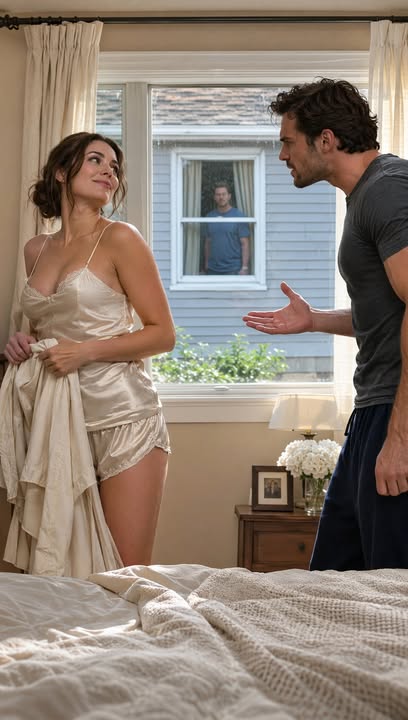
Part 6 – Morning Light
Ruth’s words seemed to stop the morning around us.
“What my mother left behind?” my wife asked.
Ruth nodded and opened the door wider.
“If you’re comfortable coming in, I can show you.”
My wife looked back at me, then at Martin.
We waited for her to decide.
“Yes,” she said at last. “I’d like to see it.”
Ruth led us into a sitting room crowded with books, framed photographs, and the gentle scent of tea.
She asked whether we would like a cup, and my wife accepted, though she held it between her hands without drinking.
Martin stayed near the doorway until Ruth invited him to sit.
The brass key lay on the table between us, catching a stripe of sunlight.
“I’ve kept this for a long time,” Ruth said. “Claire asked me to hold it until Elaine’s daughter came looking.”
My wife’s fingers tightened around her teacup.
“She knew I might come?”
“Not exactly,” Ruth replied. “Claire hoped you might, but she never wanted you to feel you had to.”
Ruth rose and went to a cabinet.
From a drawer she brought a small wooden box, its surface worn smooth at the corners.
She set it beside the key.
“This was stored in a cabinet at the old community hall,” she said. “The key opens it.”
My wife looked at the box as if it were both an answer and another question.
“What’s inside?”
“Things Elaine asked Claire to keep for her,” Ruth said. “Claire brought the box to me when she moved out of town, and I’ve held it ever since.”
“Why didn’t you give it back to my mother?”
“I tried to find her once, years later, but she had moved again. Claire said Elaine would contact me if she wanted the box.”
Ruth’s gaze softened.
“She didn’t want me to chase someone who was trying to build a quiet life.”
My wife looked down at her tea.
That sounded like her mother: choosing distance not because she had forgotten the people who helped her, but because she wanted to make a life that did not depend on returning to the past.
“Did my mother ever ask for it?” she said.
“Not that I know of.”
“Did she know Claire gave it to you?”
“I believe so. Claire wrote to her, though I don’t know what Elaine received. Some letters came back.”
Ruth rested her hands on the table.
“When Claire was ill, she asked me to keep the box safe. She said if Elaine’s daughter ever found us, I should let her decide what to do with it.”
My wife glanced at Martin.
He had been quiet, his eyes fixed on the little box.
“Did you know any of this?” she asked him.
“No,” he said. “I knew Claire kept letters and photographs. I didn’t know about Ruth or the box.”
There was no disappointment in his voice, only wonder.
He looked at the key, then at the woman who had kept it safe for so many years.
“Claire always seemed to know more than she told me,” he said. “I thought it was because she wanted to protect me from worry.”
Ruth gave him a fond look.
“She was good at protecting people, sometimes too good.”
My wife breathed out slowly.
“May I open it?”
“Of course.”
She fitted the key into the small lock.
For a moment it resisted, then turned with a soft click.
Inside lay several folded papers, a little cloth pouch, and a photograph secured between two sheets of thin paper.
My wife lifted the photograph first.
It showed her mother and Claire seated on the steps of the community hall, both of them younger than the women in the earlier pictures.
Elaine held a child wrapped in a pale blanket.
My wife’s hand rose to her mouth.
“That’s me,” she whispered.
Ruth nodded.
“You were very small.”
My wife stared at the baby’s face, her own features still indistinct in the old image.
Her mother was looking down at her, smiling with an expression so tender it made the room feel suddenly intimate.
Claire sat beside them, one arm resting along the step behind Elaine.
They were not posed for a formal picture.
They looked like people who had found one safe afternoon and wanted to remember it.
My wife turned the photograph over.
On the back, in her mother’s handwriting, were the words: *For Claire, who helped us find our way home.*
She read the sentence twice.
Then she pressed the photograph gently against her chest.
“I never knew she had a picture of me that young.”
“She kept it in the box,” Ruth said. “Claire told me Elaine wanted the ordinary moments saved too.”
The small cloth pouch held a silver charm shaped like a leaf.
Beneath it lay a folded note addressed to Claire.
My wife paused before opening it.
“Would you like me to read it aloud?” she asked Ruth.
“If you want to.”
She unfolded the page carefully.
The handwriting was Elaine’s.
“Claire, I don’t know whether I’ll ever be able to explain how much your friendship changed my life,” my wife read.
“When I was frightened, you never asked me to prove that I deserved help.”
She took a breath and continued.
“You gave me a place to rest, a way to leave, and the belief that one day my daughter might grow up knowing more about laughter than fear.”
My wife stopped.
I reached for her hand beneath the table.
She held on and read the last lines.
“If she ever asks about those years, please tell her I was not only afraid.”
“I was also loved.”
For a moment, no one spoke.
The sentence seemed to gather every missing piece without pretending there were no gaps.
My wife lowered the note.
“She did want me to know,” she whispered. “Just not every detail.”
“I think so,” Ruth said. “She wanted you to inherit the life she made, not the fear she had escaped.”
My wife looked at the photograph again.
The baby in the blanket had no memory of that afternoon.
But the woman holding the picture could feel the care that had surrounded her before she knew what care was.
“I was angry that she kept this from me,” she said.
“You can still be,” I told her.
She glanced at me.
“You don’t have to choose between understanding her and wishing she had told you more.”
Her eyes shone, but she smiled.
“I know.”
Ruth brought over a second photograph from the box.
It showed Claire standing outside the community hall with several volunteers, holding a stack of folded blankets.
A handwritten note on the back named the people in the picture and described a winter collection for families who had needed warm clothes.
There was no account of who had received the blankets.
No list of names.
Just a record that Claire and her neighbors had gathered what they could and given it freely.
My wife looked at the photograph, then at the carefully preserved papers.
“This is the part I want people to remember,” she said. “Not every painful thing that happened before it.”
Ruth nodded.
“Claire would have understood.”
“Would she have wanted the archive to know about the box?”
“Some of it, perhaps,” Ruth said. “But the choice is yours.”
My wife set the private letter beside the silver charm and the photograph of herself as a baby.
“These stay with me.”
“Of course.”
“The pictures of Claire’s volunteer work, and the note about her friendship with my mother, can go to the archive.”
Ruth smiled.
“That sounds like a good way to honor them both.”
My wife turned to Martin.
“Would you be comfortable with that?”
“I would,” he said. “I want Claire remembered for the good she did, not for things she never meant to make public.”
The ease of his answer moved her.
For so long, she had feared that preserving Claire’s story meant surrendering every part of her mother’s privacy.
Now she could see a way to honor both women: to tell the truth about kindness without forcing anyone’s private pain into the light.
At the archive, Denise helped us prepare a small collection.
We included the photograph of Elaine and Claire, the message on its back, and copies of the community notices that recorded Claire’s volunteer work.
My wife wrote a short account of their friendship, using only what her mother had chosen to share in the letters.
She asked that the most personal letter remain closed and that the archive note clearly state that Elaine had kept some parts of her history private.
Denise read the request carefully and agreed.
“We’ll preserve what you’ve offered,” she said. “And we’ll respect what you haven’t.”
My wife signed the donor form.
Her hand was steady.
On the way out, she paused beside a display of old town photographs.
She looked at them for a while, then found the picture of Claire among the volunteers and smiled.
“Now she won’t disappear,” she said.
“No,” I replied. “She won’t.”
The archive arranged a small gathering the following month to honor Claire’s years of service.
It was held in the community hall where she had once helped organize suppers and book drives.
Martin came with us, carrying a framed copy of the photograph of his sister.
Ruth came too, leaning on my wife’s arm as we walked through the entrance.
The hall was full of neighbors, old friends, and people who had heard stories about Claire from their parents.
There were no speeches about bravery or tragedy.
Instead, people remembered her practical kindness: how she brought soup when someone was ill, how she stayed late to put chairs away, how she noticed when a new family seemed lost and made sure they had someone to sit beside.
My wife stood near the photograph display, listening.
Then Denise introduced her and invited her to say a few words.
My wife looked at the faces gathered before her and took a breath.
“My mother never told me every detail of her life in Cedar Falls,” she said. “For a long time, I thought that meant there was something she did not trust me to know.”
She glanced at the photograph of Elaine and Claire.
“I understand now that she may have been trying to give me a childhood that was more than the hardest thing she survived.”
The room was quiet.
“My mother was afraid once,” she continued. “But she was also loved, and she was helped by a friend who never made her feel that accepting help made her weak.”
My wife’s voice strengthened.
“I’m grateful to know Claire’s name. I’m grateful to know she kept showing up, not only for my mother, but for this town.”
She looked at Martin.
“And I’m grateful to everyone who remembered her in the small, ordinary ways that made a life.”
Martin lowered his head, overcome.
When the gathering ended, people came forward to tell him their memories of Claire.
He listened with a humility that seemed to make each story welcome.
Ruth told him that Claire had once helped her carry groceries home through a snowstorm, then refused to let her repay the favor.
“I had forgotten that,” Martin said.
“I hadn’t,” Ruth replied.
My wife stood between them, holding the baby photograph from the box.
She was not trying to reconstruct every year her mother had left unexplained.
She was letting herself receive what had been offered: a picture, a promise, and the knowledge that somewhere along the way, people had stood beside Elaine when she needed them.
Later, in the car, she rested the photograph on her lap.
“Does it feel finished?” I asked.
“No,” she said. “But it feels complete enough.”
I understood.
There were questions we would never answer.
We might never learn exactly what the brass key had once opened, or why the name Ruth had been written beneath the date.
We did not need to solve every mystery to understand what mattered.
Elaine had been afraid, and she had been helped.
Claire had made a promise, and Ruth had kept it.
My wife had found a past she could honor without giving away what had been entrusted to her.
And I had learned that suspicion could sometimes protect a person, but it could also become a story told too quickly when the truth was still waiting to be heard.
At home, we placed the baby photograph in a new frame on the bookshelf.
Beside it, my wife set a picture of her mother as a young woman and one of Claire smiling on the steps of the community hall.
She did not put the private letter on display.
That remained in the box, folded and safe.
The curtains in our bedroom stayed closed after dark.
Not because we were afraid of the house next door, and not because we were trying to send a message.
We closed them because our home belonged to us, and privacy was not something we had to explain or earn.
In the mornings, we opened them again.
Sometimes the light fell across the room while my wife made coffee, and sometimes she left them half drawn while she read.
The choice was hers, and I no longer tried to interpret it as a signal.
A few weeks later, we invited Martin and Ruth over for tea in the afternoon.
Martin brought a tin of biscuits.
Ruth brought a small vase of flowers from her garden.
We sat together in the living room, where the photographs stood on the shelf, and listened as Martin told us about Claire’s terrible singing and her talent for winning arguments she had no business winning.
My wife laughed until she had to wipe her eyes.
For the first time, the story of her mother’s friendship felt less like a locked room and more like a window into a life that had been full of people.
When our guests left, Martin paused at the front door.
“Thank you for letting me be part of this,” he said.
“Thank you for telling us the truth,” my wife replied. “And for listening when we told you what we needed.”
“I should have done both sooner.”
“Yes,” she said, with a gentle smile. “You should have.”
He accepted the answer with a nod.
Then he crossed the lawn without glancing toward the upstairs windows.
My wife watched him reach his porch, then turned to me.
“Are we all right?” she asked.
I took her hand.
“We’re talking,” I said. “That’s how we’ll stay all right.”
She leaned her head against my shoulder.
“I don’t want either of us deciding what the other can handle.”
“Neither do I.”
“And if something strange happens again?”
“We ask each other before we build a whole story around it.”
She smiled.
“That sounds fair.”
The following morning, the curtains were open when I woke.
Sunlight spread over the floor and warmed the framed photographs on the shelf.
My wife stood beside the window, dressed for work, holding a cup of coffee.
Beyond the glass, the neighborhood was waking slowly: a dog walker turning the corner, a delivery truck at the curb, a child waving to someone across the street.
There was no one watching from the upstairs window next door.
There was only a quiet house, a shared room, and the morning we had chosen to let in.
My wife looked back at me.
“Coffee?” she asked.
I crossed the room and took the cup she offered.
Behind her, the light rested on the photographs of Elaine and Claire, on the small image of a baby held safely between them, and on the life my wife and I were still learning to share.
This time, the open curtains meant exactly what we wanted them to mean.
We were home, together, and unafraid.
**–THE END–PLEASE
Share your thoughts or feedback to motivate us to create more stories ♥️
* * *
[PREVIOUS: PART 5](https://storyly.idolsgift.com/blog/part-5-the-card-at-the-window-055)
✓ Lynn R. Adams
Part 6 – Morning Light Ruth’s words seemed to stop the morning around us. “What my mother left behind?” my wife asked. Ruth nodded and opened the door wider. “If you’re comfortable coming in, I ca…