PART 6 (THE END): The Breath Beneath the Silence 058
Part 6 – Bells for the Living
For a moment, no one spoke.
The physician kept two fingers against Edward’s wrist while Isabella held his hand, her face caught between hope and alarm.
Martha stood near the bed, watching the king’s eyes struggle to remain open.
“The voice sounded like someone from the palace,” Edward had said.
The adviser’s expression had gone still, but not hard.
He looked less like a man accused than one trying to remember every sound in a night he had never witnessed.
“Your Majesty,” the physician said gently, “you have done enough for now.”
Edward gave the smallest nod.
“I remember the warning,” he whispered. “Not the face.”
“Then we will not ask you to force it,” Isabella said. “Rest, and let the memory return in its own time.”
She drew the blanket higher over his shoulder.
Edward’s eyes closed, and his breathing steadied.
The physician waited a little longer before straightening.
“He is tired, but his pulse is holding,” he said. “A quiet room is what he needs.”
Isabella looked toward the adviser.
“Can you find out whether anyone at the palace knew the bridge was unsafe?”
“I will ask the guard captain and the household steward,” he replied. “Carefully. We should learn what was reported, rather than begin by assuming someone ignored a warning.”
The queen nodded.
“Exactly.”
Martha glanced at the adviser.
His earlier silence about the harness repair had taught her to be wary of tidy explanations, but it had also taught her that fear could make an ordinary mistake grow shadows around it.
“Perhaps the bridge keeper heard something,” she said. “Or someone who passed it that morning.”
The adviser turned to her.
“That is a sensible place to begin.”
He did not sound offended that she had spoken.
If anything, there was relief in his voice that someone had offered a question rather than a judgment.
The physician asked Isabella to remain beside Edward while he fetched a written account of the king’s condition.
The adviser left to speak with the guard captain, and Martha stayed by the bed.
For a while, the only sound was the fire and Edward’s quiet breathing.
Isabella watched her husband with the fixed attention of someone who had nearly lost him and was still learning how to believe he remained.
“Do you think he will remember who warned him?” she asked.
“I don’t know,” Martha said. “But he may remember more when he is stronger.”
The queen nodded.
“I keep wanting every answer at once.”
“I understand.”
Isabella looked at Martha, then gave a faint, rueful smile.
“I suspect you understand better than I do.”
Martha returned the smile.
“I learned that wanting an answer does not always make one arrive sooner.”
“No,” Isabella said. “It only makes the waiting louder.”
By the following morning, Edward was strong enough to sit propped against his pillows for a short while.
He tired quickly, but his thoughts were clearer, and the physician permitted him to speak for a few minutes at a time.
Isabella sat beside him, while Martha arranged a cup and a small dish of broth within easy reach.
The adviser entered with the guard captain and a folded report.
“Your Majesty,” he said, “we have spoken with the bridge keeper, the patrol guards, and the household steward.”
Edward looked toward him.
“What did you learn?”
“The bridge had been inspected the day before your journey,” the adviser replied. “The keeper noticed a loose stone near the outer edge, but it was not in the section where your carriage left the road.”
“Was that written down?” Isabella asked.
“It was mentioned to the local steward,” the guard captain said. “The steward believed the stone could be secured the next morning and did not consider the crossing unsafe.”
The adviser unfolded the report.
“No one appears to have warned the palace that the bridge should be closed,” he said. “There is no record of a message being sent.”
Edward’s gaze rested on the page.
“And the voice?”
“The bridge keeper remembers calling to a rider who crossed earlier that day,” the guard captain said. “He cannot remember the rider’s face, but he recalls warning him about the loose stone.”
“Would the rider have been able to hear him from the road?” Martha asked.
“If the wind was in the right direction,” the captain replied. “The warning may have carried.”
Edward closed his eyes, listening inwardly.
“Perhaps,” he said. “I remember someone calling, but not whether the words were meant for me.”
The physician, standing near the hearth, spoke before anyone could ask more.
“Then we leave it there for now. A memory recovered under strain is not a witness we should press.”
The queen looked at Edward.
“You heard the warning, but you cannot know who gave it or exactly what it said.”
“Not yet,” he replied. “And perhaps I never will.”
The words settled gently in the room.
The adviser set the report aside.
“We have also reviewed the bridge inspection,” he said. “The warning was not concealed. It was not sent to us because the local steward believed the repair could wait until morning.”
“Was that a wise decision?” Isabella asked.
“No,” the adviser answered. “But there is no evidence that anyone intended harm, or that anyone knew the carriage would be in danger.”
Edward’s brow furrowed.
“Then the bridge was not prepared for a royal carriage.”
“Nor for any heavy carriage,” the captain said. “The crossing should have been closed until the stone was secured.”
“Make certain it is repaired,” Isabella said. “And have the other bridges inspected before the next royal journey.”
The captain bowed.
“I will see to it.”
The adviser gathered the report, then paused.
“I also recommend that messages about roads and bridges be sent directly to the palace, even when the danger seems minor.”
“Agreed,” Edward said. “A small warning may matter greatly to someone who has not heard it.”
He looked toward the adviser.
“And no detail should be withheld merely because it might trouble the household.”
The adviser met his gaze.
“I understand, Sire.”
Edward held his eyes for a moment, then nodded.
“Good.”
There was no grand accusation and no dramatic confession, only a quiet agreement that fear must not be allowed to bury useful truth.
The adviser bowed and left with the captain to put the new instructions in place.
When the door closed, Isabella turned to Edward.
“You are already trying to govern from a bed.”
“I am trying to make sure I do not have to lie in one again.”
A soft laugh escaped Isabella, and this time it did not turn into tears.
Martha set the broth within reach.
“You should eat before you make another royal decree.”
Edward looked at her with a weary smile.
“That sounds like good advice.”
“It is only broth,” she said. “But it is the advice I have.”
He took a few spoonfuls, pausing between each one.
The physician watched closely, then permitted him no more when he began to tire.
Edward did not argue.
That afternoon, the palace announced that the king was alive and recovering.
The message did not call Martha a miracle-worker, nor did it claim that anyone had solved every mystery.
It said plainly that she had noticed a sign of life, that the physicians had examined Edward again, and that the palace would improve its procedures for people found in uncertain condition.
It also said the carriage accident was being reviewed, and that the bridge would be repaired and inspected.
The city received the news with a mixture of astonishment and relief.
The bells did not ring yet.
Isabella said they would wait until Edward could hear them.
In the days that followed, the king’s strength returned slowly.
He began with brief walks from his bed to the window, supported by the physician and an attendant.
Later, he crossed the chamber without help, though he had to rest afterward.
Each small step mattered.
Isabella learned not to measure recovery by how quickly Edward returned to the council chamber, but by the simple signs that he was becoming himself again: a teasing remark, a thoughtful question, the way he reached for her hand without looking.
Martha stayed through those days, though she was offered the chance to return to her village whenever she wished.
The physician asked her to help train the attendants in the careful observations her mother had taught her.
She agreed, but only after making one thing clear.
“I can share what I learned,” she said. “But I will not pretend to be a physician.”
“Nor should you have to,” the physician replied. “Your observations may help us notice when we need one.”
He asked the palace to establish a clear routine for examining people who had been found unconscious or exposed to severe cold.
No one would be declared dead on the basis of a rushed examination, and uncertain signs would be checked again by more than one trained person.
The physician also made a point of telling the other doctors that the change was not Martha’s responsibility alone.
They had been the ones with instruments, experience, and authority.
They had made the mistake, and they would be the ones to learn from it.
Martha appreciated that he did not turn her into a symbol to spare himself discomfort.
She had acted because she could not stand still.
Now she was willing to help, but she did not want anyone to mistake courage for certainty.
Several days later, Edward walked into the garden.
The morning was clear and cool, with a thin mist lifting from the grass.
Isabella stayed at his side, matching his slow pace.
Martha walked a few steps behind with the physician, who had insisted on coming along despite Edward’s assurances that he felt well.
The king stopped beside the stone fountain.
“I remember the river now,” he said.
Isabella’s fingers tightened around his arm.
“Do you remember what happened?”
“Some of it. The carriage jolted, and I heard the warning. Then the horses pulled hard.”
He gazed at the fountain’s quiet water.
“I remember the cold, and someone calling. I still do not remember a face.”
“Does that trouble you?” Martha asked.
“Sometimes,” Edward admitted. “But I am beginning to understand that I may not be given every piece of the story.”
The physician nodded.
“That is a wise understanding.”
Edward looked at Martha.
“You found a piece everyone else missed.”
“I noticed a movement,” she replied. “The rest was the physician’s work.”
“And the rest was patience,” Isabella added. “More patience than any of us expected to need.”
Edward turned to her.
“I am sorry you had to wait.”
“I am sorry you had to be cold and frightened.”
He lifted her hand and kissed her knuckles.
“I am here now.”
She leaned her forehead lightly against his.
For a moment, the garden held only the quiet sounds of birds and water.
Martha looked away to give them privacy, but Isabella reached for her hand before she could step back.
“Stay,” the queen said. “You are part of this moment too.”
Martha hesitated, then remained.
Edward looked from his wife to Martha.
“I know I cannot repay you for what you did,” he said. “But I can make certain the palace learns from it.”
“Then please make certain the attendants are trained,” Martha replied. “There are people beyond these walls who may need the same care.”
“I will see that they are.”
“And those who work here should be able to ask for help when someone is ill, without fearing they will be told to keep quiet.”
Isabella’s expression turned thoughtful.
“That is a fair request.”
Edward nodded.
“It will be done.”
Martha was silent for a moment.
She had not expected to make a request of a king.
Now that she had, the sky had not fallen, and no one had laughed.
The court later gathered for a smaller ceremony in the great hall.
The funeral flowers had been replaced with fresh branches of green leaves, and the stone bier had been removed.
Edward entered slowly, with Isabella beside him.
The physician had advised against a long ceremony, so the gathering was brief.
The adviser stood near the front, no longer carrying a report to hide behind.
The stablemaster was there too, cleanly dressed and visibly uneasy among the nobles.
The king thanked the physicians for their continued care, then spoke of the changes the palace would make.
He explained that the new procedures would include repeated examinations when signs were uncertain and training for attendants who served the royal household.
He also ordered that reports about unsafe roads and bridges be delivered directly to the palace, however small they might seem.
The adviser addressed the court after him.
He described the repaired harness clasp and acknowledged that he had delayed sharing what he knew because he feared blame.
“I should have trusted the truth to be more useful than my silence,” he said. “I will not make that mistake again.”
The queen listened without interrupting.
When he finished, she said only, “Then let your actions show that you have learned.”
The adviser bowed.
He did not ask to be praised for confessing, and no one pretended that his earlier silence had been harmless.
Still, the room did not turn against him.
He had accepted responsibility, and the palace had room for people to correct themselves.
The king then asked Martha to step forward.
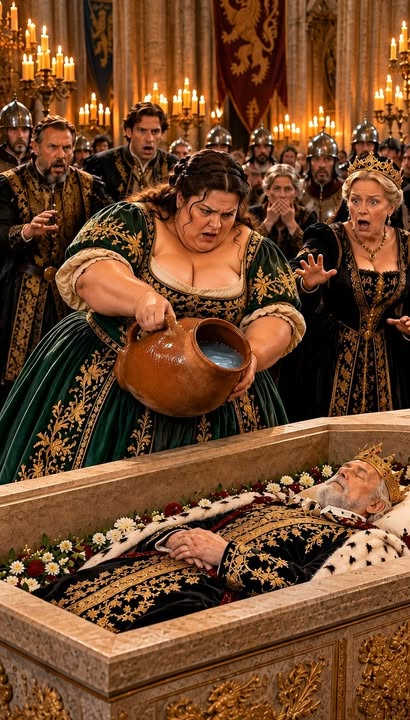
She did so, though the sight of the gathered court brought back the funeral hall: the shattered jug, the guards gripping her arms, the queen’s anguished voice.
Edward noticed her hesitation.
“You do not have to speak,” he said quietly.
“I know,” Martha replied. “But I will.”
She looked across the court.
“I do not want anyone to remember me as someone who knew for certain,” she began. “I did not know. I was afraid, and I acted before I could think of a better way.”
No one interrupted.
“I hope that if you remember anything, you remember to look again when something does not seem right. Ask another question. Call for help. Do not assume that a quiet person has nothing left to say.”
The words were simple, but they carried through the hall.
The physician bowed his head.
The stablemaster did the same.
Even the adviser looked at Martha with unguarded respect.
Edward stepped beside her.
“That is a lesson worth keeping,” he said. “And it is one this palace will keep.”
After the gathering, Isabella asked Martha to walk with her beneath the covered gallery.
The courtyard smelled of wet stone and crushed leaves.
For several moments, they walked without speaking.
“I have been thinking about your offer,” Martha said at last.
The queen slowed.
“You do not need to answer before you are ready.”
“I know. But I think I am ready to answer.”
Isabella waited.
“I miss my village,” Martha said. “I miss my mother’s kitchen, and the quiet of ordinary work. I do not want to become a court curiosity, or a person people call upon only because they heard a story.”
“You should not have to.”
“But I would like to learn more,” Martha continued. “If the physician will teach me, and if I can help the palace attendants do their work better, I would stay.”
The queen’s face warmed with relief, but she did not rush to seize the answer.
“On your own terms?”
“Yes.”
“Then we will make the role one you choose, not one imposed upon you.”
The physician, who had been waiting at the far end of the gallery, came forward.
“I would be glad to teach you what I can,” he said. “And I would learn from what your mother taught you.”
Martha looked between them.
She had expected the palace to ask her to become someone entirely different.
Instead, they were asking her to bring what she already knew and add to it.
“I would like that,” she said.
In the weeks that followed, Martha began assisting the royal physician.
Her duties were modest at first: preparing clean rooms, keeping careful records, learning how to watch a patient without disturbing them, and helping attendants recognize when a condition needed the physician’s attention.
She was not given a grand title or displayed before visitors.
She was introduced by name to the people she worked with.
The physician taught her the limits of what she knew, and Martha taught the attendants the lessons her mother had passed down: patience, close observation, and the importance of calling for help before fear made a person hesitate.
The palace workers began bringing their concerns to her without waiting for someone higher in rank to notice.
Martha did not always have an answer.
She learned that offering to listen could be useful even when she could not solve the problem herself.
The adviser kept his promise as well.
Reports from the roads were reviewed more carefully, the bridges were inspected, and messages about repairs were sent directly to the palace.
The damaged bridge near the river was secured before another royal journey.
The stablemaster was asked to create a clearer record of every repair made to the royal harnesses.
No one treated the measures as punishment.
They were simply ways to make the next journey safer than the last.
Edward’s recovery continued.
He returned to council gradually, and when he did, he kept the physician’s instruction to rest nearby.
He listened more carefully when attendants brought concerns forward, even when the problem seemed small.
Isabella noticed the change in him and did not tease him about it.
She had learned her own lesson: loving someone did not mean she could keep them safe from every danger, but it did mean standing beside them while they faced what came next.
On the first clear evening after Edward returned to the council chamber, the palace bells rang.
The sound rolled over the rooftops and through the streets, bright and warm beneath the sunset.
People came to their windows and doorways.
Some recognized the bells as a sign that the king had recovered enough to walk among his household again.
Others simply listened, relieved that the palace was no longer silent with mourning.
In the great hall, Edward stood beside Isabella beneath the open windows.
His strength was not yet fully returned, but he stood without help.
Martha was there too, dressed in a clean cream-and-brown gown much like the one she had worn on the day everything changed.
The queen took her hand.
“You once told me that you could not stand there and do nothing,” Isabella said.
“I remember.”
“Now you will have the chance to help many people before they reach the moment when someone must act in fear.”
Martha looked across the hall at the attendants and physicians gathered together.
“I hope we can make that possible.”
“We will try,” Edward said. “And we will keep trying.”
The bells continued, not for a funeral and not for a victory, but for life returned to an ordinary evening.
Edward turned toward Isabella.
“I promised I would be home before sunset,” he said.
“You were rather late.”
“I intend to do better.”
She laughed, and he kissed her gently beneath the warm glow of the hall’s lamps.
Martha watched them, feeling the old fear of being seen fade into something quieter.
She was not a spectacle, and she was not a miracle.
She was Martha, daughter of a village healer, a palace worker who had noticed what others missed, and a woman who had chosen to remain because she wanted to learn and to help.
When the bells fell silent, the hall did not return to mourning.
It filled with conversation, soft laughter, and the sound of people making room for one another.
And in the warm light, with the king beside his queen and Martha welcomed among those who would care for the household, the palace learned to listen not only for the loudest voice, but for the faintest breath.
**–THE END–PLEASE
Share your thoughts or feedback to motivate us to create more stories ♥️
* * *
[PREVIOUS: PART 5](https://storyly.idolsgift.com/blog/part-5-the-breath-beneath-the-silence-058)
✓ Lynn R. Adams
Part 6 – Bells for the Living For a moment, no one spoke. The physician kept two fingers against Edward’s wrist while Isabella held his hand, her face caught between hope and alarm. Martha stood ne…