PART 6 (THE END): The Bracelet in the Rain 041
Part 6 – The Shape of Light
For several seconds, I could hear only the quiet hum of the clinic and Cassandra’s unsteady breathing beside me.
The investigator’s message remained open on my phone, its words read aloud and then repeated in my mind: the person who had left the case was still inside the building.
“Can you find out who?” I asked.
“She’s checking the service entrance,” Cassandra said. “The camera image doesn’t show a face.”
“Then we don’t go looking for anyone,” I replied. “We preserve the footage and let the investigators handle it.”
Cassandra was quiet.
“I don’t want another person making a choice in fear,” I said. “We’ve had enough of that.”
“I agree.”
She sounded tired, but not defeated.
A few minutes later, the investigator called back and told us the person had already left through the loading entrance.
The camera showed a maintenance badge, but no one could identify its user from the footage.
The metal case had been left behind, open and empty.
There was no way to know whether it had ever contained the original safety reports or whether the person who carried it had taken something away.
For once, I did not try to make the uncertainty disappear by forcing an answer.
I told the investigator to secure the case and send the note to the independent review team.
Cassandra asked for no special treatment and made no attempt to keep the message private.
The note was added to the record with the words she said were not hers.
The handwriting specialist later confirmed what she had told us: the writing was not Cassandra’s.
No one could prove who had written it, but the independent review found that it had been left after someone accessed her office using a maintenance badge assigned to a contractor who had since moved away.
The missing evidence remained missing.
What replaced it, slowly and painstakingly, was a trail of copies, emails, clinic records, and people willing at last to speak.
The company’s board appointed an outside investigator who had no connection to Northstar or to any of us.
Cassandra cooperated with the inquiry and gave investigators her passwords, calendars, and every recollection she could offer, even the ones that made her look careless.
I did the same.
The investigators found that Northstar’s safety reports had been altered before the acquisition, and that important test failures had been relabeled as acceptable exceptions.
They found that Mara had raised her concerns through the proper channels, then sent a copy of her letter to the clinic because she feared the records might vanish.
They found that Cassandra had reviewed some of the concerns and failed to insist on a complete, independent verification before approving the acquisition.
They also found that I had opened the review file twice.
I could not remember doing so, but the records showed that my account had been used, and an assistant recalled delivering a summary to me before the acquisition meeting.
The summary described the review as routine and the discrepancies as resolved.
I had signed the approval.
The investigation could not establish who had used the missing case or who had written the note, but it established that neither Cassandra nor I had caused the collision.
The delivery van had forced my car off the wet Greenwich highway while swerving to avoid a truck that had changed lanes without signaling.
Mara had been traveling in the van with Lily, and she had been thrown against the side door when the vehicles collided.
The small metal case had been in Mara’s possession before the crash.
Cassandra had reached the scene before the emergency crews because someone had called her and told her that company evidence might be in the wreckage.
She had found Mara’s bracelet near the road and taken it, believing it might help her find its owner.
The bracelet had not been proof that Cassandra had harmed Mara.
It had been proof that she had been close enough to the wreck to witness the truth, and afraid enough to hide that fact.
When the investigation concluded, Cassandra read the findings aloud to me in our kitchen.
She did not skip the parts that implicated her.
When she finished, she set the pages down and waited.
“I’m sorry,” she said.
“I know.”
“I’m sorry I didn’t question the safety review harder.”
“So am I.”
“I’m sorry I kept the bracelet and didn’t tell you I had been at the scene.”
“I know.”
“I’m sorry I tried to manage what you heard because I was afraid of losing your trust.”
I rested my hands on the table.
“Are you sorry you were afraid,” I asked, “or sorry you let your fear decide for both of us?”
She took a moment to consider.
“The second,” she said.
That was the answer I needed, though it did not make everything right.
Trust did not return in a single conversation, or in the clean pages of a report.
It came back in small, unremarkable ways.
Cassandra began telling me what she knew, what she didn’t know, and what she was going to do next.
She stopped reaching for my arm without asking.
When I asked her to read something, she read the words as they were written rather than deciding which details might upset me.
When I wanted to walk alone, she let me.
When I wanted company, she stayed.
And when she made a mistake, she no longer waited for me to discover it.
Her resignation from the company was accepted after the review.
She did not argue that she had meant well or that other people had made similar decisions.
She accepted responsibility for her part and spent the next year cooperating with regulators, helping investigators locate records, and meeting with employees whose warnings had been dismissed.
The company survived, though not in the shape it had once been.
We sold the Northstar division, paid to review the affected products, and created an independent safety office with authority to stop a release even when it was inconvenient.
Some employees left.
Some investors did too.
The company grew smaller, slower, and more careful.
For the first time, I understood that survival and success were not the same thing.
The treatment for my sight began in the spring.
My doctor explained that the damage was permanent, but there were therapies that might help my brain make better use of the vision that remained.
There would be no sudden return to the world I remembered.
There might be only gradual changes, uncertain and incomplete.
I told him I would try.
At first, the therapy was mostly patience.
I learned how to rest my eyes before they ached, how to recognize light without expecting it to become an image, and how to let the people helping me know when I needed to stop.
There were mornings when I could distinguish the bright square of a window from the shadow around it.
There were evenings when even that blurred into darkness.
I did not mistake either outcome for a promise.
Mara’s recovery was slower.
She had injured her shoulder and suffered a concussion, and for months she struggled with headaches and the fatigue that followed them.
Lily stayed with her and Mrs. Ortega while Mara rebuilt her strength.
Her younger son, Mateo, returned home from a relative’s place once Mara was well enough to care for both children.
The first time I met him, he shook my hand with an earnestness that made me smile.
“Mom said you helped me get treatment,” he told me.
“I’m glad you got the care you needed.”
“Did you know I was scared?”
“No,” I said. “But I remember being scared about many things when I was your age.”
He looked thoughtful.
“Were you blind then?”
“No.”
“Does it make you scared now?”
“Sometimes.”
“Does it ever stop?”
“Sometimes,” I said. “And when it doesn’t, I try to let someone know.”
He nodded as if I had given him a useful answer, then ran outside to join Lily.
Mara and I spoke a few weeks later, after she had decided she was ready.
We met in the quiet room at Harbor Street Clinic, with Mrs. Ortega waiting nearby.
Mara’s voice was lower than Lily’s and steadier than Elias’s, though I heard how carefully she measured each word.
“I’m grateful you paid for Mateo’s treatment,” she said.
“I’m glad it helped.”
“But I wish I’d known.”
“I thought anonymity would make it easier.”
“It made me wonder whether there was a reason I was supposed to stay quiet.”
I lowered my head.
“I’m sorry.”
“I believe you meant to help,” she said. “I also believe you kept a distance that made it easier not to notice what was happening around you.”
The truth was gentle, but not soft.
“I think you’re right.”
“Will you do things differently?”
“I’m trying.”
“Then I’ll watch what you do.”
I welcomed that answer.
Mara told me about her fear on the highway, about the pain of leaving Lily with Mrs. Ortega, and about waking in the clinic to learn that her daughter was safe but that the people she feared might know where she was.
She had not disappeared because she wanted to abandon her children.
She had disappeared because she believed staying visible would put them in danger, and because she did not know which person inside the company could be trusted.
For six months, she had been trying to gather enough courage to come home.
Lily had been searching for her in the only way a child could: holding tight to one remembered image and refusing to let it be taken away.
When Mara finished, I told her that I was sorry we had made it harder for her to be believed.
She thanked me, then asked whether Cassandra was still with me.
“She is.”
“Do you trust her?”
“Not the way I did before.”
“Do you think you will?”
“I don’t know.”
Mara gave a small, understanding laugh.
“Sometimes that’s the most honest answer.”
I asked if she would consider speaking with Cassandra someday.
“Maybe,” she said. “But I won’t do it to make either of you feel better.”
“I wouldn’t ask you to.”
“Good.”
She did speak with Cassandra later, in her own time, with Mrs. Ortega there and no one else.
I was not present.
Afterward, Cassandra told me only that she had apologized and listened.
She did not ask what Mara had said about her.
She did not ask me to interpret Lily’s kindness as forgiveness.
That, too, was a change.
Lily visited us often after that, usually with Mateo and sometimes with Mrs. Ortega.
The first few visits were cautious.
She spoke to me easily, but she kept a careful distance from Cassandra.
Cassandra accepted it.
She learned Lily’s favorite tea, though she never served it without asking.
She kept the blue bracelet in a small cloth pouch until Mara was ready to have it back.
When she finally returned it, she did so in front of Lily and Mrs. Ortega, her hands open and her apology plain.
Mara took the bracelet and fastened it around her own wrist.
For a moment, Lily held her mother’s hand and the silver links together.
No one asked her to say the past was forgotten.
No one asked her to choose which adult had suffered more.
The bracelet belonged where it had always belonged, but the years around it could not be undone.
That was something all of us had to learn to accept.
Cassandra and I did not return to the life we had shared before the crash.
We built a different one, slowly and without pretending it would be easy.
There were evenings when she slept in the guest room because I needed quiet.
There were days when she joined me on a walk and we said little.
There were difficult conversations that ended without certainty.
But she never again treated my blindness as a reason to decide what I could bear.
And I learned that trusting someone did not mean handing them the right to speak for me.
It meant allowing them to stand beside me while I made my own choices.
By autumn, the therapy had begun to help.
My sight came back in fragments: a pale window, the darker shape of a chair, the movement of a hand against a bright background.
Sometimes I could recognize a familiar room before I could make out the people in it.
Sometimes a face appeared and vanished before my eyes could hold it.
My doctor called the progress limited but meaningful.
I called it enough to keep trying.
One clear morning, Lily came to the apartment with a drawing she had made at school.
She had included me, her mother, Mateo, Mrs. Ortega, and Cassandra in a row beneath a tree.
I could not see the details, but I could make out the paper’s bright colors where the sun touched it.
“Do you want me to describe it?” she asked.
“Yes, please.”
She explained that Mateo had drawn himself too tall and that Mrs. Ortega had made herself a hat.
When she reached Cassandra, she paused.
“I drew her with a flower,” she said. “Because she always smells like flowers.”
Cassandra let out a small laugh.
“That seems fair.”
Lily gave me the drawing to hold.
Its edges were still warm from the light.
A few weeks later, the clinic called to say an opening had become available for an advanced assessment.
I went with Cassandra, though I could have gone with my assistant or a friend.
She waited outside the treatment room while the specialists guided me through a set of visual exercises.
When I came out, she asked how it had gone.
“I saw the chart more clearly than last time.”
“That’s good.”
“It was only for a few seconds.”
“A few seconds matter.”
I heard the care in her voice, and for the first time in a long while, I let myself lean toward it.
At the end of the appointment, Lily was waiting in the lobby with Mara and Mateo.
She had brought the bracelet, which Mara had let her borrow for the day.
“Can we go to the park?” Lily asked.
“Which one?”
“Central Park.”
Cassandra’s hand settled near mine but did not touch it.
“Would you like help?” she asked.
“Yes,” I said.
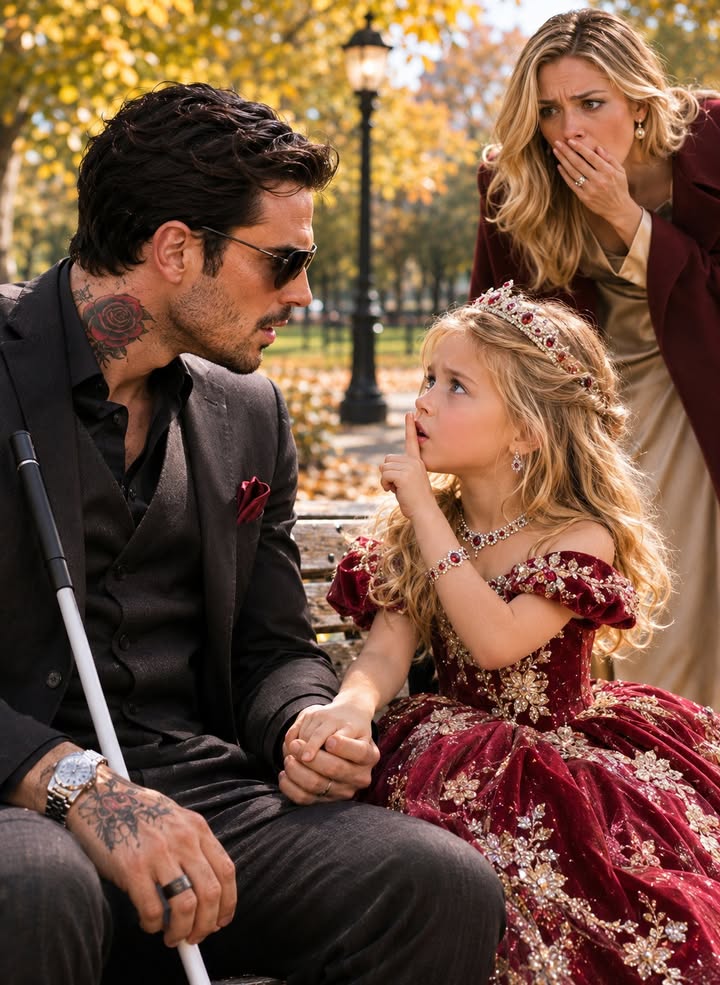
We walked through the park together, slow enough for me to follow the path by its changes beneath my cane.
The air held the cool scent of damp leaves, and somewhere nearby a child laughed.
Lily kept pace beside me.
The bench was still there.
I recognized it by the faint roughness of the wood when my hand found the backrest.
For a moment, I remembered sitting alone on it, listening to Cassandra’s heels disappear and wondering whether anyone still saw me as more than a burden.
Then Lily took my hand.
The familiar small fingers rested in my palm, no longer trembling.
“My mom says I should ask before I make promises for other people,” she said.
“That sounds like good advice.”
“So I’m not going to promise you’ll see everything again.”
“I wouldn’t ask you to.”
“But I’m glad you’re getting some sight back.”
“Me too.”
She stepped nearer.
“Can you see me?”
I turned toward her voice.
At first, there was only brightness and the dark outline of the trees.
Then the shape beside me sharpened: a small face, dark hair, and a patch of color where her coat caught the sun.
I blinked.
The image wavered, then settled.
“I can,” I whispered.
Lily’s hand tightened around mine.
“I can see your face.”
Her smile came slowly, as if she were afraid to disturb the moment.
“It looks different from what you imagined?” she asked.
“I don’t think I imagined it.”
“You did.”
“Maybe.”
She laughed, and the sound filled the space between us more clearly than any picture could.
Mara stood a few steps away with Mateo beside her, and Mrs. Ortega spoke softly with Cassandra.
Cassandra was close enough for me to see the hope in her expression, but she did not move toward me or ask what the moment meant for us.
She had learned that hope was not a claim.
I looked at Lily’s face again, holding it in the uneven light while it remained.
For the first time since the crash, the darkness did not feel like the only thing waiting ahead.
There was uncertainty still, and work still to do, and trust that would have to be earned one ordinary day at a time.
But Lily’s hand was warm in mine, her mother was alive, and the people who had hidden the truth had begun to face it.
I turned my palm beneath hers and held on, not because I was afraid she would disappear, but because I was grateful she was there.
**–THE END–PLEASE
Share your thoughts or feedback to motivate us to create more stories ♥️
* * *
[PREVIOUS: PART 5](https://echoesofstories.idolsgift.com/blog/part-5-the-bracelet-in-the-rain-041)
✓ Lynn R. Adams
Part 6 – The Shape of Light For several seconds, I could hear only the quiet hum of the clinic and Cassandra’s unsteady breathing beside me. The investigator’s message remained open on my phone, its…