PART 6 (THE END): The Bell Was Never a Choice 046
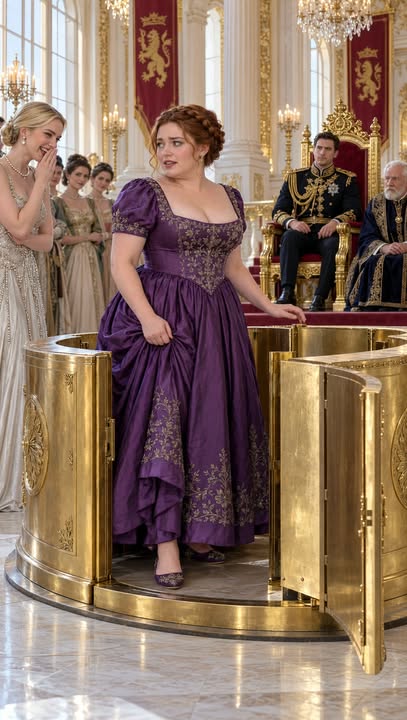
Part 6 – The Bell’s True Promise
The soft click came again, and this time Clara heard it clearly beneath the hush of the hall.
It came from inside the golden device, as faint and deliberate as a latch settling into place.
No bell followed.
The silence that came after felt different from the one that had followed her first test.
Then, the court had been waiting for an answer.
Now, it was waiting to see what she would choose.
Clara read the final line again, careful not to let the old paper tell her more than it said.
“The device must ring once more—not for a custodian, but for the one who will willingly release the crown’s claim.”
Adrian’s gaze remained fixed on the sentence.
“The crown’s claim to what?” he asked.
Rowan examined the letter and its accompanying page, turning them gently beneath the light.
“To the charter, perhaps,” he said. “Or to the right to decide what the charter means.”
“Does the page say the prince must do it?” Clara asked.
“No. It says the one who will willingly release the claim.”
A murmur passed through the gathered nobles.
Clara looked at Adrian.
The line could be made to sound like an instruction, but the old records had already taught them what happened when people mistook a device for a voice.
“The bell cannot decide for either of us,” she said.
“No,” Adrian replied. “It can only repeat what it was made to remember.”
He stepped away from the table and faced the court.
“The charter is not mine to give away,” he said. “It belongs to the people it protects, and to the custodians entrusted to witness its terms.”
A few councilors exchanged glances.
“If the crown claims the right to control its meaning, then I release that claim,” Adrian continued. “Not because a bell asks me to, but because no monarch should hold a promise as private property.”
He did not look toward Clara as he spoke.
His words were not an offering meant to win her favor.
They were a choice made before the people who would hold him to it.
Clara felt the weight of that distinction.
The prince who had once stood on a dais while others waited for a test to choose a bride now stood before the same court and refused to let a test decide what a promise meant.
The device remained still.
Clara turned to the council.
“I will witness the charter,” she said. “I will preserve its terms and make sure no one changes them in secret again.”
Her voice carried farther than she expected.
“But I will not pretend that my family’s duty gives the court a claim over my future. The charter must protect choice, not become another reason to take it away.”
Rowan bowed his head.
The woman in silver stood from her place among the witnesses.
“I believe that is what the charter says,” she replied. “At least, that is what it says when we read it without asking what would be convenient for us.”
The nobleman who had argued that Clara needed a title looked down at the table.
He did not withdraw his objection aloud, but he no longer repeated it.
The presiding councilor called for the charter to be entered into the public record in its original form, together with the altered order and the evidence of the forgery.
The council would meet again to establish protections for the archive and a process for future changes, with custodians present as the charter required.
No one proposed naming Clara queen-to-be.
No one asked Adrian to marry her.
The bell remained silent.
Only when the presiding councilor set his seal beside the charter did the device make another quiet click.
This time, no one mistook it for a command.
Clara looked at the golden panels.
They had opened to recognize her family’s mark, and now they rested in the hall as a witness to the difference between being recognized and being chosen.
The court’s breath seemed to leave it all at once.
Rowan gathered the papers, careful to keep the forged declaration beside the original charter.
Adrian stayed where he was, neither reaching for Clara nor retreating to the dais.
She was grateful for the space.
She was also aware of how much she wanted to cross it.
The council’s meeting continued, but the urgent question had changed.
They were no longer debating whom the bell had selected.
They were deciding how to honor the promise it had revealed.
Clara listened as clerks recorded the charter’s clauses and councilors discussed how to make its protections visible beyond the palace.
Some spoke of copies being sent to every regional hall.
Others proposed that future rulers be required to read the charter publicly before taking their oaths.
Rowan suggested that the original remain in a new archive chamber, one whose location would be known to the crown and custodians alike.
For each decision, Clara asked that the wording be plain enough for ordinary people to understand.
A promise hidden in difficult language, she said, could be buried almost as easily as a document locked behind stone.
The council accepted the suggestion.
By the time the gathering ended, the late afternoon light had shifted across the hall.
The nobles left in smaller groups than they had arrived, their conversations thoughtful rather than hungry for gossip.
The woman in silver approached Clara near the door.
For a moment, she seemed to search for the right words.
“I owe you an apology,” she said. “Not only for what I said about your size, but for thinking that a person’s place in a room could be decided by looking at them.”
Clara remembered how the woman’s laughter had faltered, then sharpened.
She remembered the sting of the question and the way the surrounding silks had shifted as faces turned to watch.
She also remembered that an apology could not undo a moment, but it could change what someone did with the next one.
“I accept your apology,” Clara said. “I hope we both remember this the next time someone is made to feel they must earn the right to stand where they already belong.”
The woman lowered her eyes, then nodded.
“I will.”
She left without seeking more from Clara, and Clara found herself respecting that too.
Rowan joined her beside the open doors.
“The records are safe,” he said. “And the charter will be copied before it is moved.”
“Will you oversee the archive?”
“If the council allows me to.”
“They would be foolish not to.”
A small smile touched his face.
“Coming from the custodian, I will take that as a favorable review.”
Clara laughed, and the sound felt strange in the great hall after so many days of waiting.
Rowan’s expression warmed.
“Your mother would have been proud of you.”
The happiness in the words did not lessen the ache they brought.
Clara looked down at her hands.
“I wish she could have told me herself.”
“So do I,” Rowan said. “But she trusted you to discover the truth when you were ready to carry it.”
Clara thought of the sewing box, the faded blue thread, and the careful note her mother had hidden among ordinary things.
Her mother had not left her a title or an answer to every question.
She had left her a choice.
“I think I understand why she waited,” Clara said. “Though I may never know whether I would have made the same choice.”
“You do not have to make it the same way,” Rowan replied. “That is part of what she gave you.”
He bowed to her, then turned to follow the clerks with the documents.
Adrian waited at the far end of the hall, beneath the windows that looked out over the gardens.
Clara walked toward him.
He turned when he heard her step.
“They accepted the charter,” he said.
“They accepted the need to read it. Now they have to live by it.”
“That is the harder part.”
“It usually is.”
He looked toward the device, whose golden surface caught the long bands of light.
“Do you want it moved?”
“No.”
“Do you want it covered?”
“No.”
Clara studied the old mechanism.
“For years, it was treated as if it could measure a person. I would rather people see it and remember that it cannot.”
Adrian nodded.
“Then it will remain here as a witness, not a judge.”
The words felt right.
They walked together to the gallery, where evening had softened the palace gardens into blue and silver.
Adrian did not offer his arm.
Clara did not need him to.
They stopped by the window, in the same place where he had once asked whether she wanted him to leave her alone.
Below them, a gardener crossed the path with a lantern, pausing to check a young tree braced against the wind.
Clara watched until he reached the next path.
“You changed the council today,” she said.
“We changed it.”
“I read the charter.”
“And you made sure they understood its meaning.”
“Not all of them.”
“No,” Adrian said. “But they heard it.”
Clara looked at him.
“Are you afraid of what comes next?”
“Yes.”
His honesty made her smile.
“So am I.”
“Good.”
“Good?”
“It means neither of us is pretending the work is finished.”
She rested her hands on the stone rail.
“I used to think courage meant walking into a room without being afraid.”
“And now?”
“I think it means entering anyway, even when you know the room may decide it understands you before you have spoken.”
Adrian leaned beside her, leaving a careful space between them.
“I thought being a prince meant learning to accept whatever the crown required,” he said. “I am beginning to think it means learning which requirements have no right to exist.”
“That sounds harder.”
“It is.”
The garden lantern moved among the paths below.
Clara’s thoughts went to her mother once more, to all the words they had never shared.
She could not ask why the palace had taken so much from her mother, or whether leaving had brought the peace she hoped for.
But Clara could honor what her mother had done.
She could make sure the charter was no longer hidden.
She could live a life not dictated by the device, the court, or even the brave choices made before she was born.
The days that followed were busy, but they were not hurried.
The charter was copied by the palace scribes and read aloud in regional halls, where its promises belonged as much as they did in the great palace.
The forged record was preserved beside it, marked plainly as a false account made under the former regent’s authority.
No one was allowed to erase the evidence of how the truth had been buried.
The sealed chamber beneath the western stair was restored as a public archive, with its door kept unlocked during visiting hours.
Clara asked that a small table be placed inside for anyone who wished to read the original accounts.
Rowan supervised the work.
He also began teaching a group of young clerks how to compare records rather than trust a single official version.
“The truth is rarely protected by one careful reader,” he told them. “It is protected when many people are allowed to ask questions.”
Clara returned to the palace often.
Sometimes she worked beside Rowan in the archive, learning how to read old hands and distinguish a genuine mark from one copied later.
Sometimes she attended council meetings, where she spoke when the charter required her witness and held back when the matter belonged to others.
She was honored as a custodian, but the title came with no jeweled circlet and no place in the succession.
It gave her a responsibility, not a destiny.
The court learned, slowly, that Clara would not let her presence be turned into a symbol of marriage or a political bargain.
Adrian helped in ways both visible and quiet.
He asked the council to create rules ensuring that no future marriage ceremony would treat a device or public ritual as a substitute for personal consent.
He invited the household staff to speak during reviews of palace service, then listened long enough for their answers to become more than formalities.
He stopped treating every opinion around him as a command he had to obey.
There were disagreements.
Some councilors resisted the changes, and some of the old arrangements were more difficult to alter than either Clara or Adrian had expected.
But they met each difficulty without pretending it was simple.
When Adrian asked Clara’s advice, he did not treat her answer as an order.
When she disagreed with him, he did not mistake disagreement for disloyalty.
Their conversations changed as the months passed.
At first, they spoke about the device, the charter, and what the court might do.
Then they spoke about less urgent things.
Adrian told her which parts of the palace he had loved as a boy and which he had never learned to enjoy because he had only ever seen them during ceremonies.
Clara told him about her mother’s kitchen, the herbs on the windowsill, and the way her mother used to mend a tear so neatly that Clara could never find it afterward.
She told him that she had once imagined the palace as a place where every answer could be found in a book.
He admitted that he had imagined the world beyond it as a place where no one expected anything of him.
Neither imagined it that way anymore.
When they were together, they did not speak as though every conversation had to lead somewhere.
They walked in the garden.
They worked beside Rowan.
They sat in the library when the archive’s long shelves made the hours pass more quietly.
Clara found that Adrian could laugh at himself, though he did so more readily when no councilors were nearby.
Adrian found that Clara was not always composed, despite how well she had held herself in the great hall.
Some evenings, the old humiliation returned to her without warning.
She would remember the woman in silver and feel again the certainty of being judged before she had taken a single step.
When she told Adrian, he did not rush to assure her that it no longer mattered.
He listened.
Then he asked what she wanted from him.
Sometimes she wanted company.
Sometimes she wanted quiet.
Sometimes she wanted to speak until the memory lost its sharpest edge.
He learned not to mistake support for rescuing her.
She learned that accepting kindness did not make her less independent.
A year after the bell rang, Clara returned to the great hall alone.
The court was not in session.
Sunlight passed through the high windows and rested along the floor in long, pale shapes.
The device stood beneath the chandeliers, its panels open and still.
The palace had placed a small brass plaque beside it.
It read: This device was built to recognize the custodians of the founding charter. It does not measure worth, choose a spouse, or decide a life.
Clara read the words twice.
The second time, she felt her mother close—not as a voice from the past, but as the steady knowledge that someone had believed the truth would matter when Clara was old enough to find it.
She touched the golden rim with her left hand.
The metal was cool.
No bell rang.
Clara smiled.
Footsteps sounded behind her.
Adrian came to stand beside her, wearing no crown and carrying no papers.
“Does it feel different?” he asked.
“Yes.”
“Because of the plaque?”
“Because I know it cannot decide anything for me.”
“And what will you decide?”
She looked at him.
He did not ask as a prince testing an answer.
He asked as the man who had learned to leave the choice in her hands.
Clara considered the question.
She had lived for a year without letting the court hurry her toward an answer.
She had discovered more of her mother’s past, though not every missing piece.
She had watched Adrian keep his promises in rooms where no one praised him for doing so.
She had also watched him change the court not by demanding that everyone admire him, but by giving them better ways to act.
She knew what she wanted.
“I want to keep building a life I recognize as mine,” she said. “And I would like you in it.”
Adrian’s expression softened.
“I would like that too.”
“Not because the bell rang.”
“No.”
“Not because the council expects it.”
“No.”
“Not because the charter requires it.”
“Especially not because the charter requires it.”
Clara smiled.
“Then you may ask me properly.”
He drew in a breath, and for the first time since she had known him, the prince looked nervous in a way that seemed to have nothing to do with the crown.
“Clara,” he said, “I have spent a long time learning how not to let the court decide what I want. I know I cannot promise that life beside me will be free of difficulty, or that the palace will always be quiet.”
“I would be suspicious if you did.”
“But I can promise to keep asking rather than assuming, to listen when you disagree, and to stand beside you without mistaking that for standing in your place.”
He paused, then continued.
“Will you share your life with me, as my equal, if that is what you choose?”
Clara let the question settle between them.
There was no audience waiting for the answer.
No device humming behind golden panels.
No title laid out like a reward.
Only Adrian, and the quiet hall, and the life she had chosen to make her own.
“Yes,” she said. “I choose you.”
His smile came slowly, like warmth reaching a room after a long winter.
He took her hand only after she offered it.
They stood together beneath the chandeliers, not as a prince and his appointed bride, but as two people who had met in the middle of an uncertainty and chosen to keep walking beside one another.
Later, they visited Clara’s home.
She opened her mother’s sewing box on the kitchen table and placed the brass key beside the faded blue thread.
Adrian listened as Clara told him about the small habits she remembered: her mother’s humming, the neat stitches, the way she turned every scrap of fabric into something useful.
Clara did not speak as if those memories had become less painful.
She spoke as if they had become large enough to hold both sorrow and gratitude.
“She gave you the truth,” Adrian said.
“She gave it to me in pieces.”
“Perhaps she wanted you to have room to decide what it meant.”
Clara ran a finger over the key.
“I wish she had been here.”
“So do I.”
There was no phrase that could repair the empty place her mother had left.
Adrian did not offer one.
He simply stayed beside her while the evening light faded from the window.
In the years that followed, the palace learned to treat the golden device as a witness to its past rather than an authority over anyone’s future.
The charter remained visible.
The custodian’s mark was added to the archive records, and no one could alter a copy without leaving a clear account of the change.
Clara continued to serve as custodian, not because the court had chosen a role for her, but because she chose to protect the promise her mother had kept.
Adrian’s reforms did not make every noble wise or every decision easy.
They did make the council more willing to listen before it judged, and more careful about mistaking custom for justice.
Clara and Adrian built their partnership beyond ceremonies and titles, in conversations, disagreements, shared work, and the small kindnesses that ask nothing in return.
Whenever the great hall filled with guests, the device stood quietly beneath the light.
No one called it a marriage test.
No one asked it to choose.
And on the wall beside it, the words remained plain enough for everyone to read:
It does not measure worth, choose a spouse, or decide a life.
The bell had rung to remember a promise.
What Clara and Adrian made together was not written in the charter, hidden in an archive, or sealed beneath a golden rim.
It was theirs because they had chosen it, freely, and would keep choosing it together.
**–THE END–PLEASE
Share your thoughts or feedback to motivate us to create more stories ♥️
* * *
[PREVIOUS: PART 5](https://echoesofstories.idolsgift.com/blog/part-5-the-bell-was-never-a-choice-046-1)
✓ Lynn R. Adams
Part 6 – The Bell’s True Promise The soft click came again, and this time Clara heard it clearly beneath the hush of the hall. It came from inside the golden device, as faint and deliberate as a lat…