PART 6 (THE END): The Bell Meant Something Else 046
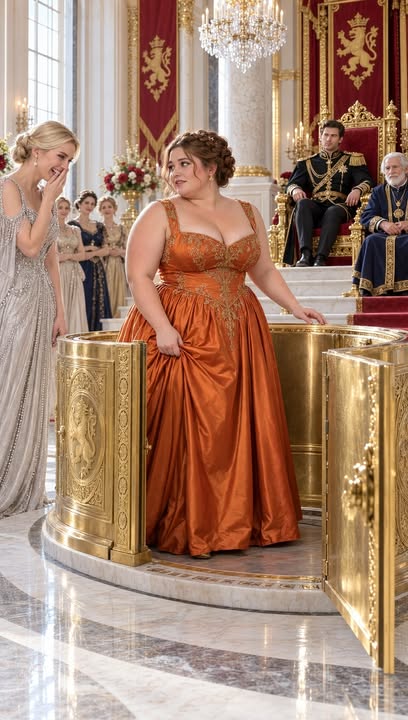
Part 6 – The Choice That Was Theirs
“To the daughter who chooses what the crown could not.”
The words settled over the hall with the hush of something meant to be found only when the right people were ready to read it.
Clara’s hand hovered above the brass lid.
She felt the crowd behind her, but for once their attention did not make her feel displayed.
The box bore her mother’s name, and no one had told Clara what she must do with it.
“May I?” she asked the archivist.
The archivist nodded and stepped back.
Clara lifted the lid.
Inside lay a folded letter, a small brass key, and a narrow strip of parchment covered in her mother’s familiar handwriting.
Clara touched the letter first.
The paper had been protected from dust and damp, though its edges had softened with age.
She unfolded it slowly, aware of Adrian standing behind her and Selene close at her side.
The first line was addressed to Clara.
My dearest girl,
If you are reading this, then the device has rung for you, and someone has finally let its answer remain a question.
Clara drew a careful breath.
The hall blurred around the edges, but she kept reading.
I do not know whether you will ever stand beneath the golden frame.
I hope you never feel you must.
I hope, if you do, that you arrive because you want to know something for yourself, not because anyone has promised that the answer will make you worthy of love.
Clara paused.
Her mother’s voice seemed so near that she could almost picture her at the kitchen table, pen in hand, pausing to choose the one word that would do no harm.
Adrian said nothing.
He did not hurry her.
Clara continued.
When I took the trial, the bell rang.
The court told me this meant I had been chosen to marry the prince who then stood to inherit the crown.
I was young, and I believed that a good person should be grateful when powerful people offered her a place.
Then I saw the words beneath the platform.
The measure is not obedience, nor grace, nor birth.
It is the courage to ask what the answer cannot decide.
Her mother had written the same inscription they had found, but now the old words carried the warmth of a hand Clara had held.
I asked what the bell meant.
No one could answer me plainly.
I was offered a choice that did not feel like a choice: accept the court’s interpretation, or leave and allow them to call my refusal a failure.
So I left.
Not because I was afraid of the prince.
Not because I believed the device had made a promise I must break.
I left because the answer belonged to me, and I wanted to hear my own thoughts before anyone named them for me.
Clara lowered the page.
For a moment she could not speak.
The quiet around her was no longer the silence of an audience waiting for a spectacle.
It was the quiet of people giving her room.
“She was offered a marriage?” Adrian asked softly.
Clara nodded.
“The letter says the court presented it as the meaning of the bell.”
The prince’s gaze lowered.
“I’m sorry.”
She looked at him.
His apology carried no plea for absolution, and she did not offer one.
Instead, she returned to the letter.
I never regretted leaving.
I did regret that I could not make the court understand why.
Years later, when the former advisor invited me to discuss the old records, I told him what I had learned.
He said the device’s true purpose had been forgotten, and that the royal household had mistaken the bell’s recognition for permission to claim what it recognized.
I asked him to preserve the record.
I also asked him to keep my name out of the public register until the court was willing to speak truthfully about what happened.
He promised he would.
The old advisor named in the archive had been the one who invited Clara’s mother to the palace years later.
He had not arranged Clara’s invitation as a test of her lineage, but as a chance to reopen a question he had failed to settle in his own lifetime.
Clara looked toward the portrait above the archive doors, visible through the open archway.
The painted man had left behind an invitation, a record, and a hope.
He had not been able to repair the harm.
But he had left the truth where someone might find it.
The letter continued.
I do not know whether the device recognized your family name, your spirit, your willingness to question, or something no one has yet understood.
I hope you will not let anyone use that uncertainty to tell you who you are.
A test may open a door.
It cannot decide whether you walk through.
The brass key in this box belongs to the cabinet in the archive marked “Founding Records.”
If the records are still there, they may help the court understand what the device was built to do.
But even if they are not, remember this:
You do not have to save the crown.
You do not have to prove that I was right.
You only have to choose what is true for you.
I love you beyond every title and every answer.
Clara.
Clara folded the letter back along its old creases.
The tears in her eyes did not feel like sorrow alone.
They carried relief, recognition, and the ache of learning that her mother had once stood in a room much like this one, trying to keep a choice of her own.
She pressed the letter against her palm.
“She wanted me to know,” Clara said.
Selene’s voice was gentle.
“She wanted you to have the choice she had to make without enough truth.”
Clara nodded.
“And she wanted me to know she didn’t regret leaving.”
Across the hall, the councilors had gathered in a quiet cluster.
The silver-haired councilor stepped closer, but stopped far enough away to leave Clara space.
“May we hear the rest of the letter?” she asked.
Clara looked at Adrian.
He gave her no sign of what she should say.
She looked at Selene, who waited beside her.
Then she looked at Lord Vey.
The advisor’s face was open now, without the careful smoothness he had worn when he first tried to explain the archive’s gaps.
“Not yet,” Clara said.
The councilor inclined her head.
“Of course.”
“I want the letter preserved, but I also want it kept private until the records are complete.”
“That is reasonable.”
“And I want every woman who took the test to receive the full account of what happened to her result.”
The councilor looked around the great hall, where former candidates stood in small groups, listening.
“That will be done.”
“Not only a notice,” Clara said. “A personal explanation, where we can provide one.”
The councilor’s expression softened.
“Yes.”
Clara studied her face, searching for the reflex to turn a request into a ceremony.
The councilor seemed to understand the difference.
“We cannot undo what was withheld,” she said. “But we can make sure the people affected are not left to invent their own explanations.”
“Thank you.”
The archivist took the brass key from the box only after Clara gave her permission.
It opened the cabinet in the archive marked Founding Records.
Inside were three thin volumes, a collection of engineering notes, and a declaration signed by the device’s makers.
The declaration described the trial as a way to recognize people willing to question customs that had outlived their purpose.
It specifically warned that the bell must never be treated as a claim upon the person who heard it.
That sentence appeared twice: once in the main declaration and again, in a different hand, in the margin.
To recognize is not to possess.
Lord Vey read the words aloud.
The simplicity of them seemed to make the room more still than any grand speech could have.
For the next several weeks, the palace moved carefully through the work of telling the truth.
The public register was corrected.
The old ceremony was suspended.
The device remained on its platform, but the panels were kept open, and a small plaque was placed beside it with the original inscription and a plain account of what the bell did and did not mean.
The thirty-two candidates who had been told they failed received letters from the palace, signed by Adrian and Lord Vey.
Some wrote back with questions.
Some asked for copies of their records.
A few returned to see the device again, not to take the trial, but to stand beside the plaque and hear the truth in the same hall where uncertainty had once been used to judge them.
Selene helped organize the replies.
She never asked Clara to tell her the apology had been enough.
Instead, she listened when the candidates spoke and made sure their words were entered into the public archive beside the official records.
Clara joined her.
At first she thought she was there because the device had rung for her.
Over time, she understood she was there because she had chosen to stay.
Lord Vey testified before the council about the pages he had hidden and the years he had mistaken caution for loyalty.
He did not defend his actions, nor did he ask anyone to forget them.
The council formally censured him, then appointed him to oversee the restoration of the archive alongside two independent scholars.
He accepted the work with humility.
When Clara saw him again in the east wing, he was carrying a box of uncatalogued letters rather than a ring of keys.
“I’m sorry I made you work so hard to discover what should have been told plainly,” he said.
“You could have told us the page existed sooner,” Clara replied.
“Yes.”
“But you brought it forward when Selene spoke.”
“I should have done so before she had to.”
Clara considered him.
“Then don’t let the next person in this archive discover a truth by accident.”
“I won’t.”
It was not forgiveness in a single shining moment.
It was a promise she could watch him keep.
The council’s review took longer.
Adrian’s position as heir remained suspended while the members debated what authority the crown should hold and how the succession should be protected from the same kind of misrepresentation.
He did not return to the title by demanding it.
He attended meetings when invited, offered records when asked, and spent many afternoons speaking with people who had never before been welcomed into the rooms where decisions were made.
Clara saw him at the archive more than once, sleeves rolled back as he helped move boxes.
He never called her to the palace merely because he wished to see her.
When he did ask for her advice, he told her what the question was and made clear she could decline.
She began to trust the difference between being wanted and being needed.
That difference became more important than either of them first understood.
The month after the public announcement, Adrian asked Clara to walk with him through the gardens.
They took the path that passed the young tree she had seen from the window of the side room.
Its branch had grown beyond the wooden support, and the gardener had loosened the tie so it would not cut into the bark.
Adrian noticed her watching it.
“It seems to be doing well,” he said.
“It has room to choose its own shape.”
“Do you think that is what the palace is learning?”
“I think it is trying.”
They walked on.
The air smelled of damp soil and early roses.
For a while they spoke about ordinary things: the stubborn archive windows, the candidates’ letters, the palace kitchens’ renewed insistence that everyone eat before attending a council meeting.
The ease of it startled Clara.
Their conversations had begun beneath the weight of a bell and a secret.
Now she could be quiet beside him without feeling that the silence was a test.
At the end of the path, Adrian stopped.
“I would like to ask you something,” he said.
Clara waited.
“Not about the device.”
“Good.”
“Would you consider staying at court?”
Her first instinct was to look for the condition hidden inside the invitation.
Adrian saw her searching.
“I mean as an independent advocate,” he continued. “The council is creating a role to review the public records and ensure that people affected by royal customs have a voice in how those customs change.”
“You want me to take the position?”
“I think you could do it well.”
“That isn’t the same as asking whether I want it.”
“No,” he said. “It isn’t.”
She watched him.
“Would you still want me here if I turned it down?”
“Yes.”
“Would the council?”
“They would have to.”
A small smile came to her before she could stop it.
“Then I’ll consider it.”
“That is all I hoped to ask.”
He did not follow with a speech about destiny or what they might become.
He simply resumed walking beside her.
Clara chose the position the following month, with terms that made her responsibilities and independence clear.
She did not owe the crown gratitude for the opportunity.
The crown did not own her work.
She helped create a process through which candidates could access their records, challenge official interpretations, and withdraw without having their silence mistaken for failure.
The device remained a symbol, but its meaning belonged to the people who stood before it, not to those who watched from the throne.
The council eventually completed its review.
It asked Adrian to return as heir under a new agreement that limited the power of the royal household and required the succession customs to be examined openly.
He did not accept at once.
He spent two days considering the terms, speaking with the council, the former candidates, and Clara.
When she asked what he wanted, he did not answer with what the crown needed.
“I want to serve without pretending the title makes me right,” he said.
“Then make sure the agreement gives other people a way to tell you when you’re wrong.”
A quiet laugh escaped him.
“That is already in the draft.”
“Good.”
He returned as a constitutional prince, not because the device had chosen him for a brighter future, but because he accepted limits on his power and a duty to answer for what he did with it.
The ceremony was modest.
No golden frame stood behind him.
No one spoke of destiny.
Clara sat among the people who had helped make the agreement, and Adrian’s eyes found hers only once during the proceedings.
He did not ask her to stand.
He did not offer her a place beside his throne.
Afterward, they walked together through the palace’s west garden, where the first spring flowers had opened.
“Do you think the device would have rung for someone else?” Adrian asked.
“I don’t know.”
“Do you think it rang for you because of your mother?”
“I don’t know.”
He glanced at her.
“I used to think uncertainty meant we had failed to find the answer.”
“And now?”
“Now I think some uncertainty belongs to the person who must choose.”
Clara smiled.
“Then the device did teach you something.”
“Not by deciding for me.”
“No,” she said. “By giving you the chance to decide for yourself.”
The months that followed brought no perfect peace.
Reform was slower than Adrian wanted and more complicated than Clara had imagined.
There were disagreements in council and difficult letters from families who missed the old ceremony.
There were days when the archive seemed to grow larger each time they found a missing page.
But the palace changed in ways that could be seen.
The candidates’ records were opened.
The device’s original purpose was taught to anyone who wished to take its trial.
People were free to stand on the platform, or not.
The bell was never described as a promise.
Selene became a steady ally to Clara, speaking honestly when she had once been afraid to speak at all.
Lord Vey learned to say “I don’t know” before he reached for a reason to hide what he feared.
Adrian learned that leading did not mean being the person with the final answer.
And Clara learned that staying was not the same as surrendering, so long as she remained free to leave.
One bright afternoon, nearly a year after the first bell had rung, Adrian asked Clara to meet him in the small room overlooking the gardens.
The same room where they had first spoken privately.
There were no officials waiting outside.
No councilors had been invited.
On the table sat two cups of tea, one already cooling beside an open window.
Clara arrived carrying a folder of notes from the archive.
Adrian looked at it and smiled.
“Should I be worried?”
“Only if you have been hiding any more ledgers.”
“I have learned not to keep secrets from people who know where the keys are.”
She set the folder aside.
“You asked to speak with me.”
“I did.”
He stood by the window, dressed simply, without the formal coat that marked his position.
The sunlight touched his face and softened the lines of concern he had worn so often since the council chamber.
“I would like to ask you a question,” he said.
Clara tilted her head.
“Is it about the device?”
“No.”
“Good.”
“Would you marry me?”
The simplicity of the question made her breath catch.
Adrian came no closer.
He did not kneel.
He did not produce a ring as though a beautiful object might make the answer easier.
He looked at her with the same attention he had given her in the archive, when he had begun to understand that listening meant allowing an answer he could not control.
“I want to be clear,” he said. “I am asking because I love you, and because I would like to build a life with you. Not because of the device, your mother’s record, the council, or what anyone thinks the crown needs.”
Clara held his gaze.
“If I say no?”
“Then nothing about the respect I have for you changes.”
“If I say no, you won’t turn it into a story about me being afraid?”
“No.”
“If I say no, you won’t ask the council to persuade me?”
“I will tell the council there is nothing to discuss.”
His voice did not waver.
The answer did not sound prepared.
It sounded like something he had learned through every choice that had brought him to this room.
Clara stepped toward him.
“For a long time, I thought the hardest part would be proving I belonged in a place that had already decided what I should be,” she said.
“And now?”
“Now I know I can belong somewhere without letting it own me.”
Adrian’s expression softened.
“I love that you know it.”
“I love that you’re learning to live by it.”
His hand remained at his side, open, offering nothing she had to accept.
Clara placed her fingers in his.
“Yes,” she said.
The word was quiet.
It did not ring through the room, and no mechanism moved to recognize it.
Nothing in the palace claimed it.
Adrian’s eyes shone with relief, but he did not pull her into his arms until she moved closer first.
When he did, the embrace was gentle and unhurried, a promise made between two people who understood that a promise mattered only when it could be freely given.
Later, they walked through the testing hall together.
The golden device stood beneath the high windows, its panels open to the daylight.
The brass plaque beside it held the inscription the court had once hidden.
Let the answer be kept, not claimed.
Clara rested her hand on the edge of the platform.
She could still remember the first day, the laughter that had tried to turn her into a joke, the prince’s hesitation, and the sudden bell that had made every person in the room believe they knew what came next.
Adrian stood beside her, close enough to share the silence, but not so close that it belonged to him.
“Do you ever wish it had given us a simpler answer?” he asked.
“No,” Clara said. “A simple answer might have kept us from asking the right question.”
“And what was the right question?”
She looked at the device, then at the man who had learned not to confuse being chosen with choosing.
“Whether we would have the courage to decide for ourselves.”
They left the hall together.
Behind them, the gold remained still beneath the windows, waiting for no one and claiming no one.
The bell had rung once for Clara.
But the life they made was chosen, day by day, by both of them.
**–THE END–PLEASE
Share your thoughts or feedback to motivate us to create more stories ♥️
* * *
[PREVIOUS: PART 5](https://echoesofstories.idolsgift.com/blog/part-5-the-bell-meant-something-else-046)
✓ Lynn R. Adams
Part 6 – The Choice That Was Theirs “To the daughter who chooses what the crown could not.” The words settled over the hall with the hush of something meant to be found only when the right people we…