PART 6 (THE END): The Bell Had Been Silent 046
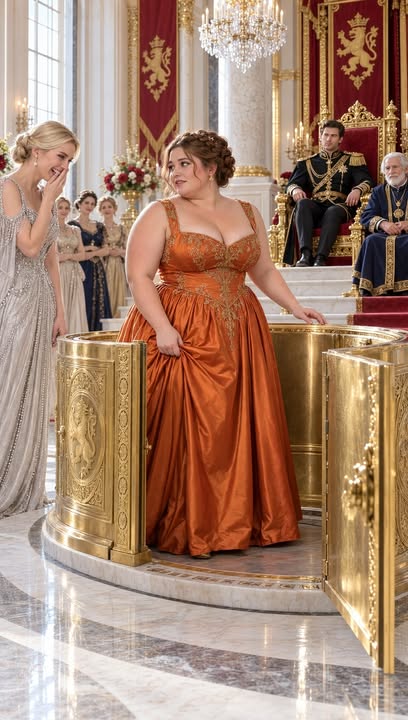
Part 6 – The Sound of Being Heard
Clara stared at the sentence until the words seemed to blur.
The bell is to remain silent until the court is ready to hear what it was made to say.
For a moment, she could hear only the small, ordinary sounds of the hall: the distant footsteps of a departing candidate, a servant closing a door, the soft shift of Lord Vale’s sleeve as he lowered his hand.
Then she looked at him.
“You didn’t write this.”
“No,” Vale said. “I would have remembered.”
“Do you know whose hand it is?”
He examined the note without touching it.
“It resembles the hand of a keeper, but I cannot be certain from one line.”
“And the other sentence?” Adrian asked. “The one about my mother—about Clara’s mother?”
Vale studied the note again.
“The wording is familiar, though that may only be because the family records share the same language.”
Clara kept her gaze on the names below it.
Her mother had come to this hall, carrying other people’s concerns, and the bell had remained silent.
The keeper had refused to let it answer.
“Why?” she asked.
“I don’t know,” Vale said.
“But the court was not ready to hear what it was made to say,” Adrian replied.
His voice had gone quiet.
Clara looked toward the open doors through which the candidates had left.
Her mother had asked the palace to listen, just as Maren Ellery had done generations earlier.
The same family mark, the same old purpose, and another moment when someone’s words had been easier to set aside.
“I thought my mother had kept this from me because she wanted to spare me a disappointment,” Clara said.
“Perhaps she did,” Vale replied. “Or perhaps she wanted the choice to remain yours.”
Clara took the note from Adrian and held it beside the silver ring.
The emblem on the page was faint but unmistakable.
“This wasn’t waiting for me,” she said. “It was waiting for the court.”
Adrian met her eyes.
“Yes.”
The answer brought no simple comfort, but it made something inside her settle.
She had not been summoned by destiny.
She had not been selected as a solution to the palace’s old mistake.
She had walked into a room that had forgotten how to listen, and the bell had answered the choice she made there.
That was enough.
The next morning, the palace opened the west library archive to the public.
The announcement was simple, printed on a single sheet and posted at the palace gates and in the town square.
It explained that the golden device had never been designed to select a bride, that its history had been altered, and that the surviving records would be available for anyone who wished to read them.
The court also invited the women who had taken the test to review the ledgers and correct anything that had been recorded unfairly.
Some came.
Some chose not to.
A few arrived only to see the device with their own eyes, then left without speaking.
No one was asked to make their disappointment public, and no one was praised for forgiving the court.
The record changed, slowly and carefully.
The word “failed” was removed from the descriptions of the candidates.
In its place, the archive noted that the device had given no response and that the court had misunderstood its purpose.
The distinction mattered.
Clara spent much of that first day at a table in the west library, helping the archive clerk copy names from the old ledgers into a new index.
She worked beside Lord Vale, who read each entry aloud before it was set down.
When a candidate’s family name had been misspelled, he corrected it.
When an old note described a woman’s appearance instead of her actions, he marked it as irrelevant to the device’s history.
He did not hurry through the work, and he did not ask anyone to forget how long it had been neglected.
In the afternoon, Celene arrived with two other candidates.
She carried a small bundle of papers tied with blue ribbon.
“I brought the letters I received about the test,” she told the clerk. “Perhaps they belong with the record of what the court told us.”
The clerk accepted them carefully.
“They should be included,” Clara said.
Celene looked at the open ledgers.
“I used to think the record was something other people wrote about me,” she said. “It seems I can have a say in it after all.”
“You always could,” Clara replied.
“I’m not sure the palace knew that.”
“No,” Clara said. “It didn’t.”
Celene gave her a small, rueful smile.
Then she turned to Vale and asked how she might help.
By the end of the week, the archive had become a place people came not only to look at the device’s history, but to tell their own.
The women who had taken the test shared memories of the day: what they had hoped for, what they had feared, and what the court’s silence had led them to believe.
Some accounts were brief.
Others filled several pages.
None of them were used to judge the women again.
Adrian attended the archive opening but remained in the background, listening while people spoke.
When one former candidate asked him whether the court would have chosen a bride by the device if it had sounded for her, he answered honestly.
“I cannot promise what the court would have done,” he said. “I can promise that I should not have allowed the result to stand in for your choice.”
It was not a perfect apology.
It was a truthful one, offered without asking her to reassure him.
The woman accepted it with a nod and returned to her conversation with the clerk.
Clara saw Adrian watching from across the room.
He did not look to her for approval.
She was glad he had learned not to.
As the days passed, the palace became less strange to Clara.
She continued to sleep in the east guest wing, where the morning light fell across her floor in a pale square and the garden roses opened one by one.
She took breakfast with the household only when she wished to.
She walked the grounds without an escort, though a gardener once insisted on showing her a rosebush that had survived three winters.
The palace did not become hers.
It became a place where she could move without being asked to prove she belonged.
Adrian kept his promise to meet her without the crown between them.
They took walks in the garden, sometimes speaking about the old records and sometimes about matters that had no royal importance at all.
He told her about his mother’s love of the council chamber windows, which overlooked the city rather than the palace gardens.
She told him how her own mother had made a home out of a small kitchen, an uneven table, and whatever books the two of them could borrow.
He listened to those stories without trying to turn them into lessons.
She learned that Adrian enjoyed maps but was bad at remembering the names of flowers.
He learned that Clara could spend an entire afternoon restoring a damaged page and still forget to eat lunch.
They laughed when the palace cook sent a tray to the library after discovering that both of them had missed the meal.
The first time Adrian took her hand, he asked before he did.
They were standing beside a stone bench at the edge of the garden, where the old river road could just be seen beyond the palace wall.
“May I?” he said.
Clara looked at his open hand.
The question was small, but she understood everything it left in her control.
“Yes,” she said.
He took her hand gently.
Neither of them looked toward the palace.
For a while, they stood together in the evening air, their hands joined and their attention on the dimming sky.
The device did not ring.
The absence of a bell felt peaceful.
Clara continued to make no promises about the future.
Adrian did not ask her to.
When the council formally confirmed that the device would no longer be used in matchmaking, he declined their offer to replace it with a new ceremony.
“There will be no test,” he said. “There will be a choice, and there will be time enough to make it.”
Some members of the court seemed relieved.
Others looked unsettled by a future that could not be summarized in a single announcement.
Adrian did not mistake their discomfort for a reason to return to the old custom.
He also understood that giving up the device’s authority did not make every other imbalance disappear.
He began meeting with the council and the river district’s representatives, not to make a show of reform, but to ask what the palace had failed to hear.
Clara was sometimes present.
Sometimes she was not.
No one treated her presence as proof that the prince had made a decision about marriage.
That freedom allowed her affection for Adrian to deepen without becoming another public duty.
At the end of the season, Clara returned home for a visit.
She took her mother’s ring with her, but left the palace documents in the archive.
She wanted the truth kept in a place where others could read it.
At home, she sat at the kitchen table where her mother had once turned the silver ring between her fingers.
The house was quiet.
The afternoon sun lay across the familiar wood, touching the small scratches her mother had never bothered to repair.
Clara placed the ring in the middle of the table.
For a long time, she simply looked at it.
Then she opened the folded letter she had carried with her.
My dearest Clara.
Do not let them make your answer into another promise on their behalf.
Her mother had known how easily a brave act could be taken from the person who made it and turned into a story serving someone else.
She had tried to leave Clara a warning, but also a kind of faith: that Clara would know what belonged to her.
Clara folded the letter and set it beside the ring.
“I wish you could have told me,” she whispered.
The room gave no answer.
She had not expected one.
Still, the words made space for the grief she had been carrying, and for the love that remained beside it.
When Clara returned to the palace several days later, Adrian was waiting in the east garden.
He did not ask whether she had made a decision.
He only asked how her home had felt.
“Like home,” she said.
“I’m glad.”
“And I missed you.”
His expression softened, but he did not reach for her until she stepped closer.
“I missed you too.”
They walked through the garden beneath the late-summer branches.
Adrian told her that Lord Vale had found the name of the last keeper in an old household record.
It was a woman called Isobel Ellery, a descendant of the original makers.
The note Clara had found was likely hers.
According to a letter written many years later, Isobel had tried to keep the bell from being used as a tool of royal judgment.
When Clara’s mother came to the palace with the river district’s petition, Isobel had refused to let the bell sound because the court was still treating the device as an ornament of its authority.
She had kept it silent not to erase Clara’s mother, but to deny the court another chance to claim the bell’s response while ignoring the people who had come to be heard.
“Do you think that was right?” Clara asked.
“I think she was trying to protect the device’s purpose,” Adrian said. “But I cannot know whether silence was the only choice she had.”
“Nor can I.”
The answer mattered.
The past did not become clean merely because they had learned more of it.
They could understand the people who had made difficult choices without pretending those choices had harmed no one.
Lord Vale had said as much when he resigned from his post as advisor to the crown and accepted a position overseeing the archive.
He wanted to spend the rest of his service making the records accessible.
Clara had not asked him to stay at the palace or to leave it.
He had chosen the work for himself.
The court had accepted his resignation with respect.
That, too, was part of the repair.
A year after the bell first rang, the palace held a small gathering in the great hall.
There were no candidates, no courtship ceremony, and no rows of seats waiting for an audience.
The gathering marked the opening of the archive’s new public collection, where the recovered letters and ledgers were kept together for anyone to study.
The golden device remained in its place at the center of the hall.
The court had polished it, but left the old marks and scratches visible.
Beside it, a new plaque explained its first purpose and the later misunderstanding.
Clara stood near the entrance, listening as Lord Vale read Queen Maren’s account aloud.
When he reached the words, “The woman was heard,” the people in the hall remained quiet.
Not because they were uncertain what the sentence meant, but because they understood it.
After the gathering, Adrian walked with Clara through the quieter side passage behind the dais.
He looked thoughtful.
“Are you well?” she asked.
“Yes.”
“You seem as though you are about to ask me something.”
“I am.”
“Would you rather wait?”
He considered that.
“No. I have waited long enough to ask without an audience.”
He reached into his coat pocket.
There was no ring on a cushion, no attendant carrying a silver tray, and no council member watching from behind a column.
Adrian held out a small ring made by a craftswoman from the city.
It was simple, with a smooth band and one tiny line of silver worked into the gold.
The line formed no royal symbol.
“What is it?” Clara asked.
“A question,” he said, then paused. “Not an answer the court has already chosen.”
She looked at the ring, then at him.
“I love you,” Adrian said. “I would like to marry you someday, if that is what you want. Not because of the bell, or the council, or the story people may tell afterward.”
His voice remained steady, but his hand did not.
“You do not have to answer now.”
Clara looked down at the ring.
A year earlier, she had stood inside the golden frame while the court waited to learn whether she belonged.
Now Adrian was standing before her with no device between them, asking whether she wanted a future they could make together.
She thought of the test, the letter, the ring her mother had left her.
She thought of every woman whose choice had been replaced by someone else’s certainty.
Then she looked at Adrian, who had learned to ask and to wait for her answer.
“Yes,” she said. “I want that future with you.”
Relief and joy crossed his face at once.
Clara held out her hand.
He slipped the ring onto her finger, and they remained there for a moment, smiling at one another without needing the hall to approve.
When they returned to the great room, Lord Vale was speaking with a group of visitors beside the archive display.
He saw them enter and stopped.
Clara looked toward the device.
The golden panels stood open, empty and still.
Adrian offered her his hand.
She took it.
Their joined hands rested between them, warm and certain in a way no mechanism could measure.
Then, from somewhere inside the old frame, the bell gave one clear note.
People turned toward the sound.
No one called it a verdict.
No one claimed it had chosen a bride.
Clara looked at Adrian, and he looked back at her.
The note faded into the high ceiling, leaving behind no command and no promise that either of them had not already chosen.
Only the sound of a truth finally heard.
**–THE END–PLEASE
Share your thoughts or feedback to motivate us to create more stories ♥️
* * *
[PREVIOUS: PART 5](https://echoesofstories.idolsgift.com/blog/part-5-the-bell-had-been-silent-046-2)
✓ Lynn R. Adams
Part 6 – The Sound of Being Heard Clara stared at the sentence until the words seemed to blur. The bell is to remain silent until the court is ready to hear what it was made to say. For a moment, s…