Part 6 – The Crown That Remembered Her-068
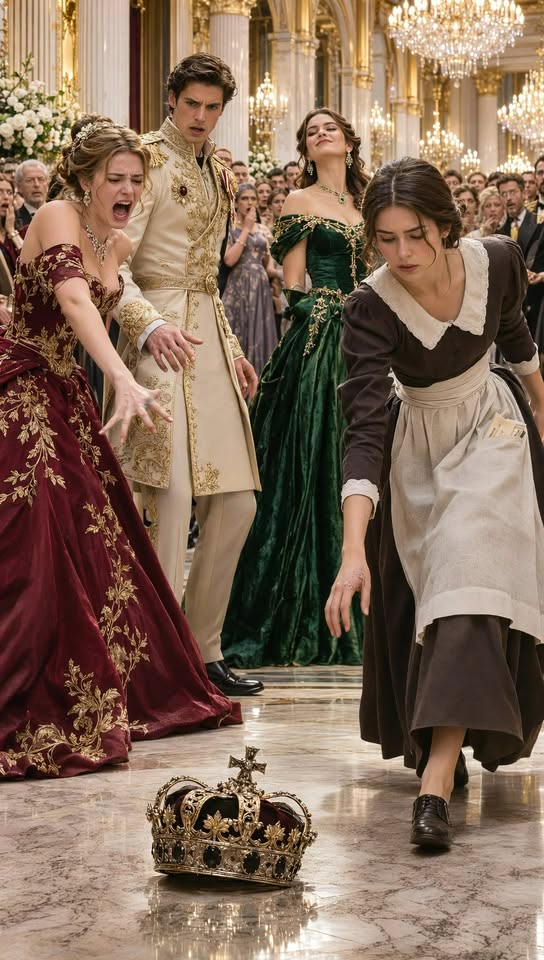
### END – The Choice Beyond the Crown
**END**
One year after Lady Celeste placed the Crown of Ashbourne upon her head, the royal hall looked entirely different.
The chandeliers were the same.
The marble remained polished.
The enormous portraits still watched from gilded frames.
But the raised platform where the crown ceremony had once taken place was gone.
In its place stood a long table.
Upon it rested the annual accounts of the Ashbourne Preservation Trust.
Open to the public.
Open to reporters.
Open to anyone willing to read several hundred pages of painfully detailed financial reporting.
Sofia considered that progress.
“Beautiful, isn’t it?” Adriano asked.
She looked at the accounts.
“Absolutely thrilling.”
“I detect sarcasm.”
“You are learning.”
Adriano smiled.
Their relationship had developed slowly over the year.
Deliberately.
Sofia finished her first year at culinary school.
Adriano assumed more responsibilities as his father’s health declined.
Sometimes they saw each other three times a week.
Sometimes three weeks passed.
Neither demanded more than the other could give.
It was not a fairy tale.
Sofia preferred it that way.
Fairy tales rarely included scheduling conflicts, burnt sauces, parliamentary meetings, or arguments over whether someone had forgotten to call.
Real affection did.
Celeste arrived ten minutes before the public ceremony.
“Am I late?”
“Almost,” Adriano said.
“Excellent.”
She hugged Sofia.
Their friendship had become unexpected and uncomplicated.
Celeste never married immediately after canceling her engagement.
Nor did she flee dramatically overseas.
She simply built a life.
Her foundation had recovered several million dollars in unnecessary consulting fees from companies connected to the old Meridian network.
She had also become an irritatingly enthusiastic advocate for transparent charitable accounting.
“You created a monster,” Sofia once told Adriano.
“I believe the crown deserves some credit.”
Celeste heard him.
“The crown deserves nothing.”
She pointed toward the glass exhibition case.
“I still dislike that thing.”
Sofia laughed.
“So do I.”
The ancient crown had become a museum artifact.
Its plaque explained everything historians could prove.
The hidden mechanism.
The altered ceremony.
The changing legend.
And the unsolved crimson phenomenon.
The museum committee had debated whether to mention that last part.
Sofia voted yes.
Mystery did not require dishonesty.
That had become the lesson of the entire year.
Some things were unknown.
That was different from pretending certainty.
At noon, Adriano addressed the gathering.
He spoke about stewardship.
Not nobility.
Not destiny.
Not worthiness.
“Ashbourne preserved many traditions because they were beautiful,” he said. “Others survived because no one asked whether they remained useful.”
Sofia listened from the side of the hall.
He had changed.
Or perhaps he had become more fully himself.
He still carried royal habits.
He thanked people too formally.
He stood whenever anyone older entered a room.
He owned far too many identical dark suits.
But he asked more questions now.
He listened longer.
King Rafael had relinquished his remaining ceremonial powers three months earlier.
The transition made Adriano prince-regent.
He refused a coronation.
Instead, Ashbourne’s council drafted a revised constitutional charter limiting royal authority and expanding elected oversight.
Some traditionalists complained.
Others celebrated.
Most people continued going to work, raising children, buying groceries, and arguing about parking.
Even historic change became ordinary eventually.
After the ceremony, Sofia escaped into the palace gardens.
She found King Rafael beneath the same maple tree.
“You’re hiding,” she said.
“So are you.”
“Fair.”
He moved his walking cane aside.
Sofia sat.
For a while they watched gardeners prepare spring flowerbeds.
“Adriano intends to propose to you,” Rafael said.
Sofia nearly dropped her coffee.
“What?”
The old king smiled innocently.
“I am retired. I require entertainment.”
“He told you?”
“No.”
“Then how do you know?”
“He has carried your grandmother’s ring in his jacket for eleven days.”
Sofia stared at him.
Rafael shrugged.
“He asked whether royal protocol required permission from your mother.”
“What did you tell him?”
“That asking Isabel for permission would be unwise.”
Sofia laughed.
Her mother would certainly agree.
“Are you worried?” Rafael asked.
Sofia thought.
“A little.”
“About becoming part of this family?”
“No.”
“About public attention?”
“Somewhat.”
“The crown?”
She looked toward the palace.
“No.”
That surprised her.
A year earlier, the crown had seemed enormous.
Now it was simply one object inside one building.
“I’m worried people will say it was destiny.”
Rafael nodded.
“They probably will.”
“It wasn’t.”
“No.”
“I chose him.”
“And he chose you.”
“That’s different.”
“Yes.”
They sat in silence.
Then Rafael said, “People like destiny because it removes responsibility.”
Sofia looked at him.
“If something is destined, no one has to admit they made a decision.”
She smiled.
“That sounds like something Queen Amalia might have said.”
“It is.”
Rafael’s eyes softened.
“She said it to me the day we married.”
Sofia looked back toward the palace.
For the first time, she wondered whether Amalia would have approved of her and Adriano.
Then immediately rejected the thought.
That was another kind of crown.
Another person’s approval placed above their own judgment.
“What do you think?” Rafael asked.
“About what?”
“If he asks.”
Sofia smiled.
“I think he should ask first.”
Rafael laughed.
That evening, Adriano did.
Not in the royal hall.
Not beneath chandeliers.
Not before cameras.
He asked in the kitchen.
Sofia was making bread.
He was supposedly helping.
He was not.
“You’re kneading it incorrectly,” she said.
“I have been kneading dough for twenty minutes.”
“You have been attacking dough for twenty minutes.”
“There is a difference?”
“Yes.”
Adriano wiped flour from his hands.
Then became unusually quiet.
Sofia noticed.
“What?”
“Nothing.”
“You’re terrible at nothing.”
“I’ve been told.”
He reached into his jacket.
Sofia immediately knew.
Apparently eleven days was the maximum amount of time a prince could secretly carry a ring before becoming obvious.
“Adriano.”
“I have a speech.”
“No.”
“You haven’t heard it.”
“You practiced it, didn’t you?”
“Possibly.”
“Then definitely no.”
He stared at her.
“You are making this extremely difficult.”
“Good.”
He laughed nervously.
Then put the speech away.
The ring belonged to Helena Maren.
Isabel had given it to Adriano months earlier without telling Sofia.
It was simple.
A small sapphire set between two tiny diamonds.
“My mother approved this?” Sofia asked.
“She said something about respecting your independent agency.”
“That means she threatened you.”
“She was very polite.”
Sofia smiled.
Adriano looked at her.
No royal title.
No formal language.
No kneeling.
Just two people covered in flour.
“I love you,” he said. “I don’t know exactly what our lives will look like ten years from now. I cannot promise that being with me will always be simple. But I can promise I will never ask a crown, a tradition, or anyone else to decide whether you belong beside me.”
Sofia’s eyes filled with tears.
“That was still a speech.”
“A shorter one.”
“Much better.”
He waited.
“Sofia Maren, will you marry me?”
She looked at him.
Then at the ring.
Then toward the kitchen door.
Mrs. Hart, Celeste, Matthias, and apparently half the staff were pretending not to listen from the corridor.
Sofia laughed.
“You’re all terrible at spying.”
Everyone disappeared.
Adriano sighed.
“I told them to leave.”
“Of course you did.”
She took his hands.
“Yes.”
He smiled.
“Yes?”
“Yes.”
There was no scream.
No ruby glow.
No legend.
Only laughter from the corridor when the staff realized she had accepted.
Their wedding took place seven months later.
Small by royal standards.
Large by Sofia’s.
All seventeen living Maren descendants attended.
Celeste stood beside Sofia.
Matthias cried before the ceremony even began.
Mrs. Hart cried while insisting she was not crying.
King Rafael slept through approximately fifteen minutes of dinner and denied it afterward.
Sofia wore no crown.
That decision caused several weeks of debate.
She finally settled it by saying, “If the constitutional charter doesn’t require one, my hair doesn’t either.”
Nobody found a convincing response.
The old Crown of Ashbourne remained in the museum.
After the wedding, Sofia continued her culinary studies.
Marriage did not suddenly transform her into a ceremonial ornament.
Adriano did not expect it to.
She eventually opened a restaurant inside a restored railway station owned by the Preservation Trust.
She leased the building at market rate.
The arrangement became public because Sofia insisted upon it.
The restaurant was called Helena’s.
No royal symbols.
No crown-shaped desserts.
Although Adriano once suggested one.
Sofia banned the idea permanently.
Three years later, she joined the independent stewardship council after completing training in nonprofit governance.
Not because of her ancestry.
Not because of marriage.
Because she applied.
The council elected her.
Life continued.
Not perfectly.
But honestly.
King Rafael died peacefully several years later, surrounded by family.
Adriano became Ashbourne’s constitutional prince.
His first act was not grand.
He signed a transparency statute requiring every organization receiving royal trust funding to publish annual reports.
His second act was to go home and wash dishes at Helena’s because two employees had called in sick.
Sofia considered the second act more impressive.
Celeste eventually married a historian named Daniel Mercer.
At her wedding, she approached the museum case containing the crown.
“You and I,” she told it, “are finished.”
Sofia laughed from behind her.
“Are you arguing with jewelry?”
“I am establishing boundaries.”
“Very healthy.”
They walked away together.
Years passed.
The story of the crown changed.
Children visiting the palace museum heard a different version.
Guides no longer told them an enchanted crown could determine a woman’s worth.
Instead they explained how stories could change over time.
How governments could hide mistakes.
How families could misunderstand one another.
How historical records mattered.
And how stewardship meant caring for something that belonged partly to people who had not been born yet.
Occasionally, children asked about Sofia.
“Did the crown choose her?”
The guides had a standard answer.
“No.”
Then they would smile.
“She chose what happened next.”
On the tenth anniversary of the famous ceremony, Sofia visited Queen Amalia’s restored study alone.
The room was preserved almost exactly as they had found it.
The crossword remained on the desk beneath protective glass.
The lavender had been replaced with fresh flowers.
Sofia stood before Amalia’s photograph.
For years she had wondered why a queen who barely knew her had written:
Protect Sofia Maren.
Now, at thirty-three, she finally understood.
Amalia had not been protecting Sofia because she believed the girl would become queen.
She had been protecting Sofia from being turned into one before she could choose her own life.
“Thank you,” Sofia whispered.
She turned to leave.
Then noticed something inside the desk.
One drawer had not been fully closed.
Sofia pulled it open.
Inside lay a letter.
Old.
Uncatalogued.
Her name appeared across the front.
Not in Amalia’s handwriting.
In Helena’s.
Sofia sat down.
Her hands trembled as she opened it.
**My dearest Sofia,**
**If you ever find this, then history has probably become inconvenient again. It has a habit of doing that.**
Sofia laughed through sudden tears.
That was unquestionably her grandmother.
She continued.
**You may be told that you come from remarkable people. Perhaps you do. But remember that everyone does if they travel far enough backward. Never allow ancestry to become an achievement. You did not earn your ancestors.**
Sofia wiped her eyes.
**You may also be told that the crown has chosen you. Do not believe it. Crowns choose no one. People choose what crowns mean.**
Sofia stopped reading.
Outside the window, children crossed the palace lawn.
Some carried museum brochures.
One little girl wore a paper crown.
**If you inherit anything from me, let it be this: ask questions when everyone else seems certain. Keep copies of important paperwork. Never trust a financial statement you have not read. And learn to make your own lemon cake because mine was better than your mother’s.**
Sofia laughed aloud.
**Most importantly, build a life that belongs to you.**
**Love, always,**
**Grandma Helena**
Sofia folded the letter carefully.
She looked once more at Amalia’s photograph.
Then left the room.
Adriano waited outside with their daughter, six-year-old Eliana, who was attempting to balance a souvenir paper crown on her head.
“It keeps falling off,” Eliana complained.
“Perhaps it has rejected you,” Adriano said solemnly.
Sofia gave him a look.
He immediately corrected himself.
“Or perhaps it is made of paper and you are running indoors.”
Eliana giggled.
Sofia crouched and fixed the paper crown.
“There.”
“Mom?”
“Yes?”
“Will I be a queen someday?”
Sofia considered the question.
“You can be many things someday.”
“A chef?”
“Certainly.”
“A scientist?”
“Yes.”
“A dragon?”
“That may require additional training.”
Eliana considered this.
“What if I don’t know yet?”
Sofia smiled.
“Then you have plenty of time.”
The girl ran toward the stairs.
Adriano offered Sofia his hand.
“What did you find?”
She showed him Helena’s letter.
He read it.
At the lemon cake line, he smiled.
“Was Helena’s cake really better?”
“No.”
“How do you know?”
“My mother told me.”
“Reliable source?”
“Absolutely not.”
They walked through the gallery together.
As they passed the Crown of Ashbourne, Adriano stopped.
Sofia followed his gaze.
The rubies sat beneath museum lights.
Deep red.
Quiet.
Ordinary.
“Do you ever wonder what happened that day?” he asked.
“The glow?”
“Yes.”
“Sometimes.”
“Matthias still wants to test it again.”
“Matthias has wanted to test it every month for ten years.”
“You always say no.”
“Yes.”
“Why?”
Sofia looked at the ancient crown.
Once, she would have desperately wanted an explanation.
Now she understood that an unanswered question did not have to control her.
Perhaps there was a chemical explanation still waiting to be found.
Perhaps sunlight had struck the stones at precisely the right angle.
Perhaps hundreds of frightened people remembered the moment differently than it happened.
Or perhaps there were still mysteries in the world that science had simply not explained yet.
None of those possibilities changed who she was.
“I already know the important part,” she said.
“What?”
“The crown didn’t make my life.”
She squeezed Adriano’s hand.
“We did.”
They continued toward the doors.
Behind them, afternoon sunlight entered through the western windows.
It crossed the marble floor.
Climbed the glass case.
And touched the ancient rubies.
For one fleeting moment, they seemed almost to glow.
A museum guard noticed.
He blinked.
Then smiled.
Probably the sunlight.
He returned to his work.
Outside, Sofia stepped into the garden with Adriano and their daughter.
The palace bells rang in the distance.
Not to announce a queen.
Not to declare a prophecy fulfilled.
Simply to mark the hour.
Sofia looked toward the open road beyond the palace gates.
Once, history had seemed like something enormous moving toward her.
Now she understood it differently.
History was made of people.
People who made mistakes.
People who hid truths.
People who recovered them.
People who inherited stories.
And people who decided which stories should continue.
Eliana ran ahead beneath the maple trees.
Adriano followed.
Sofia paused for one last moment.
She touched the old burn scar on her finger.
The scar remained.
She was glad.
Not because suffering made anyone worthy.
It did not.
But because it reminded her of who she had been before anyone knew her name.
A young woman in a kitchen.
Carrying documents inside her apron.
Trying to do the right thing without knowing whether anyone would believe her.
That woman had never needed a crown.
Sofia smiled and walked after her family.
Behind her, the palace doors remained open.
And for the first time in three hundred years, the people of Ashbourne no longer waited for a crown to tell them who was worthy.
They had learned to ask something harder.
What will you choose when the decision is finally yours?
**–THE END–PLEASE
Share your thoughts or feedback to motivate us to create more stories ♥️**
✓ Lynn R. Adams
### END – The Choice Beyond the Crown **END** One year after Lady Celeste placed the Crown of Ashbourne upon her head, the royal hall looked entirely different. The chandeliers were the same. The …