Part 6: The Breakfast That Brought a Family’s Forgotten Promise Back to Life 039
The Powder Creek railway station had not been used regularly in nearly eight years.
Its paint had faded.
One shutter hung slightly crooked.
Grass grew between the boards of the old platform.
Edith stood outside it the following morning with Coulter, Samuel Voss, and the tiny brass key.
“This feels unnecessarily mysterious,” she said.
Samuel smiled.
“Your father enjoyed mysteries.”
“My father enjoyed terrible jokes.”
“He considered those related.”
“That sounds accurate.”
Samuel unlocked the station door.
Dust floated in narrow beams of morning sunlight.
Old benches lined one wall.
A ticket window stood behind cracked glass.
At the back of the room were sixteen wooden storage compartments once used by travelers.
Samuel pointed toward number eleven.
Edith inserted the key.
The lock opened easily.
Inside rested a wooden box no larger than a bread pan.
She lifted it carefully.
Her name was carved into the lid.
EDITH.
Coulter remained beside her but did not touch the box.
Samuel stepped away.
“This part belongs to you.”
Edith opened it.
Inside were recipes.
Dozens of them.
Some were written in her mother’s handwriting.
Some belonged to Ruth Grady.
Others were written by Silas.
Edith laughed when she recognized her father’s awkward script.
“He never cooked.”
Samuel coughed.
“He believed he cooked.”
“That is very different.”
Beneath the recipes lay photographs.
Edith picked up the first.
Her mother stood outside Grady Ranch’s old kitchen.
She was young.
Her hair was loose.
Beside her stood another woman Edith had never seen but recognized immediately.
Ruth Grady.
Between them stood Silas Mayburn.
All three were laughing.
Behind them, scarcely visible near the doorway, stood Coulter’s father.
Coulter leaned closer.
“I’ve never seen this.”
Edith handed him the photograph.
More pictures followed.
A summer picnic.
A wagon beside Powder Creek.
The beginnings of the Table House foundation.
Eleanor holding a hammer.
Ruth pointing toward something outside the frame.
Silas pretending to inspect a burned loaf of bread with grave disappointment.
Then Edith found a photograph that silenced her.
Her mother sat on the porch of a small cabin.
A baby rested in her arms.
Edith.
Standing beside Eleanor was Ruth Grady.
Coulter stared.
“Our mothers met after you were born.”
Samuel nodded.
“Once.”
Edith looked toward him.
“You knew?”
“I drove Ruth there.”
“Why?”
“She wanted to see Eleanor.”
Samuel’s expression softened.
“She wanted to apologize for not fixing the situation sooner.”
“Did my father see her?”
“Yes.”
“Was he angry?”
“No.”
Samuel shook his head.
“That surprised Ruth too.”
Edith touched the photograph.
“What did he say?”
Samuel remembered for several seconds.
“He said there was no point building a home inside yesterday.”
The words sounded exactly like something Silas would have said.
Practical.
Slightly awkward.
True.
Samuel continued.
“Ruth asked him to return.”
“He refused.”
“Why?”
“He said he and Eleanor had found another road.”
Edith looked down.
“Did he forgive the Gradys?”
“I believe so.”
“Then why keep all this secret?”
Samuel sighed.
“Because forgiveness and returning are different things.”
That answer stayed with her.
There were times when repairing the past did not mean recreating it.
Sometimes people healed by building something new with what remained.
Edith searched deeper in the box.
At the bottom lay a small cloth pouch.
Inside it were seeds.
Dried and ancient.
A note had been wrapped around them.
Eleanor’s handwriting.
For the garden beside our someday kitchen.
Edith laughed through sudden tears.
“They won’t grow.”
Samuel smiled.
“Probably not.”
Coulter touched the packet carefully.
“We could plant them anyway.”
Edith looked at him.
“Why?”
“Because impossible things occasionally deserve a patch of dirt.”
“That might be the most sentimental sentence you’ve ever spoken.”
“Tell nobody.”
“Eli will know by supper.”
“Edith.”
She laughed.
They carried the box back to the Table House.
The recipes were placed in a drawer beside the kitchen.
The photographs went onto the wall.
Not as evidence.
Not as memorials.
As family history.
The packet of seeds was planted beneath the eastern windows.
Nobody expected anything from it.
Weeks passed.
Summer deepened.
The Table House became busy enough that Edith hired two women from Powder Creek to help.
Jonah cooked breakfast twice each week.
Jamie worked there on Sundays and continued pretending the pie shelf was his personal contribution to civilization.
Travelers began planning stops around Edith’s meals.
Local children came after school.
Cowboys from neighboring ranches appeared whenever rumors of fresh biscuits spread too far.
Mrs. Talbot organized a reading evening every Thursday.
Eli taught three boys how to carve wooden horses.
Coulter pretended not to notice that half his ranch hands invented reasons to visit the Table House.
Edith did not mind.
The building had become exactly what two young women dreamed decades earlier.
A place where people arrived tired.
A place where they left restored.
Yet Edith discovered something unexpected.
She no longer needed to cook every meal herself.
At first that frightened her.
When Jonah handled breakfast, Edith felt restless.
When one of her assistants baked biscuits, Edith hovered.
When Jamie successfully produced an apple pie without supervision, Edith experienced emotions suspiciously close to betrayal.
“You’re glaring at the pie,” Coulter observed one afternoon.
“I am evaluating it.”
“You have been evaluating it for ten minutes.”
“It may have hidden flaws.”
Coulter cut himself a slice.
Edith stared.
“What are you doing?”
“Investigating.”
He tasted it.
“Well?”
“It’s good.”
Edith narrowed her eyes.
“How good?”
Coulter wisely reconsidered his answer.
“Not as good as yours.”
“That pause was insulting.”
“You ask dangerous questions.”
She took his fork and tasted the pie.
Jamie’s crust was flaky.
The apples were properly spiced.
The filling was thick without being heavy.
It was excellent.
Edith sighed.
“He learned.”
Coulter smiled.
“You sound disappointed.”
“I am proud.”
“Those are different emotions.”
“Unfortunately they can occur together.”
Jamie entered the kitchen.
“Well?”
Edith looked at him.
“You used slightly too much cinnamon.”
His face fell.
“And it is one of the best pies you’ve made.”
His grin returned.
“Really?”
“Really.”
Jamie nearly ran outside to tell everyone.
Coulter leaned against the counter.
“You didn’t even pretend it was terrible.”
“I am growing.”
“I’m impressed.”
“Do not become accustomed to it.”
Their relationship grew in much the same way.
Slowly.
Without dramatic declarations.
Coulter ate supper at the Table House more often.
Edith occasionally rode with him along the creek.
He taught her to recognize approaching weather from the mountains.
She taught him that coffee did not improve merely because it was stronger.
He disagreed.
They continued arguing.
They also became comfortable with silence.
Autumn arrived.
The hills turned gold.
One Sunday afternoon, Edith closed the Table House early.
She walked toward the creek carrying no basket.
No list.
No task.
At first, doing nothing felt unnatural.
Then she sat beneath a cottonwood.
Coulter found her half an hour later.
He stopped.
“Are you ill?”
Edith looked up.
“Why?”
“You’re sitting still.”
“I sit.”
“Rarely without vegetables nearby.”
She laughed.
Coulter lowered himself beside her.
They watched the creek.
After several minutes, Edith said, “My father would be pleased.”
“With the Table House?”
“With this.”
She gestured around them.
“With you sitting under a tree?”
“With me not working.”
Coulter smiled.
“He would probably be astonished.”
“So am I.”
They sat longer.
Edith had spent most of her life fearing that if she stopped being useful, people might eventually stop finding reasons to stay.
Now the Table House functioned without her every minute.
The ranch hands liked her even when she was not feeding them.
Powder Creek welcomed her when she arrived empty-handed.
Coulter sought her company without requesting anything.
Her father had been right.
Usefulness was not worth.
She had needed fourteen years and an old letter to understand the difference.
A gust of wind moved through the cottonwoods.
Coulter glanced toward her.
“I’ve been thinking about something.”
“That usually causes trouble.”
“I expected encouragement.”
“You know me better than that.”
“I do.”
His expression changed.
Not dramatically.
Simply seriously.
“I want you to know something before I ask you anything about the future.”
Edith waited.
“The Table House is yours whether you choose me or not.”
Her teasing disappeared.
“Coulter.”
“I mean it.”
“Our families own it jointly.”
“Legally, yes.”
“That isn’t what I mean.”
“I know.”
He looked toward the creek.
“I don’t want you ever wondering whether staying with me is the price of keeping what you built.”
Edith’s chest tightened.
“You thought about that?”
“Frequently.”
“Why?”
“Because I know how important choosing your own life is to you.”
She studied his face.
People often called Coulter Grady hard.
She understood why.
He spoke carefully.
He did not reveal himself easily.
But hardness was not the same as absence of feeling.
Sometimes it was simply a man taking every important thing seriously.
Edith reached for his hand.
“I am not staying for the building.”
Coulter looked at her.
“I know.”
“I am not staying for the ranch.”
“I know.”
“I am not staying because my parents were here.”
“I know.”
She smiled.
“You are making this speech difficult.”
“I can pretend ignorance.”
“That would help.”
Coulter nodded solemnly.
“Why are you staying, Edith?”
She squeezed his hand.
“Because this is where I want to be.”
A slow smile appeared.
“And?”
“And I enjoy watching you lose arguments.”
“I rarely lose.”
“You frequently lose.”
“I allow you to believe that.”
“Remarkably generous.”
He laughed.
Edith rested her head briefly against his shoulder.
No audience watched.
No dramatic music existed.
The creek simply moved over stones.
Wind moved through grass.
Somewhere across the field, a horse called from the ranch.
Life remained ordinary.
Edith had finally learned how precious that could be.
That evening, Eli arrived at the Table House carrying a small parcel.
“For you.”
Edith opened it.
Inside was a wooden horse.
It was beautifully carved.
“I thought these were for children.”
“Usually.”
Eli looked uncomfortable.
“This one isn’t.”
Edith turned it over.
Several words had been carved beneath the base.
FOR THE WOMAN WHO BROUGHT HOME BACK TO BREAKFAST.
Edith looked at him.
Eli stared stubbornly toward the wall.
“You’re trying to make me cry.”
“I absolutely am not.”
“You are.”
“I regret the entire gift.”
She hugged him.
Eli froze.
The enormous cowboy who had frightened half the territory became completely motionless.
“Miss Mayburn.”
“Yes?”
“People are watching.”
“They survived breakfast.”
“They may not survive this.”
Edith released him.
Jamie applauded from the doorway.
Eli threatened to assign him three days of fence repair despite possessing no authority to do so.
Laughter filled the room.
Winter returned earlier than expected.
The first heavy snow arrived almost exactly one year after Coulter Grady had appeared at Edith’s cabin.
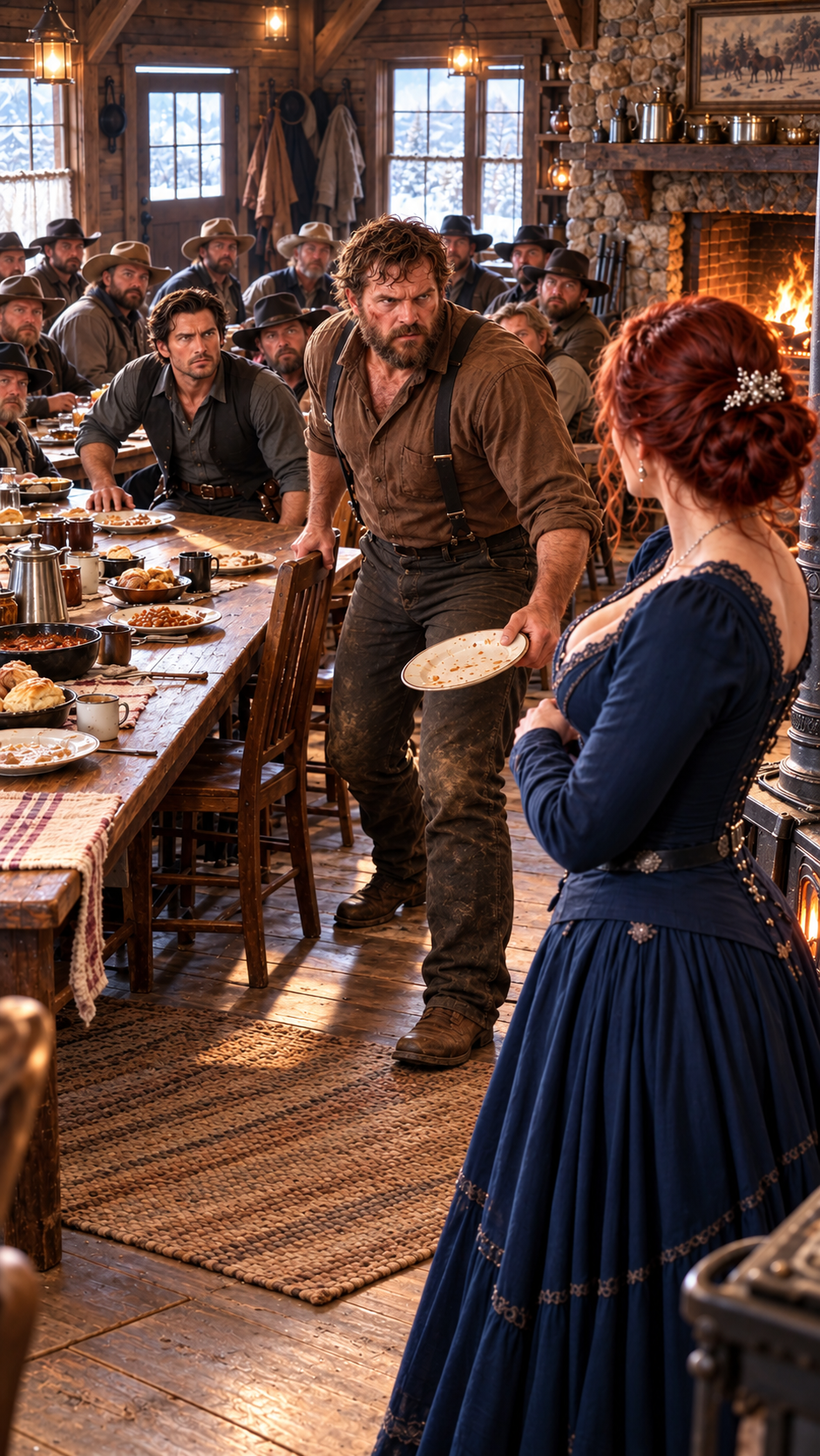
Twenty cowboys entered the Table House before sunrise.
Their boots carried snow.
Their voices filled the doorway.
Eli took his usual place.
Jamie immediately investigated the pie shelf.
Jonah poured coffee.
Coulter stood near the stove.
Edith served biscuits and gravy.
Someone at the far end of the table called, “Remember the first morning she came here?”
Benny laughed.
“Eli nearly frightened her back to town.”
“I asked for bread pudding.”
“You marched at her like a buffalo.”
“I was nervous.”
Nobody believed him.
Edith folded her arms.
“Go ahead and laugh.”
The room quieted.
Several men recognized the words.
Edith lifted her chin exactly as she had a year earlier.
“Just make sure you’re still laughing after breakfast.”
The table erupted.
This time she laughed with them.
After everyone ate, Edith walked toward the eastern window.
Outside, snow covered the little garden they had planted months earlier.
Something unusual caught her eye.
A thin brown stem stood above the white ground.
She frowned.
“Coulter.”
He joined her.
“What?”
“There.”
They went outside.
Near the kitchen wall, protected beneath the roofline, one tiny green leaf remained alive beneath a crust of snow.
Edith crouched.
“That cannot be from those seeds.”
Coulter crouched beside her.
“Why not?”
“They were decades old.”
“You told me they couldn’t grow.”
“They shouldn’t have.”
Coulter smiled.
“I believe we have already discussed impossible things.”
Edith touched the tiny leaf.
Her mother’s someday garden had waited longer than anyone could reasonably expect.
Yet something had grown.
Behind them, the Table House glowed through its windows.
Voices drifted into the winter morning.
Edith stood.
Coulter offered his hand.
She took it.
They walked back toward the door together.
Before entering, Edith glanced once toward the distant hills.
She thought of Eleanor.
Silas.
Ruth.
All the people who had loved imperfectly, stayed silent too long, tried again, made mistakes, and left behind unfinished dreams.
Their story had not ended with disappointment.
It had only paused.
Someone else had continued it.
Inside, Eli was demanding another helping.
Jamie was arguing that pie counted as breakfast.
Jonah was pretending not to listen while secretly cutting slices.
Coulter held the door open.
“You coming?”
Edith smiled.
She looked at the long table.
At the people around it.
At the place where nobody required her to prove her worth before taking a seat.
“Yes.”
She stepped inside.
And for the first time in her life, Edith Mayburn understood that being needed was a fine thing.
Being known was better.
Being chosen was better still.
But choosing the life she wanted, with people who saw more than what she could provide, was the home she had been searching for all along.
**–THE END–PLEASE
Share your thoughts or feedback to motivate us to create more stories ♥️**
✓ Lynn R. Adams
The Powder Creek railway station had not been used regularly in nearly eight years. Its paint had faded. One shutter hung slightly crooked. Grass grew between the boards of the old platform. Edith…