PART 6: My Wife Asked Me Not to Call—Then a Hidden Reservation Led Us Back to the Family Truth We Had Both Avoided_063
## END – The Name We Carried Home
For almost thirty seconds, none of us said anything.
Then Claire picked up the photograph.
“Are you certain?”
Luke nodded.
“Martin Hale died nine years ago. Heart attack. Mom sent me the obituary.”
I turned the picture over again.
The investigator had dated it seven years earlier.
“That leaves two possibilities.”
Claire looked at me.
“The date is wrong.”
“Or the person isn’t Martin.”
Luke took the photograph to the window.
I joined him.
For the first time, we studied the stranger rather than Luke.
Only part of him was visible.
Brown coat.
Left hand.
Silver watch.
No face.
Luke exhaled.
“I assumed it was Martin because of the coat.”
“You can recognize a man by his coat?”
“He wore it every winter for years.”
Claire pointed toward the hand.
“What about the watch?”
Luke’s expression changed.
He took the photograph closer.
Then he started laughing.
Not loudly.
The kind of laugh that comes when something complicated suddenly becomes embarrassingly simple.
“What?”
Luke handed me the photograph.
“That’s not Martin.”
“I gathered that.”
“Look at the watch.”
Silver.
Square face.
Black band.
Familiar.
Very familiar.
I looked toward the framed photographs on the bookshelf.
There, in a picture from our parents’ twenty-fifth anniversary, Dad stood with one hand on Mom’s shoulder.
On his wrist was the same watch.
I looked back at Luke.
“Dad.”
Luke nodded.
My father had known where Luke lived.
The room seemed to tilt slightly.
“You said he never contacted you.”
“He didn’t.”
“He stood ten feet away from you.”
“I didn’t know.”
Claire looked at the photograph.
“Maybe he followed you.”
“Dad wasn’t exactly skilled at surveillance.”
Despite everything, I smiled.
That was true.
Dad could barely surprise Mom with birthday flowers without accidentally leaving the receipt on the counter.
Luke sat.
“There’s one person who might know.”
“Elena?”
“No.”
“Who?”
“Mr. Feldman.”
Our mother’s attorney answered on the third ring.
Luke put him on speaker.
There was a long silence after we explained the photograph.
Then the old attorney sighed.
“I wondered whether that would ever surface.”
I closed my eyes.
Of course.
Another person who knew.
“You knew Dad found Luke.”
“Yes.”
“When?”
“Seven years ago.”
“Why?”
“Your father asked me for help.”
“With what?”
Mr. Feldman hesitated.
“Finding his son.”
Luke stared at the phone.
“He knew my address?”
“Yes.”
“Did he come to Boise?”
“Yes.”
Luke’s expression became unreadable.
“He never knocked on my door.”
“I know.”
“Why?”
The attorney’s voice softened.
“He lost his courage.”
No conspiracy.
No hidden enemy.
No elaborate deception.
Just a father sitting in a parking lot somewhere in Boise, looking at the son he had driven from his family, unable to cross the distance between them.
I found that almost harder to bear.
“What about the investigator?” I asked.
“Your mother called me after Adam hired him.”
“So she paid the second half.”
“Yes.”
“Why?”
“She wanted the investigator to stop digging.”
Luke frowned.
“That doesn’t make sense.”
“She knew he was getting close to your employer. She was worried he would disrupt the life you’d built.”
“Then why give him information?”
“To make sure his final report contained enough truth for Adam to stop searching.”
I stared at the envelope.
It had worked.
I had believed I knew where Luke had been.
I had believed Luke wanted nothing to do with me.
I had stopped looking.
“Who told the investigator Luke declined contact?”
Mr. Feldman was quiet.
“Your father.”
Luke closed his eyes.
“He spoke for me.”
“Yes.”
“Again.”
There was no anger in Luke’s voice.
Only exhaustion.
Mr. Feldman continued.
“That was wrong. I told him so.”
“Then why allow it?”
“Because your mother believed distance was better than another confrontation before your father was ready to tell the truth.”
Luke looked toward me.
“Was he ever ready?”
Mr. Feldman took a long breath.
“No.”
The answer settled over us.
Dad had driven hundreds of miles to find Luke.
He had stood nearby.
He had returned home.
And he had never confessed.
Love had brought him to the parking lot.
Fear had kept him from the door.
For years, I might have considered that tragic enough to excuse him.
I no longer did.
But neither did I need to turn him into a monster.
He had been a frightened, proud man who made one dishonest decision and then spent years building walls around it.
Some walls eventually become a house.
People begin living inside them.
After the call ended, Luke walked outside.
I gave him several minutes.
Then I followed.
He stood on the back porch.
Our yard had become overgrown around the fence.
Dad once complained about that fence every time he visited.
I had never fixed it.
Luke put his hands in his pockets.
“Do you remember when he taught us to build the treehouse?”
“Yes.”
“It leaned.”
“It leaned because you refused to measure.”
“You cut the boards.”
“According to your measurements.”
He smiled.
Then it faded.
“I wanted him to knock.”
I knew exactly what he meant.
“Even after everything?”
“Especially after everything.”
He looked toward the yard.
“I spent years telling myself I didn’t care whether he regretted it.”
“And now?”
“Now I know he drove all that way.”
Luke swallowed.
“And somehow that’s worse.”
I stood beside him.
“He should have knocked.”
“Yes.”
“He should have told the truth.”
“Yes.”
“He should have called you.”
“Yes.”
I looked at my brother.
“And I should have too.”
Luke’s eyes filled.
This time, when we hugged, neither of us pretended it was awkward.
Claire found us a few minutes later.
She did not interrupt.
That evening, the three of us ate dinner at the kitchen table.
Nothing dramatic happened.
Nobody delivered a speech.
Luke complained that my pasta was overcooked.
Claire agreed.
I told them both they were free to leave.
Neither did.
Over the next three weeks, we began correcting what could actually be corrected.
Elena prepared a formal reconstruction of Mercer Design’s final year.
Mr. Feldman added it to the remaining corporate records.
We contacted several former employees.
Some wanted the full explanation.
Some already suspected.
One said simply, “That was another lifetime.”
Luke called an old project manager who had believed the worst of him.
The man apologized.
Luke accepted.
Nothing magical happened afterward.
No newspaper story.
No public ceremony.
No dramatic restoration of honor.
Just one less person carrying a false version of him.
Then another.
Then another.
My uncle called one Sunday.
“I owe Luke an apology.”
“Yes,” I said.
“So do I.”
“Yes.”
He paused.
“You didn’t have to agree that fast.”
“I’ve had practice.”
Luke gradually returned to our lives.
Not as the missing brother restored to exactly where he belonged.
That place no longer existed.
He had friends I did not know.
Habits I found strange.
A house I had never seen.
Eleven birthdays I had missed.
We were not continuing an old relationship.
We were building a new one between two men who happened to remember being boys together.
Some afternoons, that felt wonderful.
Others, it felt sad.
Usually, it felt like both.
Claire stayed.
At first, that sentence tempted me to treat her staying as the ending.
It wasn’t.
Staying was only a location.
We still had to decide how to live there.
We began seeing a marriage counselor twice a month.
I hated the first session.
The counselor asked what I felt.
I told her what had happened.
She asked again what I felt.
I explained the situation more clearly.
Claire started laughing.
The counselor smiled.
I realized I had done exactly what Claire had described.
I had turned emotion into information.
So I tried again.
“Afraid.”
That was my first real answer.
Claire reached for my hand.
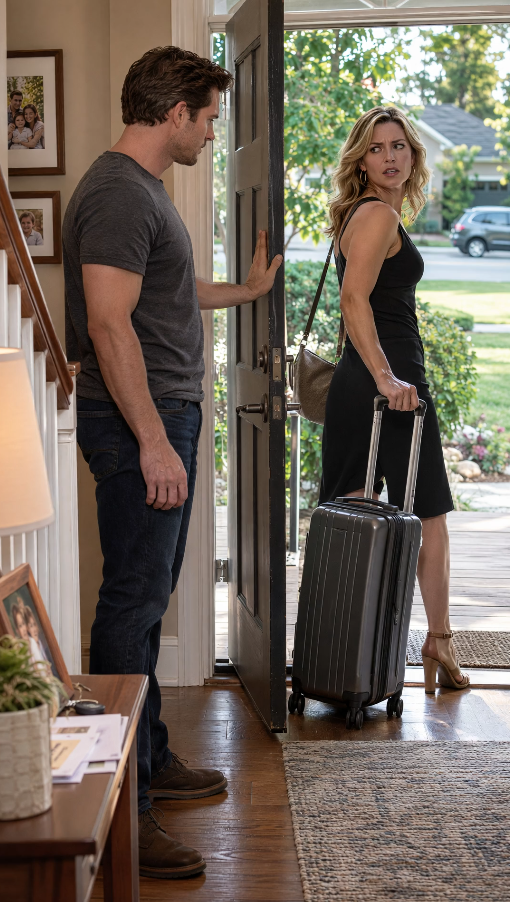
A month later, she finally unpacked the suitcase completely.
I did not mention it.
She noticed me noticing.
“You can say something.”
“I was trying not to make it dramatic.”
“Progress.”
“Thank you.”
“But you can say something.”
I considered it.
Then I asked, “Are you glad you’re here?”
She leaned against the bedroom door.
“Today?”
“Yes.”
“Yes.”
I nodded.
She smiled.
“Ask me again someday.”
I understood.
Love wasn’t a permanent answer filed away after it was given once.
Some questions deserved asking more than once.
Six months after the hotel call, Luke invited us to his house.
Boise was colder than I expected.
His home was smaller than mine, filled with books, plants, and framed photographs.
There were pictures of Mom everywhere.
I stopped in front of one.
She was sitting at Luke’s kitchen table wearing the green scarf I had given her for Christmas.
I remembered asking where she wore it.
“Oh, everywhere,” she’d said.
Apparently she had.
Claire came beside me.
“You okay?”
I nodded.
Then corrected myself.
“Actually, no.”
She waited.
“I wish I had been here.”
“I know.”
“I’m angry at her.”
“I know.”
“I miss her.”
“I know.”
I looked at Claire.
“Those can all happen together?”
She smiled.
“Apparently.”
Luke entered carrying three mugs.
“You two being emotionally healthy in my kitchen?”
“Trying.”
“Disgusting.”
He handed me coffee.
Black.
He still remembered.
That evening, after Claire went upstairs, Luke and I sat outside beneath a patio heater.
For a while, we talked about nothing important.
Sports.
Work.
Whether Dad would have hated electric cars.
Then Luke reached into his jacket.
“I found something.”
I sighed.
“Please tell me it’s not another financial document.”
“No.”
“Another secret account?”
“No.”
“Another relative?”
“Not that I know of.”
He handed me a small envelope.
My name was written on the front.
Not Mom’s handwriting.
Dad’s.
I stared at it.
“Where?”
“Inside an old drafting case Mom left me.”
I did not open it immediately.
“Have you read it?”
“No.”
“Why?”
“It’s yours.”
I turned it over.
The seal had never been broken.
For several seconds, I considered putting it away.
There had been enough messages from dead people.
Enough explanations.
Enough years governed by words written long ago.
Then I opened it.
The letter contained only five sentences.
Adam,
I went to see Luke today.
I sat across the street for forty-three minutes and failed to walk to his door.
I have spent years confusing shame with responsibility.
If I ever become brave enough to tell both of you the truth, I hope you will understand that being sorry and making something right are not the same thing.
If I don’t, please be braver than I was.
I read it twice.
Then I handed it to Luke.
He read it once.
Neither of us spoke.
Finally, he folded it carefully.
“Forty-three minutes.”
“Apparently.”
“He counted?”
“Dad measured everything.”
Luke laughed.
Then his eyes filled.
“So what do we do with this?”
Years ago, I would have looked for the correct answer.
Keep it.
Burn it.
Forgive him.
Condemn him.
Choose one.
Now I looked through Luke’s glass door.
Claire was upstairs, reading beneath a lamp.
My wife.
Still here.
Not because everything had been repaired.
Because we were repairing it.
I looked at my brother.
“Whatever we want.”
He smiled.
“That simple?”
“No.”
I took back the letter.
“But maybe it doesn’t have to be complicated in the same way anymore.”
The following spring, Claire and I drove with Luke to the old Mercer Design building.
It had become a community arts center.
Children’s paintings covered one hallway.
The drafting room where Dad once spent sixteen-hour days was now a ceramics studio.
Luke stood in the doorway.
“This is weird.”
“Very.”
A woman carrying a tray of clay bowls smiled at us.
“Can I help you?”
Luke looked at me.
Years ago, I might have answered for him.
Instead, I waited.
“My family used to own this building,” he said.
“Oh.”
She smiled.
“Then welcome back.”
Luke’s expression changed.
Not dramatically.
Just enough.
“Thank you.”
We walked through every room.
Including Dad’s old office.
There was nothing left of him there.
No desk.
No drawings.
No ledgers.
No secrets.
Sunlight fell across long tables covered in clay.
I found that comforting.
Outside, Claire slipped her hand into mine.
“Ready?”
I looked at Luke.
He was taking a photograph of the building.
“For what?”
“To go home.”
She squeezed my hand.
For years, home had meant the place where the story I understood was kept intact.
Now I knew better.
Home could survive questions.
It could survive disappointment.
It could even survive the truth.
If the people inside it were willing to keep opening doors.
Luke joined us.
We walked toward the parking lot.
Halfway there, he stopped.
“What?”
He looked at me.
“There is one thing I never understood.”
“What?”
“The night I left.”
I waited.
“You said you believed Dad.”
My chest tightened.
“Yes.”
“Did you?”
I thought about the garage.
The rain.
My father’s certainty.
My mother’s silence.
My brother asking me to come inside and look.
For eleven years, I had remembered answering yes.
But memory was more complicated than a recording.
I remembered something else now.
The pause before my answer.
The fear.
The desperate wish for one person to make the world simple again.
“No,” I said.
Luke watched me.
“I think I wanted to.”
His shoulders lowered.
As if some small weight had finally been set down.
“That makes more sense.”
Claire looked between us.
“Why?”
Luke smiled.
“Because he was always a terrible liar.”
I laughed.
Then Luke did.
Claire joined us even though she had heard the joke only secondhand.
We stood in the parking lot laughing beneath a clear spring sky where the old Mercer sign had once hung.
Nothing erased the lost years.
Nothing could.
But loss did not have to be the only thing those years meant.
Mom’s hidden visits meant Luke had not been entirely alone.
Dad’s unopened letter meant regret had existed even when courage had not.
Claire’s suitcase meant our marriage had reached an edge.
Her unpacking it meant we had chosen to see what could still be built.
And the old investigation report—the envelope I had hidden because I could not let go—eventually became one of the things that brought my brother home.
That night, Claire and I sat on our porch.
The house was quiet.
“You know,” she said, “you technically kept your promise.”
“What promise?”
“When I left.”
I remembered.
Don’t call me while I’m away.
“You said I wouldn’t receive a single call from you,” she continued.
“You didn’t.”
“No.”
“You called me.”
She smiled.
“Good thing.”
I looked at her.
“Why?”
“Because I don’t know whether you would have.”
That was fair.
I thought about it.
Then I took out my phone.
Claire laughed.
“What are you doing?”
I called her.
Her phone rang in her pocket.
She stared at me.
“You’re sitting three feet away.”
“Answer it.”
“This is ridiculous.”
“Answer.”
Still smiling, she accepted the call.
“Hello?”
I raised my phone.
“Hi.”
“Hi.”
I looked at the woman sitting beside me.
Not the woman I assumed I already understood.
Not the wife whose thoughts I could predict because we had shared a house for years.
Claire.
A person I was still learning.
“I was wondering,” I said, “if you wanted to have dinner with me tomorrow.”
She lowered her phone slightly.
“Like a date?”
“Exactly like a date.”
“We’re married.”
“I’ve heard.”
She smiled.
“I’d like that.”
“Seven?”
“Seven.”
“Should I pick you up?”
“You know where I live.”
“Convenient.”
We ended the call.
For a moment, neither of us spoke.
Then she rested her head against my shoulder.
Inside the house, the old tablet lay in a kitchen drawer.
Its cracked screen had gone dark again.
I never repaired it.
I didn’t need to.
Some broken things are not invitations to return to the moment they broke.
Sometimes they are simply evidence that a message found you anyway.
Months later, I finally threw away the investigator’s envelope.
Not because Claire asked me to.
Not because Luke wanted me to.
Because I no longer needed it to prove that my brother existed somewhere beyond my reach.
Before I did, I removed one thing.
The photograph from Boise.
Dad’s shoulder.
Dad’s watch.
Luke walking unknowingly past him.
I put it beside the final letter.
Not as proof of forgiveness.
Not as proof of guilt.
Just as the record of a man who drove hundreds of miles and stopped forty-three minutes short of becoming the person he wanted to be.
Then I placed beside it a newer photograph.
Luke.
Claire.
Me.
Standing outside the old Mercer building.
Three people smiling.
No one missing.
No false names.
No private notes.
No room waiting somewhere for the truth to arrive.
I closed the album.
Claire called from the kitchen.
“Adam?”
“Yeah?”
“Luke wants to know if we’re free next weekend.”
I smiled.
“What did you tell him?”
“I told him I’d ask you.”
There was something almost comical about how ordinary that sentence was.
Years of secrets had taught us nothing as useful as that.
Ask.
Don’t assume.
Don’t answer for someone who is still in the room.
I walked toward the kitchen.
Claire stood beside the counter with her phone in her hand.
“Well?”
I looked at the message from my brother.
**Dinner Saturday? My place. No mysterious hotels.**
I laughed.
“Tell him yes.”
Claire began typing.
Then stopped.
“Actually…”
She handed me the phone.
“You tell him.”
I took it.
For eleven years, there had been a silence between my brother and me wide enough to contain everything we were afraid to say.
Now there was a blank message box.
I typed two words.
**We’ll come.**
Then I pressed send.
And this time, nobody needed an alias to find the way home.
**–THE END–PLEASE
Share your thoughts or feedback to motivate us to create more stories ♥️**
✓ Lynn R. Adams
## END – The Name We Carried Home For almost thirty seconds, none of us said anything. Then Claire picked up the photograph. “Are you certain?” Luke nodded. “Martin Hale died nine years ago. Hear…