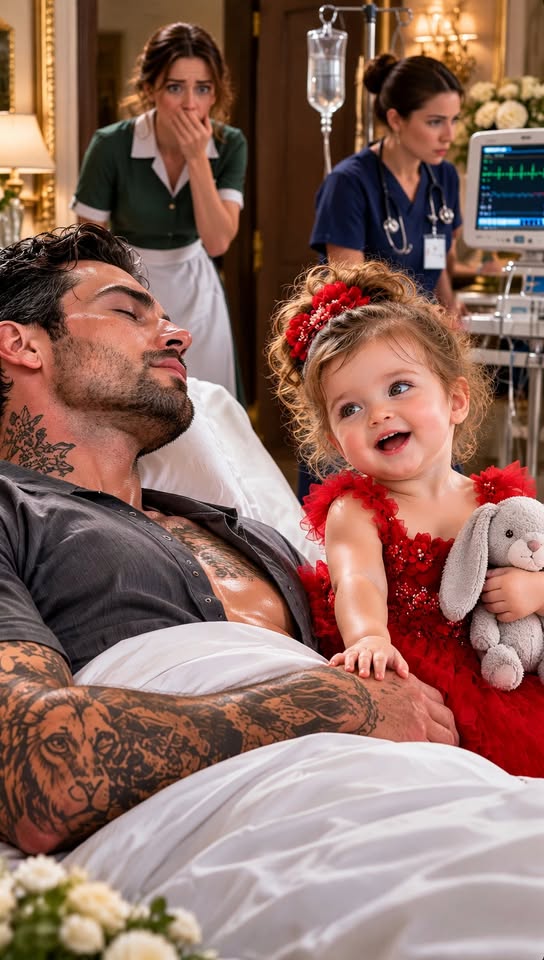
PART 6: ““Mommy, I sang to the sleeping man.” “He held my hand.”-062
Spring arrived slowly that year.
For months, New York seemed unable to decide whether winter was finished.
Cold rain washed the sidewalks one week.
Cherry blossoms appeared the next.
Then frost returned and made everyone regret believing the sunshine.
My life changed in much the same way.
Not all at once.
Not dramatically.
In small, uncertain steps.
I was accepted into the nursing program.
When the email arrived, I read it four times.
Then I screamed loudly enough that Ava began screaming too, although she had no idea why.
We celebrated with grocery-store cupcakes.
Rosa arrived with a real cake twenty minutes later because Isabella had apparently decided grocery-store cupcakes represented an unacceptable response to academic admission.
I moved out of the staff apartment.
Our new place was small.
The elevator made an alarming noise between the second and third floors.
The kitchen had exactly one drawer that opened properly.
But the lease had my name on it.
The first evening there, I sat on the floor because the furniture had not arrived yet.
Ava slept beside me under two blankets.
I listened to traffic outside.
For the first time in years, uncertainty did not frighten me.
It felt like possibility.
Lorenzo continued recovering.
His company recovered differently.
The safety investigation changed more than a maintenance department.
Independent auditors reviewed every transportation subsidiary.
Old reporting systems were replaced.
Employees received confidential ways to flag problems without fearing retaliation.
Managers were evaluated partly on whether mistakes were reported quickly rather than hidden successfully.
Several Moretti businesses were sold.
Others were restructured.
Organizations that had once depended too much on Lorenzo’s personal authority were placed under professional boards.
He became less powerful in one sense.
Strangely, he seemed relieved.
“You spent years building all of this,” I said when we finally visited the botanical garden.
Ava walked between us wearing yellow rain boots despite the perfectly dry weather.
Lorenzo watched her investigate a fountain.
“I inherited most of it.”
“That is not what I asked.”
He glanced at me.
“No.”
He understood.
For years, people had treated the Moretti name as if control itself were the family inheritance.
Lorenzo had believed that too.
Then he spent seven weeks unable to move his own hand.
It changed the meaning of control.
“When I was unconscious,” he said, “I kept trying to open my eyes.”
We walked slowly beneath flowering branches.
“I thought if I tried hard enough, eventually my body would obey.”
I said nothing.
“It didn’t.”
His voice softened.
“I could hear things sometimes.”
“What things?”
“Footsteps.”
“Machines.”
“My mother talking.”
He smiled slightly.
“Elena complaining about doctors.”
“She would deny that.”
“She should.”
We continued walking.
“Then there was singing.”
I looked at him.
“Ava?”
“I didn’t know who she was.”
His expression grew distant.
“I didn’t understand the words at first.”
“But something felt familiar.”
“Like a memory?”
“More like a place.”
I waited.
“A safe place.”
My eyes stung.
He looked toward Ava.
“She didn’t wake me because she was magical.”
“No.”
“She woke me because my brain recognized something before I did.”
“That is what Dr. Shah thinks.”
Lorenzo smiled.
“Dr. Shah refuses to say anything romantic about it.”
“He’s a neurologist.”
“Exactly.”
Ava ran back to us carrying a fallen blossom.
“For you.”
She handed it to Lorenzo.
He accepted it with extraordinary seriousness.
“Thank you.”
Then she gave me a stick.
I stared at it.
“Why does he get the flower?”
Ava shrugged.
Lorenzo laughed so hard he had to sit on a bench.
Our relationship developed carefully.
There was no fairy-tale transformation.
Lorenzo did not stop being complicated because he had awakened.
I did not become fearless because I entered nursing school.
We argued.
He planned too much.
I refused help even when accepting it would have been sensible.
He occasionally sent a car when I had already told him I intended to take the subway.
I sent the car back.
After the third time, he stopped.
I discovered that someone accustomed to being obeyed could, with effort, learn to ask.
He discovered that independence did not mean I wanted to face everything alone.
Six months after I left the estate, we went to dinner without Ava.
A real date.
I almost canceled twice.
Lorenzo admitted later that he had changed his shirt four times.
That information pleased me far more than it should have.
At dinner, nobody called him Mr. Moretti.
Nobody whispered.
Nobody hurried to open a door.
We sat beside a window in a small Italian restaurant where the owner cared far more about his sauce than Lorenzo’s surname.
For two hours, we were simply Clara and Lorenzo.
I liked him better that way.
The Moretti estate changed too.
Isabella converted part of the unused west wing into offices for a new community health foundation.
She named it the Marianne and Thomas Bennett Initiative.
I objected immediately.
“My parents would hate having their names on a building.”
“That is why there is no building named after them.”
“It’s an entire foundation.”
“Your mother cannot argue with me anymore.”
“She would find a way.”
Isabella smiled.
“I miss that.”
The foundation funded safety research, neighborhood clinics, nursing scholarships, and transportation for elderly patients who missed medical appointments because they could not reach hospitals reliably.
I refused a scholarship from it.
Lorenzo was annoyed.
“You qualify.”
“I know.”
“Then apply.”
“No.”
“Why?”
“Because every family dinner would become a conflict-of-interest meeting.”
That ended the argument.
Instead I received an ordinary state nursing grant and worked two evenings a week at the same community clinic where my mother had once worked.
On my first day, I found an old staff photograph hanging in the hallway.
There she was.
Marianne Bennett.
Twenty-six years old.
Curly hair.
Crooked name badge.
The smile I remembered.
I stood beneath that photograph until my supervisor asked whether I was all right.
“Yes,” I said.
And for once, it was true.
A year after Lorenzo’s accident, Dr. Shah invited us to the hospital.
He had completed a clinical presentation about patients who displayed signs of cognitive awareness before regaining visible responsiveness.
Lorenzo’s case was included anonymously.
Ava’s role appeared only as “familiar auditory stimulation.”
Lorenzo objected.
“That makes her sound like a radio.”
Dr. Shah looked over his glasses.
“Would you prefer ‘small child singing badly’?”
Ava, now two and increasingly opinionated, shouted, “I sing good.”
Even Dr. Shah laughed.
But Elena had something else to show us.
During a final review of Lorenzo’s monitoring archive, she discovered an earlier neurological response.
It occurred nine days before Ava entered his room.
“What caused it?” I asked.
Elena looked at Isabella.
Isabella became very quiet.
“I was there that night.”
Lorenzo turned toward his mother.
“What did you say?”
She folded her hands.
For the first time in a year, she looked uncertain.
“I told you I was sorry.”
“For what?”
“For expecting you to become the man everyone else needed.”
Lorenzo’s expression changed.
Isabella continued.
“Your father died believing strength meant never changing direction.”
“I think I taught you the same lesson.”
She looked down.
“And while you were lying there, I realized I would give anything just to see you choose your own direction.”
The room became silent.
Lorenzo sat beside her.
“You never told me that.”
“I didn’t know you heard me.”
“Neither did I.”
Elena pointed toward the neurological graph.
“But something in you did.”
Lorenzo studied the monitor.
A small line rose above the others.
Almost invisible.
A signal no one had noticed at the time.
I thought of my father’s warnings buried inside old company files.
My mother’s letter hidden in a desk.
A safety notice lost inside a reporting system.
A tiny movement in Lorenzo’s finger.
So many important things had almost disappeared because they seemed too small to matter.
Perhaps that was what the entire year had taught us.
Lives rarely changed because of one enormous moment.
They changed because someone finally paid attention to the small ones.
A warning.
A letter.
A song.
A hand closing around two tiny fingers.
Two years after the accident, the foundation opened a new pediatric clinic in Queens.
There was no enormous ceremony.
Lorenzo insisted.
He had learned to distrust enormous ceremonies.
Children painted pictures on paper taped to the walls.
Doctors carried boxes.
Nurses argued cheerfully about where supplies belonged.
Isabella stood in the middle of everything pretending she was not crying.
I was finishing my nursing degree.
Elena had already offered to help me apply for pediatric placements.
Ava wore a yellow dress and carried the same gray rabbit, now repaired so many times that almost none of the original stitching remained.
Before the doors opened, she wandered into one of the examination rooms.
Lorenzo followed her.
I found them sitting together beside the window.
Ava placed Bunny on the examination table.
“Bunny sick.”
Lorenzo nodded gravely.
“What seems to be the problem?”
“Sleeping.”
He looked at me.
I smiled.
“That can be serious.”
Ava patted Bunny’s paw.
Then she began singing.
The same song.
Her voice was clearer now.
Not beautiful in any polished sense.
It belonged completely to a child.
Uneven.
Sincere.
Certain.
Lorenzo listened.
When she finished, he clapped.
Ava bowed.
Then she looked at him.
“You sleeping man?”
Lorenzo’s smile faded into something gentler.
“Not anymore.”
She seemed satisfied.
She climbed into his lap.
I stood in the doorway watching them.
For years, I had believed survival meant working harder than whatever frightened me.
Another shift.
Another bill.
Another sleepless night.
Another promise that tomorrow would somehow be easier.
But survival had only been the beginning.
Living required something else.
It required allowing the future to contain possibilities I had not planned.
Lorenzo looked at me over Ava’s head.
“Come here.”
Two years earlier, I might have heard an order.
Now I heard an invitation.
I crossed the room.
He reached for my hand.
I let him take it.
Outside, families were beginning to gather for the clinic opening.
Some knew the Moretti name.
Some knew my parents’ names from the plaque near the entrance.
Most knew none of us.
That felt right.
The building did not exist to preserve our story.
It existed so other people could continue theirs.
Isabella appeared in the doorway.
“They are waiting.”
Lorenzo sighed.
“I was happier unconscious.”
Elena shouted from the hallway.
“I heard that.”
Ava laughed.
So did I.
We walked outside together.
The morning sun reflected from the clinic windows.
Someone handed Ava a ribbon she was supposed to help cut.
Instead she wrapped it around Bunny.
No one tried to stop her.
I looked at Lorenzo.
He looked back.
There were still unanswered questions in life.
There always would be.
But mystery no longer felt like something hiding in the darkness.
Sometimes it was simply the future waiting behind a door.
Ava took my hand.
Then she took Lorenzo’s.
The three of us stepped forward.
And as my daughter began humming the song that had somehow traveled from my mother, through a frightened eight-year-old boy, across nearly three decades, and finally back into Lorenzo’s silent hospital room, I understood that nothing truly meaningful had awakened with Ava that afternoon.
Something had returned.
A memory.
A promise.
A second chance.
And this time, all of us were awake enough to recognize it.
Share your thoughts or feedback to motivate us to create more stories ♥️
**–THE END–PLEASE COMMENT “”YES,”” AND LIKE AND SHARE THIS POST ON FACEBOOK TO GIVE US THE MOTIVATION TO SHARE EVEN MORE STORIES**
✓ Lynn R. Adams
Spring arrived slowly that year. For months, New York seemed unable to decide whether winter was finished. Cold rain washed the sidewalks one week. Cherry blossoms appeared the next. Then frost re…