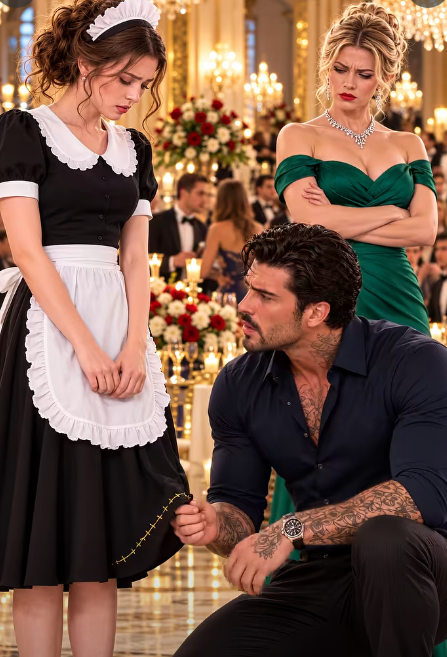
PART 6: MAFIA BOSS KNEELS BEFORE A MAID—HER DRESS REVEALS A 16-YEAR SECRET! 😱❤️ 066
“Daniel, my father left me something.”
I stood in the doorway of Daniel Carter’s office, holding a faded sheet of paper against my chest.
Three weeks had passed since we’d discovered the hidden ledger.
Three weeks since I’d found my mother alive in a little Wisconsin flower shop.
And three weeks since the most powerful man in Chicago had promised to uncover the truth about my father’s death.
Daniel looked up from his desk.
“Emma?”
I stepped inside.
He smiled.
“You don’t need an appointment.”
“I know.”
He noticed the document in my hand.
“What’s that?”
I placed it on his desk.
“My father’s dream.”
Daniel unfolded the paper.
I watched his expression change as he read the names.
Michael Bennett.
Daniel Carter.
The Yellow Rose Children’s Trust.
He sat back slowly.
“Where did you find this?”
“My mother kept it.”
Daniel stared at the old document.
For a long time, he didn’t speak.
Then his fingers moved toward the signature at the bottom.
“Michael.”
His voice broke.
I sat across from him.
“He wanted to help children whose families couldn’t afford school.”
Daniel nodded.
“Yes.”
“You remember?”
He looked up.
“Emma, your father and I talked about this for months.”
My heart raced.
“Then why didn’t you tell me?”
“Because after the accident, I believed the plans had been abandoned.”
He looked at the paper again.
“I thought everything had been lost.”
I leaned forward.
“Mom says the fund was supposed to be supported by money from the company’s profits.”
Daniel nodded.
“That was the agreement.”
“Can it still happen?”
He studied me carefully.
Then he smiled.
“Yes.”
I held my breath.
“But we need to do it properly,” he continued. “An attorney will have to review the original agreement. The proposed fund was never formally established.”
I nodded.
“And if the agreement can’t be enforced?”
Daniel looked at the photograph of his mother on the wall.
“Then we’ll establish a new one.”
My eyes widened.
“You would do that?”
He smiled sadly.
“Emma, your father saved my life. He also tried to teach me that wealth meant very little if it didn’t improve someone else’s.”
He placed his hand over the document.
“I think it’s time I finally understood the lesson.”
The investigation into Carter Holdings continued for several months.
It wasn’t easy.
Daniel hired an independent accounting firm and outside legal counsel to examine the records found in Eleanor’s hidden ledger.
The review uncovered years of improper transfers, postponed repairs, and financial decisions that had never been properly documented.
Some of the people responsible were no longer alive.
Others had retired or left Chicago.
Not every question could be answered.
But the investigation established something that mattered enormously to our family.
My father had raised legitimate concerns about safety.
The loading equipment involved in his accident had been scheduled for maintenance.
And those repairs had been delayed after approved funds were diverted elsewhere.
The independent engineering review concluded that the missing maintenance was a significant contributing factor in the accident.
For sixteen years, we’d been told Michael Bennett had died because of an unforeseeable mechanical failure.
Now the truth was finally part of the official record.
When Daniel brought the findings to our apartment, Noah read the report twice.
Then he closed it.
“So Dad was right.”
Daniel nodded.
“Yes.”
My brother looked at me.
“He knew something wasn’t safe.”
I took his hand.
“And he tried to fix it.”
Daniel’s eyes filled.
“He did.”
For a long moment, nobody spoke.
Then Noah asked, “Does this mean somebody will be punished?”
Daniel answered carefully.
“Some legal questions are still being reviewed. But the age of these events limits what can be done. The company can still acknowledge responsibility and make meaningful restitution.”
I looked at my brother.
“Dad wouldn’t want us to spend our lives waiting for someone to suffer.”
Noah nodded slowly.
“He’d want us to make sure it doesn’t happen again.”
Daniel smiled.
“Exactly.”
The following week, Carter Holdings issued a public statement acknowledging the findings.
The company committed to an independent safety oversight program, financial transparency measures, and a restitution process for affected workers and families.
Daniel personally met with employees whose pensions or benefits had been affected.
Some were angry.
Others were relieved simply to be heard.
He didn’t ask them to forgive him.
He listened.
The newspapers called it an unprecedented decision.
Business analysts questioned whether Carter Holdings could recover from the financial consequences.
But Daniel refused to withdraw the statement.
“An empire built on silence isn’t worth preserving,” he told the board.
The words appeared in newspapers across Chicago.
I read them while sitting at our kitchen table.
And for the first time, I felt that something good might grow from the terrible thing our family had endured.
Victoria Ashford came to see me one rainy afternoon.
I was still working at the Carter Grand Hotel.
A few people had suggested I should quit immediately.
After all, the owner now knew my family personally.
My father had helped establish the company.
My mother had uncovered its hidden financial records.
And I was named in the proposed documents of a foundation that could eventually help hundreds of children.
But I wasn’t ready to abandon the life I’d built.
My work had paid our rent.
It had helped Noah through college.
It had taught me how to survive difficult days with dignity.
I didn’t want to pretend those years hadn’t mattered.
Victoria found me in the staff lounge during my lunch break.
She stood awkwardly near the doorway.
“Emma?”
I looked up.
“Victoria.”
She was holding a small paper bag.
“May I sit?”
I nodded.
She settled across from me.
For a moment, neither of us spoke.
Then she placed the bag on the table.
“I brought you something.”
Inside was a carefully wrapped sewing kit.
There were needles, small scissors, measuring tape, and several spools of thread.
Including yellow.
I stared at it.
“Why?”
Victoria looked down.
“I found it while sorting through my mother’s belongings. She used to sew.”
She gave a sad smile.
“Not particularly well. But she loved it.”
I touched the yellow thread.
“It’s beautiful.”
Victoria swallowed.
“I wanted to apologize again.”
I looked at her.
“You’ve already apologized.”
“I know. But I’ve been thinking about what you said at the conservatory.”
“What did I say?”
“That somewhere along the way, I’d forgotten who I wanted to be.”
I remembered.
She drew a slow breath.
“You were right.”
Her voice trembled.
“I spent years trying to preserve my father’s reputation because I thought admitting his mistakes meant I didn’t love him.”
I listened.
“But loving someone shouldn’t require pretending they were perfect.”
I nodded slowly.
“No.”
Victoria looked at me.
“I’ve stepped away from the Carter Holdings board. I’m also cooperating with the independent review and helping locate former employees affected by the missing funds.”
“That’s good.”
She looked uncertain.
“Do you think you could ever forgive me?”
I considered her question.
There was a time when I’d imagined forgiveness as something simple.
Someone apologized.
Someone else accepted.
And everything returned to the way it had been.
But I’d learned that some things couldn’t be restored so easily.
“I think I can,” I said. “But trust will take longer.”
Victoria nodded through tears.
“I understand.”
I smiled gently.
“Then we can begin there.”
She reached for my hand.
And for the first time, I saw her not as the wealthy woman who’d humiliated me beneath the chandeliers, but as another person struggling to become better than the choices she’d made.
My mother came to Chicago in November.
She didn’t move into a mansion.
She didn’t accept Daniel’s offer of a luxury apartment.
Instead, she rented a small place near ours.
It had two bedrooms, a sunny kitchen, and a little balcony where she could grow flowers.
Thomas remained in Wisconsin to manage Willow & Rose, visiting us whenever he could.
Claire kept her little shop too, traveling between the two places until she decided what the next chapter of her life would look like.
Our family didn’t become perfect overnight.
Some mornings, I woke with anger I couldn’t explain.
Sometimes Noah became quiet when someone mentioned the childhood birthdays she’d missed.
And sometimes my mother cried when she saw old photographs of us.
But we talked.
We asked questions.
We listened to answers that weren’t always easy.
We learned each other again.
At first, Claire insisted on cooking dinner every evening.
She made too much food.
She worried when Noah came home late.
She reminded me to wear a coat even when the weather was warm.
One evening, I laughed and said, “Mom, I’m not eight years old anymore.”
She smiled sadly.
“I know, sweetheart.”
Then she looked down.
“I’m still learning how to be your mother now.”
I put my arms around her.
“And I’m learning how to be your daughter again.”
She held me.
“We have time,” I whispered.
For sixteen years, those words had felt impossible.
Now they were a promise.
The Yellow Rose Children’s Trust was formally established the following spring.
Daniel contributed the first major endowment from his personal holdings, with an additional contribution approved by the Carter Holdings board after independent review.
The foundation’s charter established a separate governing board, including educators, community representatives, and members of the Bennett family.
Its mission was simple.
Help children from working families pursue an education, particularly those whose families had faced financial hardship, illness, or unexpected loss.
When Daniel asked me to serve on the founding board, I almost refused.
“I’m a maid,” I told him.
He smiled.
“And?”
“I don’t have a business degree.”
“Neither did your father when he first began studying engineering.”
I looked down.
“What if I make mistakes?”
“You will.”
I raised my head.
Daniel smiled.
“So will I. That’s why we’ll have experienced people around us.”
He leaned forward.
“Emma, your father didn’t choose you because he expected you to know everything.”
“Then why?”
“Because he believed you’d care enough to learn.”
I thought about the little girl I’d once been.
The child who counted buttons while her mother sewed.
The girl who waited for someone who never came home.
The young woman who polished marble floors beneath chandeliers and believed nobody noticed her.
Then I nodded.
“I’ll do it.”
Daniel smiled.
“Good.”
“But I have one condition.”
He raised an eyebrow.
“What?”
“I want the foundation to support vocational training too. Not everyone needs a university degree to build a good life.”
Daniel considered it.
Then he nodded.
“Agreed.”
I smiled.
“And I’d like to keep working while I learn.”
He laughed.
“Emma, you can decide how to build your future.”
I continued at the hotel for another six months.
During that time, Margaret taught me more about hotel operations.
I enrolled in evening business courses.
Noah helped me understand budgets and spreadsheets.
And my mother sat beside me at the kitchen table whenever the numbers became difficult.
One evening, I grew frustrated over a financial statement.
“I can’t do this.”
Claire looked up from her sewing.
“Of course you can.”
“Mom, I’ve read this page five times.”
She smiled.
“Then read it a sixth.”
I groaned.
She laughed.
“Do you remember what I used to tell you?”
I rolled my eyes.
“The smallest things matter most.”
“Exactly.”
She pointed toward the figures.
“Start with the smallest thing you understand. Then build from there.”
I looked at the page again.
And this time, the numbers began making sense.
I smiled.
“Thanks, Mom.”
She returned to her sewing.
“Anytime, my little detective.”
The first scholarship ceremony took place one year after the night Daniel knelt before me in the ballroom.
It was held at the Carter Grand Hotel.
The same ballroom.
The same golden chandeliers.
The same polished marble floor.
But everything felt different.
There were no extravagant displays of jewelry or elaborate social competitions.
Instead, the room was filled with families.
Teachers.
Students.
Hotel workers.
Construction workers.
Nurses.
Parents holding children’s hands.
The first scholarship recipients came from neighborhoods across Chicago.
One was a girl whose mother worked two cleaning jobs.
Another was a boy who wanted to become an electrician.
A third hoped to study nursing.
Several were the children of employees affected by the old financial failures.
I watched them take their seats.
And I thought of my father.
The best thing a person can build is a place where somebody else gets a chance.
I touched the little yellow rose necklace at my throat.
“Dad,” I whispered, “we did it.”
Before the ceremony, Margaret came into the dressing room.
“Emma, are you ready?”
I turned.
She stopped in the doorway.
“Oh, sweetheart.”
I looked down.
“Is something wrong?”
Her eyes filled.
“No.”
She smiled.
“You look exactly like your mother.”
I was wearing a simple navy-blue dress.
It wasn’t expensive.
It wasn’t fashionable.
But along the hem were tiny yellow stitches.
Crooked ones.
Just like the stitches Claire had sewn sixteen years earlier.
Margaret moved closer.
“You kept them.”
I nodded.
“Mom helped me move a small piece of the original hem onto this dress.”
She touched the fabric gently.
“Claire would be proud.”
I smiled.
“She is. She’s waiting downstairs.”
Margaret hugged me.
Then she whispered, “You know, when you first started working here, you barely spoke above a whisper.”
I laughed.
“I was terrified.”
“And now you’re about to address an entire ballroom.”
“I’m still terrified.”
She squeezed my hands.
“Good. It means this matters.”
The ballroom doors opened.
Daniel stood near the stage wearing a dark suit.
Noah was beside him.
My mother sat in the front row with Thomas, holding a bouquet of yellow roses.
Victoria sat a few seats away.
She’d spent much of the past year working quietly with the foundation’s outreach team.
We weren’t close friends.
But we’d built something respectful and real.
When I entered the ballroom, people turned toward me.
For a moment, I remembered the first time I’d stood beneath those chandeliers.
Victoria’s crimson gown.
Her mocking laughter.
My burning cheeks.
Daniel kneeling before my yellow stitches.
I stopped walking.
The memories rose so suddenly that I felt dizzy.
Then Noah smiled at me.
And my mother lifted her bouquet.
I smiled back.
The past hadn’t disappeared.
It had simply stopped deciding who I was.
I walked toward the stage.
Daniel began the ceremony.
He spoke about the foundation.
About education.
About the importance of helping families when life becomes unexpectedly difficult.
Then his voice changed.
“Before we present the first scholarships, there’s someone I’d like you to meet.”
He looked toward me.
“A year ago, a young woman stood in this ballroom wearing an old uniform with yellow stitches along the hem.”
The room grew quiet.
“She was treated as though the work she performed made her less deserving of respect.”
I lowered my eyes.
Daniel continued.
“That evening, I recognized those stitches. They reminded me of a woman whose courage changed my life many years ago.”
He looked at Claire.
“Her name is Claire Bennett.”
My mother began crying.
Daniel smiled.
“Claire helped uncover truths that many people, including me, had failed to see.”
He paused.
“And her husband, Michael Bennett, left behind a dream that we are finally able to honor.”
He turned toward me.
“Emma, would you come here?”
I stepped onto the stage.
The audience applauded.
Daniel handed me the microphone.
For a moment, I couldn’t speak.
Hundreds of faces looked toward me.
Then I saw my mother’s yellow roses.
And suddenly, the words came.
“When I was little,” I began, “my mother used to repair everything.”
A few people smiled.
“She repaired our clothes. Our schoolbags. Our curtains. Once, she even repaired a stuffed rabbit that my brother had accidentally pulled apart.”
Noah laughed from the front row.
“She always used yellow thread.”
I looked toward my mother.
“I used to ask her why.”
Claire smiled through her tears.
“And she always gave me the same answer.”
I took a breath.
“Good things deserve to be kept, even when the world thinks they’re worthless.”
The ballroom became completely silent.
“Sixteen years ago, my family lost almost everything. My father died in an accident. My mother disappeared. And my little brother and I grew up believing we’d been forgotten.”
My voice trembled.
“But we weren’t forgotten.”
I looked at Noah.
“We had a grandmother who raised us with love. We had people who helped us when we couldn’t help ourselves. And we had a mother who was struggling to find her way home.”
I paused.
“This past year, we’ve learned painful things about the past. Some mistakes can’t be undone. Some years can’t be returned.”
I looked at Daniel.
“But I’ve also learned that what matters is what we choose to do when we finally know the truth.”
My eyes filled.
“My father dreamed of helping children who didn’t have the opportunities he wished he could give them.”
I looked at the scholarship recipients.
“Tonight, that dream belongs to all of you.”
The room was silent.
Then I smiled.
“And if there’s one thing I want every child here to remember, it’s this.”
I touched the yellow stitches along my dress.
“Your worth is not decided by the clothes you wear, the money your family has, or the job your parents do.”
I looked around the room.
“Your dreams matter. Your kindness matters. Your courage matters.”
My voice broke.
“And sometimes the smallest thing you carry can remind you of something greater than you ever imagined.”
For a second, nobody moved.
Then my mother stood.
She began clapping.
Noah rose beside her.
Margaret followed.
And suddenly, the entire ballroom was on its feet.
I couldn’t stop crying.
After the ceremony, a little girl approached me.
She couldn’t have been more than ten.
She wore a simple pink dress and carried a notebook covered in stickers.
“Miss Bennett?”
I knelt so we were eye to eye.
“Yes, sweetheart?”
She pointed toward my hem.
“Are those the yellow stitches?”
I smiled.
“They are.”
She looked thoughtful.
“My mommy repairs my school clothes too.”
“Does she?”
The little girl nodded.
“Sometimes the other girls laugh because my backpack is old.”
My heart tightened.
I gently touched her shoulder.
“Do you love your backpack?”
She nodded.
“My grandma gave it to me.”
“Then it’s special.”
The girl smiled.
“Like your dress?”
“Exactly.”
She looked toward her mother, who stood nearby with tears in her eyes.
Then she turned back to me.
“Can I tell you a secret?”
I leaned closer.
“Of course.”
“I’m going to be a doctor someday.”
I smiled.
“Then I hope you’ll become a wonderful one.”
She hugged me.
And in that moment, I felt my father’s dream come alive.
Not through grand speeches.
Not through millions of dollars.
But through one little girl who was beginning to believe her future mattered.
Later that evening, after the guests had gone, I found Daniel standing alone near the ballroom windows.
He was looking toward the city.
I walked beside him.
“Beautiful night,” I said.
He smiled.
“It is.”
For a while, we watched the lights of Chicago.
Then he turned toward me.
“Emma, there’s something I’ve wanted to tell you.”
I laughed softly.
“Another secret?”
He smiled.
“No more secrets.”
I folded my arms.
“Good.”
His expression grew serious.
“I used to believe my father’s legacy was something I had to defend.”
I listened.
“His buildings. His business. His reputation.”
He looked toward the empty ballroom.
“But I spent so much time defending what he built that I almost forgot to ask whether everything was worth preserving.”
I thought about my mother’s words.
Good things deserve to be kept.
But not everything old was good.
Sometimes the truth required us to let go.
“What changed your mind?” I asked.
Daniel smiled.
“A young woman wearing an old dress.”
I laughed.
“You make it sound dramatic.”
“It was dramatic.”
We both laughed.
Then he reached into his jacket.
“I have something for you.”
He handed me a small velvet box.
Inside was a silver brooch shaped like a yellow rose.
I stared at it.
“Daniel…”
“It belonged to my mother.”
My eyes widened.
“Eleanor’s?”
He nodded.
“She wore it whenever she visited the conservatory.”
I touched the delicate petals.
“I can’t take this.”
“Yes, you can.”
He smiled.
“She would’ve wanted you to have it.”
I looked down at the brooch.
“Why?”
Daniel’s eyes softened.
“Because you helped bring her wish to life. She wanted the truth to be known, and she wanted the people who’d been hurt to have a chance to rebuild.”
I swallowed.
“Thank you.”
He nodded.
Then he said something I would never forget.
“Emma, I once thought the greatest thing my father left me was an empire.”
He looked at the little rose in my hand.
“Now I understand that the greatest thing he left me was the chance to make something better.”
That night, our family gathered at my mother’s apartment.
Thomas brought homemade apple pie.
Noah cooked dinner.
Margaret arrived with flowers.
Even Daniel stopped by briefly to deliver a bottle of sparkling cider and congratulate the first scholarship recipients.
For the first time in my adult life, our little apartment felt too small for all the people who wanted to be there.
And I loved it.
After dinner, I found Claire standing on the balcony.
She was looking up at the stars.
I stepped beside her.
“Mom?”
She smiled.
“Hello, sweetheart.”
I slipped my arm through hers.
“What are you thinking about?”
She looked toward the sky.
“Your father.”
My throat tightened.
“I was thinking about him too.”
Claire smiled sadly.
“He would have been so proud of you.”
I shook my head.
“I wish he could have seen tonight.”
“He did, in a way.”
I looked at her.
She touched the little yellow rose necklace at my throat.
“Every kind thing you do carries something of him forward.”
My eyes filled.
“I still miss him.”
“So do I.”
We stood together for a long time.
Then I asked the question I’d been holding inside for months.
“Mom, do you think we’ve really come home?”
Claire looked at me.
She considered the question carefully.
Then she smiled.
“Home isn’t always the place we left behind.”
I listened.
“Sometimes it’s the place we build after we’ve lost our way.”
She squeezed my hand.
“And sometimes it takes sixteen years to find the road back.”
I rested my head against her shoulder.
“I love you, Mom.”
She kissed my hair.
“I love you more than all the yellow roses in the world.”
A year later, I visited my father’s grave.
It was a quiet Sunday morning.
The sky was clear, and a gentle breeze moved through the trees.
Noah came with me.
So did our mother.
We brought yellow roses.
For years, the stone had carried only his name, his dates, and the words Beloved Husband and Father.
Now a small plaque had been added beneath it.
Michael Bennett — Engineer, Father, and Founder in Spirit of the Yellow Rose Children’s Trust.
His kindness continues in every life given a chance.
Claire knelt and placed the flowers beside the stone.
For a long moment, she said nothing.
Then she whispered, “We found our way back, Michael.”
Noah stood beside her.
I looked at the yellow roses.
And I thought of everything that had happened.
The dress.
The stitches.
The hidden note.
The flower shop.
The old family secrets.
The letters that had waited sixteen years to be opened.
And the little girl who’d approached me after the scholarship ceremony.
I realized that my father’s story hadn’t ended with his death.
It had continued through the people who loved him.
Through his dream.
Through every child who now had another opportunity.
I knelt beside the grave.
“Dad,” I whispered, “I think I finally understand what you meant.”
My mother looked at me.
I smiled through my tears.
“The best thing we can build isn’t something made of stone or steel.”
I touched the little yellow rose necklace.
“It’s something that helps other people find their way.”
Sometimes people ask me whether I regret the night Victoria Ashford humiliated me in the ballroom.
I always tell them the same thing.
I don’t celebrate what happened.
Nobody should have to endure humiliation to be treated with dignity.
And I don’t believe suffering is necessary for good things to happen.
But I am grateful that I kept walking forward.
I’m grateful I didn’t throw away my mother’s old dress.
I’m grateful that Daniel recognized the stitches.
And more than anything, I’m grateful that when the truth finally appeared, we found the courage to face it together.
Today, the original dress rests in a glass case at the foundation’s community center.
Not because it’s valuable.
It isn’t.
The fabric is faded.
The collar is worn.
The stitches are uneven.
But beside it is a little plaque.
It reads:
This dress belonged to Emma Bennett.
Its yellow stitches were sewn by her mother, Claire, who believed that good things deserved to be kept.
The secret hidden within them helped reunite a family and inspired a foundation dedicated to giving children opportunities.
May we never forget that dignity belongs to everyone.
Children often stop to look at it.
Some laugh at how old-fashioned it seems.
Others ask why the stitches are crooked.
And whenever I’m there, I tell them the story.
Not about a mafia boss kneeling before a maid.
Not about wealthy families and missing money.
But about a mother who loved her children.
A father who dreamed of helping others.
A brother and sister who never stopped hoping.
And the people who discovered that telling the truth was the first step toward making things right.
Because sixteen years ago, I believed those yellow stitches were all I had left of my mother.
I was wrong.
They were the beginning of the road that brought her home.
And they became a reminder of something I hope I’ll never forget.
The world may overlook you, but that doesn’t make you invisible. Your circumstances may be humble, but that doesn’t make your dreams small. And the love you carry can become something far greater than anything money can buy.
My name is Emma Bennett.
I was once a maid who felt invisible beneath the chandeliers of a luxury hotel.
Today, I help children discover the futures they deserve.
And whenever life becomes difficult, I remember my mother’s voice.
“Good things deserve to be kept, Emma.”
I smile.
And I answer the way I always should have.
“Especially people, Mom. Especially people.”
–THE END–PLEASE
✓ Lynn R. Adams
“Daniel, my father left me something.” I stood in the doorway of Daniel Carter’s office, holding a faded sheet of paper against my chest. Three weeks had passed since we’d discovered the hidden ledg…