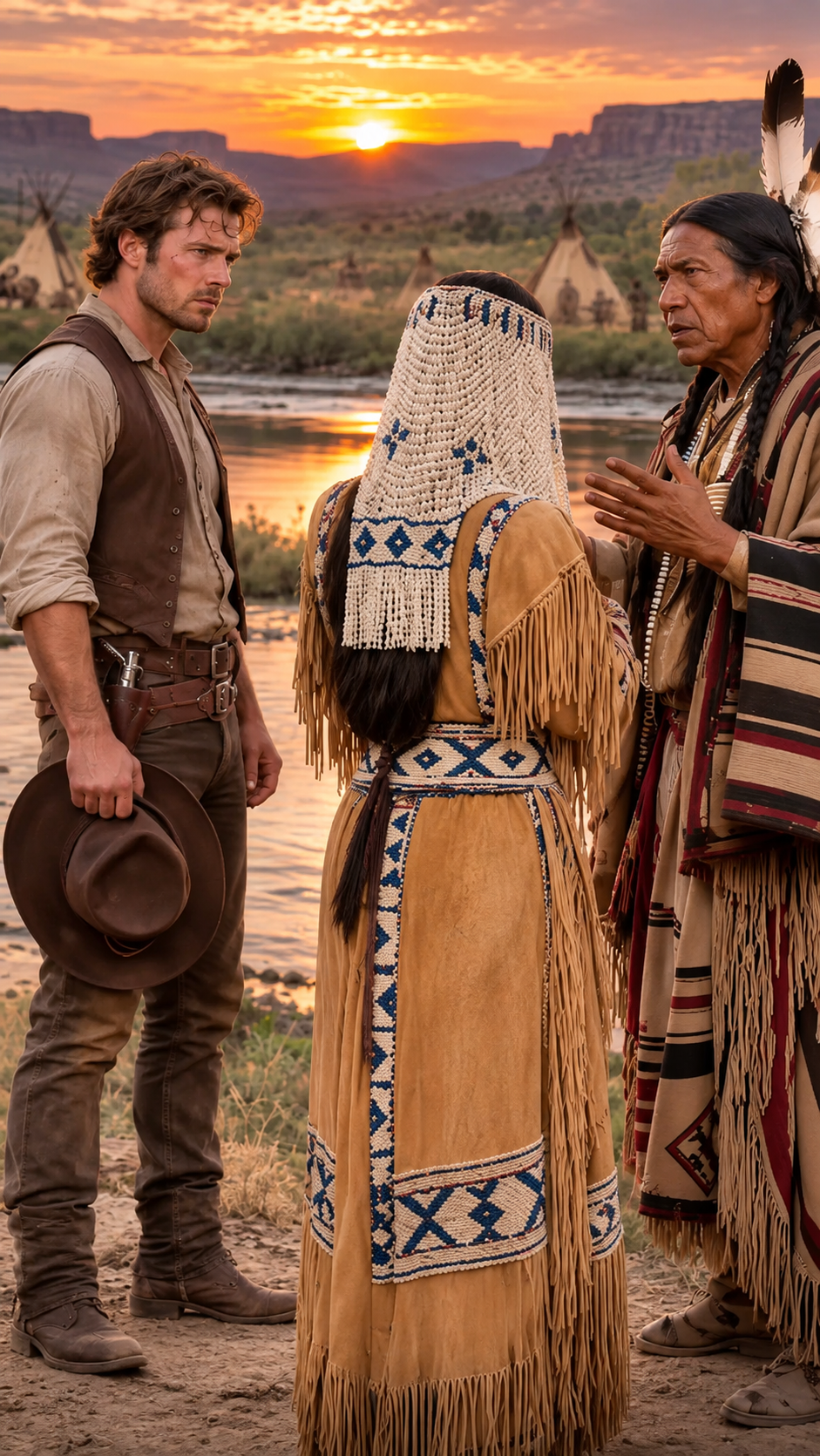
PART 5: “You want me to marry a woman I’ve never seen?” Maverick demanded, staring at the Apache chief.-062
Ayasha had imagined meeting her father many times after learning his name.
In none of those imaginings had she stood in the middle of a bank while a clerk politely pretended not to watch.
Thomas Bell looked smaller than the man she had created in her mind.
Older too.
Of course he was older.
That obvious fact struck her with peculiar force.
Parents were supposed to exist unchanged in childhood imagination.
They were not supposed to gather wrinkles while their children wondered where they were.
Thomas reached toward her.
Then he stopped himself.
The restraint mattered.
Ayasha noticed.
“You believe I am your daughter?”
“I know you are.”
“How?”
Thomas looked at the pendant.
“I bought two of them in St. Louis.”
Maverick frowned.
“Two?”
“One for Clara and one for Elizabeth.”
Thomas smiled sadly.
“They called themselves sisters long before they legally became family.”
Ayasha touched the silver crescent.
“Why did you leave my mother?”
Pain crossed his face.
“I did not.”
The bank lobby was no place for a story that had waited twenty-three years.
They moved to a quiet inn nearby.
Thomas sat opposite Ayasha and Maverick at a corner table.
For several minutes nobody knew how to begin.
Finally Ayasha asked, “Did you know she died?”
Thomas lowered his eyes.
“Not until years later.”
“And me?”
“I thought you had died with her.”
Ayasha flinched.
Thomas saw it.
“I am sorry.”
“Tell me what happened.”
Thomas folded his hands.
He had been a surveyor.
That much Clara’s journal had revealed.
What it had not explained was that Thomas had discovered duplicate claims being filed across the territory.
One set of records remained in local offices.
Another set was sent east.
Water rights disappeared between them.
Boundaries shifted.
Signatures appeared on documents people had never signed.
Western Valley Agricultural Company benefited repeatedly.
Thomas began making copies.
Samuel Hale learned what he was doing.
Maverick stared at the table.
“What did my father do?”
Thomas looked at him.
“He offered me money.”
“And when you refused?”
“He warned me.”
Maverick’s expression tightened.
Thomas continued before the younger man could ask.
“Not with violence.”
He looked toward the window.
“Your father understood reputation better than force.”
Thomas was accused of falsifying surveys.
His employment disappeared.
A warrant was issued for fraud based on documents he insisted had been forged.
He fled east, believing he could obtain evidence from company records.
He wrote Clara before leaving.
The letter never reached her.
For nearly a year he tried to clear his name.
Then he received word that Clara had died.
“And someone told me the child died too.”
Ayasha’s voice became quiet.
“Who?”
Thomas looked at Maverick.
“Samuel.”
Maverick closed his eyes.
Ayasha watched him.
She could see the old battle beginning inside him.
The son trying to reconcile the father he remembered with the man emerging from letters and testimony.
Under the table, Ayasha touched Maverick’s hand.
He looked at her.
She said nothing.
Neither did he.
But his fingers closed around hers.
It was the first time they had held hands when no ceremony required it.
Thomas noticed and looked away with a faint smile.
“What happened after that?” Ayasha asked.
“I spent years trying to prove the fraud.”
“Did you?”
“Yes.”
Thomas reached into his coat.
He removed a brass key.
“The originals are at the mission.”
Maverick stared.
“You left them there?”
“Elizabeth arranged it.”
“My mother?”
Thomas nodded.
“She believed Samuel might eventually search her belongings.”
Maverick remembered the opened bank box.
“He did.”
“Then she was right.”
Thomas pushed the key across the table.
Ayasha looked at it.
“You could have returned.”
The words were not accusing.
That somehow made them harder.
Thomas lowered his head.
“Yes.”
“Why didn’t you?”
“I was ashamed.”
Ayasha frowned.
“Of what?”
“Everything.”
Thomas’s voice broke.
“Of failing Clara.”
He looked toward Maverick.
“Of allowing Samuel to frighten me away.”
Then he looked at Ayasha.
“And after enough years passed, I became ashamed of the years themselves.”
Ayasha understood more than she wanted to.
Silence could become its own prison.
The longer a truth remained unspoken, the more impossible speaking seemed.
“My father did something similar,” she said.
Thomas looked confused.
“Lobo Negro.”
Understanding dawned.
“He raised you?”
“Yes.”
Thomas’s eyes filled again.
“Then I owe him everything.”
Ayasha shook her head.
“You do not owe him me.”
Thomas looked at her.
“No one owns another person’s love merely because they did something good.”
She thought of her marriage.
Of land.
Of bargains.
Of choices.
“I am learning that.”
Maverick smiled slightly.
The following morning they rode toward the mission.
Thomas joined them.
The journey took most of the day.
They found the abandoned building shortly before sunset.
Time had worn away part of the roof.
Wild grass grew through cracks in the courtyard.
A bell hung silently above the entrance.
Thomas stopped outside.
“I have not been here since Elizabeth hid the papers.”
Maverick looked at him.
“Why now?”
“Because Clara’s daughter is standing beside me.”
Ayasha approached the doorway.
For the first time since the journey began, she felt no fear.
Only determination.
Inside, sunlight entered through broken shutters.
Thomas led them to a small room behind the chapel.
A wooden cabinet stood against the wall.
The brass key fit.
Inside were survey books, copies of deeds, letters, and signed affidavits.
Maverick examined them.
“This could overturn dozens of claims.”
Thomas nodded.
“That was the intention.”
Ayasha picked up one document.
Her mother’s name appeared at the top.
Clara Hale.
Beneath it was Thomas Bell.
Below that were boundary measurements for the river parcel.
Then Ayasha noticed handwriting added in the margin.
She recognized Elizabeth’s script from the letter.
Do not let this become another possession.
Let the people who live beside the river decide together.
Ayasha read it twice.
Maverick stood beside her.
“My mother became philosophical near the end.”
“She became wise.”
“Those are sometimes the same thing.”
Ayasha looked around at the stacks of documents.
“What happens now?”
Thomas answered.
“We take these to the territorial office.”
“And the company?”
“If these records are accepted, its petition fails.”
Maverick looked at Ayasha.
“The land becomes yours.”
Ayasha stared at the deed.
For weeks before meeting Maverick, she had heard whispers concerning the river parcel.
Men had measured it.
Officials had written letters.
Her father had grown increasingly worried.
Now everyone was telling her that the land belonged to her.
She found the idea strangely uncomfortable.
“What would you do?” she asked Maverick.
“With the land?”
“Yes.”
He walked toward the broken window.
“I came here wanting a ranch.”
“Do you still?”
Maverick took his time answering.
“Yes.”
Ayasha appreciated his honesty.
“But?”
He looked back.
“I no longer think wanting something gives me a greater claim to it.”
Ayasha smiled.
“You really did read your mother’s letter.”
“Unfortunately.”
She joined him.
Below the mission, the valley stretched toward the river.
From there, they could see grazing land, cottonwoods, and the distant smoke of settlements.
“What if there were room for both?” she asked.
“Both what?”
“A ranch and something that belongs to everyone.”
Maverick frowned thoughtfully.
Ayasha continued.
“The river land is large.”
“Yes.”
“The southern section could support cattle.”
“Yes.”
“The northern section is closer to the community.”
“Yes.”
“And the old trading post could become a school.”
Maverick looked at her.
“A school.”
“You sound surprised.”
“You told me you wanted to teach.”
“I did.”
“But I assumed that was one dream.”
“Why should we have only one?”
Maverick smiled.
“I like that question.”
Thomas watched them from across the room.
“You sound married.”
Ayasha and Maverick simultaneously turned.
“We barely know each other,” Maverick said.
Thomas raised his hands.
“I said nothing else.”
Ayasha hid a smile.
They returned to the camp two days later.
Lobo Negro came out to meet them.
When he saw Thomas Bell riding beside Ayasha, he stopped.
For several seconds, the two older men simply stared at one another.
Thomas dismounted.
“You kept her alive.”
Lobo Negro’s expression remained guarded.
“We kept each other alive.”
Thomas swallowed.
“I owe you—”
“No.”
The chief looked toward Ayasha.
“She is not a debt.”
Ayasha smiled.
Thomas laughed softly.
“She told me the same thing.”
Something changed between the men then.
Not friendship.
Not immediately.
But recognition.
Two fathers discovering that neither could define the woman standing between them.
That evening they spread the documents before the elders.
Maverick expected celebration.
Instead, there were questions.
Many questions.
What would happen if the government rejected the documents?
Would reopening old claims threaten families who already lived on disputed parcels?
Would the company retaliate legally?
Who would control the water?
Ayasha listened.
The complexity of the truth became clear.
Finding proof had been easier than deciding what justice looked like twenty years later.
At midnight, most people departed.
Maverick found Ayasha alone by the river.
“You are thinking loudly again,” he said.
She smiled.
“Now I understand what you meant.”
He sat beside her.
“Regretting everything?”
“Only the onions at dinner.”
“Your mother would be proud.”
Ayasha laughed.
Then she became serious.
“What happens to us?”
Maverick looked at the water.
“I have been wondering.”
“We married because my father thought it would protect the claim.”
“Yes.”
“We no longer need the marriage for that.”
“No.”
Ayasha drew her knees toward herself.
“So we could end it.”
Maverick felt an unexpected heaviness.
“Yes.”
Ayasha stared across the river.
“Would you want to?”
He could have answered immediately.
Instead, he remembered their first conversation.
Freely.
If anything mattered, it was that.
“I want the decision to be ours,” he said.
Ayasha looked at him.
“Not your father’s.”
“No.”
“Not a land office.”
“No.”
“Not Clara’s journal.”
“No.”
“Not even your mother’s letter.”
“Especially not my mother’s letter.”
Ayasha smiled.
Maverick continued.
“I would like to know you.”
The smile slowly disappeared.
Not because she was unhappy.
Because she was listening carefully.
“I would like to know who you are when nobody is asking anything from you,” Maverick said.
Ayasha’s eyes shone in the moonlight.
“And then?”
“Then we decide.”
She nodded.
“That seems fair.”
He held out his hand.
She took it.
They sat beside the river for a long time.
Nothing dramatic happened.
No declarations.
No promises.
Only two people who had been made husband and wife by circumstances gradually choosing to become friends.
For Maverick, it felt more meaningful than the ceremony.
The next morning brought a territorial messenger.
He carried an envelope addressed to Lobo Negro.
The chief opened it before the elders.
His expression darkened.
Maverick stood.
“What is it?”
Lobo Negro handed him the paper.
The Western Valley Agricultural Company had withdrawn its petition for the river parcel.
Maverick blinked.
“They withdrew?”
Ayasha frowned.
“That should be good.”
“It would be.”
Maverick kept reading.
The company had not simply abandoned the claim.
It had transferred its interest to a private individual.
Ayasha moved beside him.
“Who?”
Maverick reached the final line.
His blood went cold.
The new claimant had produced an older deed.
One supposedly signed by Clara Hale herself.
And according to the document, Clara had sold the river land twenty-four years earlier.
The buyer’s name was written clearly beneath hers.
Elizabeth Hale.
Maverick’s mother.
Ayasha stared at him.
Maverick stared at the paper.
If the deed was genuine, the river property had never belonged to Ayasha.
It had passed to Elizabeth.
And after Elizabeth’s death, it would have passed to her only surviving heir.
Maverick.
**–END OF PART 5–CLICK “NEXT” AT THE BOTTOM OF THE PAGE TO CONTINUE READING**
✓ Lynn R. Adams
Ayasha had imagined meeting her father many times after learning his name. In none of those imaginings had she stood in the middle of a bank while a clerk politely pretended not to watch. Thomas Bel…