PART 5: “You laughed at me because I wore a simple dress. You watched them humiliate me because you thought I was nobody. And now, Your Highness, you want me to become your queen?”-062
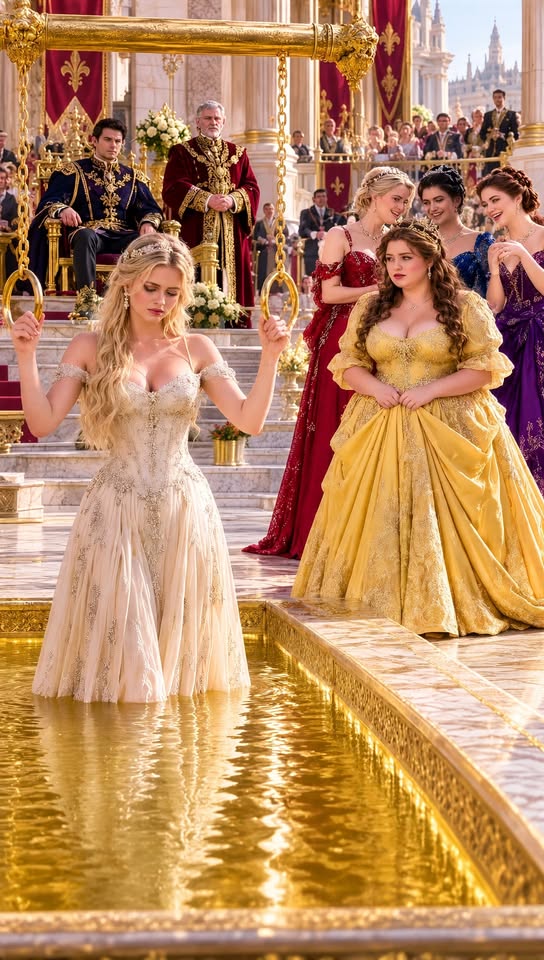
Adrian remained beside the desk, staring at Margaret Bell’s final words.
Ask Adrian what he chose.
Isabella waited.
Whatever answer he carried, she wanted him to give it without being rescued by excuses.
Finally he opened another drawer.
Inside was a thin folder.
“I received your grandmother’s letter during my final year at university.”
“You said you never met her.”
“I didn’t.”
“Then what did you choose?”
Adrian took out a document.
It was a proposal dated three years earlier.
Across the top were the words Renewal of the Golden Pool Tradition.
Isabella read the first page.
The royal council had been concerned that younger generations were losing interest in the monarchy.
Someone had proposed reviving the ancient bride ceremony as a major public event.
Television coverage.
International guests.
Charitable galas.
A carefully managed romantic spectacle.
Isabella looked at Adrian.
“You approved this?”
“No.”
She turned the page.
Across the final section, Adrian had written a refusal.
Tradition does not become meaningful merely because it is old.
I will not participate in a ceremony requiring women to demonstrate their worthiness to marry me through an unexplained ritual.
If the event is ever restored, participation must be voluntary, ceremonial, and without any expectation of marriage.
Isabella read it twice.
“But the ceremony happened today.”
“Yes.”
“What changed?”
“My grandfather’s centennial foundation tied several cultural grants to the restoration of historic royal traditions.”
Adrian looked embarrassed.
“The council argued that refusing would jeopardize programs supporting museums, libraries, and preservation projects.”
“So you compromised.”
“Yes.”
“And women still came believing the pool might choose your future queen.”
“Yes.”
“You knew that.”
“Yes.”
There was no defense in his answer.
Only acknowledgment.
Isabella placed the proposal on the desk.
“Then Grandma knew you had objected.”
“I think she did.”
“But she also knew you might eventually give in.”
Adrian looked toward the window.
“Apparently.”
Isabella understood the meaning of Margaret’s message now.
The green water had revealed her ancestry.
But Adrian’s choices revealed his character.
And character, unlike ancestry, could change.
“You tried to stop the ceremony,” Isabella said.
“I did.”
“But today, when it happened anyway, you stood there.”
“Yes.”
“And when people laughed at me, you said nothing.”
“Yes.”
His willingness to admit it made it difficult to remain angry in the uncomplicated way she wanted.
She sat beside the window.
“Why?”
Adrian thought for a long moment.
“Because I have spent most of my life learning how to avoid making a situation worse.”
“That sounds sensible.”
“Sometimes it is.”
He gave a small, unhappy smile.
“Sometimes it becomes an excuse for doing nothing.”
He sat across from her.
“When those women mocked you, I thought if I intervened, every newspaper would report that the prince had publicly defended one candidate.”
“So?”
“So I imagined headlines.”
“Speculation.”
“Questions about whether I favored you.”
“And I decided avoiding those things mattered more than what was happening in front of me.”
Isabella looked at him.
“At least you understand it.”
“I understand it now.”
“That’s different from having understood it then.”
“I know.”
The answer was quiet.
No demand for forgiveness followed.
No grand declaration.
That helped.
The next morning, the constitutional council assembled in a chamber overlooking the eastern gardens.
There were historians, judges, elected representatives, senior ministers, and members of the royal household.
Isabella entered without a crown.
Without jewels.
And, despite several offers from palace designers, wearing another simple dress she had brought from home.
Adrian noticed.
“Blue today,” he said.
She glanced down.
“I thought I should keep everyone guessing.”
He smiled.
The meeting lasted six hours.
At first, everyone spoke too formally.
Then Isabella asked a simple question.
“If the original Charter says the crown is borrowed, who exactly is it borrowed from?”
An elected representative answered.
“The nation.”
“Then shouldn’t the nation eventually decide how this arrangement works?”
The room became quiet.
The conversation changed after that.
Historians explained that the Charter could serve as the foundation for modern constitutional reform.
Legal scholars cautioned against treating a three-hundred-year-old document as automatically binding.
Adrian agreed.
“We shouldn’t replace one unquestioned tradition with another.”
Isabella looked at him approvingly.
By afternoon, several principles had emerged.
The royal family would publicly acknowledge the true history of House Evermere.
The golden pool ceremony would no longer be connected to marriage.
Future royal succession would require constitutional review rather than approval from a hereditary Keeper.
The monarchy’s ceremonial and public roles would be clarified by law.
Most importantly, Isabella’s unique authority under the old Charter would end once the reforms were completed.
She had suggested that condition herself.
“I don’t want my children someday receiving mysterious letters because one of my ancestors happened to sign something three hundred years ago.”
One historian smiled.
“Your ancestor appears to have anticipated that concern.”
He showed her a passage near the end of the Charter.
The Keeper may return this trust to the kingdom whenever institutions exist capable of carrying it collectively.
Isabella stared at the sentence.
“So the role was always supposed to be temporary.”
“Yes.”
Adrian leaned back.
“Apparently our ancestors had more faith in the future than we gave them credit for.”
Late that afternoon, one question remained.
Adrian’s coronation.
The council could proceed as planned if Isabella signed the declaration.
Everyone turned toward her.
She hated that.
Not because she doubted Adrian entirely.
Because no single person should have been placed in such a position.
She looked at him.
“What do you think I should do?”
Adrian’s answer came immediately.
“Nothing.”
Several council members exchanged glances.
Adrian continued.
“Postpone the coronation.”
His father watched him.
“For how long?”
“Until the constitutional review is finished.”
“That could take months.”
“Then it takes months.”
A minister leaned forward.
“Your Highness, politically that may appear uncertain.”
“Then we explain why.”
Adrian looked toward Isabella.
“She should not have to decide whether I deserve a crown.”
“The country should decide what the crown means first.”
Something warm moved through Isabella.
Not romance.
Not yet.
But trust beginning where disappointment had been.
Frederick nodded slowly.
“Then the coronation is postponed.”
The announcement was made that evening.
The reaction was intense but far less chaotic than many officials feared.
Some citizens questioned the monarchy.
Others admired the transparency.
Historians appeared on television holding copies of ancient maps.
Children began drawing emerald pools at school.
Within two days, Isabella’s yellow dress had somehow become the most discussed piece of clothing in the country.
She found that particularly absurd.
Camille, the woman who had apologized in the courtyard, sent her a message.
For what it’s worth, every designer in the capital is now selling yellow dresses.
Isabella laughed for nearly a minute.
Adrian found her reading the message in the palace garden.
“What happened?”
“I have accidentally influenced fashion.”
“A terrifying responsibility.”
“I may never recover.”
He sat beside her on a stone bench.
For a while, they watched gardeners trimming roses.
No cameras were present.
No advisors.
No glowing pool.
Only two people sitting beneath an old chestnut tree.
“I’ve been thinking about your grandmother’s letter,” Adrian said.
“So have I.”
“She told me to invite you only if I would have wanted you here without knowing about your family.”
“Did you?”
“Yes.”
“Why?”
Adrian smiled.
“At the museum fundraiser, you told the ambassador from France that he had misidentified a painting.”
“He had.”
“Everyone else knew he had.”
“Then someone should have told him.”
“You did.”
“He thanked me.”
“Eventually.”
Isabella laughed.
Adrian continued.
“Then you spent twenty minutes talking to the museum janitor about his daughter’s art school application.”
“I remember.”
“You spoke to him exactly the same way you spoke to the ambassador.”
She looked at Adrian.
“So?”
“So I noticed.”
Something shifted between them.
Isabella looked down at her hands.
“If we had never discovered any of this, would you still have asked me to come here?”
“Yes.”
“To the ceremony?”
Adrian winced.
“That part now seems considerably less intelligent.”
She smiled.
“At least you’re learning.”
“I’m trying.”
Weeks passed.
Isabella stayed.
Not because anyone required it.
Because she wanted to see the constitutional work completed.
She called her parents every night.
She attended meetings with historians.
She spent mornings reading documents with Matthias.
And occasionally she wandered through the palace with Adrian, who began showing her places that did not appear on official tours.
The kitchen where he had stolen biscuits as a child.
The roof terrace where his mother taught him constellations.
The tiny library where he hid whenever royal dinners became unbearable.
One rainy evening, Isabella found him there reading.
“You’re avoiding a dinner.”
“Yes.”
“You’re the host.”
“I delegated.”
“That sounds suspiciously like growth.”
“I’m hoping to receive a certificate.”
She sat beside him.
Outside, rain traced silver lines down the windows.
Adrian closed his book.
“When all this is finished, will you go home?”
The question held more emotion than he intended.
“Yes.”
His disappointment showed.
Isabella continued.
“For a while.”
He looked at her.
“My life is there.”
“I know.”
“My parents are there.”
“I know.”
“My work is there.”
Before coming to the palace, Isabella had worked as an architectural conservator, restoring historic buildings that powerful people often forgot until the roofs began leaking.
She loved the work.
Adrian understood that asking her to abandon it would mean repeating the very mistake the Charter warned against.
“So go home,” he said.
Isabella studied him.
“That sounded difficult.”
“It was.”
She smiled.
“What if I come back?”
Adrian’s expression softened.
“I would like that.”
Their hands rested near each other on the window seat.
Neither moved closer.
The restraint somehow made the moment more intimate.
Three months later, the constitutional agreement was ready.
The Keeper’s authority would be dissolved.
The crown would remain, but its responsibilities and limits would be publicly defined.
The golden pool would be preserved as a historical site.
No woman would ever again enter it to prove she was worthy of becoming someone’s wife.
On the morning the Charter was formally transferred to the national archive, Isabella stood beside the pool.
Its water had returned to gold.
Adrian joined her.
“Any regrets?”
“About giving up mysterious hereditary constitutional powers?”
“Yes.”
“Strangely, no.”
He smiled.
Matthias approached carrying one final document.
“We found something.”
Isabella turned.
“What?”
“During restoration work in the hidden chamber.”
He handed her a narrow strip of parchment discovered inside the binding of the original Charter.
“It appears to be the final page.”
Isabella read aloud.
“When the Keeper freely returns the trust to the people, House Evermere shall be released from its obligation.”
She smiled.
“That seems straightforward.”
“There is another sentence,” Matthias said.
She continued.
“Should an heir of House Vale and a descendant of House Evermere one day choose one another freely, let no crown claim credit for what belongs to the heart.”
Adrian laughed softly.
“Your ancestors were unusually specific.”
Isabella turned toward him.
“Don’t become too pleased with yourself.”
“I wouldn’t dare.”
Matthias cleared his throat.
“There is one more thing.”
He unfolded the bottom of the parchment.
A final paragraph appeared.
Isabella read it.
Her smile vanished.
Adrian noticed immediately.
“What does it say?”
She looked at him.
According to the Charter, once the Keeper surrendered her authority, the golden pool would perform one final function.
It would reveal whether the covenant had truly been fulfilled.
And if it remained gold, the transfer had failed.
Everyone turned toward the pool.
For several seconds, nothing happened.
The water remained perfectly golden.
**–END OF PART 5–CLICK “”NEXT”” AT THE BOTTOM OF THE PAGE TO CONTINUE READING**
✓ Lynn R. Adams
Adrian remained beside the desk, staring at Margaret Bell’s final words. Ask Adrian what he chose. Isabella waited. Whatever answer he carried, she wanted him to give it without being rescued by ex…