Part 5 – Twenty Glasses and Thirty Steps-069
### Part 5 – What a Crown Is Meant to Carry
**Part 5**
They returned to the palace quietly.
No dramatic confrontation awaited them.
Emma was grateful.
Truth, she had learned over the past several days, often became harder to understand when everyone immediately began accusing one another.
Alexander called for an independent review.
Not a royal family meeting.
Not a private conversation between influential men.
An actual review.
Outside accountants.
Legal advisers.
Representatives from several communities served by the Rose Fund.
Evelyn was invited.
So was Emma.
Victoria insisted on attending despite knowing the inquiry might embarrass her family.
Lord Sebastian Vale arrived on the second morning.
He was fifty-seven.
Polished.
Courteous.
Clearly uncomfortable.
He did not deny using Grace’s proposal.
“I found it among my father’s papers.”
Emma sat across the conference table.
“Why didn’t you credit her?”
Sebastian looked ashamed.
“At first, I intended to.”
“What changed?”
“I presented the idea informally at a meeting. Everyone assumed it was mine.”
“And you corrected them?”
“No.”
Victoria closed her eyes.
Her uncle continued.
“Then the press office wrote a statement.”
“And you corrected them?”
“No.”
Alexander spoke calmly.
“Why?”
Sebastian looked at him.
“Because it was flattering.”
There was no sinister explanation.
That almost made it sadder.
“I had spent thirty years serving committees,” Sebastian continued. “Suddenly everyone called me innovative.”
He looked at Emma.
“I liked it.”
Emma appreciated that he did not invent excuses.
“But you knew.”
“Yes.”
“That my grandmother created the plan.”
“Yes.”
“Did you know Eleanor wanted the fund changed?”
“No.”
That part appeared genuine.
The archive had been incomplete.
The unsent letter had been stored separately among Queen Eleanor’s correspondence.
Sebastian had stolen credit.
He had not deliberately suppressed Eleanor’s final wishes.
The distinction mattered.
Alexander asked him to resign temporarily while the board reviewed the matter.
Sebastian agreed.
Victoria walked him from the room.
When she returned, she seemed older somehow.
Not unhappier.
More grounded.
“He apologized to me,” she said.
Emma frowned.
“For what?”
“For teaching me that appearances matter more than admitting mistakes.”
Alexander looked toward the closed door.
“And?”
“I told him he can teach me something different now.”
Emma smiled.
The Rose Fund reform became public two weeks later.
The palace credited Grace Harcourt by name.
Evelyn Rowan as co-founder.
Queen Eleanor’s original role was rewritten more honestly.
Rather than presenting the queen as a flawless visionary, the revised history described a foundation shaped through argument, error, compromise, and eventual understanding.
Emma expected public criticism.
Instead people responded warmly.
The truth was less polished.
But more human.
The fund itself changed too.
Local boards received greater authority.
Grant decisions became transparent.
Application procedures were simplified.
Communities receiving support gained seats on oversight committees.
The royal family retained patronage.
Not control.
At the announcement, Evelyn sat in the front row wearing her violet scarf.
Emma sat beside her.
Victoria stood onstage as one of the new junior board members.
She had asked not to speak.
Alexander made her.
“You owe me,” he said.
“For what?”
“The staircase.”
“That was your staircase!”
“You were rude during it.”
“I have apologized.”
“Not publicly.”
Victoria stared.
He smiled.
“I’m joking.”
“You are becoming unbearable.”
But Victoria spoke anyway.
She did not discuss her family’s reputation.
She did not present herself as brave.
She simply said:
“Sometimes we inherit institutions. Sometimes we inherit mistakes. Maturity requires learning the difference between defending our history and learning from it.”
Emma watched with pride.
Afterward Victoria found her.
“How was that?”
“Good.”
“Only good?”
“Very good.”
Victoria smiled.
“Acceptable.”
Their friendship was still strange.
Perhaps it always would be.
But it was real.
Alexander and Emma continued seeing each other.
Slowly.
Deliberately.
No competition.
Emma returned to Harbour & Hart most weeks.
Alexander visited when duties allowed.
He learned to help in the bookshop.
Badly.
On his first afternoon behind the counter, he placed three novels in the history section.
Emma discovered them twenty minutes later.
“How?”
“They looked old.”
“That is not a classification system.”
“It could be.”
“No.”
He smiled.
Customers gradually became accustomed to him.
One little girl asked whether he lived in a castle.
“Yes.”
“Do you have dragons?”
“No.”
She looked disappointed.
Alexander added:
“We have accountants.”
“Are they scary?”
Emma coughed to hide her laughter.
Alexander answered solemnly.
“Sometimes.”
He became good at ordinary things.
Making tea.
Carrying boxes.
Closing the shutters in the evening.
Listening to Evelyn argue about modern poetry.
Emma, in return, learned pieces of his world.
Formal dinners.
Diplomatic etiquette.
Opening hospitals.
Reading briefing papers during breakfast.
Remembering which duke had divorced which countess and why seating them together would apparently create an international emergency.
She found palace life less glamorous than outsiders imagined.
Mostly, it required patience.
One evening, six months after the glass challenge, Emma and Alexander walked along Bellhaven harbor.
Rain threatened.
Fishing boats rocked gently.
Alexander seemed unusually quiet.
“What?” Emma asked.
“Nothing.”
“That means something.”
“I received a letter.”
“From whom?”
“My father.”
Emma looked surprised.
“You live in the same palace.”
“Yes.”
“Why did he write?”
“Because apparently my family prefers unnecessary paper.”
He removed the letter.
King Edmund had announced his intention to reduce his public duties the following year.
Alexander would assume significantly greater responsibility.
Not the crown.
Not yet.
But enough that his life would change.
Emma read.
“You’re worried.”
“Yes.”
“About the work?”
“About us.”
There it was.
Emma looked toward the sea.
Alexander continued.
“I can ask you to tolerate photographers.”
She looked at him.
“No.”
“No?”
“You cannot ask me to tolerate photographers.”
“Fair.”
“You can ask whether I’m willing to live with the reality that they exist.”
“Are you?”
“Sometimes.”
He smiled faintly.
“That is not reassuring.”
“It is honest.”
He nodded.
Emma continued.
“I can’t promise I’ll enjoy palace life.”
“I don’t either.”
“I want to keep the bookshop.”
“Good.”
“I want a home that feels like ours, not a museum.”
“Yes.”
“And I’m never carrying twenty glasses again.”
Alexander laughed.
“Agreed.”
Then he became serious.
“Emma.”
She knew.
Not because he knelt.
He did not.
Not because music began.
There was none.
She knew because his voice changed.
“I love you.”
The words were simple.
They carried more weight than any crown.
Emma looked at him.
“I love you too.”
Relief softened his entire face.
Then he reached inside his coat.
Emma raised one hand.
“If that is a ring, think carefully.”
He stopped.
“It is a ring.”
“Alexander.”
“I have thought carefully.”
“For how long?”
“Six months.”
“Only six?”
“Seven if we count the staircase.”
“We do not.”
He smiled.
The ring was beautiful.
Not enormous.
A warm gold band with a single old-cut diamond.
“It belonged to my grandmother.”
“Eleanor?”
“Yes.”
Emma stared.
Alexander continued.
“She left instructions.”
“Of course she did.”
“She was extremely fond of instructions.”
“What did this one say?”
“That the ring should go to someone who understands the twentieth glass.”
Emma laughed softly.
“That woman planned too far ahead.”
“Apparently.”
Alexander took her hand.
“I am not asking because you passed a challenge.”
“Good.”
“I am not asking because my family approves.”
“Also good.”
“I am not asking because you fit some idea of a future princess.”
“Excellent.”
He looked at her.
“I am asking because when I am with you, I become less interested in appearing certain and more willing to become better.”
Emma’s eyes filled.
“I don’t need you to carry my world.”
His thumb brushed her fingers.
“I want us to carry what matters together.”
Emma looked toward the harbor.
At Harbour & Hart.
At the home she loved.
Then at Alexander.
A man who had begun their acquaintance with perhaps the worst marriage proposal in royal history.
She smiled.
“Yes.”
For once, he had no clever reply.
“Really?”
“Yes.”
“You sounded less surprised when you finished the staircase.”
“I was exhausted.”
He laughed.
Then kissed her.
The rain finally began.
Neither moved.
When they told Evelyn the following morning, she stared at the ring.
Then at Alexander.
“Did she make you carry anything first?”
“No.”
“Shame.”
Emma laughed.
Victoria screamed when she heard.
Then immediately denied screaming.
Preparations began.
Emma insisted the wedding remain modest by royal standards.
“Three hundred guests,” Alexander proposed.
“One hundred.”
“Two hundred and fifty.”
“One hundred and twenty.”
“Two hundred.”
“One hundred and fifty.”
“Done.”
Emma frowned.
“You agreed too quickly.”
“I started at three hundred intentionally.”
She stared.
“You manipulated me.”
“I negotiated.”
“I may reconsider the marriage.”
“You already accepted.”
Victoria, sitting nearby, said:
“She has a point.”
Alexander looked betrayed.
“You are supposed to be my friend.”
“I am Emma’s friend.”
“When did this happen?”
Victoria smiled.
“Somewhere around the twentieth glass.”
Two weeks before the wedding, Evelyn asked Emma to visit the palace ballroom alone.
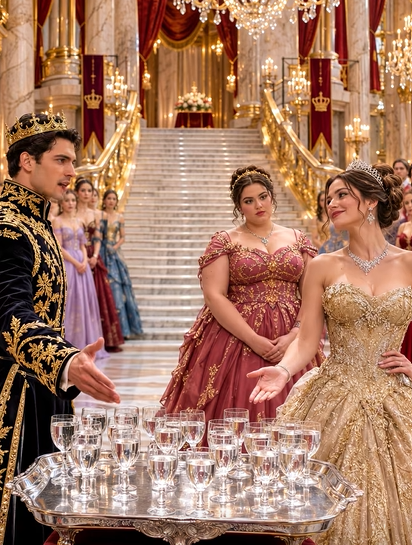
The twenty glasses had been placed in a new exhibition.
The silver tray rested beneath them.
A small plaque told the story of Grace, Evelyn, and Eleanor.
Emma stood before it.
Evelyn joined her.
“You know,” the elderly woman said, “your grandmother would have hated this.”
Emma laughed.
“The exhibition?”
“The attention.”
“What would she have wanted?”
“For people to use the fund properly and stop discussing her.”
“That sounds sensible.”
Evelyn touched the edge of the tray.
“She worried that institutions made ordinary problems complicated.”
Emma smiled.
“I think about her often now.”
“So do I.”
They stood quietly.
Then Evelyn reached beneath the display case.
She removed a small folded paper.
Emma stared.
“What is that?”
“Something Eleanor gave me when we reconciled.”
“Another message?”
“Your royal family likes messages.”
“It isn’t my royal family yet.”
“Two weeks.”
Emma accepted the paper.
Eleanor had written only four lines.
_The twentieth glass was heavier._
_But we made the mistake of believing one person must carry all twenty._
_If the challenge is ever used again, the final lesson must be this:_
_No worthy crown should ask one pair of hands to carry everything._
Emma read the words twice.
Then she looked toward Evelyn.
The elderly woman smiled.
“Remember that.”
“I will.”
But as Emma folded the paper, something slipped from between its pages.
A small brass key.
Emma frowned.
“What does this open?”
Evelyn’s smile vanished.
“I don’t know.”
On the key was engraved a number.
**30.**
Alexander arrived ten minutes later.
He recognized it immediately.
“That is not a room number.”
“What is it?”
He looked toward the grand staircase.
Thirty marble steps rose above them.
Alexander walked to the final one.
Step Thirty.
At its side, almost hidden beneath decorative molding, was a tiny brass keyhole.
Emma stared.
“You cannot be serious.”
Alexander inserted the key.
A narrow panel opened.
Inside lay one final envelope.
This time, the handwriting belonged not to Eleanor.
But to Emma’s grandmother.
Grace Harcourt.
Emma’s hands trembled as she opened it.
The first sentence read:
_If my granddaughter ever stands here, tell her I hope she did not come because a prince promised her a crown._
Alexander slowly looked at Emma.
She continued reading.
_Tell her she should accept only if she has found something better._
Emma swallowed.
Below that was one final question.
_Did he learn to carry the tray with her?_
Emma looked at Alexander.
And for the first time, neither of them knew whether the strange royal challenge had truly ended at all.
**–END OF PART 5–CLICK “NEXT” AT THE BOTTOM OF THE PAGE TO CONTINUE READING**
✓ Lynn R. Adams
### Part 5 – What a Crown Is Meant to Carry **Part 5** They returned to the palace quietly. No dramatic confrontation awaited them. Emma was grateful. Truth, she had learned over the past several…