PART 5: The Word That Changed Everything 027
Part 5 – The Door We Had to Close
The voice on the recording seemed to remain in the room long after the file ended.
“You shouldn’t have kept the copies.”
No one moved.
Rosalind’s hand rested against Matthew’s, and the monitor kept its measured rhythm as if nothing had changed.
The investigator returned to the tablet and replayed the last seconds, lowering the volume and listening through headphones.
Victor stood beside the bed, his face pale beneath the steady overhead light.
“Do you recognize the voice?” Rosalind asked him.
He did not answer immediately.
“I can’t tell from that fragment.”
“You said you didn’t know Matthew had the files.”
“I didn’t.”
“Then who knew?”
“I don’t know.”
The investigator removed the headphones.
“The voice is too distorted for identification. We’ll send the file for further analysis and compare it with the other recordings.”
Rosalind kept her gaze on Victor.
“Did you say those words to him?”
“No.”
“Did anyone else from security know about the audit?”
“Several people knew he was reviewing the accounts. Not what he found.”
The investigator closed the audio file.
“We’ll need statements from everyone with access to the records and the estate. For now, it’s best not to draw conclusions from a few seconds of damaged audio.”
Victor gave a small nod.
Rosalind looked at her son.
“Matthew was trying to warn me,” she said, almost to herself.
The investigator’s voice softened.
“It appears he was trying to reach you. We still need to establish what happened after that.”
She nodded, but her eyes had gone distant.
I understood the pull of the past in her expression, the way one unanswered call could become the only moment she saw when she closed her eyes.
Dr. Sen stepped closer.
“Mrs. Sterling, I know this is difficult, but Matthew needs rest. We should leave the room quiet for now.”
Rosalind drew her hand back from her son’s.
“Of course.”
She stood with care, as if her legs had become uncertain beneath her.
I walked beside her into the corridor.
Victor remained behind with the investigator, and Gwen stayed near Matthew’s bed.
The moment the door closed, Rosalind stopped.
“I spent weeks believing I had missed one chance to speak with him,” she said.
“You still have a chance to speak with him now.”
“I know.”
Her voice trembled.
“But I don’t know if he can hear me.”
“I don’t know either.”
She took a slow breath, then looked at me.
“Thank you for not pretending you know.”
I had no answer that would make the burden lighter.
So I stayed beside her until Gwen came out to tell us that Dr. Sen wanted the hallway clear.
The next few days brought no clear confirmation of what Matthew had said.
The audio file was being examined by the investigators, but the damaged voice remained impossible to identify.
Victor continued to cooperate with their questions.
He stayed away from Matthew’s room unless asked to provide information, and Rosalind stopped calling him to discuss family matters.
They were civil when they met.
The ease between them was gone.
It was a small change, but one that could be felt throughout the estate.
Matthew’s condition remained stable.
His hand moved once during an examination, and his lips parted when Rosalind spoke to him, but neither response repeated in a way Dr. Sen could confidently call purposeful.
The doctors continued their assessments, measured and careful.
Poppy’s visits became less frequent.
She asked to see Matthew twice that week, and each time she stayed only a few minutes.
Once she sang softly.
The other time, she sat beside me and told him that the rain had stopped and that Bunny’s paper bed had fallen apart.
She never asked whether he had heard.
Afterward, she would ask whether we could go back downstairs.
I always said yes.
The people in the house began to treat her less like a visitor and more like a small person whose wishes mattered.
Rosalind asked before offering her a snack.
Gwen let her carry the sailboat’s drawing to the room.
Even the guards in the hall learned to greet her with a quiet nod rather than a question.
That should have made the estate feel safe.
Instead, it made the possibility of leaving harder to bear.
One morning, Dr. Sen asked Rosalind and me to meet him in the consultation room.
He had a folder open on the table.
“The specialist team has reviewed Matthew’s recent assessments,” he said. “They recommend moving him to a neurological rehabilitation facility.”
Rosalind clasped her hands together.
“When?”
“The transfer could be arranged within the next several days.”
“And the visits?”
“The facility has strict visiting hours. They’ll limit the number of people in the room at first and keep visits short while they establish a routine.”
I felt a tightness beneath my ribs.
“Would Poppy be allowed to visit?”
“Not immediately,” Dr. Sen said. “They’ll decide based on his condition and their assessment of what he can tolerate.”
Rosalind looked down at the folder.
“Could he be moved without risking his progress?”
“The transport team has experience with patients in his condition. The facility has a specialist staff and equipment suited to intensive rehabilitation.”
“If he’s responding to us, even slightly, could leaving the house set him back?”
“We don’t have evidence that staying here would improve his recovery,” Dr. Sen replied. “Nor do we have evidence that the visits are responsible for his responses.”
Rosalind’s fingers tightened.
“I understand the distinction.”
“I know this is not easy,” he said. “But this recommendation is about giving Matthew the level of ongoing care that may best support him.”
His explanation was calm, but the words made everything feel suddenly immediate.
A transfer.
A different room.
A door we could not open whenever we wanted.
Rosalind asked questions about the facility, the staff, and the medical plan.
She listened carefully to every answer.
When the meeting ended, she walked with me to the quiet sitting room off the main hall.
“Poppy has begun to feel at home here,” she said.
“She’s comfortable with some parts of it.”
“And she cares about Matthew.”
“She cares that he’s lonely.”
Rosalind stopped near the windows.
“I don’t want to turn her kindness into an obligation.”
“Then don’t.”
“I wouldn’t.”
“You asked her to visit because she wanted to, and you kept your promise that she could leave whenever she wanted.”
“I did.”
“But now things have changed.”
Rosalind folded her arms.
“The specialist facility will limit visits. I was thinking I could ask you and Poppy to stay here while Matthew begins rehabilitation.”
I could hear what she had not yet said.
“You want her nearby in case he responds again.”
“I would like her to be nearby. I wouldn’t ask her to sing or make her responsible for his progress.”
“Would she be able to see him?”
“Possibly, if the doctors agree.”
“And if they don’t?”
Rosalind looked away.
“I would have to accept that.”
I watched her struggle to keep hope from becoming a plan for someone else.
“Mrs. Sterling, Poppy can’t be the reason we stay here.”
“I know.”
“Can you promise she won’t be?”
Rosalind’s eyes met mine.
“Yes.”
It was a clear answer, but I could see how much it cost her to say it.
That afternoon, she asked me to meet her in her office.
The door remained open this time.
On her desk sat a folder with a contract, a bank document, and a set of keys.
“I want to offer you a permanent position,” she said. “A salary high enough to give you stable housing and childcare, with no requirement that you work in the medical wing.”
I glanced at the papers.
“What does that mean?”
“There’s a cottage on the property. It’s separate from the main house. You and Poppy could live there while you work.”
“And while Matthew is at the facility?”
“If you choose to.”
She had not placed the contract in front of me as a command.
She had laid it there like an answer to a problem she wished she could solve.
“I don’t want you to feel pressured,” she said. “The offer stands whether or not Poppy visits Matthew.”
“Would it still stand if we left?”
“Yes.”
“Would you expect us to come back?”
“No.”
“Would you expect Poppy to sing?”
“Never.”
I looked at the keys.
They were small and ordinary.
They could mean a safe roof, a steady wage, and a room Poppy could call her own.
For a moment, I let myself imagine it.
A quiet cottage with a little garden.
No more counting the money before the grocery shop.
No more waking in the night to wonder whether the landlord would give us another month.
Poppy could have a bed of her own and a place to leave Bunny without worrying that we might have to pack everything by morning.
Then I imagined the other part.
Every time Matthew had a difficult day, I would wonder whether Poppy should visit.
Every time he made a small movement, someone might look to her.
Even if Rosalind never asked, the hope in the house could ask for her.
I would see it in the way people watched Poppy sing.
I would hear it in the careful silence afterward.
And one day, without anyone meaning harm, my daughter might begin to believe that a grown man’s recovery depended on her being good, gentle, and brave.
“I can’t accept a home for Poppy because she might help Matthew,” I said.
Rosalind’s face tightened with regret.
“I understand.”
“I know you wouldn’t say that to her. But the offer is tied to us staying close.”
“It doesn’t have to be.”
“Not in the contract. But it would be in all of our minds.”
She slowly sat down.
“I thought I could separate the two things.”
“So did I.”
The honesty between us left no room to hide behind good intentions.
Rosalind closed the folder.
“I’m sorry.”
“I know you wanted to give us something good.”
“I still do.”
“Then help me find a home with no connection to Matthew’s care.”
She looked at me for a long moment.
“All right.”
“I’m not asking you to pay for it.”
“I know.”
“I want something I can afford, and I want to keep working.”
“Then I’ll ask the staff coordinator to help you look for a suitable position closer to the city. No conditions, no link to Matthew’s recovery.”
“I’d appreciate help finding the work. I don’t want a gift that makes me answerable to you.”
“That’s fair.”
She pushed the keys away from herself.
“Thank you for being honest with me.”
“I’m trying to be honest with both of us.”
That evening, after Poppy fell asleep, I sat at the small table in our room and began sorting our belongings.
There was very little to sort.
A few clothes.
Poppy’s coloring pencils.
The gray rabbit.
A stack of drawings.
I folded her sweater and placed it in the canvas bag we had brought when we came to the estate.
The bag looked smaller than I remembered.
I wondered whether I was being foolish.
Maybe we could stay in the cottage and let the doctors decide when Poppy visited.
Maybe I could keep the job and still make sure she never felt responsible.
Maybe leaving now would feel like abandoning Rosalind just as she had begun to face what she had been avoiding.
But every time I considered staying, I pictured Poppy in the medical room, offering her comfort because she wanted to—not because anyone needed something from her.
I had promised her that her kindness would remain her own.
I could not keep that promise if I let the whole household wait for her to perform it.
The next morning, I told Poppy that Matthew would soon move to a place where doctors could help him more.
“Will he still have his boat?” she asked.
“Yes.”
“Will his mama go with him?”
“I think she’ll visit.”
“Can we go?”
“The doctors haven’t said yet.”
Poppy looked down at Bunny’s repaired ear.
“If we can’t, he’ll still have his boat.”
“Yes.”
“And his mama.”
“Yes.”
She thought about it.
“Then he won’t be alone.”
I swallowed.
“No, sweetheart. He won’t be alone.”
At breakfast, Rosalind said Dr. Sen had confirmed the transfer plan.
The move would take place in two days, after the specialist team received Matthew’s full medical file.
She did not mention the cottage or the keys.
She did not ask whether we would stay.
I was grateful.
The rest of that day passed in a quiet, careful rhythm.
I helped Gwen prepare a list of Matthew’s personal items for the transfer.
The sailboat would go with him, along with the drawings Poppy had made and a framed photograph Rosalind selected from the family room.
In the photograph, Matthew stood beside a younger Rosalind on a beach.
He was perhaps ten, with windblown hair and a grin so open that I almost failed to recognize the man in the bed.
Rosalind placed the frame in a padded case.
“I thought he might like to see it when he wakes,” she said.
“I think he would.”
She nodded, then pressed her palm briefly against the glass.
That evening, she came to our room.
“I’d like to say goodbye to Poppy,” she said. “If she is ready.”
Poppy looked up from the picture she was coloring.
“Can I say goodbye to Matthew, too?”
“Yes,” Rosalind said. “If you want to.”
“Can Mama come?”
“Always.”
We went upstairs together.
Gwen was already in the room, checking the final transfer notes.
The sailboat stood in its padded travel box, and Poppy’s picture rested safely beside it.
Matthew looked as he had for days, still and pale against the pillow.
Poppy climbed onto the chair beside him.
She held Bunny close, then looked at me.
I gave her a small nod.
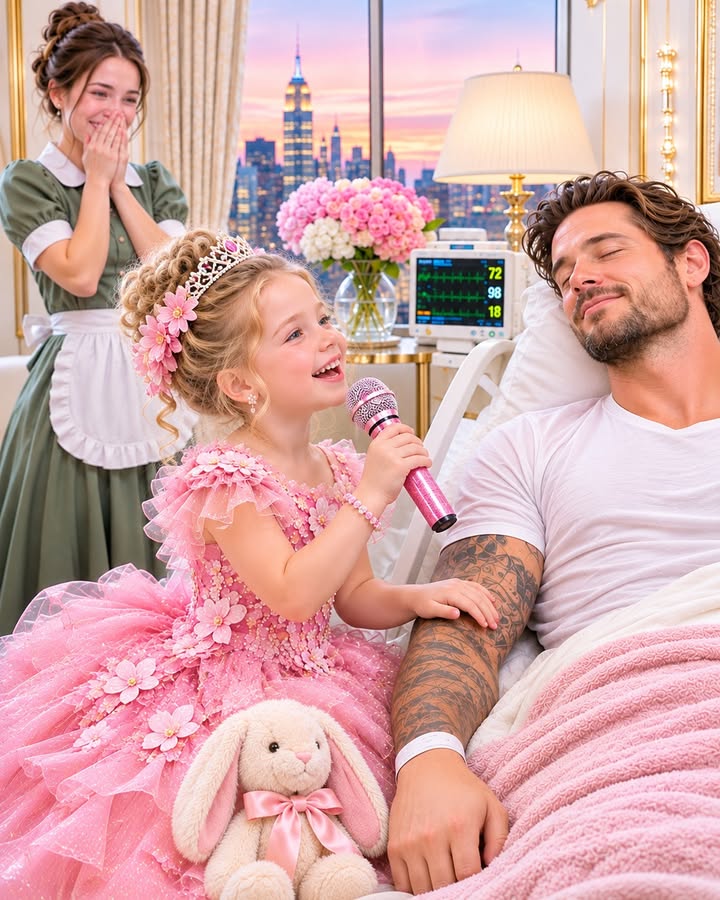
She began to sing.
Her voice was soft and unhurried, the familiar song offered without expectation.
Rosalind stood by the bed, her hands clasped together.
When Poppy finished, she rested her fingers lightly on Matthew’s.
“Goodbye for now,” she whispered. “Your boat is coming with you.”
She started to pull her hand away.
Matthew’s fingers closed around hers.
The movement was small.
The pressure, unmistakable.
Poppy stopped breathing.
So did I.
Rosalind made a sound that was almost a sob, but held it back as Gwen leaned toward the bed to check the monitor.
“Matthew?” Rosalind whispered.
His hand remained around Poppy’s for one long, fragile second.
Then his fingers relaxed.
“Was that purposeful?” I asked.
Gwen’s eyes were fixed on the monitor.
“I can’t say yet.”
Dr. Sen, called from the hall, arrived a moment later and began his assessment.
Matthew did not squeeze again.
His eyelids did not open.
The doctor took notes and repeated the same careful instructions he had given us before: one movement could not establish awareness, and the medical team would need to evaluate him over time.
Poppy climbed down from the chair.
“Did he say goodbye?” she asked.
“I don’t know,” I said, holding her close.
She looked at Rosalind.
“Maybe he heard.”
“Maybe,” Rosalind whispered.
The following morning, the specialist facility confirmed that they were ready to receive him.
The transport team would arrive early the next day.
I packed the last of our things.
Rosalind did not ask me to stay.
She asked only whether she could walk with us to Matthew’s room before we left.
“I want to say goodbye properly,” she said.
“We’ll be there.”
That night, I lay awake beside Poppy, listening to her quiet breathing.
I thought about the cottage, the keys, and the life we might have had within the estate’s walls.
I thought about Matthew’s hand closing around Poppy’s fingers.
The memory tightened around my heart.
In the morning, I would take my daughter home and trust the doctors.
I would leave the door to the Sterling estate behind us, even though I could not know whether Matthew would ever open his eyes.
A soft knock came at our room.
Rosalind stood outside, holding the framed beach photograph.
“Dr. Sen just called,” she said, her voice unsteady. “He reviewed the recording from last night’s bedside monitor.”
I opened the door wider.
“Did he find something?”
“He found a response in Matthew’s breathing just before he squeezed Poppy’s hand.”
Her fingers tightened on the frame.
“The doctor says it may be a coincidence, but he wants to speak with us before the transfer.”
I looked down at Poppy, who had woken and was rubbing her eyes.
“Is Matthew waking up?” she asked.
Rosalind’s gaze moved to the child.
“I don’t know,” she said. “But Dr. Sen says there’s something else he needs us to hear.”
Behind her, the medical-wing door stood open, and from inside came the faint, uneven sound of Matthew trying to speak.
**–END OF PART 5–CLICK “NEXT” AT THE BOTTOM OF THE PAGE TO CONTINUE READING**
* * *
[PREVIOUS: PART 4](https://puretales.idolsgift.com/blog/part-4-the-word-that-changed-everything-027) | [NEXT: PART 6(THE END)](https://puretales.idolsgift.com/blog/part-6-the-end-the-word-that-changed-everything-027)
✓ Lynn R. Adams
Part 5 – The Door We Had to Close The voice on the recording seemed to remain in the room long after the file ended. “You shouldn’t have kept the copies.” No one moved. Rosalind’s hand rested agai…