PART 5: The Voice That Wouldn’t Hang Up5 025
Part 5 – The Cost of Silence
Lena Park said she had found my number in an old company directory.
She spoke carefully, as if she had rehearsed the opening and was now afraid of what came after it.
“I’m not calling to tell you what to think about Carter,” she said. “I’m calling because I sent the message your investigator found, and I should have done more.”
I looked toward Sarah, who had set the tea down without a sound.
“Are you the person who called me before the wedding?” I asked.
“I believe so,” Lena replied. “I left a message, but I can’t remember exactly what I said.”
The memory of an unknown call surfaced in my mind: a brief ring during a week crowded with wedding plans, a number I had not recognized, and no message I remembered hearing.
“I didn’t get a message.”
“I know. I saw the call record when the company archived the account.” Lena paused. “I’m sorry I waited so long to reach out.”
I did not know what to say.
She had been the stranger behind the first loose thread in a story I had thought I understood, yet her voice held no triumph at having been right.
She sounded tired.
“Why are you calling now?” I asked.
“The detective told me the records were part of an investigation. I thought you deserved to hear what I remember directly, not just read a fragment.”
I asked if she would speak with the detective again.
“Yes,” she said. “I already agreed to. But I wanted you to know that the message wasn’t a warning about your marriage. Not exactly.”
My fingers tightened around the phone.
“What was it a warning about?”
“Carter had asked the company to arrange a meeting with people connected to a defense housing initiative. I found your name while checking who might be relevant to the request. Then I recognized your father’s name.”
She stopped for a breath.
“I realized Carter had married into a connection he hadn’t disclosed to anyone at work, and that you believed he didn’t know who your father was.”
“Did you think he married me for access?”
“I didn’t know,” Lena said. “I still don’t know what he felt for you. I only knew he was asking about contacts and that he had concealed what he knew.”
Her answer offered no neat judgment, and I was grateful for that.
“What happened after you sent the message?”
“I told my manager I thought the company needed to be careful. The project was legitimate, but the request could look improper if Carter approached people through his wife or her father.”
“Did he?”
“Not through you, as far as I know. He made the request through the usual business channels.”
I looked down at my free hand, resting over the quiet curve of my stomach.
“So he never used me to get the meeting.”
“Not that I saw,” Lena replied. “But I can’t tell you what he intended.”
She said she had left the company a few months later and had not known how to contact me without making things worse.
She had kept a copy of the message because she worried the records might disappear, but she had not understood how to reach me safely or what I would want to know.
“I should have tried,” she said.
I thought of the years I had spent trying to keep my marriage beyond the reach of my family, my father’s questions, and anyone who might complicate the story I had chosen to believe.
“I don’t know what I would have done if you had,” I said.
“Neither do I.”
When the call ended, Sarah sat beside me.
“You don’t have to decide whether she should have called sooner,” she said.
“I know.”
“But you can decide what to do with what she told you.”
I looked at the old letter on the table, its creased pages resting beside my untouched tea.
For months, I had hoped there might be one explanation that made everything simple.
If Carter had loved me, perhaps he had made a terrible choice for reasons he could not admit.
If he had wanted my father’s connections, perhaps every kind moment had been a performance.
I was learning that people did not always fit into the cleanest version of their actions.
Yet complexity was not a debt I owed him.
It did not require me to excuse what he had done or trust him again.
Dad came into the room, having heard only the last part of my conversation.
“Was that Lena?”
“Yes,” I said. “She confirmed she sent the message.”
He waited.
“She says Carter’s company sought a meeting through business channels, but she has no evidence he used me to get it.”
Dad’s expression held both relief and concern.
“That distinction matters,” he said. “But it doesn’t erase what he knew.”
“No.”
“And it doesn’t change what happened at the estate.”
“No.”
He pulled out a chair, then asked, “Would you like to talk about the next step?”
I already knew the question he meant.
The prosecutor’s office had reviewed the case, and the trial date was approaching.
The evidence was substantial: the hospital’s records, photographs of my injuries, the security footage, the neighbor’s doorbell recording, and the statements I had given.
Carter and Eleanor had both been charged, though each continued to dispute parts of the account.
Carter maintained that Eleanor had acted without his direction.
Eleanor continued to say that he had ordered her to teach me a lesson.
Their lawyers had begun discussing a possible resolution.
I had not yet heard the details.
“I want to know what they’re offering,” I said.
Dad remained still.
“I can ask the prosecutor to explain it to you.”
“Not decide for me.”
“Of course not.”
The next afternoon, the prosecutor’s office arranged a meeting with me, Sarah, and Thomas Greene.
Dad offered to come, but I asked him to wait outside unless I wanted him in the room.
He agreed without protest.
That small act of restraint made it easier to breathe.
The meeting took place in a quiet office with pale walls and a window overlooking a parking lot.
The prosecutor, Ana Morales, sat across from us with a folder open on the table.
She explained that Carter’s family had proposed a private settlement tied to a plea arrangement.
The terms were presented as a way to spare me the strain of trial and provide financial security for me and the baby.
In exchange, I would sign a broad nondisclosure agreement and agree not to publicly discuss what had happened.
The family also wanted the incident described as a tragic accident during a household argument.
I listened without interrupting.
The money could pay for medical expenses, help me find a safe home, and support my son’s future.
The settlement would not require me to take the stand.
It would spare me the experience of having my marriage examined in a courtroom by strangers who knew only pieces of it.
It might also keep our private lives from becoming a subject of public attention.
Then Ms. Morales explained what the proposed wording meant for the criminal case.
The prosecutor’s office would still be able to use evidence already collected, she said, but my cooperation and testimony could be important if the case proceeded to trial.
The settlement terms were designed to discourage me from making any public statement, and the family wanted the incident characterized in a way that could contradict the evidence.
“Would I be allowed to tell the full truth in court?” I asked.
“You would not be giving up your right to testify unless you agreed to a specific provision that prevented it,” Ms. Morales said. “But this proposal is structured around your silence and a reduced account of the events.”
“Would they be able to say it was an accident?”
“They would likely present it that way publicly. The agreement also asks you not to contradict that account.”
I looked at the wording in the folder.
The money was not abstract.
It had a shape: rent, medical care, childcare, the kind of room where my son could grow without hearing people argue over the details of his birth.
I thought of the estate, of the nursery I had begun to prepare, and of the way I had imagined bringing my baby home from the hospital.
I thought of Carter telling me that no one would believe a penniless farm girl.
The offer did not erase those words.
It offered me a different kind of safety, but it asked me to help hide what had happened in return.
“How long do I have to decide?” I asked.
“Five days,” Ms. Morales replied. “You don’t need to decide today, and no one here can tell you what the right choice is.”
Thomas folded his hands on the table.
“The agreement has financial terms as well as legal ones,” he said. “You can review it with independent counsel. Your father can help arrange that, but you should have a lawyer whose role is to advise you—not to push you toward either outcome.”
I nodded.
It was the first time the choice had been placed before me in a form that looked orderly.
A document.
A deadline.
A sum of money.
The disorder lived inside me.
On the way out, Dad was waiting in the corridor.
He looked at my face, then at Sarah.
“Do you want me to ask what they offered?” he said.
“Not yet.”
“All right.”
He held the door as we stepped outside.
He did not demand to know what I was thinking, and he did not tell me what he believed I should do.
That evening, I sat in Sarah’s living room with the settlement papers beside me.
The house was quiet except for the soft tick of the clock and the faint sound of rain against the windows.
Sarah had brought me a glass of water and placed it within reach.
She had not read the agreement, though I had offered.
“I don’t want your opinion before I know my own,” I told her.
“Then I won’t give it.”
I turned a page, though the words had stopped making sense.
“What if I take it?” I asked.
“Then we’ll help you build the safest life we can.”
“What if I don’t?”
“Then we’ll help you through court.”
“You make it sound simple.”
“It isn’t,” she said. “But you don’t have to earn our support by making the hardest choice.”
I looked at her.
That was not the same as saying every choice would be easy.
It was better.
“I’m afraid of what happens if I testify,” I said.
“Of the trial?”
“Of seeing him. Of having people ask what I did, what I said, why I stayed, why I didn’t tell anyone.”
Sarah sat down on the couch beside me.
“Those questions may come,” she said. “And they may hurt. But none of them changes who chose to hurt you.”
“I know that in my head.”
“Your heart may need to learn it more slowly.”
I leaned back and closed my eyes.
For a while, neither of us spoke.
Then Sarah asked, “What do you want your son to know about the day he was born?”
The question landed quietly, without the force of an argument.
“I want him to know he was wanted.”
“He will.”
“I want him to know I tried to protect him.”
“You are protecting him.”
“Even if I choose the money?”
“Money can protect him. So can telling the truth. Those things aren’t always opposites.”
I opened my eyes.
“Then why does this feel like I can only choose one?”
“Because their offer has made silence part of the price.”
I stared at the agreement.
If I signed, I could keep Carter and Eleanor out of public discussion, but the story might harden into the version their family preferred.
If I refused, I might face a trial that asked me to reopen the worst night of my life.
The choice was not between courage and cowardice.
It was between two kinds of cost, and both would follow me into motherhood.
The following morning, Dad came by with a list of attorneys who could review the settlement.
He placed the list on the table and asked whether I wanted him to make an introduction.
“I’ll choose one,” I said.
“Good.”
“You don’t have to approve.”
“I’m not choosing for you.”
He reached for the folder, then stopped himself.
I noticed and gave a small, tired smile.
“You can look at the first page,” I said. “I want to know whether there’s anything I’m missing.”
He sat opposite me and read it carefully.
His expression changed only once, when he reached the paragraph describing the incident as an accident.
He put the pages down.
“What do you think?” I asked.
“I think that language asks you to sign away more than privacy.”
“Would you take the offer?”
“I’m not the person who would have to live with the decision.”
“That isn’t an answer.”
“No,” he said. “It’s the most honest one I have.”
I looked at him for a long time.
“Are you afraid of me testifying?”
“Yes.”
“Because of the questions?”
“Because I know it will be hard, and because I can’t make it easy for you.”
He did not say the case would be won.
He did not promise that no one would question me or that the truth would automatically persuade everyone.
His honesty felt more useful than reassurance.
“I don’t want you standing outside the courtroom trying to fix everything,” I said.
“I’ll be there if you want me there.”
“But you won’t speak for me.”
“No.”
“And you won’t call anyone to make this disappear.”
“No.”
I believed him.
That belief was not the same as trust restored.
It was the beginning of a different kind of trust, built from what he was willing not to do.
Sarah’s relationship with Dad had also shifted during those days.
They spoke more directly than they had in years, sometimes disagreeing about the legal process and sometimes sharing the silence of two people who had both wished they had acted differently.
One evening, I heard Sarah tell him that she had felt he trusted his own caution more than he trusted her judgment.
Dad apologized for that, too.
He did not ask her to forgive him quickly.
She did not pretend the apology erased everything.
When she came into my room afterward, she sat on the edge of the bed and told me what he had said.
“I needed to hear it,” she admitted.
“Did it help?”
“Yes,” she said. “It didn’t fix the past, but it made the next conversation possible.”
I thought of the years I had spent hoping Carter would change without ever asking him to name what he had done.
I had believed that waiting was a form of patience.
Now I understood that honesty had to be spoken, not simply hoped for.
That night, I asked Sarah to read the settlement agreement aloud.
She did, slowly, pausing whenever a sentence felt difficult.
The language was polished and restrained.
It referred to an “unfortunate domestic incident,” a “mutual misunderstanding,” and a “private resolution intended to preserve the family’s dignity.”
I stopped her.
“Read that line again.”
She read it again.
A mutual misunderstanding.
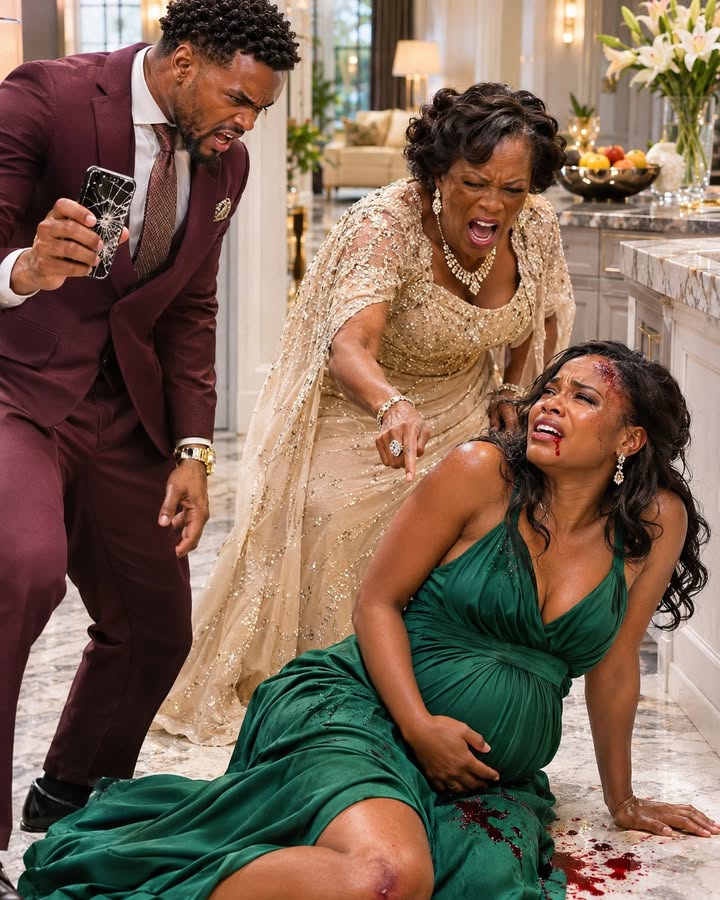
I thought of Eleanor’s hands at my back and Carter breaking my phone.
I thought of the blood on the floor and my father’s voice asking me to stay still.
The phrase was not merely inaccurate.
It asked me to replace my own memory with something that made their family more comfortable.
“Do you want to keep going?” Sarah asked.
“No.”
She closed the folder.
I sat with the words for a while, feeling the old urge to soften them.
I had spent so long making room for Carter’s explanations that even now part of me wanted to believe the right wording could make the marriage easier to remember.
But there was no sentence that could make what happened harmless.
The next day, I met with an independent attorney named Priya Shah.
She explained the settlement in plain language and identified several provisions that could limit my ability to speak with investigators or testify.
She also pointed out that the financial offer would be paid through a family trust, with conditions that extended beyond the criminal case.
“Would this agreement guarantee that my son is financially secure?” I asked.
“No agreement can guarantee every future circumstance,” Priya said. “This one provides significant support, but it also gives Carter’s family considerable control over how the story is told.”
“Could the terms be changed?”
“They could make a different offer. But the central condition appears to be your silence.”
I did not ask her what she would choose.
I already knew that no one else could choose the cost for me.
When I returned to Sarah’s house, Dad was sitting on the porch beneath the overhang, watching the rain thin into mist.
He stood when he saw me.
“Did the lawyer help?”
“Yes.”
“Do you want to tell me what you’re thinking?”
“I think I know.”
He waited.
“I don’t want the money to be the last thing my son inherits from this night.”
His face softened, but he did not interrupt.
“I want him to have a safe home and a future,” I continued. “I want to give him those things. But I don’t want to give him a story that says his mother agreed she fell when she knows she was pushed.”
Dad drew a slow breath.
“You don’t have to decide because of what you think he might ask someday.”
“I know. But I want to be able to answer him honestly.”
“What are you choosing?”
“I’m choosing to testify.”
He nodded once.
There was pride in his expression, but he kept it quiet.
“Then I’ll stand beside you,” he said. “Not in front of you.”
I felt my eyes fill.
“That’s what I need.”
Sarah came to the doorway and leaned against the frame.
“Do you want me there, too?”
“Yes.”
She walked over and hugged me gently, mindful of my back.
The decision did not make me feel fearless.
It made me feel responsible for the fear I carried, instead of ruled by it.
I signed nothing that evening.
Priya sent a formal response declining the settlement as written and stating that I would continue cooperating with the prosecution.
Carter’s family did not reply immediately.
For several days, I waited for the consequences of my choice to arrive.
The doctors continued monitoring me.
The baby remained steady, though I was told to rest as much as possible and return for any changes.
Sarah prepared the guest room for the weeks ahead, while Dad helped arrange practical support without taking over my decisions.
The trial date drew nearer.
I met with the prosecutor to review the sequence of events and the evidence likely to be presented.
Ms. Morales did not promise an outcome.
She explained that the defense could question my memory, my relationship, and the choices I had made before the incident.
She said I could ask for breaks and that the court would make reasonable arrangements for my pregnancy.
I listened and asked questions.
Each answer made the courtroom feel more real.
On the evening before the trial was due to begin, I laid out a simple dress and a cardigan.
Sarah helped me pack the medical notes and water the doctor had advised me to carry.
Dad waited downstairs, giving us room.
I sat on the edge of the bed and looked at the old letter he had written before my wedding.
The paper had begun to soften along its folds.
I had read it so many times that I knew where each line bent.
I did not want to treat it as proof that my father had been right about everything.
It was proof that he had been afraid, and that he had loved me enough to doubt his own fear.
I placed the letter in my bag.
Sarah stood beside the door.
“Are you ready?” she asked.
“No,” I said.
She nodded.
“Then we’ll go as you are.”
At the courthouse the next morning, the hallway smelled of old wood, paper, and rain-soaked coats.
Ms. Morales met us near the courtroom entrance and explained what would happen first.
Dad asked whether I wanted him to sit beside me.
“I want you in the gallery,” I said. “Where I can see you, but where you don’t have to watch every word.”
He accepted the boundary with a quiet nod.
Sarah remained close as we entered.
The room was smaller than I had imagined.
There were no cameras, no crowd, and no spectacle.
Just polished benches, a clerk arranging files, and the low murmur of people preparing to begin.
Then I saw Carter.
He sat beside his lawyer, dressed in a dark suit, his hands folded on the table.
For a moment, I could not tell whether he had seen me.
Then his eyes lifted and met mine.
The courtroom doors closed behind us, and the clerk called my name.
**–END OF PART 5–CLICK “NEXT” AT THE BOTTOM OF THE PAGE TO CONTINUE READING**
* * *
[PREVIOUS: PART 4](https://puretales.idolsgift.com/blog/part-4-the-voice-that-wouldn-t-hang-up5-025) | [NEXT: PART 6(THE END)](https://puretales.idolsgift.com/blog/part-6-the-end-the-voice-that-wouldn-t-hang-up5-025)
✓ Lynn R. Adams
Part 5 – The Cost of Silence Lena Park said she had found my number in an old company directory. She spoke carefully, as if she had rehearsed the opening and was now afraid of what came after it. “…