PART 5: The Voice on the Other End 047
Part 5 – The Cost of Coming Home
The photograph on Vincent’s phone showed Ellie asleep in Isabella’s arms.
The room around Vincent seemed to lose its shape.
He held the phone out toward the officer, who examined the image without touching it.
“Is that from the farmhouse?” the officer asked.
“Yes.”
“Was anyone else given that address?”
“Only the people who needed it.”
“Who?”
Vincent looked down at the message beneath the photograph.
You have the wrong story. Ask your wife who else was in the second car.
“Isabella,” he said into the phone. “Did you tell anyone else where you were?”
“No.”
“Not Marisol?”
“She knew the farmhouse.”
“Anyone from your old life?”
“No.”
The officer nodded toward the papers spread across the bed.
“We need to move you and the child somewhere secure while we sort this out.”
“Isabella is with her.”
“We can send a unit there.”
“Quietly,” Vincent said. “No uniforms at the door.”
The officer took out his phone to arrange it.
Vincent looked at the message again.
The photograph had been taken through a window, from outside the farmhouse.
Whoever sent it had been close enough to see the room, yet had chosen to send a warning instead of approaching.
That did not make it harmless.
It made it harder to understand.
“Salvatore is still outside,” the officer said after a brief call.
“Keep him there.”
“He’s asking to speak with you.”
“He can speak through you.”
The officer glanced at the evidence.
“He says the papers are incomplete.”
“So does the message.”
“Do you want to hear what he has to say?”
Vincent looked at the signature on the clinic instruction.
For years, Salvatore had stood beside him as a steady voice in the aftermath of the crash.
He had chosen the funeral arrangements, guided Vincent through the first months of grief, and helped him keep the organization from fracturing.
Vincent had called that loyalty.
Now he wondered how much of it had been a way to keep him looking in the wrong direction.
“I’ll hear him,” he said. “But the police stay in the room.”
The officer nodded.
“And no one approaches Isabella or Ellie without her permission.”
“That’s understood.”
Vincent called Isabella again.
“I’m going to speak with Salvatore.”
“Don’t let him turn it into a private conversation.”
“I won’t.”
“Don’t let him make you choose between trusting me and trusting the evidence.”
“I won’t.”
There was a pause.
“Vincent, the message said to ask who else was in the second car.”
“I saw it.”
“I don’t remember another person.”
“You were injured.”
“I remember headlights, rain, and waking up at the clinic.”
“Maybe the message is meant to unsettle us.”
“Maybe.”
“But if there was someone else, we’ll find them.”
She took a breath.
“Whatever you hear from him, remember that I did not leave you because I stopped loving you.”
Vincent shut his eyes.
“I know.”
“I thought I could keep our daughter safe by keeping her away from you.”
“I know that too.”
The first truth did not undo the second, but he could hold both now without letting either one erase the other.
“I’ll call as soon as I can,” he said.
“Keep Ellie close.”
“I will.”
The call ended.
Vincent gathered the papers and placed them in the officer’s evidence folder, then kept the original note from Isabella in his coat.
He did not want it separated from him.
When he entered the front hall, Salvatore was waiting beneath the porch roof, rain shining on his shoulders.
He was older than Vincent remembered, though the change might have come from the way Vincent now looked at him.
Salvatore’s silver hair was neatly combed, his dark coat buttoned, his hands visible at his sides.
Two officers stood between them.
“You found the papers,” Salvatore said.
Vincent stopped several feet away.
“You knew they were there.”
“I suspected.”
“You signed the clinic instruction.”
“I did.”
“Did you arrange the crash?”
Salvatore’s eyes lowered for a moment.
“No.”
“Did you know Isabella survived?”
“Yes.”
The answer was plain.
It hurt more than a denial would have.
“Why didn’t you tell me?”
“I thought I was protecting you.”
“From my wife?”
“From the men who wanted to use her against you.”
“You let me bury her.”
“I believed the false identity would keep her alive.”
“You let me believe she was dead.”
Salvatore’s face tightened.
“I believed it was the only way to keep you from tearing the organization apart looking for her.”
Vincent looked at the man who had stood beside him at the funeral.
“You thought I would choose her over the organization.”
“I knew you would.”
“And that frightened you.”
“It frightened me because there were people ready to take advantage of it.”
“Who?”
“Your enemies. The families who watched us for weakness. The men who saw your marriage as a way to control you.”
“You decided for me.”
“I made a choice when the situation was closing around all of us.”
“You made a choice that cost my wife three years with her husband and my daughter three years with her father.”
Salvatore took in the words without flinching.
“I know.”
“Do you?”
“I have spent every day knowing it.”
“Then why continue lying?”
“Because I had already built the lie around you. I thought the truth would make you reckless.”
Vincent felt the old anger rise in him, but it no longer seemed clean or useful.
There was pain in it, and shame too.
He had let Salvatore guide the years after the crash because grief had made decisions feel impossible.
He had called that dependence trust.
“Who sent the vehicles to my house?” Vincent asked.
“I don’t know.”
“Who found Isabella?”
“I don’t know that either.”
“Did you send the men who took Ellie from Marisol?”
“No.”
“Did you pay Rourke?”
“No.”
“Did you know he was involved?”
“I knew he had been speaking to people he shouldn’t have.”
“You knew, and you left him in charge of my security.”
“I thought I could find out who he was working with.”
“You thought you could control it.”
Salvatore’s silence was answer enough.
The officer beside Vincent shifted slightly.
Salvatore looked at him, then back to Vincent.
“The documents in your safe are real,” he said. “But they don’t tell you everything.”
“Then tell me what they leave out.”
“Isabella was not the only person in the second car.”
The words seemed to draw the rain closer around them.
Vincent studied Salvatore’s face.
“Who was with her?”
“I don’t know.”
The answer came too quickly.
“You signed the clinic order.”
“I was told there were two people. By the time I arrived, only Isabella remained.”
“Who told you?”
“A driver.”
“What was his name?”
“I don’t remember.”
“You don’t remember the name of the person who brought you the news that my wife was alive?”
“I was dealing with several things at once.”
“You remember the clinic and the death certificate.”
“I remember the paperwork.”
“And not the person?”
Salvatore looked past him toward the dark driveway.
“I could find out.”
“No.”
“Vincent, you need to know who else was in that car.”
“I do.”
“Then let me help.”
“You had three years to help.”
A distant siren rose and fell beyond the estate walls.
Salvatore’s gaze shifted toward the sound.
“You’re going to the police with this?”
“Yes.”
“You know what that will do to the organization.”
“I know what it will do to my life.”
“If you turn over the records, the people you’ve spent your life protecting will scatter. Some will be arrested. Some will panic. Some will try to make sure no one talks.”
“I won’t protect them from the truth.”
“Your father built that business. Your family—”
“My father is dead.”
“And you’re still responsible for what remains.”
Vincent looked down at his hands.
He had spent years telling himself that the empire had been inherited, maintained, and shaped by necessity.
He had used those words to avoid naming what it was.
He had made money from fear.
He had allowed violence to become a tool, then treated the tool as though it were a law of nature.
Isabella and Ellie had been kept away from him partly because the people around him knew he would protect them.
They had also been kept away because his life gave those people leverage.
“I can give the investigators the records,” Vincent said. “I can cooperate with them.”
“And if they charge you?”
“I’ll answer for what I did.”
“Your daughter will see her father taken away.”
“She may.”
“Your wife may lose you again.”
Vincent felt the words strike where they were meant to.
Salvatore’s voice softened.
“Think carefully. You can put your family in danger by trying to save them.”
Vincent looked toward the upstairs window of the house, where Ellie had once slept as a baby only in a life he had not known existed.
He thought of her tiny hand around his finger.
He thought of her asking, Daddy stay?
He could not promise her a life untouched by consequences.
He could promise not to build another life around a lie.
“Keeping the organization intact isn’t protecting them,” he said. “It’s making sure the danger has a home.”
Salvatore studied him.
“You’re willing to let all of it go?”
“I’m willing to stop deciding that everyone else has to live with what I built.”
The siren grew louder.
The officer turned toward the entrance.
“Mr. Romano,” he said, “the investigators are here.”
Vincent looked at Salvatore.
“Are you coming inside?”
“I’ll speak with them.”
“You’ll give them everything you know.”
“I will.”
“And you won’t contact Isabella.”
“I won’t.”
“You won’t send anyone near her or Ellie.”
“I won’t.”
The answer sounded sincere.
That no longer made it enough.
The officers escorted Salvatore into the house.
Vincent stood in the hall as the investigators began asking questions about the records, the payments, and the night of the crash.
He answered carefully.
He did not minimize his role in the organization.
He did not pretend that every crime had been someone else’s decision.
When they asked about the company accounts, he gave them access.
When they asked whether the business had been used to route payments, he said yes.
When they asked whether he had personally authorized transfers that supported illegal activity, he said yes again.
Each answer pulled away another part of the life he had used to hide from grief.
He felt no relief.
He felt the weight of what the truth would mean.
At the edge of the room, an investigator placed the papers from the safe into a separate folder.
“We’ll need to speak with Mrs. Romano,” she said.
“You may, with her consent.”
“We’ll also need to locate Marisol Vega.”
“She’s alive, but hiding.”
“Do you know where?”
“No.”
“Could she be in danger?”
“Yes.”
The investigator wrote it down.
“We’ll arrange protection once she makes contact.”
Vincent gave them the number she had used, the words on the note, and the name on the suitcase label.
He did not know whether it would be enough.
When the interview ended, he stood alone in the study, surrounded by familiar furniture that no longer felt like his.
A phone lay on the desk.
It was Salvatore’s, sealed in a clear evidence bag.
The screen had lit up when the investigators carried it in.
A message preview appeared beneath the glass.
The child is with him. Keep the exchange on schedule.
Vincent looked toward the officers.
“I need to see that.”
One of them examined the bag.
“We can’t open it without following procedure.”
“I understand.”
“Do you recognize the number?”
“No.”
Another message arrived.
This time the preview showed only six words.
Bring Isabella. Bring the records. Come alone.
Vincent’s mouth went dry.
“Where did this come from?” he asked.
The officer checked the screen through the plastic.
“Unknown number.”
“Can you trace it?”
“We’ll try.”
Vincent called Isabella from his own phone.
She answered immediately.
“Are you all right?”
“Yes. Are you and Ellie safe?”
“We’re still at the farmhouse.”
“You need to leave.”
“What happened?”
“Salvatore’s phone received a message. It says to bring you and the records to an exchange.”
“What exchange?”
“I don’t know yet.”
“Who sent it?”
“An unknown number.”
“Vincent, I’m not going anywhere with anyone.”
“I don’t want you to.”
“Then what are you planning?”
He glanced at the investigators.
“To give them the evidence and go where the message tells me.”
“No.”
“I’m not going armed.”
“That doesn’t make it safe.”
“I know.”
“Then don’t go.”
“If I refuse, they may come for you or Ellie.”
“Or they may be trying to make you do exactly what they want.”
“They might be.”
“You said you would listen to me.”
“I am listening.”
“Then listen when I tell you this could be a trap.”
“It is a trap.”
The answer came out more calmly than he expected.
“Vincent, I won’t let you walk into it alone.”
“I’m not asking you to.”
“You’re planning to go without telling me where.”
“I’m telling you now.”
She made a small, frustrated sound.
“Why do you think they want me?”
“Because they believe you have the remaining records.”
“I don’t.”
“They may not know that.”
“Then I won’t go.”
“I’ll make sure they never get near you.”
“By bringing them what they want?”
“By giving the evidence to the investigators first.”
The line was quiet.
“Are you going to surrender yourself?”
“I’m going to cooperate.”
“That isn’t the same thing.”
“No.”
“Vincent.”
“I won’t turn Ellie’s future into another reason to use violence.”
He heard her draw a breath.
For a moment, they were back in the farmhouse with the child asleep between them, trying to decide which fears belonged to the past and which still had a claim on them.
“I can’t ask you to trust that this will work,” he said. “I can only tell you I won’t protect the organization at your expense.”
“What about protecting yourself?”
“I’m trying to learn that there’s a difference.”
She did not answer at once.
Then she said, “I won’t let Ellie see you leave without knowing you’re coming back.”
Vincent’s throat tightened.
“I can’t promise what happens after.”
“I didn’t ask for a promise about what happens after.”
He looked at the phone in his hand.
“I’ll call when I know more.”
“You call before you go.”
“I will.”
The investigators took the evidence from the safe and started arranging a protected route to the farmhouse.
Vincent asked them to keep their presence discreet and to let Isabella decide whether she wanted to move.
She chose a different safe location, one she had used before, and agreed to travel there with an officer she could speak with directly.
When Vincent called her back, she had already packed the yellow blanket and Ellie’s pink suitcase.
“You can meet us at the location,” she said. “You won’t come inside until we know the area is clear.”
“That’s fair.”
“Don’t bring Salvatore.”
“He’s in custody.”
“Is he?”
“He’s being interviewed.”
“That isn’t what I asked.”
Vincent looked toward the west office, where an officer stood watch.
“I don’t know.”
“Then keep distance from him.”
“I will.”
“Bring the little bunny,” she said.
“It’s with Ellie.”
“Good.”
The sun had gone down by the time the convoy left the mansion.
Vincent rode with two investigators in a plain vehicle, while another car carried the evidence.
The organization’s records were on their way to the authorities.
The safe was open.
The years of silence could not be put back inside it.
At the new location, Isabella waited beneath a covered entryway with Ellie in her arms.
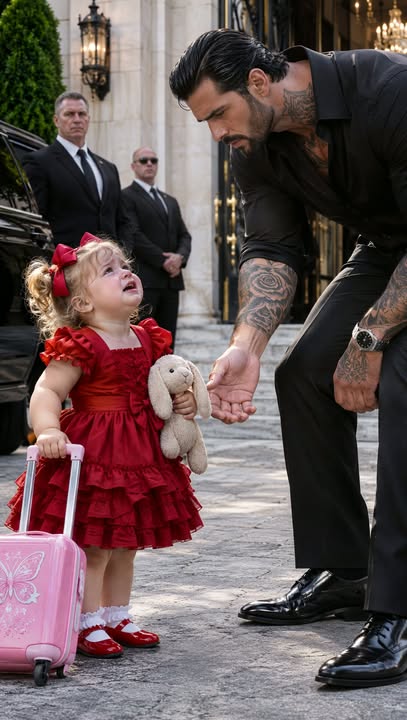
The child wore the red princess dress again, though a yellow cardigan covered its sleeves.
Her bunny was tucked under one arm.
When Vincent stepped from the car, Ellie reached toward him.
“Daddy!”
He crossed the distance slowly, letting Isabella see every movement.
She handed the child to him.
Ellie tucked her face against his shoulder and held on.
“Daddy stay?”
“I’m here.”
“Stay long?”
He held her carefully.
“As long as I can.”
Isabella’s hand rested on his arm.
It was a small touch, but it carried more than either of them could say in front of the officers.
A knock sounded from the open car behind them.
One investigator held up the phone that had been taken from Salvatore.
“We traced the message,” she said. “It came from a prepaid device near the old pier.”
Vincent looked at Isabella.
The old pier stood at the edge of the river, a place he had visited once with her before their wedding.
“Is that where they want you?” Isabella asked.
“The message says to bring you and the records to the exchange.”
“I’m not going.”
“They may expect me to.”
“Then let them expect.”
Vincent looked down at Ellie.
She had fallen quiet, her fingers curled in the lapel of his coat.
The investigators had advised against going.
The police had not yet identified who sent the messages.
A meeting with an unknown group could be dangerous, even without a weapon.
He knew all of that.
He also knew that if someone believed Isabella and Ellie were the leverage that could draw him out, staying hidden might only delay the moment.
“I’m going,” he said.
Isabella’s face tightened.
“Not alone.”
“I won’t bring you.”
“Then you’ll go without the one person who knows what they’re asking for.”
“I can’t take you into danger.”
“You don’t get to decide that by yourself anymore.”
He held her gaze.
The old instinct—to shut her out, to keep her safe by making the choice without her—rose in him.
He let it pass.
“What do you think we should do?”
“We give the investigators the records. We tell them exactly what the message says. We don’t let them make us rush.”
“And if the sender moves before they can secure the area?”
“Then we adapt together.”
Vincent nodded.
“Together.”
The investigators asked to speak with Isabella privately.
She agreed, taking Ellie inside while Vincent remained by the car.
For the next hour, the police reviewed the known addresses, checked the riverfront, and arranged plainclothes officers near the pier.
No one could guarantee the message sender would appear.
No one could guarantee the pier was safe.
Vincent gave them everything he knew about the exchange, including the fact that he had never agreed to attend.
When the investigators finished, he went inside.
Ellie was asleep on a narrow bed with the bunny tucked under her chin.
Isabella stood near the window, watching the dark street.
“We have to make a choice,” Vincent said.
“We have already made one.”
“We could wait here.”
“Then they’ll know we’re waiting.”
“We could leave the city.”
“And keep running?”
He looked at the child.
“Maybe.”
“Vincent, she deserves a life that isn’t decided by whoever sends the next message.”
“She does.”
“Then whatever you choose at the pier, don’t choose the empire.”
“I won’t.”
“Don’t choose revenge.”
“I won’t.”
“Choose her future.”
He looked at Ellie’s small sleeping face.
“I will.”
The investigators called him out again.
A second message had arrived.
It included a photograph of the pier, taken minutes earlier.
Beside it was a short line: We know you have the records. Come before midnight.
The lead investigator looked at Vincent.
“We’re not recommending that you go.”
“I understand.”
“We can secure the pier, but we can’t know who is watching.”
“I understand.”
“If you attend, you do not approach anyone until our signal.”
“I won’t.”
“And you bring nothing except yourself.”
Vincent looked at the evidence case now locked in the police vehicle.
“The records are already with you.”
“Yes.”
“Then I’ll go.”
Isabella joined them at the doorway.
“You can still change your mind.”
“So can you.”
“I’m not going to the pier.”
“I don’t want you to.”
“But I won’t leave you without help.”
“I know.”
She looked at him for a long moment.
There was fear in her face, but there was also the steadiness he remembered from the life they had thought was over.
“Come back to us,” she said.
“I will do everything I can.”
“Don’t give me a speech.”
“I wasn’t going to.”
“Good.”
She touched his cheek.
He leaned into her palm, just as Ellie had done when they first met.
For one quiet second, the years between them seemed less like a wall and more like something they might cross together.
Then Isabella lowered her hand.
“Go tell the truth,” she said. “Not the version that keeps you safe.”
He nodded.
The investigators drove Vincent toward the riverfront.
The night air smelled of rain and wet stone.
The pier was dark except for two lamps near the entrance, their reflections trembling in the water.
Plainclothes officers were stationed along the surrounding streets.
Vincent stepped from the vehicle without a weapon.
He carried no records, no phone, and no money.
He had surrendered the tools he once believed made him powerful.
The lead investigator remained several yards behind him.
“Wait for our signal,” she said.
Vincent looked across the empty pier.
A figure stood near the far end, too distant to identify.
His phone buzzed.
The investigator beside him checked it and went still.
“What is it?” Vincent asked.
“The message says the records aren’t enough.”
“What do they want?”
The phone buzzed again.
The investigator read the new line aloud.
Bring the person who was in the second car.
Vincent looked back toward the road, toward Isabella and Ellie waiting with the officers.
A siren sounded in the distance.
The figure at the end of the pier stepped into the light.
Vincent recognized the face.
And then, from behind him, a small voice called through the night.
“Daddy!”
**–END OF PART 5–CLICK “NEXT” AT THE BOTTOM OF THE PAGE TO CONTINUE READING**
* * *
[PREVIOUS: PART 4](https://echoesofstories.idolsgift.com/blog/part-4-the-voice-on-the-other-end-047) | [NEXT: PART 6(THE END)](https://echoesofstories.idolsgift.com/blog/part-6-the-end-the-voice-on-the-other-end-047)
✓ Lynn R. Adams
Part 5 – The Cost of Coming Home The photograph on Vincent’s phone showed Ellie asleep in Isabella’s arms. The room around Vincent seemed to lose its shape. He held the phone out toward the officer…