PART 5: The Voice in the Crystal 052
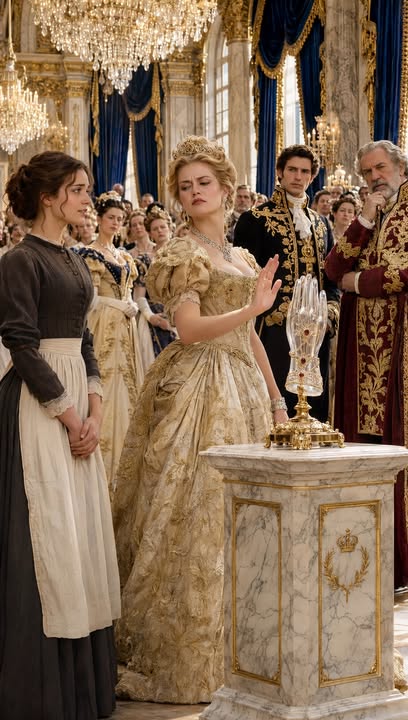
Part 5 – A Choice Without a Crown
“They want the court to recognize you as a princess—and they expect you to marry me.”
Alexander’s words seemed to settle over the room like a layer of winter frost.
Emily looked at him, then down at the note from her mother, its old paper warm beneath her fingers.
“Did my father agree to this?” she asked.
“He has not agreed to anything.”
“But the council expects him to.”
“He told them the decision belongs to you.”
Emily let out a quiet breath, though the knot in her chest did not loosen.
“That is more than he said yesterday.”
“It is.”
Alexander stood just outside the threshold, careful not to enter unless she invited him.
“The council believes that recognizing your mother’s place in the royal family will repair the history the palace concealed,” he continued. “Some of them think a marriage between us would make the restoration complete.”
“And what do you think?”
“I think they are trying to turn our lives into a solution they can present to the kingdom.”
His answer was immediate, but his expression held more than anger.
There was uncertainty there too, and sorrow for the future they had only just begun to imagine.
Emily folded her mother’s note and placed it inside the pendant.
“Do you want to marry me?”
Alexander did not look away.
“I care for you,” he said. “But I won’t answer that question as though the council’s demand has made it urgent.”
“That isn’t an answer.”
“No,” he admitted. “Because I don’t want to offer you a promise while the whole palace is telling you what your answer should be.”
Emily felt the quiet kindness of his restraint, and it made the situation harder rather than easier.
Had he pressed her, she might have found something to resist.
Instead, he had left the choice entirely in her hands, where it seemed both heavier and more precious.
“I don’t want to be a princess,” she said.
“Then you do not have to become one.”
“Even if refusing complicates the restoration of my mother’s name?”
“Her name should not depend on what you agree to do.”
“Even if the council says the kingdom needs a marriage?”
“The kingdom does not need you to surrender your life to make its history more comfortable.”
Emily turned toward the window.
Beyond it, the garden lay quiet beneath a pale evening sky.
The bare branches held no leaves, but she remembered how they had looked in warmer months, green and full, with the paths below crowded by servants and guests.
She had once imagined that the palace might become a place where she could belong without having to explain herself.
Now she understood that belonging could be offered with conditions hidden inside it.
“The council will not accept that easily,” she said.
“Perhaps not.”
“And my mother left because she knew they might try to claim me.”
“I think she feared they would.”
Emily touched the pendant through the fabric of her dress.
Her mother had chosen a life away from the palace so her daughter could grow without being told what blood required of her.
If Emily accepted a title and a marriage because the council wanted a tidy answer, would she be repeating the very surrender Anne had resisted?
Yet refusing could mean leaving the palace, perhaps leaving Alexander as well.
It could mean that the truth about her mother would be spoken in public while Emily herself stood apart from the family whose history she had inherited.
She had never wanted a crown.
She had only wanted to know who her mother had been.
“I need to hear what they plan to say tomorrow,” Emily said.
“I will be there.”
“Not to answer for me.”
“Not unless you ask me to.”
She looked at him then.
The candlelight made his face softer than it had appeared in the ballroom, but she could still see the strain beneath his careful composure.
“You may want things I cannot give you,” she said.
“I know.”
“And I may not know what I want until I am no longer being asked in front of everyone.”
“That is fair.”
Emily wondered whether she was protecting herself from the council or from the hope she had begun to feel whenever Alexander was near.
Perhaps it was both.
“Will you stand beside me tomorrow?” she asked.
“If you want me there.”
“I do.”
He bowed his head once, not as a prince acknowledging a subject, but as someone accepting a request.
“I’ll be there.”
The next morning, the public council gathered in the great chamber, a long room of pale stone and high arched windows.
The chamber had been built for formal announcements, but its high ceiling and rows of polished benches gave it a solemn quiet that made even whispered conversations seem important.
Nobles, ministers, and senior household officers filled the room.
The old service records and the former queen’s letters rested on a table before King Edward, protected beneath a clear glass case.
Emily stood near the entrance with the pendant at her throat.
Her dress was simple, chosen from her own small collection rather than provided by the royal household.
It was blue-gray wool, clean and carefully mended at the cuffs.
She had asked the housekeeper to leave her apron in her room.
She did not want to appear dressed as a servant to prove that she had once been one, or dressed as a princess to suggest she had agreed to become one.
Lady Victoria stood among the noblewomen on the right side of the chamber.
When Emily entered, Victoria’s gaze met hers.
She did not smile, but neither did she look away.
Alexander stood beside the king’s chair, dressed in formal blue with the silver royal emblem at his collar.
His eyes found Emily’s, and he gave her a small nod.
It did not promise that everything would be easy.
It only reminded her that she was not standing alone.
King Edward rose.
“The council has asked to hear the truth concerning Anne, my mother’s daughter, and the history of the crystal glove,” he began.
His voice carried clearly across the room.
“Today, I will speak without the concealments that once seemed safer than honesty.”
The chamber grew still.
The king recounted what the former queen’s letter had revealed: Anne’s birth, her marriage to an American healer, the nobles’ objections, and the royal family’s decision to remove her name from the official record.
He did not soften his own part in the matter.
He admitted that, as a young man, he had accepted the silence because he believed it would preserve stability.
“I have no excuse for allowing fear to be written into our history as if it were a virtue,” he said. “The concealment caused harm, even where harm was not intended.”
Emily listened with her hands folded before her.
She thought of her mother’s small home, the stories she had told about the seasons, and the one line she had never explained.
A promise freely kept.
The king continued.
“Anne’s marriage was freely chosen, and her daughter, Emily, is her lawful child. We will restore Anne’s name to the royal record, along with the truth of her marriage and the life she chose afterward.”
A murmur passed through the room.
Some nobles lowered their eyes.
Others looked toward Emily as though her place had already been decided.
One of the councilors rose.
“Your Majesty, the restoration is necessary, but incomplete,” he said. “Miss Emily is descended from the royal line. She should be recognized as a princess.”
Another councilor stood behind him.
“And a union with Prince Alexander would put the old division to rest. It would unite the family and assure the people that the succession remains secure.”
The words were spoken formally, without hostility, but Emily felt their effect in the way the room turned toward her.
There it was: an invitation made to sound like an obligation.
The king’s jaw tightened.
“Emily’s ancestry does not grant this council the right to arrange her future.”
“With respect, Your Majesty,” said the first councilor, “the matter concerns the crown as well as the family.”
“The matter concerns a woman who has not agreed to be made a symbol.”
A few members of the council exchanged uneasy glances.
The second councilor looked toward Emily.
“Miss Emily, the restoration of your mother’s name would bring honor to her memory. Surely you can see the value of allowing the royal family to welcome you fully.”
“I can see the value of restoring my mother’s name,” Emily replied.
Her voice sounded steadier than she felt.
“But that is not the same as agreeing to a title or a marriage.”
The councilor inclined his head.
“Would you not consider the needs of the kingdom?”
“I have considered them.”
Emily looked across the chamber, at the people who had spent the morning discussing her ancestry as if it were a matter of state property.
“My mother was hidden because powerful people believed her life could be used to protect the crown,” she said. “If you now ask me to accept a title and marry the prince so that her story can be made useful again, you have not restored her freedom. You have only found another name for the same demand.”
The room fell quiet.
Emily could hear a faint rustle from the tall curtains as the morning breeze pressed against the windows.
King Edward watched her, his expression grave but attentive.
“I do not want royal status,” she continued. “I will not ask for a claim to the crown, and I will not marry Prince Alexander because the council thinks it would repair a family line.”
Alexander remained still beside the king.
His hands rested at his sides, though Emily could see the tension in his fingers.
“I will not be a promise I did not make,” she said.
For a long moment, no one answered.
Then a noblewoman rose from the front bench.
“Are you refusing the palace itself?”
Emily turned toward her.
“I am refusing to be kept here by a title or a duty.”
“That is not quite the same,” the woman said.
“No,” Emily replied. “It isn’t.”
The distinction mattered to her, even if she could not yet tell whether it would be enough.
“I know my mother loved me,” Emily continued. “I know she wanted me to be able to choose a life without owing the palace anything. If I stay because the council has decided I belong here, I will be making the same choice for the wrong reason.”
The first councilor sat down.
The second remained standing.
“And what of Prince Alexander?” he asked. “Does your answer mean you reject him as well?”
The question was not asked cruelly, but it was placed before the whole room, where no private truth could remain private.
Emily looked at Alexander.
He did not give her an answer with his face, nor ask her to spare him embarrassment.
He only waited.
“I will not turn my feelings for him into evidence that the council is right,” she said. “If there is to be anything between us, it must be ours to choose, away from this demand.”
Alexander’s eyes softened, though sadness remained there.
The councilor sat down.
King Edward rose from his chair.
“The council has heard Emily’s decision,” he said. “Her mother’s name will be restored whether Emily accepts a title or not. No one will require her to marry into the royal family.”
One of the older nobles lifted a hand.
“Then what title shall be entered for her?”
“None,” Emily said before the king could answer.
The old noblewoman regarded her carefully.
“You would refuse recognition of your own birth?”
“I will not refuse the truth,” Emily said. “I am Anne’s daughter, and that is enough. But I do not want the word princess placed before my name to make people believe I have promised my life to the crown.”
A rustle moved through the room again, not quite disapproval and not quite respect.
The king looked toward the council.
“Her decision is clear.”
“What of the glove?” asked another member. “If it has no role in choosing the future queen, should it remain a royal instrument?”
King Edward glanced at the glass case containing the record.
“No,” he said. “The glove will no longer be used as a marriage test. Its history will be preserved, and its purpose recorded honestly.”
Emily felt a quiet ease in her chest.
For generations, the court had treated the glove as permission to choose a bride.
Now its real meaning would be restored.
The council did not offer a single, united response.
Some looked disappointed.
Others appeared relieved that the king had ended the discussion before it could become an argument.
Lady Victoria stood near the wall, her hands clasped before her.
When the council began to disperse, she approached Emily.
“You made your choice clearly,” Victoria said.
“I hope so.”
“You may find that clarity does not make the next part easier.”
“I expect it won’t.”
Victoria’s face softened.
“I was wrong to assume you were seeking influence.”
Emily studied her.
The admission sounded sincere, though it came with no elaborate apology.
“Why did you think I was?”
“Because I have watched people enter this court with a purpose hidden behind a modest appearance,” Victoria replied. “I thought I recognized it in you.”
“And did you?”
Victoria glanced toward the king and the councilors, who were still talking among themselves.
“No,” she said. “You were trying to keep something that belonged to you from becoming theirs.”
Emily did not know what to say.
Victoria gave a brief nod and moved away.
Alexander came to Emily once the chamber had emptied enough for their voices to be private.
“Do you want me to walk with you?”
She looked toward the nearest doorway.
“I should speak to your father first.”
“He is waiting in the small council room.”
“Then I’ll speak with him.”
Alexander did not ask to accompany her.
That restraint felt like another promise freely kept.
King Edward stood alone beside the council table, looking down at the glass case.
The formal papers had been gathered, but the former queen’s letter remained open beside it.
“Your decision was brave,” he said when Emily entered.
“It was the only decision I could make honestly.”
“That is often what bravery looks like.”
“I am leaving the palace.”
The king’s eyes lifted.
“I thought you might.”
“I don’t want my departure to be mistaken for anger.”
“Nor do I want it mistaken for a punishment.”
“It is neither.”
Emily took a breath.
“I am grateful that you restored my mother’s name. I know you could have kept it hidden.”
“I should have restored it long ago.”
“Yes.”
She did not soften the answer.
The king accepted it.
“I will make sure your work in the palace is recorded as well, if you wish it,” he said. “Not as a servant’s footnote, but as part of the life you chose.”
Emily looked at him.
“I do not need a royal record of my work.”
“No,” he said. “But your mother’s name should not be the only truth the court learns about you.”
For the first time, Emily felt that he was not trying to make the situation manageable.
He was trying to listen.
“Thank you,” she said.
“Will you stay with friends in the city?”
“I haven’t decided yet.”
“Your choice will be respected.”
“I need time away from the palace to know what I want.”
King Edward bowed his head.
“That is fair.”
The old king’s eyes rested on the pendant at her throat.
“Anne gave you a good guide.”
“She gave me a hard one.”
The king’s mouth formed a faint, sorrowful smile.
“Most of the useful ones are.”
Emily turned to leave, but paused at the door.
“Will you tell the court the full truth about her father?”
“I will.”
“Even if they object to his being a common-born American?”
“Especially then.”
The answer seemed to cost the king something, but he gave it without hesitation.
Emily nodded and stepped into the corridor.
Alexander waited farther along the passage, giving her enough space that she could approach him or continue past him without feeling watched.
She went to him.
“I’m going,” she said.
“I understand.”
“I don’t know when I’ll come back.”
“I understand that too.”
She studied his face, searching for disappointment, anger, or some hidden request that she remain.
There was sadness, but no attempt to make her carry it for him.
“Do you still want me here?” she asked.
“I want you to be here only if you choose it.”
“And if I never choose it?”
“Then I will still be grateful that I met you.”
The simplicity of his answer left her with no defense.
Emily looked down at her hands.
The little scratches were fading, though the roughness remained.
She had once thought they were the part of her that made the glove’s golden light impossible.
Now she understood that the glove had never required her to be someone else.
It had only responded when she was allowed to choose for herself.
“Would you come with me?” she asked.
Alexander’s breath caught.
For a moment, she feared she had made the question sound like an offer he was obliged to accept.
He took his time before answering.
“Not today,” he said. “My place is here while my father tells the truth. I cannot ask you to stay for my sake, and I cannot leave the people who need to hear it.”
Emily nodded.
It was the right answer, even if it hurt.
“Then we are both choosing something difficult.”
“Yes.”
He reached for her hand, stopping just before their fingers touched.
“May I?”
She placed her hand in his.
He held it lightly, as if the promise between them was not something he intended to close around.
“I care for you,” he said. “But I want the next words between us to be ours, not the council’s.”
“So do I.”
Their hands parted.
No vow followed.
No one announced them as a future couple, and no courtier stepped forward to bless a marriage they had not chosen.
The absence of a promise left a tender ache, but beneath it Emily felt something new.
The ache did not belong to the palace.
It belonged to her.
That evening, the housekeeper helped Emily pack the few belongings she had brought to the palace.
She folded her dresses and placed them in a small canvas case.
The pendant went beneath her collar, where it had rested through childhood, work, fear, and discovery.
The housekeeper watched from the doorway.
“You could stay, you know,” she said gently. “No one is ordering you to go.”
“That is why I can choose to leave.”
The older woman’s eyes shone with understanding.
“Your mother would be proud of you.”
Emily swallowed.
“I hope she would understand.”
“I think she would.”
The housekeeper helped her carry the case to the servants’ entrance, where a hired carriage waited beyond the gate.
The palace seemed different when Emily crossed its threshold.
The stone walls no longer appeared to press down on her, yet they did not feel like home either.
She stepped into the open air and drew in a long breath.
Winter had softened into early spring.
The ground beyond the gates was damp from recent rain, and a thin veil of mist rested over the gardens.
For one brief moment, she thought she saw a figure at an upper window.
Then the glass reflected the gray sky, and the shape disappeared.
The carriage driver opened the door.
Emily placed one foot on the step.
Behind her, the palace doors remained open, but no one called her back.
Then the bells began to ring.
Not the measured chime marking the hour, but the old chapel bell, sounding from deep within the palace.
It rang once, paused, then rang again.
The coachman looked toward the tower.
“That bell has not been used in years,” he said.
Emily turned back toward the palace.
A messenger came running through the courtyard, carrying a sealed paper in both hands.
“Miss Emily!” he called. “The king asks you to return.”
The carriage driver lowered the door.
Emily looked at the palace gates, then at the messenger.
“What has happened?”
The messenger stopped before her, breathless.
“The king has found another letter from your mother,” he said. “It was hidden with the former queen’s papers.”
Emily’s fingers closed around the pendant.
“What does it say?”
The messenger glanced toward the palace, as though afraid the walls themselves might hear him.
“It says that the name Anne was given at court was never the name your mother was born with.”
Emily’s breath caught.
The carriage door remained open beside her.
Beyond the messenger, the chapel bell rang a third time.
Alexander appeared at the palace entrance, the second letter in his hand.
His face was pale, and the words he carried seemed to have changed something he had not yet found a way to explain.
“Emily,” he said, “the letter names your father.”
A quiet wind lifted the edge of her coat as she stood between the open road and the palace, unsure which one now held the greater truth.
**–END OF PART 5–CLICK “NEXT” AT THE BOTTOM OF THE PAGE TO CONTINUE READING**
* * *
[PREVIOUS: PART 4](https://storyly.idolsgift.com/blog/part-4-the-voice-in-the-crystal-052) | [NEXT: PART 6(THE END)](https://storyly.idolsgift.com/blog/part-6-the-end-the-voice-in-the-crystal-052)
✓ Lynn R. Adams
Part 5 – A Choice Without a Crown “They want the court to recognize you as a princess—and they expect you to marry me.” Alexander’s words seemed to settle over the room like a layer of winter frost….