PART 5: The Village Beneath the Paper 056
Part 5 – The Cost of Remembering
The prince opened the envelope.
Inside was a letter in his mother’s hand, folded twice and dated the winter after the flood.
Adrian read the first line silently, then stopped.
The chamber seemed to wait with him.
“Would you like me to read it?” the protagonist asked.
He glanced at her, and the worry in his eyes made him look less like the prince whose word could move a council and more like a son afraid of what a familiar voice might say.
“Please,” he answered.
She took the letter with both hands.
The paper was thin but well preserved, and the queen’s handwriting moved across it in firm, graceful lines.
“To those who find this after the people of Reedbank have been restored to the record: their homes were lost to the river, but their community was not lost.”
The protagonist paused, letting the words settle.
The noblewoman stood beside the table, her gloved hands clasped tightly.
The steward had returned to the doorway, but remained there, listening.
The protagonist continued.
“When the flood took the lower village, its people led families from the neighboring farms to the higher road, though many of their own homes had already begun to fail.”
Adrian lowered his eyes.
His mother’s words seemed to bring a person into the room whom none of them had ever truly known.
“She wrote that Reedbank’s residents sheltered their neighbors on the rise,” the protagonist said, “and that the crown agreed they could settle there permanently.”
The letter described the promise plainly.
The land would be granted to the thirty households once the boundary between the old river course and the new one was confirmed.
Until the papers were complete, the queen had arranged for food, blankets, and medical supplies to reach them.
The promise had been made before witnesses.
But the grant had never been entered into the permanent register.
At the bottom of the letter, the queen had added a final note.
“I have asked the council to finish the record, but they say the boundary must first be settled with the estate owners. I will not allow the families to be counted as absent while that work continues.”
The protagonist stopped reading.
The room held the silence that followed.
The prince took the letter from her, his gaze fixed on the final lines.
“She knew,” he said.
“She knew they were still there,” the protagonist replied.
“And she knew the record was being changed.”
“Perhaps she knew it was at risk of changing.”
Adrian turned the page over, but there was nothing more.
The noblewoman looked down at the Voss survey.
“My family’s land office must have received a copy of the boundary proposal.”
“Do you know whether they agreed to the grant?” the prince asked.
“I don’t know.”
She spoke carefully, but there was no longer certainty in her voice to hide behind.
The letter made the cost of the missing record plain.
The queen had tried to hold the promise in place with supplies and reminders, yet the families had remained on land whose ownership was undecided.
A council had postponed what should have been settled.
A map had hardened into an answer.
Then the village had been taken out of the count, and the postponement had become permanent.
The steward stepped into the chamber.
“Your Highness,” he said, “I have found a later account that may explain the change.”
Adrian looked up.
“What does it say?”
“After the queen’s death, the council reviewed the northern boundary. My predecessor recommended removing Reedbank from the public roll until the land claim could be resolved.”
“Recommended,” the protagonist repeated.
“Yes.”
“Was the village actually outside the kingdom?”
The steward hesitated.
“The newer map placed the north rise beyond the royal boundary.”
“That is not what I asked.”
“No,” Mr. Vale said. “The record does not establish that the residents were outside the kingdom. Only that the boundary had been drawn around them.”
Adrian looked at the map, where the line passed between the old settlement and the higher ground.
“Who authorized the change?”
“The council accepted the map as the working boundary.”
“Did the crown approve it?”
“The record is incomplete.”
The steward’s voice had not grown defensive.
If anything, it seemed to have lost the last layer of formality that had kept his guilt at a safe distance.
“I preserved the omission,” he added. “I told myself the boundary dispute was not mine to reopen.”
The prince held his mother’s letter.
“Did you know she had made this promise?”
“I knew she had sent supplies. I did not know the land grant had been promised.”
“Yet you knew the village had been removed.”
“Yes.”
The answer carried a weight that did not ask for sympathy.
Adrian looked down at the queen’s seal.
“Why did you not tell me?”
“I believed the matter had been closed before I became steward.”
“And when you saw the name in the old ledger?”
“I was afraid that restoring it without resolving the boundary would create confusion.”
“Or reveal the confusion already there,” the protagonist said.
The steward lowered his head.
“Yes.”
No one accused him of cruelty or greed.
The harm had taken a quieter shape: a decision to avoid a difficult question, made again and again until the people concerned were no longer visible to those with the power to answer it.
The prince folded the letter along its old creases.
“The council meets tomorrow morning.”
The chief clerk, who had been waiting with the updated supply order, glanced at him.
“Your Highness, the council’s agenda includes the sale of the north rise.”
The noblewoman turned sharply.
“The sale?”
“The estate has offered the land for a winter road and storage development,” the clerk said. “The council planned to approve the agreement before the season ends.”
The prince’s attention moved to the survey.
“If the land was promised to Reedbank, it cannot be sold as though the promise never existed.”
“The grant was not completed,” the steward said.
“That does not make the promise disappear.”
“It may make the sale legally possible.”
“Possibly,” the prince replied. “But I will not treat uncertainty as permission to proceed.”
The protagonist saw the choice forming before he named it.
To announce what they had discovered would expose the crown’s failure to honor its own word.
It would anger council members who had approved the map and estate owners who believed their claim secure.
It might also weaken the prince’s standing at a moment when he was expected to show that he could govern without hesitation.
To keep quiet would preserve the council’s plans and let the blankets be delivered without disturbing the land question.
The village might be fed for a winter and remain erased for another generation.
Adrian looked toward the protagonist.
“What do you think I should do?”
It was the second time he had asked her to judge the matter.
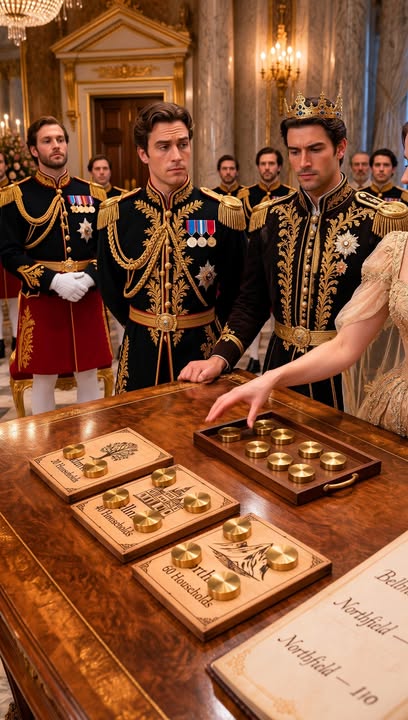
The first time, the task had been twelve counters and three painted boards.
Now there was no clean arrangement, no answer that left every household fully supplied.
She looked at the queen’s letter, then at her mother’s signature on the receipt.
Her mother had carried blankets to people whose names were being taken from the record.
The queen had sent provisions because she feared they would be forgotten.
To say nothing now would turn both gestures into kindness without consequence.
“We cannot keep the supplies separate from the promise,” she said.
Adrian remained still.
“Tell the council the truth,” she continued. “Tell them what we know, and what we still need to establish.”
“And if they suspend the sale?”
“Then the sale should wait until the residents’ claim is heard.”
“That could cost us support.”
“It could.”
He watched her face, perhaps searching for an easier reassurance.
She had none to offer.
“People may say I am using an old letter to challenge the council,” he said.
“Then show them the letter, the maps, and the records. Let them see what you know and where the gaps remain.”
“And if the gaps are used against us?”
“They already have been used against Reedbank.”
The words did not come harshly.
They came with the steadiness of something she had finally understood.
The prince looked at his mother’s seal.
The noblewoman stood near the survey, her eyes on the boundary line that had placed her family’s estate over the promised land.
“My family’s claim is built on the newer map,” she said.
The protagonist turned to her.
“If you speak tomorrow, people may ask whether your family knew the grant existed.”
“I know.”
“Do you?”
The noblewoman took a breath.
“I know what I’ve been taught. I don’t know what my family knew.”
Her gaze moved to the register entry that marked Reedbank as outside the royal jurisdiction.
“Until tonight, I thought the residents had left,” she said. “I repeated that because it was what I had inherited. If the estate papers show they were still there, I can’t pretend I never saw it.”
“That may put your family under scrutiny,” Adrian said.
“Yes.”
“Your land claim could be challenged.”
“Yes.”
He did not rush to thank her for a decision she had not yet made.
The noblewoman looked down at the old survey.
“I won’t accuse my family without proof,” she said. “But I will say publicly that the boundary records relied on a map that excluded the village, and that I was taught to treat the land as empty without asking who had lived there.”
The protagonist felt something in her ease.
It was not forgiveness, not yet.
It was recognition of a person choosing to step beyond the safety of an inherited belief.
The prince turned to Mr. Vale.
“Will you tell the council what you knew?”
The steward met his gaze.
“I will tell them I knew Reedbank had been removed from the public count and failed to challenge it.”
The chief clerk looked down at the agenda in his hands.
“The council may ask whether the records are reliable.”
“Then we will show them the originals,” Adrian said.
“The royal letter is private correspondence,” the clerk noted. “Making it public may invite questions about the queen’s actions.”
“My mother did not write this to preserve her reputation.”
The prince’s voice remained gentle, but its firmness left little room for retreat.
“She wrote it because she believed people should not be forgotten.”
He looked from the letter to the new map.
“If we use her words only when they make the crown look good, we will have learned nothing from them.”
The protagonist watched him.
The decision had become real in his face.
He was not choosing between two versions of the same good outcome.
He was choosing whether to tell the truth when it might damage the authority he had inherited.
The noblewoman stepped closer to the table.
“I will bring my family’s boundary documents to the council,” she said. “Even if they support the estate’s claim, the council should see what was used to establish it.”
“Are you sure?” the protagonist asked.
“No,” she said. “But I am sure that I have been wrong before, and that is enough reason to stop pretending I know.”
The answer was quiet, but it held more courage than a promise made with certainty.
Adrian turned to the chief clerk.
“Prepare a statement for the council. It must include the flood, the relocation, the promised grant, the change to the boundary, and the fact that the public roll was altered.”
The clerk began writing.
“Do not say the grant was legally completed,” the prince added. “It was not.”
“And do not say the village abandoned the land,” the protagonist said.
The clerk wrote that down.
“Add that riders are being sent to confirm the community’s present location and hear directly from its residents.”
The prince’s gaze moved to her.
“Yes.”
The careful distinctions mattered.
They would not turn suspicion into certainty or a paper promise into a completed grant.
But neither would they soften the record until the people disappeared again.
The steward remained beside the doorway.
“Your Highness, if the council asks who allowed the altered boundary to stand, the responsibility may reach beyond the present office.”
“It should,” Adrian said.
“My predecessor may be named.”
“Then we will name what the records show, not what we wish them to show.”
The steward bowed his head.
“I understand.”
“Your own part should also be included.”
Mr. Vale looked up.
“I will not deny it.”
The prince seemed to consider whether there was anything more to say.
There was not.
A quiet movement in the corridor announced the return of a palace messenger.
He carried a sealed note for the noblewoman, which she opened beside the map.
The estate office had found the original survey and would send it with a copy of the boundary correspondence at dawn.
She read the short message twice.
“Is there anything else?” the protagonist asked.
“No. Only that the records are being sent.”
The woman set the note down, but her fingers stayed on it.
The prince looked toward the windows.
The snow had thinned, leaving the dark gardens beneath a silver wash.
“Then tomorrow we will tell the council,” he said.
The chief clerk stopped writing.
“Your Highness, once the statement is read aloud, the council may ask for an immediate vote on the land sale.”
“Then I will move to suspend it.”
“And if the council refuses?”
“I will ask them to explain why they wish to sell land while its residents’ claim is unresolved.”
The answer was not a threat.
It was a promise to make the choice visible.
The clerk finished the draft and passed it to Adrian.
The prince read the statement closely, correcting two phrases and adding the number of households.
Thirty households.
One hundred and fifty in the winter ledger.
The count had once included them.
Then it had not.
The protagonist stood close enough to see his hand pause over the final paragraph.
The council had expected him to approve the sale the next morning.
It would have been an easy way to show decisiveness, to continue the plan already in motion.
Instead, he wrote that the sale should be suspended until Reedbank’s people were found and the boundary could be reviewed in public.
He signed his name at the bottom.
The signature was small, but it seemed to alter the room.
The prince set down the pen.
“I will present it myself.”
The protagonist felt the weight of the words.
“You understand what it may cost you.”
“Yes.”
“And you will still do it?”
He looked at the letter his mother had left, then at the place on the map where Reedbank had been erased.
“If I let the sale go forward while we know this much, the cost will belong to them.”
She had no answer to that except the truth.
“Yes,” she said.
The noblewoman watched him, her face caught between worry and respect.
“I’ll be there tomorrow,” she said. “I will testify about the maps and what my family taught me.”
Adrian inclined his head.
“Thank you.”
The steward placed his own report beside the prince’s statement.
“I will give the council the account of what I knew and what I failed to do.”
The prince accepted it.
“Then we will begin with the facts.”
The protagonist looked at the papers arranged across the table.
The queen’s letter.
The receipt signed by her mother.
The Voss survey.
The temporary register.
The altered map.
They were no longer fragments held in separate rooms.
They were a story the palace could choose to tell or conceal.
The first cart of blankets would leave at dawn.
Two riders would follow the old northern road, carrying the queen’s letter’s location as a clue and the map’s route as a guide.
They would look for the village, but the prince had already decided the council should hear its name before it could be confirmed.
That decision frightened him.
The protagonist could see it, even as he stood straight beneath the crown.
She moved closer, not to comfort him with promises, but to stand beside him while he faced the consequence.
“You don’t have to feel certain,” she said.
“I was taught that a prince should.”
“Maybe that is another lesson worth questioning.”
His mouth curved, though the worry remained.
“Then I will go uncertain.”
The noblewoman gathered her gloves, but did not leave.
For a moment, the three of them stood around the table as if the map had drawn a new boundary between them—not one of land, but one between what they had been taught and what they were willing to learn.
The prince lifted the old map.
“Tomorrow, this comes with me.”
The chief clerk placed the signed statement in a portfolio.
The steward gathered the remaining records, leaving the queen’s letter on the table for the prince to keep.
The chamber slowly emptied.
Only the protagonist remained beside him.
She looked once more at the empty northern space on the newer map.
“Do you think they’ll believe us?” she asked.
“I think some will.”
“And the rest?”
“We will show them the evidence, and we will listen to the people who were left out of it.”
He folded his mother’s letter carefully.
“After that, they will have to decide what kind of kingdom they want to be.”
The words were still between them when the palace doors opened again.
A young rider stood in the entrance, snow clinging to his cloak.
He had been one of those assigned to leave at dawn.
“Your Highness,” he said, breathless from hurrying through the corridors. “The northern watchman has sent word. A messenger arrived from the old river road.”
The prince straightened.
“From Reedbank?”
The rider looked at the old map.
“He says the settlement is still there.”
The protagonist felt the room turn toward the rider.
“Did he bring a message from the village?” Adrian asked.
“He brought a name, Your Highness. And a request.”
“What request?”
The rider unfolded a small piece of paper, damp at the edges from melted snow.
The handwriting was hurried but legible.
“Tell the prince not to send blankets alone,” he read. “Tell him to bring the old boundary book.”
The prince’s gaze dropped to the papers on the table.
The noblewoman’s face had gone pale.
The rider turned the note over.
On the back, in a second hand, someone had added a line.
“We have kept the original promise.”
**–END OF PART 5–CLICK “NEXT” AT THE BOTTOM OF THE PAGE TO CONTINUE READING**
* * *
[PREVIOUS: PART 4](https://storyly.idolsgift.com/blog/part-4-the-village-beneath-the-paper-056) | [NEXT: PART 6(THE END)](https://storyly.idolsgift.com/blog/part-6-the-end-the-village-beneath-the-paper-056)
✓ Lynn R. Adams
Part 5 – The Cost of Remembering The prince opened the envelope. Inside was a letter in his mother’s hand, folded twice and dated the winter after the flood. Adrian read the first line silently, th…