PART 5: The Thread Beneath the Hem 069
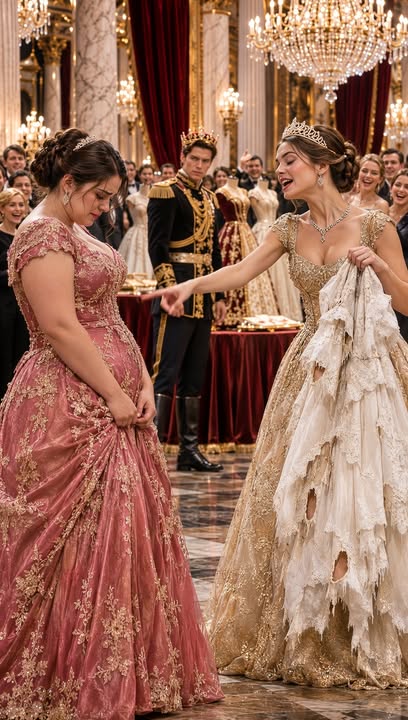
Part 5 – The Choice No One Could Make for Him
“Could it identify where the dress was stored?” Mara asked.
Mrs. Rowe turned the tiny linen square beneath the magnifying glass, careful not to let its brittle edge catch on the lens.
“Perhaps,” she said. “The east wing used numbered shelves before the archive was reorganized.”
Adrian leaned toward the table.
“Can you find the old shelf lists?”
“I can look, Your Highness, though it may take time.”
“Then please do.”
Mara watched the archivist wrap the fragment in a protective sheet.
The gown had already yielded more answers than anyone expected, but its smallest clue was still pointing toward another room, another record, another piece of a history the palace had almost forgotten.
The archive staff began their search while Master Vale secured the dress.
Adrian remained beside the table, quiet now, his mother’s message resting in its clear sleeve between them.
“The contest was meant to end tonight,” he said.
Mara glanced at the tall windows.
Beyond them, the palace gardens were bright with rain, the paths shining beneath the afternoon sky.
“People will still expect you to choose someone.”
“They will.”
“And the council?”
“They will expect me to keep the challenge on schedule.”
Mara folded her hands together.
“Do you still want to continue it?”
“I don’t know.”
The answer was not the one she expected.
Adrian looked down at the old gown.
“Before yesterday, I thought the challenge was a way to learn which woman could see beyond a beautiful dress,” he said. “I believed that asking the contestants to judge the gowns would tell me something about their judgment.”
“But it started with a false assumption.”
“Yes.”
“And now?”
“Now I am asking them to compete for a place beside me, while knowing that the court has already decided some of them belong and others do not.”
He looked at her.
“I am not sure a fair answer can come from an unfair question.”
Mara felt the weight of his uncertainty, and with it the weight of what a decision might cost.
“If you stop the contest,” she said, “some people will say you changed the rules because I found the truth.”
“They may.”
“Others will say you are avoiding the choice.”
“They may say that too.”
“And Lady Celestine’s family may think you led her to believe she had a chance.”
“I did not promise her a match.”
“No,” Mara said. “But people can build a promise from silence.”
Adrian’s face grew still.
“That is true.”
He seemed to be listening to the words as much as to the way she had said them.
Mara glanced toward the archive door, where Celestine had stood earlier, watching the examination without trying to take control of it.
“I don’t want you to stop the contest because you think it will make me feel better,” she said.
“That is not why I would stop it.”
“I don’t want to be the reason someone else is humiliated.”
“Neither do I.”
“Then you will have to tell the truth about what you decided and why.”
Adrian’s eyes held hers.
“You would say that even if the choice cost you the chance to remain at court?”
Mara’s throat tightened.
The answer was easy to understand and difficult to give.
“Yes,” she said. “The gown and your mother’s words matter more than whether I stay.”
He looked at the rose-pink sleeve of her dress, then at the hands that had spent the morning coaxing an old thread out of fragile silk.
“I do not want you to think your work has no place here.”
“My work has a place anywhere someone needs a garment restored.”
“That is not quite the same as having a place here.”
“No,” she said. “It isn’t.”
For a moment, neither of them looked away.
Then the archive door opened, and Celestine entered with her mother.
Her expression was composed, but the corners of her eyes carried the weariness of someone who had spent the afternoon listening to other people decide what her future meant.
“The council has asked for a private word with you, Your Highness,” she said. “They are discussing whether the final challenge should go forward.”
“Have they reached a decision?”
“They seem to believe it should.”
“Why?”
“Because the guests are waiting, the announcements have already been made, and the court prefers a ceremony with a beginning and an end.”
Adrian let out a quiet breath.
“Do you agree?”
Celestine looked at the gown.
“No.”
Her mother turned slightly toward her, surprised.
Celestine continued before she could be interrupted.
“I have spent most of my life being told what the contest was meant to lead to. I thought that was what I wanted. I still want to matter to my family, but I don’t want a match that begins with everyone pretending the terms are fair.”
Her words were careful, but there was no hesitation in them.
Adrian studied her.
“What would you have me do?”
“I cannot make that choice for you.”
“That is not what I asked.”
Celestine’s eyes moved toward the open ledger.
“Then I would tell you not to choose a bride because the court expects the evening to end with one.”
Her mother’s face softened with sorrow and pride.
“You’ve never said that before,” she murmured.
“I’ve never understood it before.”
Celestine looked toward Mara.
“I also owe you an apology without asking you to make me feel better about it.”
Mara’s fingers tightened around one another.
“You already apologized.”
“I apologized for making a spectacle of you. I should also apologize for treating your work as if it were a threat to me.”
Mara did not answer at once.
Celestine held her gaze, accepting the pause.
“I was afraid you would make it obvious that I had no idea what I was doing,” Celestine said. “So I tried to make you look as though you did not belong.”
“You could have asked me about the seams.”
“I could have.”
“Or listened when I answered.”
“Yes.”
Mara felt the old sting of the ballroom return, though it no longer had quite the same sharp edge.
“I don’t know if I can trust you,” she said.
“I understand.”
“But I believe you mean the apology.”
Celestine gave a small nod.
“That is more than I deserve, for now.”
Adrian looked from one woman to the other.
The strain in his face eased, but the decision before him remained.
His mother’s note lay between them, no larger than a hand, and seemed to hold the whole room still.
A knock sounded at the door.
The royal secretary entered, carrying a message from the council.
“Your Highness, they are ready to receive you.”
Adrian took the folded note.
“Thank you.”
As the secretary withdrew, Celestine’s mother spoke.
“They will ask you to continue the challenge.”
“I know.”
“They may also remind you that my family has supported the crown for generations.”
“I know that too.”
Her mother’s expression remained measured.
“My family contributed to the wedding preparations because we believed in the crown, not because we were owed a prince.”
Celestine looked at her, startled.
“Mother, you always said—”
“I said the court would remember our loyalty. I did not mean you should be required to marry for it.”
The older woman took her daughter’s hand.
“I should have made that clearer.”
Celestine lowered her eyes.
The family expectation that had shaped her hopes did not disappear in a single conversation.
But for the first time, the adults who had helped create it were speaking plainly.
Adrian folded the council’s note.
“I will meet them now.”
Mara stepped back from the table.
“I should return to the restoration rooms.”
“You should come with me,” he said.
She hesitated.
“I’m not part of the council.”
“You are part of the truth they need to hear.”
The request made her uneasy.
A room full of councilors was not a ballroom, but it was another place where her words might be weighed against her position.
“Your Highness,” Celestine said, “if you want to show that this is your decision, do not ask Mara to carry it for you.”
Adrian looked at her.
“You are right.”
He turned back to Mara.
“You do not have to come.”
“I’ll come,” Mara said. “But I won’t tell them what choice to make.”
“I wouldn’t ask you to.”
They crossed the palace together, with Master Vale carrying the record of the gown’s restoration and Mrs. Rowe bringing copies of the transfer documents.
Celestine and her mother followed at a distance.
The council chamber was smaller than the ballroom, paneled in dark wood and lit by tall windows.
The members of the royal council sat around a long table, their papers arranged in exact stacks.
Some had served the crown for decades.
Others had joined more recently, but each wore the same expression of polished concern.
Adrian took his place at the head of the table.
Mara remained beside Master Vale, aware of the difference between her plain workroom shoes and the councilors’ polished boots.
The oldest councilor spoke first.
“Your Highness, we understand that an unexpected matter has arisen.”
“It is not unexpected any longer,” Adrian replied. “The queen’s gown was not stolen. It was entrusted to the first seamstress for safekeeping, then misplaced during the wardrobe transfer.”
The councilor glanced at Mrs. Rowe’s papers.
“Are the records conclusive?”
“The original transfer ledger and the archive entry both support that account,” Mrs. Rowe said. “The gown was later misidentified as damaged property.”
“And the message found in the sleeve?”
“It confirms Queen Elara’s request that the gown be preserved and returned to the prince when he was old enough to understand her meaning,” Master Vale replied.
The councilor looked at Adrian.
“Does the message contain anything that should be made public?”
“It contains my mother’s thoughts about judgment, compassion, and the worth of a person beyond appearance or family,” Adrian said. “I will share the relevant portion when the archive report is complete.”
“That may invite questions about the contest.”
“It should.”
The councilor folded his hands.
“Your Highness, the challenge was designed to help you make a careful choice. The contestants were told that the winner would earn your personal consideration. No promise was made.”
“No written promise,” Celestine said from the back of the room.
Her voice was steady, though every face turned toward her.
“Still, the court allowed the expectation to grow. My family helped fund the queen’s wedding, and people spoke for years as though that meant I would someday be chosen.”
The councilor’s expression tightened.
“That was never an official arrangement.”
“I know that now.”
Her mother stepped beside her.
“It should have been said plainly long ago.”
The councilor considered them, then looked to Adrian.
“Even so, the contest can continue. The remaining task is straightforward. The contestants can identify the altered gown, and you can make your decision afterward.”
Mara listened to the words and felt the old unease rise again.
Straightforward was how a complicated truth became a convenient story.
Adrian glanced toward her.
She said nothing.
The councilor continued.
“If the competition is halted, some will interpret it as a change of heart prompted by the seamstress’s discovery.”
“Then I will explain my reasons.”
“They may believe the court has been made to look careless.”
“We were careless.”
A few councilors shifted in their seats.
Adrian did not raise his voice.
“We kept an accusation alive for years without verifying the records. We invited these women to compete in a challenge based on a question that was not what it appeared to be. We let people assume that a family contribution had created a claim to a marriage.”
“Your Highness, no one intended harm.”
“I am not judging anyone’s intentions. I am deciding what I will do with what we now know.”
The oldest councilor leaned back.
“And what do you propose?”
Adrian looked down at the message from his mother.
For an instant, the room seemed to fall away from him.
Mara saw his hand rest beside the protective sleeve, not on the note itself.
Then he looked up.
“I will end the bride competition.”
The silence that followed was complete.
He continued before anyone could fill it.
“I will not choose a wife through a contest that asks women to prove their worth to a court that has already decided what worth should look like.”
One councilor frowned.
“Your Highness, a public withdrawal could be seen as a rejection of every contestant.”
“I will make clear that no woman is being rejected for failing. The process itself was wrong.”
“What of Lady Celestine?”
The question was asked gently, but it carried the weight of her family’s long expectations.
Adrian looked toward her.
“Lady Celestine deserved an honest answer long before this evening. I will not pretend that choosing her would repay her family’s support, because marriage is not a debt the crown can settle.”
Celestine’s face changed.
The answer hurt, but it did not humiliate her.
Her mother squeezed her hand.
“And the seamstress?” another councilor asked.
Mara felt the room turn toward her.
Adrian answered before she could.
“Mara’s work helped uncover the truth, but she will not be made a symbol to excuse the court’s failures. She is a skilled seamstress whose expertise should be recognized on its own merits.”
Mara’s throat tightened.
She had not expected him to say her name without making it part of the competition.
The councilors exchanged glances.
“Your Highness, that is an admirable sentiment,” one said, “but the restoration rooms do not fall under your direct office.”
“They fall under the royal household.”
“They are already staffed.”
“Then we will review the staffing and the condition of the collection.”
“That will require funding.”
“Then the budget will be amended.”
The answer was immediate, but not reckless.
Mara recognized the tone of someone who had already begun weighing the work it would take.
The oldest councilor looked toward the archive records.
“You are prepared to accept the consequences?”
“Yes.”
“The nobles will ask why the prince has canceled the contest.”
“Then I will answer them.”
“They may question whether you are ready to choose a partner at all.”
“I may not be.”
That answer surprised them more than the decision had.
Adrian’s expression remained calm.
“I will not make a lifelong choice because the court expects a ceremony to conclude with an engagement.”
The councilors had no simple reply for that.
Celestine moved closer to the table.
“I support the decision,” she said. “Not because it benefits me, but because it is the first honest thing I have heard about the contest.”
Her mother nodded.
“Our family will not oppose it.”
A councilor looked between them.
“You understand that your support may be interpreted as a withdrawal of your family’s claim?”
“We had no claim,” Celestine replied. “We had an expectation, and we let it stand in for a promise.”
The words seemed to release something from her shoulders.
The oldest councilor rose.
“Then the prince has made his choice.”
“No,” Adrian said. “I have made a choice about the contest. I have not chosen a bride.”
The distinction mattered.
Mara could see it in the way Celestine held herself, and in the councilors’ guarded faces.
Adrian would not replace one assumption with another.
He would not turn a seamstress’s skill into a romantic reward, or Celestine’s family history into a debt, or the court’s impatience into a reason to decide before he was ready.
The council meeting ended without applause.
The members left carrying their documents and their concerns, some more quietly than others.
Outside the chamber, Celestine stopped beside Mara.
“I am sorry,” she said.
Mara met her eyes.
“I believe you.”
“I’m glad you found the truth, even though I don’t know what it means for me yet.”
“Neither do I.”
Celestine gave a faint smile.
“Perhaps that is the first fair answer we’ve both had.”
She returned to her mother.
Adrian stood a few steps away, looking toward the tall windows at the end of the corridor.
The rain had stopped, and the gardens shone beneath a break in the clouds.
“Was that the right decision?” he asked Mara.
She considered the question.
“Was it the honest one?”
“I believe so.”
“Then you will have to live with the rest of it.”
He gave a small, almost weary smile.
“I suppose I will.”
A royal announcement was prepared for that evening.
Adrian stood before the assembled court, with the contestants, the council, and the palace staff gathered beneath the chandeliers.
This time, the queen’s wedding gown was not carried into the ballroom as a prop.
It remained in the archive, protected from the crowd and returned to the care it had once been promised.
Adrian spoke without a ceremonial flourish.
“The competition is over,” he said. “No winner will be named, and no marriage will be expected of any contestant.”
A quiet murmur rose, then faded.
He explained that Queen Elara’s gown had been entrusted to a palace seamstress, misplaced during a wardrobe transfer, and wrongly labeled in later records.
He did not call the error theft.
He did not suggest that the people who had repeated the old story were malicious.
He simply said the story had been wrong, and that the crown had a responsibility to correct it.
Then he described his mother’s message.
He shared only the passage about judgment and compassion, preserving the rest of her words for the archive.
When he finished, he faced the gathered court.
“I asked you to judge a mystery before I understood its history. I made the challenge sound fair because I believed the rules were fair. I was wrong.”
Mara stood among the palace workers at the rear of the room.
No one looked through her.
But the attention did not feel like a prize.
It felt like a chance for everyone in the room to see the person whose work had been dismissed as small.
“Queen Elara’s gown will be returned to the royal archive,” Adrian continued. “The records will be corrected, and the staff who cared for the royal collection will be acknowledged by name.”
He paused.
“And I will no longer treat marriage as a contest to be won.”
The statement sent a stir through the room.
Some nobles looked disappointed.
Others seemed relieved that he had said aloud what many had thought but never dared to question.
Celestine stood near her mother, her head held high without the hard pride she had worn before.
Mara saw her take a measured breath.
Then Celestine stepped forward.
“I would like to add something,” she said.
Adrian turned toward her.
The court quieted.
“My family supported the royal wedding generations ago, and I grew up believing that support gave us a place in the future of the crown,” she said. “I was wrong to treat that belief as a promise, and wrong to make another woman feel she did not belong because I was afraid my own place was uncertain.”
Her gaze found Mara.
“I’m sorry.”
The apology did not erase what had happened.
But it was offered in front of the people who had witnessed the insult, and Celestine did not ask Mara to rescue her from the discomfort of saying it.
Mara gave her a small nod.
Celestine’s mother stepped beside her daughter.
“My family’s support was freely given,” she said. “We will continue to support the palace workers who preserve its history, and we will not ask for a marriage in return.”
The promise was quiet but meaningful.
A few of the councilors looked surprised.
Adrian inclined his head to them both.
“Thank you.”
The evening ended without a winner, a proposal, or a parade of congratulations.
Some people left still questioning the decision.
Others remained to speak with Master Vale and Mrs. Rowe about the archive records.
Mara stayed behind to help return the magnifying glass to its padded case.
Adrian came to stand beside her.
“You were right,” he said. “I had to make the choice without asking you to make it for me.”
“I only told you what I believed.”
“That was enough.”
The ballroom seemed different with the chandeliers dimmed and the guests gone.
Without the crowd, it was possible to see the worn places in the floor beneath the polished surface.
“I’m sorry the contest put you in the middle of the court’s expectations,” he said.
“I was in the middle of the mystery before I knew what it was.”
“And now?”
“Now I’d like to go back to the workroom and finish the sleeve.”
He smiled faintly.
“I should have expected that answer.”
“Old silk doesn’t care whether there was a royal announcement.”
“No,” he said. “It only asks to be handled carefully.”
Mara looked at him.
He had remembered his mother’s words, and her grandmother’s lesson, and the difference between being admired and being trusted.
Perhaps that was what the message had been waiting for.
A palace attendant approached with a sealed document bearing the royal crest.
“Your Highness, this was delivered from the east-wing records office. Mrs. Rowe asked that you see it before the archive report is finalized.”
Adrian accepted the document.
“What is it?”
“A newly discovered shelf register, Your Highness.”
He broke the seal.
Inside was a narrow page of handwritten entries, its ink faded but legible.
Mara stepped closer as he read.
The first lines listed ordinary garments, each paired with a number and a storage location.
Then Adrian stopped.
His expression changed.
“What does it say?” Mara asked.
He turned the page toward her.
A line had been added in a different hand: E—17, bridal collection, to remain sealed until the prince is ready.
Beneath it was another note, written much later.
The gown had not been the only item placed on that shelf.
**–END OF PART 5–CLICK “NEXT” AT THE BOTTOM OF THE PAGE TO CONTINUE READING**
* * *
[PREVIOUS: PART 4](https://storyly.idolsgift.com/blog/part-4-the-thread-beneath-the-hem-069) | [NEXT: PART 6(THE END)](https://storyly.idolsgift.com/blog/part-6-the-end-the-thread-beneath-the-hem-069)
✓ Lynn R. Adams
Part 5 – The Choice No One Could Make for Him “Could it identify where the dress was stored?” Mara asked. Mrs. Rowe turned the tiny linen square beneath the magnifying glass, careful not to let its …