PART 5: The Stitch Beneath Her Apron 057
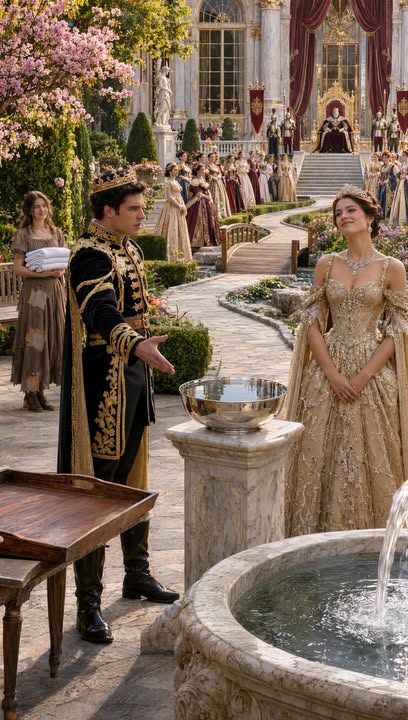
Part 5 – The Choice Beneath the Crown
The name on the letter was written in the queen’s familiar hand.
Lena stood beside the archive table, staring at it as if the ink might rearrange itself into something less impossible.
The king did not reach for the envelope.
Neither did the prince.
Master Orren lowered the box carefully onto the table, then stepped away to give Lena room.
“Is it really addressed to me?” she asked.
“It appears so,” the king said.
“But the queen never knew me.”
“No,” he replied. “She could not have known you as the woman standing here.”
The distinction mattered.
Lena was not a princess hidden in the laundry quarters, nor the lost child entrusted to Maris.
She was Maris’s daughter, born years later, raised beyond the palace, and brought here by a silver bowl and a fair question.
Still, the queen had known that one day she might read those words.
“May I open it?” Lena asked.
The king nodded.
“It belongs to you.”
She eased the paper from the box.
The outer fold had yellowed, and the queen’s seal had broken long ago, but the letter itself remained intact.
Lena opened it with careful fingers.
The first lines were written in the same steady hand as the note from the locket.
To the daughter of Maris, if you have come to this letter, then time has carried the truth farther than I could.
Lena stopped.
For several seconds, the words blurred before her.
She blinked and continued.
Your mother was trusted with a child who could not safely remain at court.
She did not take that child for her own, nor did she leave the palace with anything that belonged to the royal household without my consent.
The child was Princess Elowen’s daughter, and the locket was given to Maris so the girl might one day be known, should it become safe to speak her name.
Lena felt the weight of the locket beneath her apron.
The letter continued.
Maris’s own child was not born when she left us.
I have seen the baby’s first blanket and heard Maris speak of the little one she hopes to have.
If you are that child, know that your mother left because she had promised to protect another life, and because I asked her to do so.
She did not ask for honor or payment.
She asked only that her daughter be allowed to grow beyond the reach of courtly ambition.
The queen had written those words before Lena’s birth.
The room around her seemed to draw a slow breath.
She read the next lines in silence.
If my name has become a burden to you, set this letter aside.
You owe the palace no gratitude for being kept safe from a history you never chose.
But should you wish to know what became of the child Maris protected, search the household records for the name she was given beyond the court.
The name is—
The line ended there.
The rest of the page had been torn away.
Lena looked at the narrow, ragged edge.
“Was the last part lost?” the prince asked.
“It appears so,” Master Orren replied. “The tear is old.”
“Could it have been removed from the box?” Lena asked.
“Yes,” the archivist said. “But I cannot say when.”
The king lowered his eyes.
“I am sorry.”
Lena folded the letter along its original creases.
She felt neither the sudden relief of a mystery solved nor the clean grief of an answer found.
Her mother had protected a child.
The queen had trusted her.
The king’s records had been altered to hide the arrangement, and the missing name remained missing.
But one truth had come into the light: Maris had not been accused of stealing the locket.
She had carried it with permission, just as she had carried the child.
“Your Majesty,” Lena said, “you can clear my mother’s name now.”
“I will.”
“Not privately.”
The king met her gaze.
“You want it entered into the public record.”
“I want people to know she did nothing wrong,” Lena said. “Not just because you and I have seen a letter in an archive.”
“It will be announced before the court,” he replied. “And recorded in the household history.”
“Will you tell them what she did?”
“Only what the evidence supports.”
“Then tell them that.”
The king nodded.
He did not try to dress the truth in grander words than it could bear.
“I will say Maris served the late queen faithfully, and that she left the palace at the queen’s request to protect a child during a dangerous time.”
Lena’s hand closed around the letter.
“Will the court ask who the child was?”
“They may.”
“Will you tell them?”
“Not until we know where she is and what she wants.”
Lena looked at him, surprised.
“You would keep the secret?”
“If revealing it could endanger her, yes.”
The answer came without hesitation.
“Even if it would help the royal family?”
“Especially then.”
Something in Lena eased, though she was not ready to call it trust.
The king had spent years not knowing the truth.
Now that he knew part of it, he seemed willing to let the missing piece remain missing rather than claim it for the throne.
The prince leaned forward, resting his hands on the edge of the table.
“What do you want to do now?”
Lena looked down at the queen’s letter.
The obvious answer was to return to her work and let the palace continue its search without her.
She had never asked to become part of royal history.
She had never wanted the attention of nobles, courtiers, or the prince.
The garden challenge had already brought more eyes upon her than she had known how to bear.
“I want my mother’s name cleared,” she said. “Then I want to go home.”
The prince’s expression changed, but he did not interrupt.
The king’s gaze softened.
“You are free to leave whenever you wish.”
“I know.”
“Would you like me to arrange a safe journey?”
“Yes. But not today.”
The answer surprised even her.
She needed time, she realized, though she could not yet say what for.
The queen’s letter had given her mother a place in the story, but it had also placed Lena inside the palace’s unfinished questions.
She did not want to leave because she was frightened.
She did not want to stay because the prince had looked at her kindly.
And she did not want the court to mistake her presence for a claim, a reward, or an invitation to make her into something she had never chosen to be.
The prince seemed to understand at least some of that.
“I’m not going to ask you to stay because of what your mother did,” he said.
“Good.”
“And I won’t ask you to marry me because you carried a bowl without spilling it.”
“Also good.”
A faint smile touched his face.
“But I would like to ask you to stay at court for a while, if you choose to.”
Lena looked at him.
“As what?”
“As yourself,” he said. “Not as a symbol, and not as a prize.”
“That may be difficult for the court to understand.”
“Then the court can learn.”
“That sounds easier when you say it than when I have to live it.”
“I know.”
She studied his face for any hint of impatience, but he gave her none.
“What would you ask me to do?”
“Help us make the contest fair,” he replied. “Help us listen to the people who keep the palace running. You see things I have overlooked.”
“I’m not a royal adviser.”
“I didn’t say you were.”
“I’m a maid.”
“You are Lena.”
The simple answer settled between them.
It was not a promise that the palace would change.
It was not a guarantee that he could protect her from every difficult glance or careless word.
But he was not pretending she had become someone else just because the king had found an old letter addressed to her.
Celeste waited outside the archive with a report from the gardeners.
When Lena emerged, Celeste looked at her face before asking anything.
“Do you want to talk about it?” she asked.
“Not yet.”
“Then we can talk about the course.”
That was a kindness Lena understood.
They returned to the garden together.
The old bridge had been taken apart, its softened support set aside for repair.
A new route had been marked along the stone path, with sturdy boards laid across the damp stretch near the steps.
Several contestants had gathered beneath the trees.
Some looked eager for another attempt; others appeared relieved to be released from the competition.
The prince stood before them with the judge and the gardeners.
He held no ceremonial scroll and wore no crown.
“Yesterday’s results will not decide the contest,” he announced. “The course was not fair to everyone who attempted it, and the challenge will be reopened only when every part has been inspected.”
A noblewoman in a pale green gown raised her hand.
“Will we all have to try again?”
“No,” the prince said. “Anyone who chooses not to compete may withdraw without penalty.”
“And those of us who do compete?”
“You will receive the same course, the same time, and the same rules.”
Celeste stood beside Lena, her notebook tucked beneath one arm.
“The bridge and stones have been checked by the gardeners,” she said. “I have recorded what was changed, and the judge will inspect it again before the first attempt.”
The noblewoman in gold listened from the front of the group.
When the prince finished, she stepped forward.
“I would like to make a suggestion.”
“Please do,” he said.
“Yesterday’s challenge measured balance, but the rules did not allow contestants to stop when they noticed a danger.”
A few women glanced toward Lena.
The prince looked to her, but did not ask her to speak for Celeste.
Celeste continued.
“If noticing a hazard is part of good judgment, the contestant should be able to call for an inspection without being treated as if she has failed.”
The prince nodded.
“That seems reasonable.”
Lena looked along the course.
“Then the clock should stop for anyone who raises a safety concern,” she said. “The judge can inspect it, and the contestant can decide whether to continue.”
“Agreed,” the prince said.
“And the same time should be restored if the course is found unsafe,” Celeste added.
“Agreed.”
The judge began writing down the revised rule.
One of the older contestants, who had spilled water at the final steps, studied the repaired path.
“Will you be competing again, Lena?” she asked.
The question was not unkind, but it carried the curiosity of the whole garden.
Lena felt every face turn toward her.
“I haven’t decided.”
The prince did not fill the silence for her.
Celeste did not either.
The choice was hers to make, and she felt its weight more clearly than she had felt the silver bowl.
If she competed again, the court might say she wanted to be queen.
If she stepped away, it might say she had been afraid, or that the king had made a special arrangement for her.
If she stayed at the palace, she might become part of a story that had begun before she was born.
If she left, the servants who worked beside her would still carry the palace’s burdens without being heard.
“I’ll decide after the rules are written,” she said.
The prince accepted this with a nod.
“That is fair.”
A scribe brought forward the revised rules, and Celeste checked each line against her notes.
Lena read them slowly.
Every contestant would begin with a full bowl.
Each would have the same time.
Any safety concern would pause the clock for inspection.
No result would be final until the judge certified that the course had been fair.
At the end, the contestant would be asked not only how she had completed the task, but what she had noticed along the way.
Lena looked up.
“Did you change the challenge into a different one?”
“I changed it into the question I should have asked from the beginning,” the prince replied.
“What question is that?”
“Whether someone can carry responsibility without pretending the path is always safe.”
Celeste gave him an approving look.
“That is better.”
“It is still a little grand,” Lena said.
The prince laughed.
“I’ll work on it.”
By noon, the gardeners had finished their inspection, and the judge signed the revised rules.
The contestants were invited to decide whether they would continue.
Several stepped back from the line.
Some wanted to try again.
Lady Celeste raised her name first.
Then the pale-green noblewoman stepped forward.
The gold-gowned contestant joined them.
Lena remained beside the bench.
The prince approached only after the others had gathered around the fountain.
“Would you like time to think?” he asked.
“I’ve had more time than I wanted.”
“That doesn’t mean you need to decide now.”
“I know.”
She watched Celeste adjust her grip on the bowl.
The noblewoman’s hands trembled slightly, but she breathed once, slowly, and steadied them.
Yesterday, Celeste had approached the course certain that preparation could protect her from failure.
Today, she seemed more interested in discovering what the course demanded.
Lena recognized the feeling.
The judge called the first contestant forward.
Celeste began the course at a measured pace.
She passed the narrow turns and stopped before the repaired bridge to test it with the toe of her shoe.
The judge paused the clock.
The plank remained firm.
“Continue,” Celeste said.
She crossed safely, reached the steps, and completed the route with a small ripple at the rim but no spill.
She set the bowl down and let out a breath.
“Not perfect,” she said, looking at the water.
“But complete,” Lena replied.
Celeste smiled.
The next contestant took her turn.
Then the next.
The contest unfolded without applause for every graceful step or jeers for each mistake.
The prince watched the women as people rather than pieces in a royal display.
When one contestant decided she no longer wished to continue, the judge thanked her and recorded her withdrawal without judgment.
Lena found herself watching the servants as much as the contestants.
A groundskeeper held the measuring cord.
Two attendants refilled the bowls.
The judge asked the gardeners for their inspection before each round.
For the first time, the work around the challenge was visible to everyone, not merely the polished performance at its center.
The king arrived in the garden before the final contestant’s turn.
He had changed into a dark blue coat, and in his hands he carried a sheet bearing the palace seal.
“I have a public statement to make,” he told Lena.
Her stomach tightened.
“Now?”
“If you are ready.”
She looked toward the contestants, then toward the servants gathered along the garden wall.
“Let them finish first.”
The king accepted her answer.
He waited beside the judge until the last contestant had completed her attempt.
Then he stepped forward.
“The palace has reviewed its records concerning Maris, who served as a laundress and trusted attendant in the household of the late queen,” he said.
The garden quieted.
Lena stood beneath the cedar with Celeste beside her.
The king continued.
“An old record had been altered, leaving an incomplete account of her departure from service and the queen’s property. The evidence now before us shows that Maris left at the queen’s request, carrying an item entrusted to her for the protection of a child.”
A hush passed through the gathered nobles.
“She did not steal from the royal household,” the king said. “She acted faithfully and with discretion. The crown clears her name, and her service will be entered into the public record.”
Lena felt the words move through her, slow and deep.
Her mother’s name had been spoken aloud in the garden where Lena had first been told she belonged in the laundry room.
Now the king was saying that Maris’s work had mattered.
Not because she had been noble.
Not because she had been related to anyone on the throne.
Because she had been trusted, and she had kept faith.
The king turned toward Lena.
“I am sorry that it took so long for the truth to be recorded.”
Lena held his gaze.
“Thank you for saying it where everyone could hear.”
He bowed his head.
The response from the gathered court was not thunderous.
It was a quiet, respectful stillness, followed by the gardeners’ applause and then the servants’ voices joining them.
Lena heard her mother’s name pass from one person to another.
For a moment, she could almost feel Maris beside her, the needle moving through brown linen, the lavender scent of clean clothes rising around them.
The king’s statement did not return the years they had lost.
It did give them a name they could speak without shame.
When the applause faded, the prince stepped forward.
“The contest will continue under the revised rules,” he said. “No winner will be announced until every contestant who wishes to compete has had a fair opportunity.”
He looked toward Lena, but did not single her out.
“And no one will be expected to accept a crown, a title, or a future they have not chosen.”
The court murmured.
One of the older noblemen shifted uncomfortably.
“Your Highness,” he began, “the purpose of the challenge was to choose a queen.”
“The purpose was to find a partner,” the prince replied. “A crown cannot make that choice for either of us.”
His words carried farther than Lena expected.
She could see the noblemen exchanging glances, some disapproving, others thoughtful.
The prince did not look back at them.
He turned to the contestants.
“If anyone wishes to withdraw, you may do so without losing the respect of this court.”
Lena watched him speak and understood that his decision might cost him something.
The powerful families had expected a swift announcement, perhaps a beautiful bride chosen by a simple test.
Instead, he was delaying the result and inviting questions about the rules that had once seemed unquestionable.
It was the first time Lena saw him risk more than an easy answer.
When the garden began to empty, he found her beneath the cedar.
“I meant what I said,” he told her. “I would like you to stay at court for a while, if you want to.”
“And if I don’t?”
“Then I’ll arrange your journey home.”
“You won’t be disappointed?”
“I will miss having your judgment nearby,” he said. “That isn’t the same as believing you owe me your presence.”
Lena looked at the fountain.
The silver bowl rested beside it, its rim catching the afternoon sun.
“I don’t want to be offered a place at court because my mother protected someone.”
“I know.”
“I don’t want to be asked to marry you because I won a contest you haven’t finished judging.”
“I know.”
“And I don’t want to stay because I think I can repair the palace by myself.”
“No one should ask you to do that.”
She let the silence stretch.
The palace had always been two places to her.
There were the bright halls she entered only when summoned, and the narrow corridors where servants carried water, laundry, trays, and tired feet.
She could leave and return to the quiet life she knew.
Or she could remain, not as a secret to be uncovered or a symbol to be displayed, but as someone who had seen the palace from below and now had the chance to speak where decisions were made.
“If I stay,” she said, “it will not be as a contestant the prince has already chosen.”
“Agreed,” he replied.
“The challenge must be completed fairly.”
“Yes.”
“The bridge stays closed until the gardeners certify it is safe, and the servants who maintain the course are thanked by name.”
“I can do that.”
“And the court must hear from the workers whose labor keeps this place standing, not just from people who sit at the table.”
The prince nodded, though she saw the difficulty in his expression.
“That will take time.”
“Then it will take time.”
He looked toward the palace, where several nobles were gathered in a tight circle.
“Some of them will object.”
“Some of them already do.”
“Would you still stay?”
Lena thought of Maris.
Her mother had left the palace to protect a child, then raised her own daughter far from the court’s reach.
She had not left because she despised the palace.
She had left because someone she loved needed safety more than the palace needed obedience.
Lena could honor that choice without repeating it.
“I will stay until the challenge is judged fairly,” she said. “And until my mother’s name is entered into the record.”
“Both will be done.”
“After that, I will decide whether I still want to remain.”
The prince bowed his head.
“That is more than fair.”
“It isn’t a promise to marry you.”
“I understand.”
“It isn’t even a promise to compete again.”
“I understand that too.”
“Good.”
He smiled, but did not ask for more.
Across the garden, Celeste approached with the revised contest record in her hands.
“The judge has signed it,” she said. “Every contestant has the same rules now.”
“Thank you,” Lena replied.
Celeste studied Lena’s face.
“You’re staying?”
“For now.”
“Then I am glad.”
Lena looked toward the line of contestants.
“Are you still competing?”
Celeste considered the question.
“Yes,” she said. “But I’m no longer sure I want to be chosen. I want to find out whether I can do the task without performing for everyone watching.”
“That seems a better reason.”
“I thought so too.”
Celeste tucked the record beneath her arm.
“I also spoke with the gardeners. They want their names included in the official report.”
“Then their names should be included.”
“I agree.”
The three of them stood together in the garden as the last of the sunlight slipped across the stone path.
The king had returned to the palace with the queen’s letter secured in the records room, while Lena kept the locket close against her waist.
The past had given her an answer about her mother.
It had not given her the name of the child Maris once protected.
The torn edge of the queen’s letter remained in Lena’s thoughts.
That evening, Master Orren sent word that he had found a second copy of the missing household page.
Lena returned to the records room with the king and the prince.
The page had been hidden inside the cover of a household account book, sealed there with brittle wax.
Master Orren had opened it carefully.
The record confirmed that Maris had taken Princess Elowen’s daughter from the palace.
It also named the village where the child had been placed.
Lena recognized the name.
It was the village where she and her mother had lived during her earliest years.
Her hands turned cold.
The king read the page again, his brow drawn.
“Does it say the child was raised with your mother?” the prince asked.
“Not exactly,” Master Orren replied. “It says Maris was to deliver the child to a household near the eastern river.”
Lena knew the river.
She had played on its banks as a little girl while her mother washed clothes in a basin nearby.
“Who was the child given to?” she asked.
Master Orren unfolded the lower edge of the page.
There, in the queen’s handwriting, was a name the archivist had not yet read aloud.
The king leaned closer.
Then he looked at Lena, and his expression changed.
“Do you know this name?” he asked.
Lena read the line.
The name belonged to the woman who had raised her mother after Maris died.
For a long moment, no one spoke.
Then Lena understood why her mother had kept the locket, why she had left the palace, and why the queen had written that the truth should not be told until the child was safe.
Maris had not carried the princess’s daughter to some distant household.
She had taken her to the very home where Lena herself had grown up.
The question that remained was no longer whether the child had been hidden in Lena’s village.
It was whether Lena had known the princess’s daughter all her life without ever knowing who she was.
**–END OF PART 5–CLICK “NEXT” AT THE BOTTOM OF THE PAGE TO CONTINUE READING**
* * *
[PREVIOUS: PART 4](https://storyly.idolsgift.com/blog/part-4-the-stitch-beneath-her-apron-057) | [NEXT: PART 6(THE END)](https://storyly.idolsgift.com/blog/part-6-the-end-the-stitch-beneath-her-apron-057)
✓ Lynn R. Adams
Part 5 – The Choice Beneath the Crown The name on the letter was written in the queen’s familiar hand. Lena stood beside the archive table, staring at it as if the ink might rearrange itself into so…