PART 5: The Slipper Turned Toward Me 046
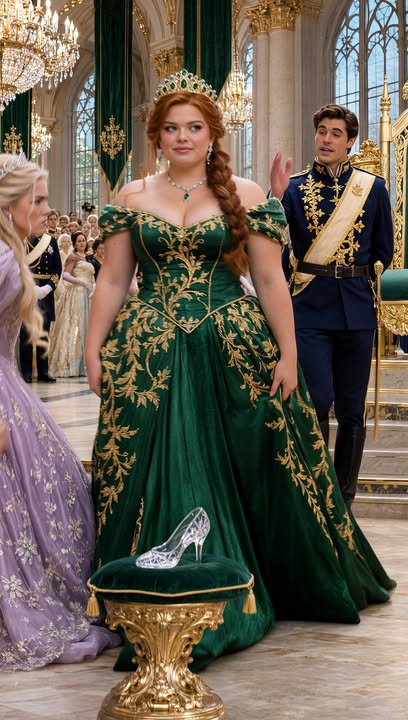
Part 5 – The Choice in the Open
“‘If the guardian chooses truth, the heir must choose her—or the crown.’”
The queen’s voice lingered in the library after she had read the hidden line.
William looked down at the page, his face composed but pale.
I wondered whether the letter had turned the room quiet, or whether we had all simply run out of words.
The old papers lay across the table between us, their faded ink carrying more weight than anything made of gold.
The queen sat back, her hands folded in her lap.
“This letter cannot decide the future for either of you,” she said.
“No,” I replied. “But it tells us someone expected us to face a choice.”
“Someone feared the choice might be made for you,” William said.
He looked at me when he said it, and I understood that the words on the page had changed something between us.
Not because he loved me.
We had not said that, and neither of us had the right to borrow love from an old letter and pretend it belonged to us.
But because the possibility of a cost had entered the room.
The queen rose and went to the window.
“By noon, the court will know that Eleanor Brooks was the king’s daughter,” she said. “The question is how much more we make public, and who gets to speak first.”
“Who gets to speak first?” I repeated.
“The palace has begun preparing a statement.”
“Without asking me.”
“I was going to discuss it with you.”
“After the words were already written?”
She turned from the window.
“They are only a draft.”
I looked to the archivist, who had been standing quietly by the door.
He avoided my eyes.
That was answer enough.
“What does the draft say?” I asked.
The queen hesitated.
“It says the palace has confirmed Eleanor’s identity and recognizes her descendants as members of the royal family.”
“Descendants,” I said. “That’s me.”
“Yes.”
“And what happens next?”
“Your ancestry becomes public knowledge.”
“That isn’t what I meant.”
William rose from his chair.
“Mother, what is the palace asking her to do?”
The queen’s expression tightened with fatigue.
“Nothing has been decided.”
The archivist shifted his weight.
“Your Majesty, the council asked that Miss Brooks be offered the choice to accept formal recognition.”
“Formal recognition as what?” I asked.
The queen looked at me.
“As the granddaughter of the king’s elder daughter.”
“That’s a fact, not a title.”
“They may also ask you to accept a place within the royal family.”
“What place?”
“A public one.”
I let the words settle.
A place in the royal family could mean a title, an official role, a place at ceremonies and on the steps of the palace whenever a camera waited.
It could mean strangers discussing my face, my body, my mother, my grandmother, and the decisions Eleanor had made before I was born.
It could mean that the first thing people learned about me was not that I was Amelia Brooks, but that I was a missing piece of a royal family’s history.
“Would I be expected to claim a place in the succession?” I asked.
“No,” the queen said quickly. “Eleanor chose not to contest the line, and the family will honor that.”
“Would I have a title?”
“If you accepted one.”
“And if I didn’t?”
“You could still be recognized as family.”
I glanced at William.
He had not tried to persuade me one way or the other.
His silence felt like a gift.
The queen moved toward the table.
“I want to be clear about something,” she said. “You owe the palace nothing. Your grandmother owed it nothing either.”
“Then why is the palace writing a statement about me?”
“Because the truth has been hidden, and hiding it longer would repeat the harm.”
That was the first answer she had given that did not sound like it had been shaped for the crown.
I believed her.
I also believed she was frightened.
The queen took a careful breath.
“I have spent my life protecting the institution I serve,” she continued. “I told myself that this was the same as protecting the people within it. Sometimes it was. Sometimes it wasn’t.”
She looked toward the portrait of Eleanor.
“I cannot undo what happened to her. I can only refuse to repeat it.”
A part of me wanted to take comfort in the promise.
Another part remembered that Eleanor had asked only to be remembered, and even that modest wish had been set aside.
“What if I don’t want to be a royal figure?” I asked.
“You are not required to become one.”
“What if I want the truth known, but I don’t want the palace to decide what my life means?”
“Then we must find a way to tell the truth without claiming your life for the institution.”
“Can the palace do that?”
The queen gave a small, rueful smile.
“We will have to learn.”
The archivist closed the wooden case containing the king’s papers.
“I should return these to the secure archive.”
“Please do,” the queen said.
He bowed, then gathered the ledger and the portrait.
Before he left, he glanced at me.
“Miss Brooks, the promise in the household ledger matters. It may be possible to restore Eleanor’s name to the official history without making any claim on your behalf.”
“Will the palace do that?”
The queen answered before he could.
“Yes.”
“Even if I decline a title?”
“Especially then.”
The archivist carried the documents out.
When the door closed, William came to stand near the table.
“Do you want me to leave?” he asked.
“Would that make anything easier?”
“I don’t know.”
His answer was gentle, and it sounded honest.
“No,” I said. “Stay.”
The queen returned to the window, giving us the room without leaving.
William leaned his hands against the back of a chair.
“I don’t want you to feel that the letter is a promise I’m asking you to keep,” he said.
“I don’t.”
“I also don’t want you to feel that my feelings, whatever they are, should decide what you tell the public.”
I searched his face.
“What are your feelings?”
He looked down for a moment, as if choosing words that would not turn into pressure once spoken.
“I care about you,” he said. “I care about what happens to you, and I want to know you beyond the things this palace has discovered about your family.”
The warmth that moved through me was quiet, but it was real.
“I care about you too,” I said. “But I don’t know what this becomes.”
“Neither do I.”
“And I don’t want to be chosen because a slipper recognized my blood.”
“I don’t want that either.”
“Nor do I want to become a test of whether you are willing to give up the crown.”
“I wouldn’t ask you to carry that.”
“You may not ask,” I said, “but the palace might.”
He absorbed that without protest.
“Then we won’t let the palace ask it of you.”
The queen turned from the window.
“William, neither of you can decide the effect of a public revelation in advance.”
“Then we’ll decide what we can,” he replied. “And accept what we can’t.”
His mother studied him.
For a moment, I saw the young prince who had been given a warning by his father and left without the answer.
The same uncertainty that had troubled me was waiting for him too.
“Your father’s letter says the heir must choose,” I said.
“It says that if the guardian chooses truth, the heir must choose between her and the crown.”
“I don’t want you to make that choice today.”
“I know.”
“I mean it, William.”
“So do I.”
“I won’t let the palace turn me into a reason you have to prove something.”
“You aren’t a reason,” he said. “You’re a person.”
The words were simple, but something in me loosened.
For years, I had learned to watch people decide what I was before they learned what I liked, what I feared, or what I hoped to do.
In the ballroom, they had seen my size before they had seen my name.
The slipper had offered a different kind of danger.
It had seen my bloodline before the rest of the world did.
“I don’t want to be a symbol,” I said.
“Then don’t be one,” William replied.
The queen’s voice was quiet.
“That may not be a choice the public allows.”
“Then I’ll keep correcting them,” I said.
The words surprised me with their certainty.
William’s expression softened.
The queen looked at me with something like respect, though there was sorrow beneath it.
“What do you want?” she asked.
I did not answer at once.
I thought of Eleanor’s note: Wear this when you are finally ready to be seen.
I had believed it meant I should stop hiding from other people’s judgment.
Maybe she had meant something more.
Maybe she had wanted me to be seen as myself, even when the truth around me was larger than I could imagine.
“I want her name restored,” I said. “I want the palace to admit she was the king’s daughter, and that she was entrusted with the slipper rather than accused of stealing it.”
The queen nodded.
“And you?”
“I don’t want a title.”
“Amelia,” William said, “you don’t have to decide everything now.”
“I know. But I know that much.”
The queen’s face showed relief, followed by concern.
“Then we can make that clear in the statement.”
“I want more than a statement.”
“What do you mean?”
“I want to speak for myself.”
The queen watched me carefully.
“You could make a personal statement after the palace confirms the records.”
“I don’t want to be introduced to the country as a royal discovery and then given a few minutes to explain why I don’t want the role they chose for me.”
“Then what would you propose?”
“I want to speak at the gathering this afternoon.”
“The court gathering?” William asked.
“The one you planned to use to announce the results of the selection ceremony.”
His expression changed.
“It isn’t only for the candidates. Several members of the press are expected.”
“I know.”
The queen stepped closer.
“Amelia, you do not have to stand in front of cameras to prove that you are willing to tell the truth.”
“I’m not doing it to prove anything.”
“I worry you’re making the decision while you are still hurt.”
“I am hurt,” I said. “That doesn’t mean I can’t think.”
The queen bowed her head slightly.
“No,” she said. “It doesn’t.”
“I won’t claim a place in the succession. I won’t accept a title just because the palace wants the story to end neatly. But I also won’t let Eleanor remain a line in a ledger with the word ‘dismissed’ beside her name.”
The room was quiet.
I could feel the decision moving into place within me, not as a sudden burst of courage, but as something steady that had been waiting for me to stop asking whether I was allowed.
“I want to tell the truth,” I said. “All of it that we can prove. I want the palace to say that Eleanor was the king’s daughter, that she gave up her claim by choice, and that she was the rightful keeper of the slipper.”
The queen’s eyes shone.
“And you will refuse any royal title?”
“Yes.”
“Even if you are offered one publicly?”
“Especially then.”
William looked at me, and I saw no disappointment in his face.
Only a question he did not ask.
“What will this mean for the selection ceremony?” I asked.
The queen answered after a pause.
“It cannot continue in its present form.”
“Because the slipper has chosen a keeper?”
“Because we now know it was never meant to choose a bride.”
“Will you announce that?”
“Yes.”
“And will you acknowledge that the ceremony judged women unfairly?”
The queen looked toward the ballroom, though its doors were far away.
“I will.”
“I want Olivia included.”
“Why?”
“She was humiliated by a tradition she believed she was meant to win. She also apologized to me, and she told me what her family knew. I don’t want her treated as a footnote in a story about me.”
The queen considered this.
“That is fair.”
“Will she speak?”
“I can invite her to stand with you.”
“Ask her. Don’t decide for her.”
“I will.”
A knock sounded at the door.
An attendant entered with a folded sheet of paper and a message from the palace secretary.
The draft statement had been prepared for the queen’s review.
She accepted it and read the first paragraph.
Her expression changed.
“What is it?” William asked.
The queen passed the paper to me.
At the top, in formal lettering, was a proposed headline for the palace announcement:
THE LOST PRINCESS RETURNS: AMELIA BROOKS RECLAIMS HER PLACE IN THE ROYAL FAMILY.
I read it once.
Then again.
The words made my skin feel too tight.
“I said I don’t want a title,” I said.
“This is only a proposed heading,” the queen replied. “It was written before our conversation.”
“Then it should be changed.”
“Of course.”
I set the sheet down.
There was a second page beneath it, covered in smaller text.
The palace secretary had included talking points, a short family history, and a suggested description of me.
“Amelia Brooks, granddaughter of the lost princess, whose blood awakened the ancient slipper.”
I looked up.
“Whose blood awakened it.”
The queen took the paper from my hand.
“I did not approve this language.”
“But it is already written.”
“I will have it removed.”
The words on the page were not cruel.
They were not intended to hurt me.
That almost made them worse.
The palace had taken a story about a woman who had been denied her name and turned it into a story about blood, magic, and a lost princess returning to her proper place.
I saw how easily my own life could disappear inside a phrase that sounded beautiful to everyone else.
“I want to see the statement before it goes out,” I said.
“You will,” the queen promised.
“And I want the palace to use Eleanor’s name, not ‘the lost princess.’”
“Yes.”
“I want it to say that she chose not to pursue the succession.”
“Yes.”
“And I want it to say she was erased despite asking to be remembered.”
The queen looked at the draft.
“That may be uncomfortable for the family.”
“It should be.”
A delicate silence followed.
Then the queen nodded.
“You’re right.”
William stepped beside me.
“You don’t have to carry this alone.”
“I know.”
“I mean it.”
“So do I.”
His hand rested near mine on the table, not touching until I turned my palm upward.
Then he placed his fingers gently against mine.
The contact was brief.
It did not feel like a promise, and that was what made it honest.
The queen watched us, but she did not interfere.
“I will have the statement rewritten,” she said. “And the afternoon gathering will proceed only if you are still willing to speak.”
“I am.”
“Then I will tell the court that the selection ceremony is suspended indefinitely.”
“Not suspended,” I said. “Ended.”
The queen held my gaze.
“Ended?”
“The slipper was never a prize. The ceremony shouldn’t continue as if it were.”
“Then ended,” she agreed.
William exhaled, as if the decision had lifted something from his chest.
“What happens to the tradition?” he asked.
“We will discuss that later,” the queen replied. “It should become something that honors service and character, not a contest in which women are judged by whether an object fits.”
“People will say we changed it because the slipper responded to me,” I said.
“They may,” the queen answered.
“Then I want them to know it was already wrong before it responded.”
The queen nodded.
“We will say so.”
For the next hour, the palace moved around us in quiet, purposeful currents.
The queen met with her secretary and the archivist to confirm which parts of Eleanor’s history could be verified.
William asked that the original household ledger be brought to the public archive, where the relevant pages could be viewed by historians.
I sat with Olivia in a small drawing room while the palace staff prepared the gathering.
She had returned to the lavender gown but had removed the diamonds from her hair.
When I told her I planned to speak, she listened without interrupting.
“I’d like you to stand with me,” I said. “If you want to.”
“Why me?”
“Because you were part of the ceremony, and because you were honest with me when it mattered.”
“I also laughed at you.”
“Yes.”
“I don’t know if I deserve to be beside you.”
“That isn’t the question.”
Olivia’s eyes lowered.
“I don’t want to be there to make myself look better.”
“Then don’t.”
She gave a small, unsteady laugh.
“You make that sound simple.”
“It isn’t simple. But it’s still your choice.”
Olivia sat with the words for a moment.
“Then I’ll stand with you,” she said. “If you’re sure.”
“I am.”
“I don’t know what I’ll say.”
“You don’t have to say anything.”
“I think I should.”
“Then say what you believe.”
She looked at me, and this time the uncertainty in her face did not seem like fear.
It seemed like the beginning of thought.
“I believed the slipper belonged to my family,” she said. “I believed that made me more deserving than you. I never asked why I believed it.”
“Maybe we can both ask better questions now.”
She nodded.
When I left her, William was waiting in the corridor.
“Are you ready?” he asked.
“No.”
“Would you like more time?”
“No.”
“Then I’ll walk with you.”
The palace doors opened into the great hall.
Beyond them, the gathering waited beneath the chandeliers where I had first approached the slipper.
The glass case stood on a raised table near the center of the room.
It was empty.
The slipper had been returned to the secure chamber.
Still, when I entered, I felt the crowd looking toward the space where it had rested.
The queen waited at the far end of the hall beside a lectern.
Several courtiers stood behind her.
The press had gathered near the columns, their cameras lowered for the moment.
Some of the candidates from the ceremony sat together near the front.
Olivia joined me on one side.
William stood on the other.
The queen’s eyes met mine, and she gave a small nod.
I stepped toward the lectern.
My emerald gown whispered against the polished floor.
For one brief moment, I was again the woman standing behind the crowd, wondering whether she had the right to ask.
Then I remembered Eleanor’s words.
Wear this when you are finally ready to be seen.
I faced the room.
“My name is Amelia Brooks,” I began. “I am not here because a glass slipper has chosen me, and I am not here to claim a title.”
A murmur moved through the hall.
I kept my gaze steady.
“I am here because I have learned that my grandmother, Eleanor Brooks, was the eldest daughter of King Edward. She chose not to pursue a place in the succession. She asked only that her name be remembered, and the royal household failed to honor that promise.”
The queen stood still beside me.
“Eleanor was accused of taking the glass slipper,” I continued. “The records we have found show that she was entrusted with it as its guardian. The palace’s own history made her look like a thief when she had been protecting something the crown placed in her care.”
The silence in the hall changed.
It was no longer the frozen silence of the ballroom.
It was the silence of people listening.
“I will not accept a royal title,” I said. “I will not claim a place in the succession. My ancestry is part of my history, but it does not tell you who I am, and it does not give anyone the right to decide what my life should become.”
I turned slightly toward the queen.
“I ask the palace to restore Eleanor’s name, to correct the record about the slipper, and to admit publicly that the selection ceremony used women’s bodies as a measure of worth.”
The queen’s mouth tightened with emotion.
“We will,” she said.
Her voice carried clearly across the hall.
“We will restore Eleanor Brooks’s name to the official history of this family, acknowledge her as King Edward’s daughter, and correct the record that wrongly connected her dismissal with theft. She was entrusted with the glass slipper. She should never have been described otherwise.”
A few people lowered their heads.
The queen stepped closer to the lectern.
“I also owe Eleanor an apology,” she continued. “The royal family protected its own reputation by remaining silent about her, and that silence erased a life she had asked us to remember. I cannot speak for every person who came before me, but I can say that we were wrong.”
A hush passed through the hall.
I looked at her.
For the first time since the slipper had turned toward me, the queen did not seem frightened by what the truth would cost her.
She seemed prepared to pay it.
William came to the lectern.
“I will support the queen’s decision,” he said. “And I will support Amelia’s right to choose her own future, whether or not that future is connected to this palace.”
The court watched him.
His words were careful, but his hand rested on the lectern beside mine.
“I will not ask Amelia to become a symbol of my family’s history,” he said. “She has already carried enough of what we failed to say.”
I turned my head toward him.
He met my eyes.
Neither of us smiled, but I felt the warmth between us all the same.
Olivia stepped forward next.
“I was part of the ceremony,” she said. “I believed the slipper was meant to prove that certain women were born to be chosen. I mocked Amelia when the glass did not fit me. I was wrong to judge her, and I was wrong to believe that the tradition made any of us more worthy than another.”
She looked toward the gathered candidates.
“The ceremony should not continue as it was.”
The queen nodded.
“It will not.”
No applause followed at first.
The silence held, uncertain and respectful.
Then someone near the back began clapping.
The sound spread through the hall, not like a wave of triumph but like a series of small decisions to acknowledge what had been said.
I looked at the faces before me.
Some were thoughtful.
Some were uncomfortable.
A few seemed angry, though I could not tell whether they were angry with me, with the queen, or with the version of history they had grown up believing.
I did not need them all to agree.
I only needed the truth to stop being mistaken for a threat.
When the gathering ended, the queen remained at the lectern to speak with the court.
Olivia was surrounded by candidates who seemed relieved to talk to someone who had stood beside them rather than above them.
William led me through a side corridor and onto the same covered terrace where we had spoken after the first night.
For a while, we watched the garden without speaking.
“You did it,” he said.
“I said what I meant.”
“That can be harder.”
“I know.”
“Are you all right?”
“I don’t know yet.”
He nodded.
“I’m glad you didn’t let the palace give you words.”
“I almost did.”
“But you didn’t.”
“I wanted the truth to be enough.”
“Is it?”
“I think it has to be.”
A breeze stirred the trees below us.
I looked down at the emerald fabric.
“I didn’t know this gown carried so much,” I said.
“It may have been carrying it for a long time.”
“Do you think my grandmother wanted this?”
“I think she wanted you to have the choice she never had.”
“That doesn’t mean she wanted me to stand in front of the court.”
“No,” he said. “But you did it because you chose to.”
The distinction mattered.
I had spent the day speaking about a life that belonged to me.
I did not want to surrender that ownership to a royal letter, a bloodline, or even the wishes of the grandmother I loved.
“I’m glad you stood beside me,” I said.
“I would have stood there even if you had told me to stay away.”
“I know.”
He looked at me with a tenderness he did not try to make grand.
“Amelia, the letter said the heir must choose between you and the crown.”
“Do you think it was a prediction?”
“I think it was a warning written by someone who understood how the court might react.”
“And what do you choose?”
He did not answer immediately.
Before he could, the terrace door opened.
The queen stepped outside, carrying a sealed envelope.
Her expression was unsettled.
“Amelia,” she said. “The archivist has found another document.”
“What is it?”
“A letter from Eleanor.”
I reached for the envelope, but the queen held it carefully.
“It was hidden in the lining of the wooden case that held the portrait,” she said. “It appears to have been written shortly before she left the palace.”
“Why wasn’t it with the other papers?”
“I don’t know.”
“Is it addressed to me?”
The queen glanced at the writing.
“It is addressed to the next guardian.”
William moved beside me.
“Then it belongs to Amelia.”
The queen gave the letter to me.
The paper was thick, its edges worn from years of being folded and unfolded.
The seal had already been opened by the archivist, but the letter inside remained untouched.
I drew out the page.
The first line was written in Eleanor’s familiar hand.
“To the one who comes after me, if the slipper has finally found its way home.”
My breath caught.
I read on, silently at first.
If you are reading this, then the palace has told you what I could not tell you myself.
I am sorry for that.
I wanted you to know me as your grandmother, not as a piece of the royal family’s unfinished history.
But I also wanted you to understand that being hidden was not the same as being ashamed.
My father loved me in the only way he knew how, and then asked me to live with the consequences of a choice he made before I could choose for myself.
I gave up my place in the succession because I would not let my existence become a quarrel between people who had done nothing wrong.
I did not give up my name.
The palace took that from me.
My hands began to shake.
William watched my face, waiting.
The letter continued.
The slipper is not a crown, and it is not a promise that
**–END OF PART 5–CLICK “NEXT” AT THE BOTTOM OF THE PAGE TO CONTINUE READING**
* * *
[PREVIOUS: PART 4](https://echoesofstories.idolsgift.com/blog/part-4-the-slipper-turned-toward-me-046) | [NEXT: PART 6(THE END)](https://echoesofstories.idolsgift.com/blog/part-6-the-end-the-slipper-turned-toward-me-046)
✓ Lynn R. Adams
Part 5 – The Choice in the Open “‘If the guardian chooses truth, the heir must choose her—or the crown.’” The queen’s voice lingered in the library after she had read the hidden line. William looke…