PART 5: The Secret Beneath the Surface 058
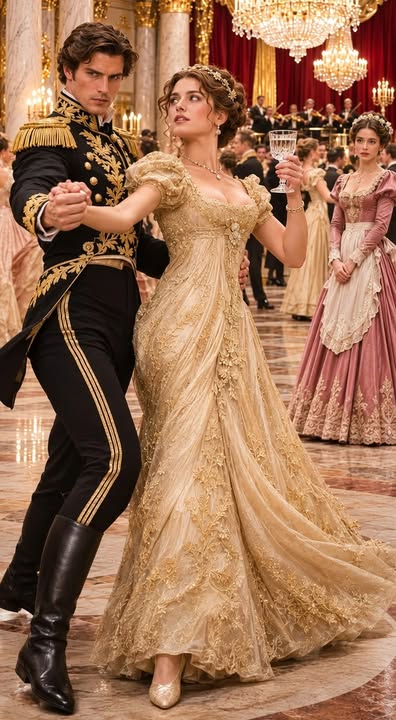
Part 5 – The Cost of the Truth
The second sentence on the back of the note had been written in a smaller hand.
The archivist angled it toward the lantern, and I leaned closer to read.
“Should the exercise be repeated as a contest, the court must be told that its purpose has changed.”
The words were faint, but unmistakable.
Alexander read them silently, then looked at Lord Harbury.
“You knew the contest would repeat the exercise.”
“I knew the old demonstration involved a glass and a waltz,” Lord Harbury said. “I did not know Miss Vale’s mother had designed it, or what she had written about its purpose.”
“But you wrote that the page should remain sealed until I completed the lesson.”
“I did.”
“Why?”
The adviser’s gaze shifted to the letter in my hands.
“Your father believed you would understand the page only after you had lived through the exercise yourself.”
“Then why was the record altered?”
Lord Harbury did not answer at once.
The silence was not the polished pause of a courtier choosing a convenient phrase.
It was the silence of a man searching for a memory he had not wanted to revisit.
“I cannot say with certainty,” he replied at last. “The note was written after your father’s death. I was trying to preserve a private arrangement until the right moment. I may have thought the record would be corrected later.”
“And it was not.”
“No.”
“Instead, someone wrote that Eleanor Vale had been dismissed for theft.”
“I did not write those words.”
“But you were responsible for keeping the record.”
Lord Harbury lowered his eyes.
“Yes.”
My mother’s letter trembled slightly in my hand.
I pressed it flat against the table, careful not to let my anger make me careless with the paper.
“What did my mother mean by saying the court might claim her work?” I asked.
The adviser looked at me.
“I do not know what was said to her at the time.”
“Did she leave because she was afraid?”
“No,” he said. “The letter does not read that way.”
“It says she would not remain to see the lesson claimed as a court invention.”
“That is what she chose to write.”
“And the record called her a thief.”
“I can’t explain the alteration.”
I watched his face, but no answer appeared there.
Alexander turned from him to the original page.
“My father kept her work, then hid it until I repeated the exercise.”
“Your father intended you to learn from it,” Lord Harbury said.
“He intended me to learn from a lesson he never explained.”
“Perhaps he believed explanation would defeat the purpose.”
“Perhaps he was wrong.”
The prince’s voice was quiet, but the words carried through the small room.
The archivist gathered the papers in a careful stack.
“We should secure these documents and make a proper record of where they were found,” she said. “The original must be preserved.”
I looked at the page bearing my mother’s name.
“Will the record be preserved too?”
“Yes,” the steward said. “The ledger will be examined, and the altered entry will be corrected.”
“Not merely crossed out,” I said. “The correction should explain that the accusation was unsupported.”
The steward nodded.
“That can be done.”
“And it should say she left by her own choice.”
“It should.”
Lord Harbury’s gaze lowered to the table.
“I will ensure it is done.”
I wanted to believe him.
I also knew how easily a promise could become a quiet phrase in an office, then disappear beneath newer papers.
“Will the court be told what happened?” I asked.
The room grew still again.
Alexander looked at the note, then at the original page.
“That depends on me,” he said.
Lord Harbury folded his hands.
“Your Highness, there are considerations beyond this room.”
“I know.”
“The contest was announced as a way for you to consider a marriage. The court expects an answer.”
“I know that too.”
“Then you understand that a public correction could invite questions about the fairness of the challenge, the advice you were given, and the conduct of the royal household.”
“I understand.”
The adviser spoke with care, not as a threat but as a man presenting the weight of a decision he believed could not be avoided.
“If the record is corrected privately and the page returned to the family papers, the matter need not become a public scandal. The contest can conclude as planned. Lady Victoria remains the strongest political match, and the kingdom avoids uncertainty.”
The words landed gently.
That made them harder to refuse.
He was offering Alexander a path that sounded sensible, even merciful.
A corrected ledger.
An honored name in a private archive.
A marriage that would settle the court and preserve the appearance that the contest had been fair.
Nothing in his proposal required cruelty.
Nothing in it required anyone to raise their voice.
It merely asked that my mother’s truth remain a secret, and that the women who had stood in the ballroom continue to believe they had been judged by a fair test.
Alexander looked at me.
I could not tell him what to choose.
I could tell him what I would not accept.
“If the truth is hidden again,” I said, “then my mother’s name will be repaired only where no one can see it.”
“I understand,” he said.
“Do you?”
“I think I do.”
“No, Your Highness. You understand the papers. I mean the cost.”
I rested my palm beside my mother’s letter.
“She worked in this palace. She left because she would not let the court take credit for something she had made. Then someone turned her decision into an accusation. For years, I have carried a book she wrote as if it were only a private piece of her life.”
My voice caught, and I waited until I could continue.
“If the court learns the truth, people may question her. They may question me. But if the court never learns it, then the palace keeps the only version that makes her look guilty.”
Alexander did not turn away.
“You’re right,” he said.
“I am not asking you to make my mother a symbol. She was a person. She had a reason for leaving, and she wrote it down. That should be enough for her name to be cleared.”
“It is enough,” he said.
Lord Harbury looked toward the prince.
“Your Highness, I must caution you against making a decision in the first hours after a discovery like this.”
“I have been making decisions for months without knowing what they meant.”
“Then take another day.”
Alexander’s attention remained on the old page.
“Would another day change what it says?”
“No,” the adviser replied. “But it may help you decide how much of it must be made public.”
“How much of the truth can be kept without becoming another lie?”
Lord Harbury did not answer.
I felt the question settle between them.
The archivist wrapped the letters in protective paper, leaving the original page visible beneath a clear sheet.
The work was quiet and methodical, but every fold seemed to make the discovery more real.
My mother’s words would not vanish now.
They had been found, read, and witnessed.
Yet the court beyond that room knew nothing of them.
Alexander walked with me back through the gallery after the records staff had secured the packet.
He did not offer his arm.
I was grateful.
At the foot of the stairs, he stopped beside a tall window overlooking the winter garden.
“Do you think I should tell them?” he asked.
“I think you know what you ought to do.”
“That is not the same as knowing what I will do.”
“No.”
He looked out at the bare trees beyond the glass.
“If I tell the court the contest was unfair, they will ask why I held it at all.”
“You held it because you thought it would show you something important.”
“I wanted to choose well.”
“You wanted an answer you could measure.”
“Yes.”
“Perhaps choosing well means accepting that people are not measured by a glass.”
He gave a small, weary smile.
“You make difficult things sound simple.”
“I do not think they are simple.”
“What would you have me say?”
“The truth.”
“And if the truth damages the crown?”
I studied him.
“I do not know what the crown needs. I know what your father’s page says.”
He turned from the window.
“What does it say?”
“It says the lesson was meant to teach you to notice the person beside you, not to make her prove she could endure whatever you decided.”
His expression changed.
“I have been asking women to follow me,” he said. “Then I called the result a choice.”
“You did not know the lesson had been changed.”
“But I knew they had no say in the rules.”
“That is true.”
The honesty hurt him, but he did not look away from it.
“I cannot undo the evening,” he said.
“No.”
“I can only decide what I do now.”
“Yes.”
He seemed to want me to offer some comfort, but I had none that would not soften the decision before he made it.
So I remained beside him in silence.
After a while, he said, “I will not ask you to stay in the palace while I decide.”
“I have not asked to leave.”
“You should not have to stay because you are waiting for me.”
“I am not waiting for you.”
“Good.”
The word came with relief, and a sadness I did not know how to name.
“I want the record corrected,” I said. “I want the original page kept with the family papers. And I want my mother’s name attached to her work.”
“It will be.”
“Privately?”
He took a breath.
“I don’t know yet.”
“Then you still have a decision to make.”
“Yes.”
I had meant to leave then, but the sound of footsteps in the gallery made us turn.
Lady Victoria approached with a folded invitation in one hand.
She looked first at Alexander, then at me.
“I was told you were in the east wing,” she said. “I hope I am not interrupting.”
“You are not,” Alexander replied.
Victoria’s gaze shifted to the papers under his arm.
“Have you found what you were looking for?”
“We found something,” he said.
She studied his face.
“Does it change the contest?”
“Yes.”
The answer was quiet.
Victoria’s fingers tightened around the invitation.
“Does that mean I have won?”
“No.”
A faint color rose in her cheeks.
“Then does Miss Vale?”
“No.”
I saw the hurt behind Victoria’s composure, and I understood that his answer had not spared her.
She had entered the challenge believing she was competing for a future, whatever else she might have told herself.
“Then what did we all spend the evening doing?” she asked.
Alexander did not answer immediately.
“Trying to succeed in a test whose purpose I did not understand.”
Victoria looked at him for a long moment.
“And you only learned that after Emma succeeded.”
“Yes.”
“That must be convenient.”
The words were restrained, but the disappointment beneath them was not.
“You’re right to question me,” he said.
“I did not ask for an apology.”
“I know.”
Victoria glanced at me.
“I imagine the court will tell us a different story before supper.”
“I’m sorry,” I said.
Her eyes softened, though only slightly.
“Do not be. You did not arrange the contest.”
“No, but I was part of it.”
“So was I.”
She looked down at the invitation, then folded it more carefully.
“What happens now?” she asked.
“I will decide before the court meets tomorrow.”
“And will your decision include me?”
“It will include everyone who took part.”
For the first time, Victoria’s expression lost some of its practiced polish.
“I wanted the contest to be fair,” she said. “I told myself the rules made it fair.”
“So did I,” Alexander replied.
She gave a small nod, as if recognizing the truth in his answer even though it did not comfort her.
“Then I hope you choose an answer you can live with.”
She turned to me.
“Miss Vale.”
“Lady Victoria.”
There was no triumph in her face, and none in mine.
She walked away alone, the invitation held at her side.
I watched her disappear around the gallery arch.
“She expected to marry you,” I said.
“She expected the contest to mean what I said it meant.”
“And it didn’t.”
“No.”
The palace bells sounded the hour.
Alexander looked toward the stairs leading to the council rooms.
“I have to meet with Lord Harbury.”
“Then go.”
“Emma—”
“Do not ask me what to decide.”
“I wasn’t going to.”
“Good.”
He gave a quiet breath that might almost have been a laugh.
“Would it be wrong to ask what you would do?”
“I am not the prince.”
“No,” he said. “You are not.”
It was the clearest he had ever spoken about the distance between us.
For a moment, it stood there without either of us trying to disguise it.
Then he bowed his head and went toward the council rooms.
That evening, the palace moved with the subdued urgency of a household expecting a difficult announcement.
Footmen carried fresh candles into the state rooms.
The steward’s clerks gathered in small groups near the records office, speaking quietly over the corrected copy of the ledger.
Mrs. Bell told the servants not to repeat rumors.
No one obeyed for long.
I returned to my room and opened my mother’s music book.
The page with the penciled rhythm lay beneath my hand.
Four strokes, a pause, then three.
I could hear my mother’s voice as clearly as I could remember it, humming the old waltz while rain tapped the window of our small room.
She had taught me to notice what moved before it reached the edge.
She had also taught me that a person could leave without being forced, and that a quiet refusal was still a refusal.
I had not known how much of her life was hidden inside those lessons.
A knock came at the door.
Clara stood in the corridor, holding a sealed message.
“This was brought from the steward’s office,” she said.
“For me?”
She nodded.
I opened the envelope.
The note inside was brief.
His Royal Highness asks that you attend the court gathering tomorrow, not as a contestant, but as a witness to the correction of the record.
I read it twice.
Beneath the message, the steward had added a sentence in his own hand.
You are free to decline.
Clara watched me.
“Will you go?”
“I don’t know.”
“Do you want the truth spoken?”
“Yes.”
“Then perhaps you should be there.”
“I do not want to stand beside the prince as proof that everything has been made right.”
“Then don’t let them use you that way.”
She was right.
The truth belonged to my mother, but I did not want her memory made into a convenient ending for a story the court could applaud and forget.
I folded the note and placed it inside the music book.
The next morning, I went to the palace chapel before the gathering.
It was empty except for the pale light entering through the high windows and the faint scent of wax left from the previous service.
I sat in the back pew and tried to decide whether attending would help my mother or merely help the prince make his announcement look sincere.
No answer came.
I did not want a place beside him.
I did not want a title, a reward, or a promise.
I wanted the ledger corrected in words no one could mistake.
I wanted the page preserved.
I wanted the court to hear that Eleanor Vale had left by her own choice and had not stolen anything.
If Alexander chose a quieter version, I would leave the palace.
Not in anger.
Not to punish him.
I would simply refuse to be made part of a story that hid the truth again.
The doors opened behind me.
Alexander entered without attendants.
He stopped several paces away, giving me the choice to rise or remain.
“Have you decided?” I asked.
“I have.”
“Will you tell them?”
“Yes.”
The word was calm, but there was strain beneath it.
“And the contest?”
“It ends.”
“The court may not accept that easily.”
“I know.”
“What about Lady Victoria?”
“I will speak to her before the gathering. She deserves an answer that is not delivered as part of an announcement.”
I nodded.
“That is fair.”
He took one step nearer, then stopped again.
“I will tell them the test was unfair, and that I should never have asked anyone to prove herself under rules I did not understand.”
“Will you mention my mother?”
“I will say her name and explain what she made.”
“Will you say she left voluntarily?”
“Yes.”
“Will you say the accusation was false?”
“I will say there is no evidence she stole anything, and the accusation was added to the record after her departure.”
“That is not quite the same.”
“No,” he said. “I will say it was false.”
The answer settled something in me.
“Then I will attend.”
“I’m glad.”
“Do not be glad yet. I will speak if they ask me.”
“I would expect nothing less.”
He seemed as if he wanted to say more, but the chapel doors opened again.
Lord Harbury entered, followed by the steward.
The adviser looked at Alexander.
“The council is assembled.”
“I will come.”
Lord Harbury gave me a measured nod.
“Miss Vale.”
“Lord Harbury.”
“We have prepared the corrected record,” he said. “The alteration will be documented, and the accusation removed.”
“Will the original wording be preserved in the archive?”
“So future readers can see what was changed and why,” the steward replied. “It will not be erased.”
I was grateful for that.
A correction without a record of the harm could become another clean page over a damaged one.
Alexander looked from the adviser to the steward.
“Is the statement ready?”
“It is,” Lord Harbury said.
“Then it should be read in full.”
“Your Highness, the draft is longer than the court expects.”
“Then the court can listen longer.”
The adviser’s expression tightened, but he bowed.
“As you wish.”
We walked together toward the great hall.
The doors were open, and the murmur of the assembled court spilled into the corridor.
Beyond them waited the people who had watched the contest, the women who had danced, the servants who had carried the glasses, and the courtiers who had turned every gesture into a rumor.
I saw Lady Victoria near the front, composed in a pale blue gown.
She met my eyes and gave the smallest nod.
I returned it.
Alexander paused at the threshold.
“You can still leave,” he said.
“I know.”
“I will not think less of you if you do.”
“I know that too.”
He looked toward the hall.
“Once I begin, I cannot take it back.”
“That is what makes it a choice.”
For a breath, he seemed less like a prince and more like the boy his father had tried to teach: someone standing at the edge of a decision he could not yet measure.
Then he entered.
The court quieted.
I followed at a distance, not at his side.
Alexander stood before the gathered people, his father’s papers in one hand and the corrected record in the other.
Lord Harbury took his place behind him.
The prince looked over the room.
“I called you here to correct a matter that concerns my family, this palace, and every woman who took part in the recent contest.”
The murmurs faded.
He opened the record.
“The challenge was presented as a test of judgment and composure. I now know that it repeated an exercise created for a different purpose, without explaining its meaning or acknowledging the woman who designed it.”
A rustle moved through the hall.
Alexander continued.
“The exercise was made by Eleanor Vale, a former member of the palace staff. She intended it to teach attention and trust, not to rank women as candidates for marriage.”
My hands tightened at my sides.
He spoke my mother’s name clearly.
“She left the palace voluntarily because she would not allow her work to be claimed without her name. The accusation of theft entered in the staff ledger was false and has no supporting evidence. The record will be corrected, and the original page will be preserved with her letters.”
The hall had gone completely still.
Alexander lowered the paper.
“I also owe an apology to the women who entered the contest. I made rules that I believed were fair because they were clear. I did not ask whether they were just, or whether the test measured anything worth choosing a wife by.”
He looked toward Lady Victoria, then across the room.
“I will not name a winner. The marriage competition is canceled.”
For a moment, no one moved.
Then the royal adviser stepped forward.
“Your Highness,” Lord Harbury said, keeping his voice low, “the council has not yet reviewed the final wording.”
“It has now been reviewed.”
“The alliance discussions—”
“Can continue without pretending this contest was fair.”
A quiet stir passed through the court.
Lord Harbury looked at the papers in Alexander’s hand, then at the room.
“If you state that the household mishandled the record, you will be asked who was responsible.”
“Then I will answer what I know and say what I do not.”
“And if they ask whether you were advised to keep the matter private?”
Alexander did not look away.
“Then I will tell them the truth.”
The adviser’s face changed.
He had offered Alexander a safe path, one built on privacy and careful phrasing.
The prince had refused it in front of the court.
I watched Lord Harbury lower his head.
Not in surrender, exactly.
In recognition that the decision had passed beyond his hands.
The hall began to stir, voices rising in uncertain whispers.
Alexander remained where he was, the corrected record open before him.
Then the steward hurried from the side entrance with a newly opened envelope.
“Your Highness,” he said, pale with urgency. “There is another document among the correspondence.”
Alexander turned.
The steward held out a sheet bearing my mother’s handwriting.
“I found it inside the lining of the packet,” he said. “It appears to be addressed to the prince’s father.”
The court fell silent once more.
Alexander took the page.
His eyes moved across the first line, and the color left his face.
“What does it say?” I asked.
He looked up at me, then down at the letter again.
“It says the lesson was not meant to end with the prince learning to follow the water.”
His fingers tightened around the paper.
“It says my father promised Eleanor Vale that, when I was old enough, he would tell me why she left.”
And beneath that promise was one final line, written in my mother’s hand:
“The truth must be spoken before the prince is asked to choose whom he will marry.”
**–END OF PART 5–CLICK “NEXT” AT THE BOTTOM OF THE PAGE TO CONTINUE READING**
* * *
[PREVIOUS: PART 4](https://storyly.idolsgift.com/blog/part-4-the-secret-beneath-the-surface-058) | [NEXT: PART 6(THE END)](https://storyly.idolsgift.com/blog/part-6-the-end-the-secret-beneath-the-surface-058)
✓ Lynn R. Adams
Part 5 – The Cost of the Truth The second sentence on the back of the note had been written in a smaller hand. The archivist angled it toward the lantern, and I leaned closer to read. “Should the e…