PART 5: The Secret Beneath the Little Horse 052
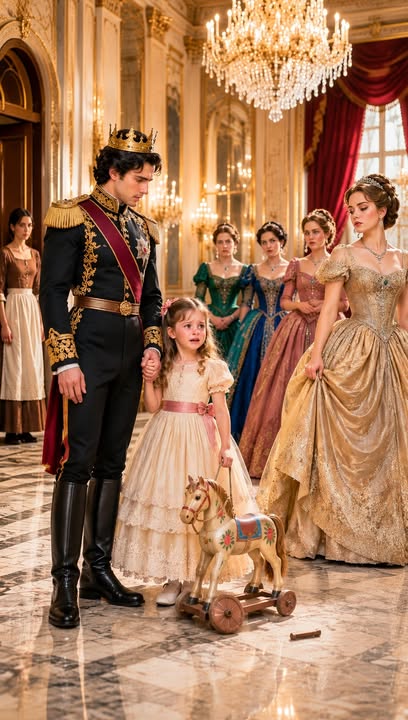
Part 5 – The Promise She Would Not Make
The final line was written in a hand none of them recognized.
It was brief, almost hidden beneath the fold of the paper.
The steward leaned toward the light and read it twice before speaking.
“‘The craftsman declined the invitation, saying his daughter had need of him at home.’”
The maid’s breath left her in a slow, unsteady exhale.
She had been there.
She had been a child in the workshop, waiting for her father to come in from the cold, never knowing that a royal messenger had been sent to find him.
The prince looked at her, but did not reach for her hand.
“Your father chose to stay with you,” he said.
The maid pressed her fingers to the worn awl in her pocket.
“I don’t remember him telling me there was an invitation.”
“Perhaps he thought it would only worry you,” the steward said gently.
The princess had stopped brushing the horse.
She looked from the paper to the maid, her small face troubled by the quiet that had fallen over the room.
“Did your father come here?” she asked.
“No,” the maid replied, lowering herself beside her. “He stayed at home with me.”
“Because you needed him?”
The maid thought of all the ordinary evenings she had taken for granted: her father’s boots by the door, his warm voice in the workshop, the sound of his tools set down for the night.
“I think so,” she said. “And I needed him very much.”
The princess’s fingers curled around the horse.
“Then he chose you.”
The maid’s eyes stung.
“Yes,” she whispered. “He did.”
The prince turned from the old record and looked toward the window.
The discovery had given him no claim on the maid, no right to decide what the past meant for her.
It had only shown them a kindness repeated across years: a father who stayed with the child who needed him, and a daughter who had sat beside a lonely little girl without knowing that their histories had already touched.
The steward folded the paper with care.
“I will preserve this with the queen’s records,” he said. “There is no need to make more of it than the truth allows.”
“Thank you,” the maid said.
The princess held the horse close to her chest.
“Can he stay with me?”
“Of course,” the prince said.
“And can the maid stay too?”
The child’s question came softly, but it held the worry she had been trying not to name.
The prince sat beside her.
“She may stay with you today, if she wishes.”
The girl turned to the maid.
“Do you wish?”
“I do.”
The princess nodded, but did not look entirely reassured.
The maid understood why.
The palace had been speaking about her future in rooms where the princess was not meant to hear, and children often understood the shape of a fear long before they knew its proper name.
That afternoon, the prince asked the maid to meet him in the small garden beyond the east gallery.
He did not send an attendant to summon her with a formal order.
Instead, the steward brought her a note in the prince’s own hand, asking whether she would speak with him when her duties allowed.
She found him near a stone bench beneath an old pear tree, where the branches were bare but already dotted with tight green buds.
The late winter air was cool, and the garden paths held the damp scent of recent rain.
The prince stood as she approached.
“I hope you don’t mind that I asked to see you.”
“I don’t.”
He gestured toward the bench, then waited until she had chosen a place before sitting beside her.
For a while, they watched a pair of sparrows hop across the path.
The prince spoke first.
“The court has taken the story of the horse and made it into something larger than either of us intended.”
“I know.”
“Some of the nobles believe my public challenge means I must now invite you to accept a place among the marriage candidates.”
The maid rested her hands together in her lap.
“And what do you believe?”
“That a promise made in a crowded hall can still be a poor foundation for a life.”
She looked at him.
He continued carefully.
“I owe you no marriage proposal because you repaired a toy, and you owe me no answer because my daughter trusts you.”
The maid felt her shoulders loosen, though the unease did not disappear.
“Then why did you ask to speak with me?”
“Because I have something honest to say, and I don’t want the court to say it for me.”
He turned toward her.
“I have grown fond of you.”
The words were quiet, without ceremony, and he left them between them without reaching to make them more than they were.
The maid looked down at the damp path.
She had sensed the change in him, in the way he listened when she spoke and in the care with which he left every choice in her hands.
Hearing him name it brought warmth and fear together inside her.
“I care for you,” he said, “but I do not expect you to turn that feeling into an answer today. I can offer you a place at court, with duties chosen by you and enough time to decide whether this life is one you want.”
“A place as what?”
“Not as a prize, and not as a substitute for anyone my daughter has lost. You could work with the household if you wish. You could study, or learn the records, or help oversee the children’s rooms. Or you could refuse the offer altogether.”
The maid looked at him.
“And if I refuse?”
“Then I will still be grateful that you helped my daughter.”
The sincerity in his face was what made the choice difficult.
It would have been easier if he had ordered her, or offered her a title that shone brightly enough to hide the cost.
Instead, he had offered her room to choose, and she could see how much care he had taken not to make that room feel like a trap.
“I need time,” she said.
“You may have it.”
“The princess is beginning to think I might be taken from her.”
His expression turned pained.
“I know.”
“She asked me to promise I would never leave.”
The prince lowered his gaze.
“I heard her.”
“I can’t promise that,” the maid continued. “Not honestly. I don’t know what my life will become, and she deserves more than a promise made because she is afraid.”
The prince listened without interrupting.
“She has already lost her mother,” the maid said. “I won’t let my kindness become another thing she thinks she must hold onto before it disappears.”
“I agree.”
The maid looked at him again.
“But I also won’t pretend that I can simply step away and make her feel secure. She trusts me now. If I vanished, it would hurt her.”
“Yes.”
“I want to stay with her, at least for now. But I don’t want anyone to tell her that my staying means I have accepted a title, or that I might become her mother.”
The prince’s voice remained steady.
“I will not allow anyone to tell her that.”
“Can you be certain?”
“I can be certain of what I will say. I cannot control every whisper in the palace, but I can make sure my daughter hears the truth from me.”
The maid nodded, though she knew the answer would not solve everything.
The prince’s gaze moved to the garden.
“I should have protected her from the marriage challenge becoming a spectacle.”
“You were trying to give her hope.”
“I was trying to find someone who would notice her.”
“And she found someone.”
The prince looked at her.
“She did.”
The understanding in his face touched her more than praise would have.
The maid drew a breath.
“I need to know that if I remain here, it will be because I choose to remain—not because your daughter needs me, not because the queen’s note seems to point toward some story the court wants to believe, and not because repairing the horse has made me useful.”
“It will be because you choose it,” the prince said.
“And if I never choose to marry you?”
“Then I will respect that.”
The answer was so simple that the maid felt tears gathering before she could stop them.
The prince did not move closer.
He let her have the quiet she needed.
When she finally spoke, her voice was low.
“I don’t know what I feel about you yet.”
“That is fair.”
“I know I trust you more than I expected to.”
“That matters to me.”
“But trust isn’t a promise.”
“No,” he said. “It isn’t.”
She looked toward the palace windows.
Beyond them, the rooms of the court held people already shaping their own version of her future.
“I will stay at court for now,” she said. “But not as a candidate for your hand. I will stay because I want to keep my word to the princess, and because I want time to understand what I want.”
The prince’s face softened.
“Then that is what we will tell the court.”
“And the princess?”
“We will tell her that you are here because you chose to be, not because a marriage has been decided.”
The maid nodded.
“And when I need to leave a room, or take a day for myself, I must be allowed to do that without anyone treating it as a betrayal.”
“You must.”
“And I need the freedom to change my mind.”
“You have it.”
The prince held her gaze.
“I would rather have your honest uncertainty than a promise made out of fear.”
She believed him.
That did not make the choice easy, but it made it possible.
The next morning, the prince asked the senior members of the court to gather in the small council room.
The maid attended because she had agreed to speak for herself, not because anyone had ordered her to stand before them.
The noblewoman in lavender was there, along with the steward and several advisers.
No one wore the jeweled finery of a public ceremony.
The meeting had the sober feel of a household trying to decide how to treat its own people.
The prince stood at the head of the table.
“The challenge I announced was intended to find someone who would respond to my daughter with care,” he said. “It was never meant to make her affection a measure of another person’s worth, or to bind anyone to me.”
A murmur passed through the room.
The prince continued.
“The maid helped my daughter. She has also shown me that the court can be gentler than its traditions sometimes allow. But she has made no commitment to marry me, and she will not be treated as though she has.”
One adviser cleared his throat.
“Your Highness, the question is not whether she showed kindness. It is whether the household can support her presence without creating confusion about her position.”
“That is a fair question,” the prince said.
The maid was grateful that he did not dismiss it as cruel.
She stepped forward.
“I do not want the court to pretend that the questions do not exist,” she said. “I also don’t want to be required to answer them by becoming something I have not chosen.”
The noblewoman in lavender studied her.
“Would you remain at court if there were no possibility of marriage?”
“Yes,” the maid said. “For now. I want to continue visiting the princess, and I want to do work that is useful to the household. But I will not promise that I will stay forever.”
A gentleman near the window shifted in his seat.
“Would that not unsettle the child further?”
The maid took a moment before replying.
“Perhaps. But she is already unsettled by people speaking about a future she does not understand. I think she deserves honesty more than certainty that no one can guarantee.”
The prince watched her with quiet attention.
The adviser nodded once, though he did not look fully convinced.
The noblewoman in lavender spoke.
“Then her position should be clear. She is not a candidate, and she should not be introduced to the court as a possible queen.”
“That is my intention,” the prince said.
The noblewoman’s eyes moved to the maid.
“And your duties?”
“I would like to continue helping the princess when she asks, but I don’t want her care to become an obligation that removes my own choices.”
The steward leaned forward.
“That can be arranged. Her existing duties may be reassigned gradually, and she can be given a defined role in the household without being made responsible for the princess’s whole life.”
The prince looked toward the maid.
“Would that be acceptable?”
“Yes.”
A silence followed.
Then the older adviser by the window said, “This is not how such matters are usually handled.”
“No,” the prince said. “It is not.”
The adviser looked toward him.
“Your Highness, there will be criticism.”
“There already is.”
“And if the court’s doubts prove justified?”
“Then we will address them when they arise, not by denying someone the chance to live honestly.”
The noblewoman in lavender lowered her eyes.
“I agree,” she said. “A child should not be asked to trust anyone because a room full of adults has decided the shape of her future.”
The maid looked at her, surprised.
The woman met her gaze without smiling.
“This does not mean I think the court will be easy for you,” she added.
“I know.”
“But I will not oppose your remaining here on the grounds that you were born to a different station.”
The words did not erase her earlier conduct.
They did, however, mark a change.
The maid inclined her head.
“Thank you.”
The meeting ended without a vote or a declaration of victory.
Some nobles left still troubled.
Others appeared relieved that the prince had refused to turn a child’s comfort into a contest.
The maid stepped into the corridor with the prince and the steward.
“Are you all right?” the prince asked.
“I think so.”
“You spoke well.”
“I spoke honestly.”
“That was better.”
A little later, the prince asked her to meet him in the princess’s sitting room.
The child was waiting with her horse and stuffed rabbit.
She looked at the maid, then at her father.
“Are you staying?”
The prince sat beside her.
“The maid has chosen to remain at court for now,” he said. “She wants to spend time with you, and she wants to do work here. But we have not decided what the future will be.”
The princess frowned.
“Will she become your queen?”
The prince did not answer for the maid.
The maid knelt in front of the girl.
“I don’t know,” she said. “I care about you, and I like being with you. But I have not chosen to marry your father.”
The princess looked down at the horse.
“Could you choose not to?”
“Yes.”
The child’s face tightened.
“Then you might leave.”
“I might one day have to leave,” the maid said. “People’s lives change, even when they love one another.”
The princess’s eyes filled, but she did not cry.
“Can’t you promise to stay forever?”
The maid reached out, then waited.
The girl placed her hand in hers.
“I can’t promise forever,” the maid said. “It would not be fair to promise something I may not be able to keep.”
The child’s lower lip trembled.
The maid continued, “But I can promise to tell you the truth. I can promise not to disappear without saying goodbye. And when I am here, I will be here because I want to be.”
“Even if you don’t marry Father?”
“Even then.”
The princess looked at the prince.
“Would you be sad if she didn’t marry you?”
The prince’s face held no evasion.
“Yes,” he said. “I might be sad. But I would still want her to choose freely.”
The princess seemed to find that answer harder to understand than a simple promise.
She rested her cheek against the horse’s painted back.
“I don’t want everyone to keep asking.”
“I won’t let them ask you about it,” the prince said.
“And I don’t want the horse to make anyone think I have to give the maid away.”
The maid’s heart tightened.
“No one can give me away,” she said. “I belong to myself.”
The girl looked up at her.
“Then you can stay because you belong here?”
The maid held her gaze.
“I can stay because I choose to.”
For a moment, the princess seemed content with that.
Then she leaned forward and wrapped both arms around the maid’s neck.
The maid held her gently, feeling the child’s breath against her shoulder.
She knew the embrace could not settle the future.
It could only make the present honest.
That evening, the prince found the maid alone in the small gallery, returning a book to the shelf.
The court had emptied from the meeting, but its decisions still seemed to echo through the halls.
“You gave her the truth,” he said.
“I tried.”
“She was disappointed.”
“She has a right to be.”
The prince stood beside her.
“I am sorry that my challenge helped create a fear she now has to carry.”
“You were trying to help her.”
“I was,” he said. “But good intentions can still make things harder.”
The maid placed the book carefully among its neighbors.
“Then we can do better from here.”
He turned toward her.
“Will you let me court you, without a promise attached?”
She felt a small, almost shy warmth stir beneath her ribs.
The question held no demand.
It also held no guarantee that she would return what he felt.
“Yes,” she said. “Slowly.”
“Slowly,” he agreed.
“And if I ask for time, you will give it.”
“I will.”
“And if I ask you to stop?”
“I will stop.”
The prince’s eyes were steady.
The maid found herself believing that he would keep those words.
He offered his hand, palm up, and waited.
She placed her hand in his.
They stood that way for a moment, not as a prince and a servant, nor as a future king and an uncertain bride, but as two people beginning to trust the space between them.
From the far end of the gallery, the steward approached.
He carried a small wrapped parcel in both hands.
“I beg your pardon,” he said. “This was delivered from the archive keeper.”
The prince released the maid’s hand so that she could decide whether to step away.
She did not.
The steward set the parcel on a nearby table.
“It was found inside the binding of the queen’s household ledger,” he explained. “It appears to have been placed there with the older travel records.”
The maid’s attention went to the parcel.
The paper wrapping had yellowed with age, and a thin cord had been tied around it.
The steward carefully loosened the knot.
Inside lay a small folded note and a narrow piece of pale wood.
The maid recognized the wood at once.
It was a sliver from a toy horse’s axle, cut cleanly at one end.
The prince looked at the note.
“Is it addressed to anyone?”
The steward opened it.
The writing was unmistakably the queen’s.
“To the craftsman who mended my daughter’s horse,” he read.
The maid held her breath.
The steward continued, “I was told that he left before my messenger could thank him. If he is willing, I would be glad to meet him. If he is not, let him know that his kindness has already reached the child it was meant to serve.”
The prince’s face softened.
There was more written beneath the message, but the ink had smudged along the fold.
The steward turned the paper toward the lamp.
A few words emerged from the blur.
The maid leaned closer.
“‘And if he has a daughter,’” she read. “Then—”
The note stopped there, torn along its lower edge.
The steward looked inside the parcel again.
“There may be another piece.”
He unfolded the paper wrapping and found a second scrap tucked into the corner.
This one was so small that it could have been mistaken for waste.
The prince took it carefully.
The handwriting matched the queen’s.
He read the fragment aloud.
“‘I would have her know that she need not earn a place beside us by mending what was never hers to mend.’”
The maid looked at the note, then at the little princess’s horse resting on the nearby shelf.
The queen had written those words years before the maid ever entered the palace.
Years before she had knelt beside the child.
Years before the prince had offered her a place at court.
The prince met her eyes.
“What do you think she meant?” he asked.
The maid looked again at the worn awl in her hand, its carved star and crescent almost polished away.
She had come to the palace carrying nothing but the lessons her father had given her.
Now the queen’s words seemed to reach across the years, offering a welcome that did not demand she repay it.
Before she could answer, the steward unfolded the first note once more.
At its bottom edge, beneath the queen’s faded signature, lay one final line in the handwriting of the household courier.
The maid recognized the name beside it.
It was her father’s.
**–END OF PART 5–CLICK “NEXT” AT THE BOTTOM OF THE PAGE TO CONTINUE READING**
* * *
[PREVIOUS: PART 4](https://storyly.idolsgift.com/blog/part-4-the-secret-beneath-the-little-horse-052) | [NEXT: PART 6(THE END)](https://storyly.idolsgift.com/blog/part-6-the-end-the-secret-beneath-the-little-horse-052)
✓ Lynn R. Adams
Part 5 – The Promise She Would Not Make The final line was written in a hand none of them recognized. It was brief, almost hidden beneath the fold of the paper. The steward leaned toward the light …