PART 5: The Secret Behind the Chime 069
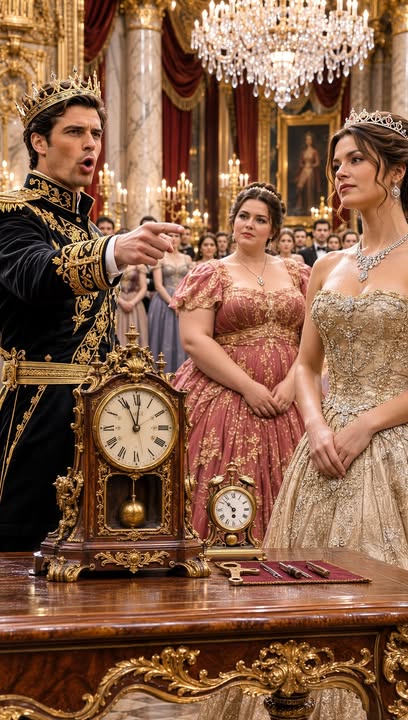
Part 5 – The Truth in the Open
The clock had spoken once, not to announce the hour, but to tell them where the queen’s unfinished promise might still be waiting.
Adrian looked toward the west archive.
“Then we’ll find the petition,” he said.
Mistress Wren hesitated.
“The room has been closed for years, Your Highness, and its records were transferred in several stages.”
“Then we’ll begin with the inventories,” Adrian replied.
Lord Vale remained by the ballroom doors, his face pale beneath the warm light.
“I should accompany you,” he said.
Adrian studied him for a moment.
“You may, if you can help us understand what the queen intended.”
Vale lowered his eyes.
“I can try.”
Elara slipped her father’s journal into her satchel and looked once more at the clock.
Its pendulum had settled into a steady swing.
The mechanism was no longer silent, but the note beneath the clock had made clear that the chime was only the beginning of what it had been meant to say.
As they left the ballroom, Adrian walked beside Elara without the formality he had shown before the contest.
The distance between them had narrowed, though neither seemed willing to name it.
“You don’t have to come,” he said quietly.
“I know.”
“You’ve already done more than anyone could have asked.”
“I know that too.”
“Then why are you coming?”
Elara looked down the corridor, where the light grew dimmer toward the older wing.
“Because someone waited a long time for that clock to speak,” she said. “I don’t want us to stop listening now.”
He nodded, accepting the answer without trying to make it into something grander.
The west archive lay behind a pair of tall oak doors in a wing that had once held the queen’s private offices.
Dust had gathered along the carved panels, and the brass handles showed the dull patina of years without use.
Mistress Wren unlocked the doors with a key from her ring.
Inside, shelves stood beneath high windows, their contents arranged in careful rows.
The room smelled of dry paper and cedar, with a faint trace of lavender that might have been left by the queen’s old writing cabinet.
A long table occupied the center.
On it rested several boxes bearing faded labels.
Adrian looked around the room.
“My grandmother brought me here once,” he said. “I was too young to read the papers. She let me play with the brass weights.”
“Did she tell you what was in the boxes?” Elara asked.
“She said they held the voices of people who could not come to the palace themselves.”
He moved toward the nearest shelf.
“I thought she meant letters.”
“She may have,” Elara said. “A petition is a letter asking someone with power to act.”
Adrian looked at her.
“And if no one answers?”
“Then the person who wrote it has to decide whether their words mattered.”
Mistress Wren began checking the old inventories.
Lord Vale stood at the threshold, not quite entering the room.
Adrian noticed.
“You may come in, Vale.”
“Thank you, Your Highness.”
The steward crossed the threshold, then stopped near the table.
“I was present when the queen’s papers were moved,” he said. “Not all of them came here.”
“Where were the others taken?” Adrian asked.
“Some went to the royal library. Some were returned to the families who had sent them. A few were placed in the household archive.”
“And the petitions she promised to answer?”
Vale’s hands folded behind his back.
“I believed they had been dealt with.”
“Did you see the records?”
“I saw the lists.”
“That isn’t the same thing.”
“No,” Vale admitted. “It isn’t.”
Elara watched him carefully.
He seemed tired rather than evasive, but years of habit had taught him to hold his feelings behind his words.
Mistress Wren found a ledger with a label matching the date on the clock’s note.
“This may help,” she said.
She set it on the table and opened it to the contents page.
The pages listed petitions by district, then by date.
Elara brought out her sketch of the clock’s chime pattern.
“Could the five notes correspond to the first five districts in the ledger?”
Mistress Wren read the list.
“Northmere, Bell Crossing, Lowfield, Eastbank, and Greystone.”
“The clock’s pattern named them in that order,” Elara said. “Then the long pause marked the place whose petition was refused.”
Adrian looked at the remaining names.
“Which district came after Greystone?”
“Willowmere,” Mistress Wren replied.
The name seemed to settle over the room.
She turned several pages.
“There is one petition from Willowmere in this year’s record.”
Elara’s fingers tightened around the edge of her father’s journal.
“Can we see it?”
Mistress Wren searched the ledger’s index.
“The petition itself is not listed here. Only a note that it was received and sent for review.”
“To whom?” Adrian asked.
The archivist turned another page.
“Her Majesty’s secretary.”
No one looked at Vale, but everyone seemed aware of him.
“I did not remember that particular petition,” he said.
Adrian’s voice remained quiet.
“Do you remember a petition from Willowmere being refused?”
“I remember many requests. The queen received hundreds.”
“Do you remember this one?”
Vale looked at the entry.
“No.”
Elara glanced toward the shelves.
“What would happen to a petition that was never answered?”
“It would normally be filed with the correspondence,” Mistress Wren said. “If it were returned, there would be a record of that.”
“And if someone wanted it kept out of the ordinary records?” Adrian asked.
The archivist did not answer at once.
“It might be placed with the private papers.”
They searched the boxes marked for the queen’s household correspondence.
Mistress Wren read the labels aloud while Elara sorted through the inventory sheets.
Adrian helped lift boxes from the lower shelves, setting them gently on the table.
Lord Vale remained near the ledger, following each reference with his finger.
The work was slow, but it felt honest.
No one tried to force an answer from the papers.
They opened one box at a time, checked the contents against the inventories, and returned each document to its place.
A little over an hour passed before Mistress Wren found a narrow folder with no district name on its spine.
Inside lay a thin stack of letters tied with faded blue thread.
The top page was not a petition, but a list of villages whose requests had been received by the queen’s office.
Willowmere appeared near the bottom.
Beneath it, in another hand, was a short note: “Held pending clarification.”
Elara recognized the mark beside the words.
It was the same circle, the same three lines, and the same small crescent.
Her father’s journal had shown it beside Bellweather’s repairs.
The note in the clock carried it too.
“This is the mark,” she said.
Mistress Wren leaned closer.
“It may have been used by the queen’s household office.”
“Or by Bellweather,” Elara said. “We need to compare it with the original papers.”
She turned the page.
The note had been written years after Bellweather’s recorded visit.
Her father’s journal had described the mark as a maker’s stamp, but this one looked hand-drawn.
Perhaps the symbol had been adopted by the queen’s office because of the clockmaker.
Or perhaps the mark had always meant something else.
Elara kept her uncertainty to herself until she could inspect the journal more closely.
Adrian watched her.
“Do you recognize the writing?”
“No. But the mark is familiar.”
“Could it tell us who wrote the note?”
“Not by itself.”
Mistress Wren lifted the folder’s last sheet.
“There is a reference here to a sealed packet transferred to the queen’s private cabinet.”
“Where is that cabinet now?” Adrian asked.
“In the palace library, I believe.”
Lord Vale’s face had gone very still.
“The cabinet was not moved with the rest of the records,” he said.
Adrian turned to him.
“Where was it taken?”
“To the queen’s apartments.”
“Those rooms have been closed since her death.”
“Yes.”
“Why?”
“They were kept as she left them, by your grandmother’s request.”
Adrian absorbed this.
“All these years, no one has searched the private cabinet?”
“Not that I know of.”
“Then we should.”
The queen’s apartments lay across the old wing, behind a narrow passage lined with portraits.
Adrian walked ahead with Mistress Wren, while Elara followed with Lord Vale.
At the end of the passage, a guard stood beside a door with a small brass plate bearing the queen’s initials.
Adrian asked him to unlock it.
The room beyond was modest compared with the ballroom, though its furnishings were fine.
A writing desk stood near the window, its surface cleared except for a silver inkstand and a small framed portrait.
The queen’s chair remained beside the desk.
A folded shawl lay across its back.
Elara felt the years of absence in the room more keenly than she expected.
It was not the stillness of neglect.
It was the stillness of someone’s life preserved in the hope that the room might continue to belong to her.
Adrian stopped at the threshold.
“I haven’t been in here since her funeral.”
His voice was low.
“You don’t have to go in,” Elara said.
“I know.”
He stepped inside.
Mistress Wren moved toward the desk, but Adrian raised a hand.
“Let’s look without disturbing more than we need to.”
A small writing cabinet stood beneath the window.
Its drawers were closed, and a brass lock held the central door.
The keyhole was worn.
Vale moved toward it.
“I may have the key.”
Adrian looked at him.
“You remember where it is?”
“I remember the queen kept it in the top drawer of her desk.”
“Then please retrieve it.”
Vale opened the desk’s top drawer.
A shallow tray lay inside, containing a few writing quills and a small brass key.
He lifted it carefully.
For a moment, he stared at it without moving.
“Is something wrong?” Adrian asked.
“No,” Vale said. “I had forgotten the queen kept two keys here.”
He set the first key in the lock, but it would not turn.
The second fitted.
The cabinet door opened with a soft click.
Inside were several small compartments, each labeled in the queen’s neat handwriting.
Mistress Wren searched the lower section.
“Here,” she said. “A packet marked Willowmere.”
The folder was tied with a faded blue ribbon.
Elara looked at Adrian before Mistress Wren untied it.
He gave a small nod.
Inside lay a single sheet of paper, folded twice.
The petition was written in a careful hand by someone named Mara Vale.
Elara did not know the name, but Lord Vale’s face changed when he saw it.
Adrian noticed.
“Do you know this person?”
Vale’s voice was unsteady.
“She was my older sister.”
The revelation silenced the room.
Elara looked from the petition to the steward.
“My sister lived in Willowmere,” he continued. “She wrote to the queen about the river crossing. The old bridge was damaged, and the village had been promised repairs.”
“Was the petition refused?” Adrian asked.
“I don’t know.”
“You said you remembered no such petition.”
“I remembered the bridge. I did not know the queen had kept the letter.”
He stared at the paper, as if it held a voice he had once known but had not heard in years.
Mistress Wren read the petition quietly.
Mara Vale had written that the river crossing had become dangerous after seasonal flooding.
She had asked the crown to repair the bridge before another winter, because children had to cross it to reach the school in the neighboring village.
At the bottom, a later hand had written: “Request denied. Funds reserved for road improvements near the eastern estates.”
Adrian’s face tightened.
“Who wrote the denial?”
Mistress Wren examined the ink.
“The hand appears to match the household secretary’s office.”
Lord Vale looked down at the note.
“I signed it.”
Adrian remained silent.
Vale lifted his eyes.
“The queen had asked me to sort the petitions and mark those we could answer immediately. The treasury was limited that year. I thought the road project would benefit more people.”
“And the bridge?” Elara asked.
“I believed the district could maintain it themselves.”
“Did you tell the queen that?”
“I don’t remember.”
The answer was small, and it carried no excuse.
Adrian moved to the window.
Outside, the palace gardens lay under the deep blue of evening.
“My grandmother kept this petition,” he said. “And had the clock silenced.”
“Perhaps she wanted you to understand the cost of a decision made from a distant office,” Elara said.
Vale’s eyes remained on the paper.
“She may have wanted me to answer my sister.”
“Did you?”
“No.”
“Did you tell her the request had been denied?”
Vale shook his head.
“I told her the palace was reviewing it.”
A painful quiet followed.
There was no cruelty in the room, only the weight of a decision that had once seemed practical to the person who made it and had become something more when its consequences were left unspoken.
Adrian looked back at him.
“Why did you hide the note in the clock?”
Vale seemed startled.
“I did not.”
“Then who did?”
“I don’t know.”
Elara studied the old petition.
The mark beside the denial had been drawn in the same ink as the note in the clock.
Yet the symbol did not appear in the queen’s handwriting.
“Could the mark have belonged to the person who reviewed the petitions?” she asked.
Mistress Wren examined it through her lens.
“It may have been a filing mark.”
“Then why is it in the clockmaker’s journal?”
“Perhaps Bellweather used it when he repaired the striking assembly,” Elara said. “Or perhaps the office used the mark because he had designed the pattern.”
She turned to her father’s journal, which was open in her hands.
The note about preserving the original teeth sat beside the symbol.
A second line, faint beneath it, read: “The queen’s mark for an unanswered word.”
Elara’s breath caught.
She showed it to Adrian.
He read the line carefully.
“An unanswered word,” he repeated.
The clock’s hidden note, the petition, and her father’s journal now seemed to belong to one story.
The queen had not hidden the paper merely to protect a secret.
She had marked something the palace had failed to answer.
Adrian looked at Vale.
“Why did you let the contest go forward with the clock on display?”
“I did not think the hidden note remained inside,” Vale said. “The clock had been examined only from the outside.”
“Who knew it was there?”
“I don’t know.”
“Did you know the screw was removed before the contest?”
“I knew Celestine had taken it at my request.”
“You knew the clock was altered.”
“I thought I had ordered a harmless adjustment.”
“Then why didn’t you tell me as soon as Elara found the screw?”
Vale’s silence stretched.
“Because I feared the queen’s private papers would become a spectacle,” he said. “And because I did not know what the note contained.”
“That may explain your hesitation,” Adrian replied. “It does not justify keeping me in the dark.”
“No, Your Highness.”
Vale’s shoulders seemed to lower.
Elara looked down at the petition.
The truth had reached beyond the clock and into the lives of people who had never entered the ballroom.
Mara Vale had written because a bridge mattered to her village.
The queen had received the petition.
The palace had denied it.
And then the matter had been hidden behind a pattern of chimes, waiting for someone to notice what had gone unanswered.
Adrian returned to the desk.
“We can still repair the bridge.”
“Perhaps,” Vale said. “But the petition is nearly twenty years old.”
“Then we can find out what the village needs now.”
“The bridge may have been replaced.”
“Or it may not have been.”
Elara knew what he meant.
The first step was not to promise a remedy.
It was to ask what had happened, and listen to the answer.
Adrian looked at her.
“If the court learns this, there will be questions about why the petition was refused and why it was kept.”
“There should be questions,” Elara said.
“I know.”
“There will also be questions about your grandmother’s decision to hide it.”
“I know that too.”
“And about Lord Vale.”
Vale accepted the words without protest.
Adrian’s eyes shifted toward the petition.
“If I release it publicly, his family will be drawn into the matter.”
“My sister is gone,” Vale said. “But her words should not be made to carry blame for a choice that was mine.”
“You were following the queen’s office,” Adrian replied.
“I signed the denial.”
The admission was plain.
It did not make him a villain.
It made him a man who had once chosen a practical answer and later spent years avoiding the part of it that still hurt.
Elara felt a reluctant understanding for him.
She also understood how easily a person could mistake silence for protection.
The queen had kept the petition hidden.
Vale had kept his memory hidden.
The clock had been made to speak only when the prince was old enough to hear what the palace had failed to hear before.
Adrian turned to Elara.
“Would you tell this story publicly?”
She looked at him, surprised by the question.
“You mean the petition?”
“The whole truth. That the clock was deliberately silenced. That a request from Willowmere was denied. That the palace failed to answer it.”
“I would tell what we know,” she said. “And I would be clear about what we do not know.”
“Even if the court calls it an embarrassment?”
“Yes.”
“Even if people say the queen should have handled it differently?”
Elara hesitated.
“She did handle it differently. She preserved the evidence, but she did not answer the petition herself.”
Adrian’s face tightened, though he did not look away.
“That may be difficult to hear.”
“It’s still true.”
“And Lord Vale?”
“He should have a chance to explain his part. But his explanation shouldn’t erase what happened.”
Vale bowed his head.
“I agree.”
Adrian studied the letter, the petition, and the old cabinet.
He had the authority to keep the matter private.
He could announce that the clock had been restored, leave the petition in its drawer, and spare the court a difficult reckoning.
The story might be reduced to a charming account of a young woman who repaired an old royal clock.
No one would need to know that the queen had left an unanswered request, or that the steward had signed its denial.
The palace could move on without ever asking whether Willowmere still needed help.
Elara saw the choice forming in Adrian’s face.
He was not looking for permission.
He was weighing what kind of ruler he wanted to become.
“If we release the petition,” he said, “I will have to admit that the royal household kept it from the people who sent it.”
“Yes.”
“And I will have to admit that I did not know.”
“Yes.”
“That could weaken confidence in the palace.”
“It could,” Elara said. “Keeping it hidden could weaken it more, once the truth comes out.”
He nodded slowly.
“Would you still stand beside me if I chose to reveal it?”
Elara felt the question reach beyond the archive.
He was asking whether she trusted him.
Whether she would remain close to him when the matter became uncomfortable, when the court’s admiration might turn uncertain, and when their connection could no longer be hidden beneath the pretense of a contest.
“I would stand beside the truth,” she said. “And I would hope you stood beside it too.”
Adrian held her gaze.
“That is fair.”
“No,” Elara said gently. “It’s difficult. Fair is what we have to work toward.”
A quiet breath left him.
He seemed to accept that she was not offering a promise to make his decisions easier.
She was offering the harder thing: honesty.
Adrian turned to Lord Vale.
“You will provide Mistress Wren with a full account of the queen’s petition process and your part in it.”
“I will.”
“You will not be dismissed before we have established the facts.”
“Thank you, Your Highness.”
“That is not a favor. It is a fair process.”
Vale lowered his head.
“I understand.”
Adrian looked to Elara.
“And the contest?”
“Has nothing to do with the petition,” she said. “It can wait.”
“Then it will.”
He looked at the folded papers on the desk.
“Tomorrow, I will speak to the council. I will ask them to investigate the Willowmere petition and the way the palace handled it.”
Mistress Wren nodded.
“I can provide copies of the records.”
“Please do.”
Adrian glanced toward the small portrait on the desk.
His grandmother’s face, painted years earlier, held a thoughtful expression that seemed almost to meet his.
“I wish she had trusted me with this sooner,” he said.
“Perhaps she was waiting for you to become the person who would ask the right question,” Elara replied.
He took in the words, then looked down at the petition.
“And perhaps I should have asked long before tonight.”
The archive’s tall windows had darkened with the evening.
Mistress Wren gathered the records into a portfolio, while Vale remained near the desk, looking at his sister’s petition.
Elara closed her father’s journal.
The mark beneath the unfinished note was still there, but she had not yet understood its full meaning.
She wondered whether her father had ever known what the clock’s pattern had revealed.
Perhaps he had guessed.
Perhaps the queen had asked him to keep the mechanism intact without telling him why.
A knock sounded at the door.
A palace messenger entered and handed Adrian a sealed letter.
The prince broke the seal.
As he read, the color left his face.
“What is it?” Elara asked.
“An urgent message from the district officer in Willowmere.”
“Does it concern the bridge?”
Adrian looked up.
“It says the old crossing has been closed after a recent flood.”
The words seemed to settle over them.
“How long has it been closed?” Elara asked.
“Three days.”
“Have the residents been asked what they need?”
“The message says the village is requesting emergency materials and help repairing the road to the temporary crossing.”
Adrian’s expression hardened with resolve.
“Then we’ll answer them tonight.”
He turned to Lord Vale.
“Can the household arrange a messenger and supplies?”
“Yes, Your Highness. I’ll see to it.”
“No promises we can’t keep. First, send someone to assess the crossing and speak with the residents.”
Vale nodded.
“I’ll arrange it.”
Elara felt a painful warmth gather behind her eyes.
The petition had waited nearly twenty years.
The need it spoke of had returned in a different form, and this time the palace would not file it away without listening.
Adrian gave the messenger instructions to carry a reply to Willowmere, then turned toward Elara.
“I want the court to hear the truth before rumors decide what it means.”
“You should.”
“Will you be there when I speak?”
Elara looked at the papers, then at the clock’s note in her father’s journal.
“Yes.”
He seemed grateful, but he did not ask for comfort.
That made her answer easier to give.
They left the queen’s apartments as a group.
The palace corridors felt different on the way back, less like a grand stage and more like a place where choices had to become actions.
When they reached the ballroom, the clock continued to tick softly beneath the chandeliers.
Its face no longer looked lifeless.
Adrian paused before it.
“My grandmother wanted me to hear the people who stood farthest from the throne.”
“And now you have,” Elara said.
“Only one petition.”
“One is enough to begin.”
He looked at her, and something passed between them that neither of them tried to name.
For a moment, she allowed herself to imagine what might happen after the palace had faced the truth.
Then the thought seemed too large and too fragile to hold.
Adrian turned to the assembled guards.
“Keep the room open,” he said. “Tomorrow, the court will hear what we found.”
Lord Vale stood behind him, silent.
Elara wondered what he would say when the council asked him to explain the decision he had kept buried.
She wondered what the people of Willowmere would think when they learned their old petition had survived.
Most of all, she wondered whether the clock had finished speaking.
The answer came from the table.
A single metallic click sounded behind its wooden face.
Elara turned sharply.
The pendulum kept swinging.
The clock’s hands continued to move.
But from the concealed compartment came a soft scrape, as if something had shifted inside.
Adrian stepped closer.
“Did the mechanism catch?”
“I don’t know,” Elara said.
She looked at the brass screw, which remained in its place.
The small wooden plate behind the striking mechanism had eased outward by the width of a fingernail.
A second piece of paper showed beneath it.
Mistress Wren hurried to the table, her expression alert.
“Don’t touch it yet,” Elara said. “Let me see where the paper is caught.”
Adrian held the lamp steady.
The paper had been folded around something narrow, tucked deeper than the first note.
Elara eased the edge free with the tip of a wooden tool.
A small, brittle slip emerged.
Its ink had faded almost to brown, but the writing was legible.
Adrian read it over her shoulder.
“‘If the first petition is answered, open the second account.’”
Beneath the sentence was a name.
Mara Vale.
Lord Vale stared at the paper, his face drained of color.
Adrian looked from the note to the steward.
“Your sister left another account?”
Vale’s voice was barely above a whisper.
“She never told me there was one.”
Elara turned the paper over.
On the back, a line had been written in a different hand, one she recognized from the queen’s papers.
It read: “The first promise was not the only one the palace failed to keep.”
And beside it, in the late queen’s unmistakable script, were the words:
“Begin with the people still waiting.”
**–END OF PART 5–CLICK “NEXT” AT THE BOTTOM OF THE PAGE TO CONTINUE READING**
* * *
[PREVIOUS: PART 4](https://storyly.idolsgift.com/blog/part-4-the-secret-behind-the-chime-069) | [NEXT: PART 6(THE END)](https://storyly.idolsgift.com/blog/part-6-the-end-the-secret-behind-the-chime-069)
✓ Lynn R. Adams
Part 5 – The Truth in the Open The clock had spoken once, not to announce the hour, but to tell them where the queen’s unfinished promise might still be waiting. Adrian looked toward the west archiv…