PART 5: The Secret Behind the Bell 057
Part 5 – The Price of Silence
Julian kept his eyes on his mother’s signature.
The courtyard had filled with the ordinary sounds of palace work again: a cart rolling over stone, an attendant speaking softly near the entrance, the engineer shifting a tool beside the bell.
Yet around the open document, the morning seemed to have stopped.
“My mother signed the order,” Julian said at last.
Lord Harrow did not look away from the paper.
“The signature appears genuine, Your Highness.”
“Then I will ask her what she knew.”
“That is your right,” Emma said.
Julian turned toward her, and she saw the question in his face before he gave it words.
“Will you come with me?”
Emma glanced at the document, at her father’s name, and at the bell whose safe pulley had been removed.
“I will come if she wants me there,” she said. “But I won’t be brought in as proof that your family owes me something.”
“No,” Julian replied. “You shouldn’t be.”
The answer was quick, but his expression remained troubled.
Victoria stepped closer to the table.
“Perhaps the queen signed the order to protect something other than the palace’s reputation,” she said. “We don’t know what she was told.”
“Nor do we know what she understood,” Mr. Vale added. “A signature can confirm a decision without revealing the reasons behind it.”
Emma appreciated the care in their words.
She had spent years watching people turn a partial story into a complete judgment whenever it suited them.
Still, the order had been renewed, and her father’s account had remained sealed.
Whatever the reason, the silence had outlived him.
Julian placed the document flat on the table.
“Then we ask her directly, and we listen to the whole answer.”
The queen returned to the palace that afternoon.
By then, word of the sealed account had reached the royal household, though no details had been made public.
Queen Eleanor received Julian, Emma, Victoria, Lord Harrow, and Mr. Vale in a small sitting room overlooking the eastern gardens.
She was an elegant woman in her late fifties, with silver threaded through her dark hair and a thoughtful steadiness in her face.
When Julian explained what they had found, she listened without interruption.
Only when he placed the preservation order before her did she reach for it.
Her fingers rested beside the signature.
“I remember signing this,” she said.
Julian’s shoulders tightened.
“Do you remember why?”
“I remember being told that the account contained private details about the fire and the people involved in the rescue,” she replied. “I was advised that it should remain sealed until the family’s obligation to Thomas Bell could be properly addressed.”
Emma heard the pause before obligation, as if the word had waited years for someone to speak it aloud.
“What did you believe the obligation meant?” she asked.
The queen looked at her, not with offense, but with the careful attention of someone who understood that an answer could either honor or diminish the person asking.
“I believed the palace would recognize your father’s work,” she said. “I thought a formal decree would be prepared once the account had been reviewed.”
“Was one prepared?”
“Not that I saw.”
“Did you ask why?”
Queen Eleanor lowered her gaze to the signature.
“I should have.”
No one hurried to fill the quiet that followed.
Emma had imagined this moment differently.
She had expected a defense, perhaps, or a polished explanation that would make the document seem harmless.
Instead, the queen sat with her own regret and did not ask Emma to soften it for her.
“I remember the fire,” Queen Eleanor continued. “I was trapped in a room filled with smoke. I could hear people searching for me, but the corridors were blocked, and the ordinary bell cord could not be reached.”
Her hands folded loosely in her lap.
“Then the bell rang. The sound carried through the east wing, and the guards found the safer passage. I was carried out before the smoke reached the room.”
Julian’s eyes had fixed on his mother.
“You never knew who made the bell ring?”
“I was told that a palace craftsman had designed a release system. I was young, frightened, and ill for several weeks afterward. Sir Alistair Rowe handled the records and said the craftsman would be thanked through the proper channels.”
“Did you meet my father?” Emma asked.
The queen’s expression softened with recognition, though not with certainty.
“I may have seen him once in the infirmary corridor. A man with a bandaged hand, carrying a small tool case. I remember someone telling me he had stayed near the bell until the guards arrived.”
Emma pictured her father as he might have been then, younger than she could remember him, his hand wrapped in linen, his attention still fixed on the mechanism he had built.
“Did you know he was promised recognition?” she asked.
“I knew the palace intended to recognize him. I did not know the promise had been crossed out.”
“And when you signed the order?”
“I believed the matter was being held temporarily, not erased.”
The queen looked down at the page.
“I signed because I trusted the steward’s advice and because I was told the account contained personal details that could distress the people involved. I did not ask to read it first.”
Julian’s voice was quiet.
“You signed away the chance to know what had happened.”
“Yes,” she said. “I did.”
The plainness of her answer seemed to hurt her more than any accusation could have.
Emma felt no sudden release, no clean resolution.
Understanding why the order had been signed did not return the years her father had spent believing the palace had forgotten him.
But it changed the shape of the wrong.
The queen had not set out to deny him.
She had trusted the very office that controlled the record, then failed to question what became of the promise.
“I can’t tell you that I forgive it today,” Emma said.
“You should not feel obliged to,” Queen Eleanor replied. “I am not asking you to.”
Julian looked toward the open order.
“What happens now?”
“I will lift the preservation restriction,” the queen said. “The account should be read in full, and the palace must correct its record.”
Lord Harrow inclined his head.
“I can arrange access immediately.”
“Not privately,” Emma said.
The queen regarded her.
“Tell me what you mean.”
“If the account is opened only in this room, then the palace may correct a name in a book and leave everything else as it was. My father’s work was hidden from the people it served. A private apology cannot undo that.”
Julian looked at her, and Emma saw him beginning to understand the distance between restoring a record and repairing a wrong.
“I agree,” he said.
Lord Harrow folded his hands.
“Publicly releasing a sealed account may bring questions the palace is not prepared to answer,” he said. “There may be private information about the fire, and we should protect the dignity of those who were there.”
“I agree that private details should be treated with care,” Emma replied. “But the fact of my father’s work is not a private embarrassment. It belongs in the history of the bell.”
Queen Eleanor studied her for a long moment.
“What would you ask of the palace?”
Emma had rehearsed no speech.
She had not expected to sit across from a queen and be asked to decide what fairness should look like.
“I would ask you to open the record,” she said. “To name my father as the designer of the safe pulley system and the man who rang the bell during the fire. I would ask that the altered rope be investigated, not quietly repaired and forgotten.”
She paused, feeling the room turn toward her.
“And I would ask that the royal workshops be open to people who have the skill to work in them, whether or not they fit someone’s idea of a proper presence.”
The last words came more softly than the rest, but they were the ones she had carried longest.
The queen’s expression changed.
“I am sorry that the palace once made you feel unwelcome.”
“It didn’t only make me feel unwelcome,” Emma said. “Someone told me I belonged somewhere quiet, where people wouldn’t have to look at me.”
Julian’s face tightened with anger, but he did not interrupt.
Emma kept her gaze on the queen.
“I want the decision reviewed, and I want the workshops to have clear, fair standards. I don’t want a position handed to me because of my father or because you feel sorry for me.”
“No one should be asked to accept a place as compensation for being denied one,” the queen said.
“Then don’t offer me a title instead of changing the rule.”
“I won’t.”
Julian drew a breath.
“There is another part I need to address,” he said. “The challenge.”
Emma turned toward him.
He had not spoken since they entered the sitting room, except to explain the discovery.
Now he stood with his hands resting at his sides, no longer speaking as though the room belonged to him.
“I announced that anyone who rang the bell could become my queen,” he said. “I thought I was making a playful contest, but I used marriage as a prize and invited the court to judge a woman’s worth by whether she could perform in front of it.”
He looked at Emma.
“I’m sorry for putting you in that position, and I’m sorry for making your achievement part of my spectacle.”
Emma held his gaze.
“I heard the apology before,” she said. “This time I want to know what you intend to do with it.”
The question settled over the room.
Julian did not glance toward his mother or the steward.
“I intend to say it publicly,” he replied. “I will tell the court that the challenge was unfair, that the bell’s mechanism had been altered, and that no one’s worth should be measured by a test I invented.”
“Will you say that before the archive is fully opened?”
“Yes.”
“Even if people think you are admitting the palace failed?”
“Yes.”
A flicker of surprise crossed Victoria’s face.
Lord Harrow remained still, but Emma noticed how carefully he listened.
Julian turned to his mother.
“I don’t want the record corrected in a way that protects us from the truth.”
Queen Eleanor nodded slowly.
“Then it must be corrected with the truth included.”
“Not every detail belongs in a public announcement,” Lord Harrow said. “The old account may contain the names of servants or private correspondence.”
“Then we review it carefully,” the queen replied. “We can protect people’s privacy without hiding the fact that Thomas Bell’s service was concealed.”
Emma felt the weight of the choice growing.
It was one thing to ask for truth when the palace had not yet offered anything.
It was another to watch the people before her decide what truth could cost them.
Julian’s promise would make the court look closely at his judgment.
The queen’s admission would invite questions about the way she had trusted the steward.
Victoria’s family would have to explain how its renovation seal appeared on an unauthorized work order.
And Emma’s father’s name would become the subject of public attention, something she had wanted for him and feared for herself.
“I don’t want this used to make me look like a perfect heroine,” she said. “I solved a problem with the tools in front of me. That is all.”
“It is not all,” Julian said.
“It’s what I want people to understand. My father taught me something useful, and I used it. I don’t want the story turned into a tale about how one clever woman defeated a cruel court.”
“Nor do I,” he said.
“Then tell them the court made a mistake. Tell them the bell had been made harder to use, and that the record of the person who designed it was hidden. Tell them the workshops need to change.”
Julian nodded.
“I will.”
Queen Eleanor reached for the preservation order.
“I will lift the seal today,” she said. “Mr. Vale will review the account with Lord Harrow, and a public record will be prepared once the names and private details are properly checked.”
“May I be present for the review?” Emma asked.
“Of course,” the queen replied. “It is your father’s account.”
Emma looked to Mr. Vale.
“And the missing pulley?”
“We will continue searching the workshop stores and the renovation inventory,” he said. “If it cannot be found, we will reconstruct the mechanism from the original plans, but we will not install anything until the engineer has confirmed it is safe.”
“Good,” Emma said.
Victoria opened the leather folder she had brought.
“My father sent a signed statement confirming that he did not authorize the bell alteration,” she said. “He also wants the renovation seal removed from any order that was added after the agreement.”
Lord Harrow accepted the statement.
“That will help establish when the work order was changed.”
Victoria looked at Emma.
“I know this does not repair the harm, but I want to help find out who altered it.”
“I believe you,” Emma said.
This time, Victoria’s smile carried a little more warmth.
“I’m glad.”
The queen rose.
“I want to speak with you privately, Emma, if you are willing,” she said. “Not to ask you to forgive me, and not to offer you a position. I would like to hear more about the workshops and the application you submitted.”
Emma considered the request.
She had once dreamed of being asked through a proper doorway rather than invited as an apology.
“I’ll speak with you,” she said. “But I would like Julian and Mr. Vale to stay for now.”
“Of course.”
The queen sat again.
For the next hour, Emma described the small mechanisms she had built with her father, the repairs she had made since his death, and the workshop application she had carried to the palace when she was eighteen.
She did not embellish the work or pretend it had been flawless.
She described the hinge that had taken three attempts to align, the pulley she had made from a broken kitchen drawer, and the brass tool her father had once placed in her palm without explaining everything it could do.
The queen asked practical questions.
Mr. Vale asked whether the workshop’s records included rejected applications.
Lord Harrow said he would check.
Julian listened, speaking only when Emma asked him something directly.
By the time the conversation ended, the afternoon light had begun to turn gold against the windows.
The queen stood beside the table.
“The royal workshops will have a review of their admissions process,” she said. “I will not promise that every applicant will be accepted, and I will not promise that you will receive a particular role. I can promise that the standards will be written, relevant to the work, and applied fairly.”
“That is what I’m asking for,” Emma replied.
“And if you choose to apply again, your application will be judged on its merits.”
“Then I may apply again.”
A quietness passed over the room.
It was not a triumphant moment.
It felt more like opening a door she had once learned to walk past.
Julian waited until the queen had left with Lord Harrow and the archivist.
Victoria remained to speak with him about her father’s statement, while Emma stepped into the corridor to breathe.
The palace was bright with late afternoon, the marble catching the light in long, pale bands.
She walked as far as the courtyard entrance.
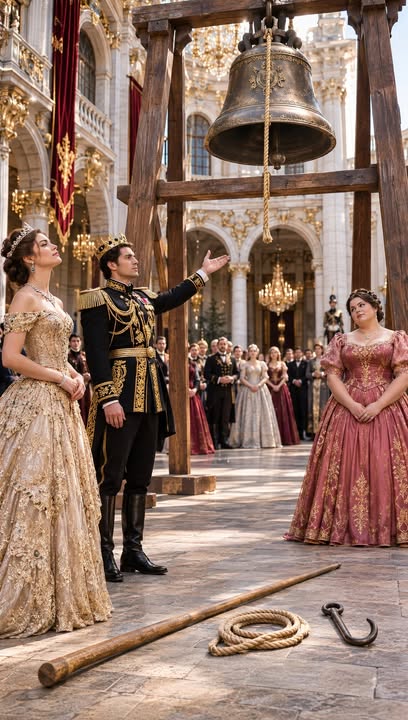
The bell stood where it had all begun, its rope hanging free.
A palace engineer had placed a barrier around the frame while he examined the missing pulley socket.
Emma stopped just beyond it.
She imagined what her father might have said about the order, the promise, and the years of silence.
He would likely have wanted to see the mechanism first.
He would have asked which parts were damaged, which could be saved, and what needed to be rebuilt.
She had inherited his way of looking at a problem before she had understood the history behind it.
“Emma.”
Julian came to stand a few paces away.
“You came after me,” she said.
“I wanted to ask something, but I didn’t want to ask it in front of everyone.”
She studied him carefully.
“Then ask.”
“I would like to spend time with you when this is no longer a palace matter,” he said. “Not as the prince who made a promise, and not because of what your father did for my family.”
Emma felt her heart answer before her judgment could catch up.
She did not trust that answer yet.
“What would that look like?”
“A conversation without a court watching. A walk, perhaps, if you wanted one. No announcement, no expectation that it must lead anywhere.”
“And if I say no?”
“Then I will accept it.”
“Will you still support the workshop review?”
“Yes.”
“Will you still tell the truth about the challenge?”
“Yes.”
“Will you still open the account if I decide I want no further part in your life?”
Julian’s expression grew serious.
“Yes.”
The answers came without hesitation, but Emma remembered how easily a sincere promise could become a comfortable story people told about themselves.
She would need time to see what he did when keeping his word became inconvenient.
“I don’t know what I want from you,” she said.
“You don’t have to know today.”
“I don’t want to be turned into a symbol of reform.”
“You won’t be.”
“Or a reward for doing something useful.”
“You aren’t.”
“And I won’t marry a man because his family owes my father.”
“I would never ask that of you.”
Emma searched his face.
“Then don’t ask me to trust you because you say the right thing.”
“I won’t,” he replied. “I’ll try to give you reasons.”
The answer was modest enough to feel possible.
“I may agree to a walk sometime,” she said. “But not yet.”
Julian’s smile was small and warm.
“Whenever you’re ready.”
A bell chimed from the palace interior, marking the hour.
Its sound was bright and ordinary, nothing like the deep note of the bronze bell in the courtyard.
Emma turned back toward the old frame.
“Will the account be opened tomorrow?” she asked.
“The queen has signed the order,” Julian said. “Mr. Vale and Lord Harrow will review it in the morning.”
“And then the court will hear the truth?”
“Yes.”
“What happens if the account names someone who is still part of the palace?”
Julian’s expression shifted.
“We will address what it says.”
“That isn’t an answer.”
“No,” he admitted. “It isn’t.”
The honesty did not reassure her, but it was better than a false certainty.
They returned to the records room just before the doors were locked for the evening.
Mr. Vale was waiting beside the table, holding the queen’s signed authorization.
Lord Harrow had already opened the cabinet where the sealed archive’s index was kept.
“It may take several hours to retrieve the full file,” he said. “The original papers are stored in a secured room beneath the west gallery.”
“Is the account there?” Emma asked.
“The index says it is.”
“Then we begin in the morning,” Julian said.
Mr. Vale nodded.
“I have arranged for the file to be brought here under witness. No one will remove a page without recording it.”
Emma looked toward the brass instrument resting in its open case.
“And the tool?”
“It will remain with you,” the archivist said. “There is no reason to keep it in the palace.”
She folded the cloth around it and placed it safely inside her gown.
Julian watched her, then turned to his mother’s authorization.
At the bottom of the page, below the queen’s signature, was a short notation in her hand.
“Open the account, including all correspondence concerning the promise made to Thomas Bell.”
Emma read the line twice.
All correspondence.
The words promised more than the single summary they had seen.
They promised the exact choices, written in the hands of the people who had made them.
Lord Harrow examined the authorization.
“There is one complication,” he said.
“What is it?” Julian asked.
“The file is listed under two names.”
Mr. Vale leaned over the index.
“Thomas Bell and Eleanor of the royal household,” he said.
The queen’s name had been entered beside her own account years before she became queen.
Julian glanced toward Emma.
“What would her correspondence be doing in the same file?”
“I don’t know,” Mr. Vale replied. “But the index also lists a sealed letter addressed to the next sovereign.”
“Who wrote it?” Emma asked.
The archivist turned the page.
The name had been concealed beneath a strip of old archival paper, placed there to protect the writing from light.
Lord Harrow carefully lifted one corner.
Beneath it, a single line appeared.
“From Thomas Bell, to be opened only when the royal family is prepared to hear the whole truth.”
Emma’s hand closed over the brass tool inside her gown.
And beneath the letter’s title, written in the same careful ink, was a date from the year her father had died.
**–END OF PART 5–CLICK “NEXT” AT THE BOTTOM OF THE PAGE TO CONTINUE READING**
* * *
[PREVIOUS: PART 4](https://storyly.idolsgift.com/blog/part-4-the-secret-behind-the-bell-057) | [NEXT: PART 6(THE END)](https://storyly.idolsgift.com/blog/part-6-the-end-the-secret-behind-the-bell-057)
✓ Lynn R. Adams
Part 5 – The Price of Silence Julian kept his eyes on his mother’s signature. The courtyard had filled with the ordinary sounds of palace work again: a cart rolling over stone, an attendant speaking…