PART 5: The Rhythm Beneath the Drums 069
Part 5 – The Measure of a Choice
“Queen Elara herself.”
The words seemed to remain in the observatory after Adrian had spoken them, caught among the covered instruments and the still hands of the brass clock.
Mara looked from the faint writing to the prince.
He had gone very still, his face pale in the lantern light, but his voice had not risen.
“Could the ink have been added later?” he asked.
Mistress Orla bent close to the page without touching it.
“It could have been,” she said. “The handwriting is not the queen’s.”
“Then the sentence may be a lie.”
“Or a correction,” Mara said.
Adrian turned toward her.
She could not yet explain why the words troubled her more than the accusation they seemed to contain.
The queen’s own letter had spoken of a simplified count, of Lord Veyne’s insistence, and of a rhythm that must not be changed.
If Elara had ordered the drums altered, perhaps she had done so for a reason they had not yet understood.
Or perhaps the faint line had been placed there to make the queen appear responsible for a decision she had opposed.
The truth was somewhere inside the ink, but the evening had already given them enough reasons not to accept the first answer that presented itself.
“We shouldn’t decide what it means from one sentence,” Adrian said.
He looked at the archivist.
“Can you establish when it was written?”
“I can try. The surface has aged differently, but that alone proves little.”
“Then document it carefully.”
Mara leaned toward the page.
Beside the sentence was a tiny mark, almost hidden in the grain of the paper.
It looked like a small musical note with its stem crossed through.
She had seen that mark on the old diagram, though there it appeared at the end of a line of timing notation.
“Do you recognize it?” Adrian asked.
“I’ve seen it before, but I don’t know what it means.”
Mistress Orla studied the mark.
“Queen Elara sometimes used symbols to indicate changes that were not yet approved for the official records.”
“Could it mean the sentence was an instruction?” Celestine asked.
“Possibly,” the archivist replied. “Or it could mark a passage she intended to revise.”
Adrian looked again at the words.
“Either way, we need to know what happened at the course tonight.”
A distant bell rang from the lower corridors.
The sound came twice, then stopped.
The engineer checked his pocket watch.
“That will be the inspection crew reporting from the ballroom.”
They descended from the observatory together, carrying the new clue and the unanswered questions back toward the course.
By the time they reached the ballroom, the spectators had been moved behind the inner rail.
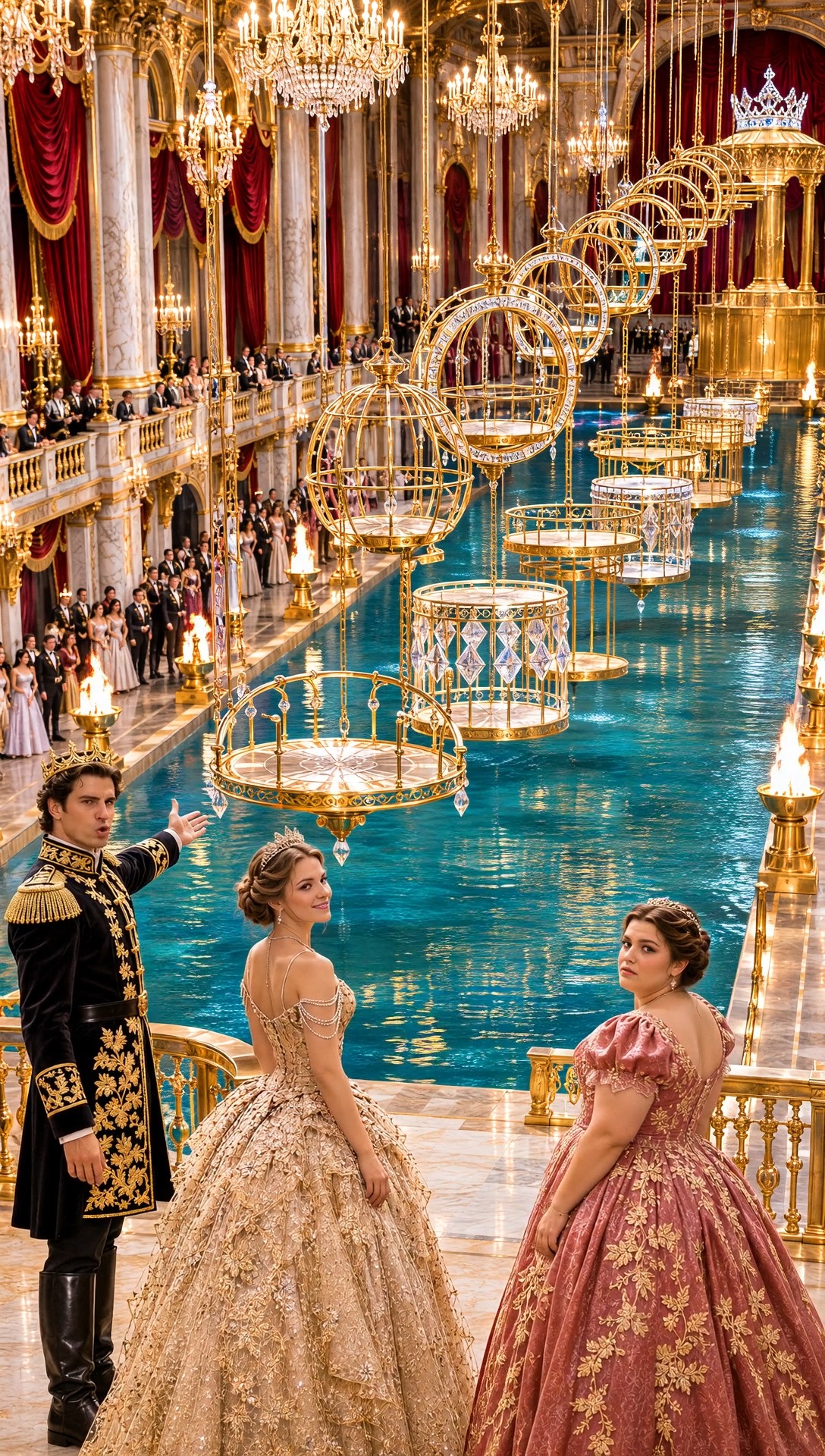
The golden structures hung above the pool in a quiet, suspended line, their reflections trembling on the water.
The crown still gleamed at the far end.
Mara’s legs ached from the crossing, and her rose-colored gown felt heavier now that the excitement had passed.
She had nearly touched the crown.
Yet the thought of it had become less important than the stopped mechanisms, the hidden rhythm, and the people who had trusted the official beat.
The palace engineer had gathered three assistants beside the control panel.
Each counterweight had been secured with a locking pin, but the gears continued to hold tension.
“We can bring the frames down in sequence,” he told Adrian. “It will take time, and we need the pool area clear.”
“How much time?”
“Twenty minutes if everything holds.”
“And if something doesn’t?”
“Then we keep the course secured and take longer.”
Adrian nodded.
“Proceed carefully.”
The engineer turned to his assistants, and they began checking the locks.
Mara stood near the edge of the inner rail, watching the sixth cage.
Even with the mechanisms stopped, she could picture the older rhythm moving beneath it.
Three quick beats, a rest, then two.
The true pattern had carried her safely farther than anyone expected.
Now it seemed to have led them to a question no one could answer.
Celestine joined her.
“I have been thinking about the note I received,” she said.
“Do you remember the exact wording?”
“Not all of it. It said the sixth cage would return on the third beat, and that I should trust the course.”
“Did it tell you to hurry?”
“No.”
Celestine looked down at the still water.
“But I read it as permission to move before I had understood what it meant.”
Mara glanced at her.
“Being given information can feel like being given certainty.”
“That is exactly what I wanted it to be.”
Celestine’s voice held no self-pity.
She had made a poor choice, and she was trying to understand it without pretending that someone else had made it for her.
“I’m sorry you fell,” Mara said.
“So am I.” Celestine’s mouth curved faintly. “Though I’m beginning to think the fall was the least important part of the evening.”
“What do you think was the most important?”
“That I was so eager to be chosen that I forgot to ask what kind of choice I was making.”
Mara looked toward the crown.
“I came here because I wanted to prove I could cross.”
“And did you?”
“I think so.”
“Then perhaps you’ve already proved enough.”
Mara studied Celestine’s face.
There was no challenge in her words, nor any attempt to make the contest disappear.
There was only an honest uncertainty about what should matter now.
“I don’t know what proving enough feels like,” Mara admitted.
Celestine considered this.
“Neither do I.”
The admission made them smile at the same time.
Across the ballroom, Adrian spoke with the engineer while the attendants watched the suspended course.
He turned occasionally toward Mara, not to hurry her, but to make sure she was still steady.
When their eyes met, he gave her a small nod.
Mara answered with one of her own.
The first counterweight came down with a muted thud.
A golden frame shifted a few inches and stopped.
The engineer checked its locking pin.
“Good,” he called. “That one is released.”
The assistants moved to the next support.
The sequence was slow and deliberate, but the work had only just begun.
A low metallic knock came from above the pool.
Everyone turned.
The sixth cage trembled.
The chief attendant moved toward the engineer.
“That frame should be locked.”
“It is,” the engineer replied.
He crossed to the control panel and checked the marked levers.
The sixth cage shivered again.
Its outer ring began to turn.
“Clear the pool!” Adrian called.
The attendants ushered the nearest spectators farther back.
Mara watched the cage swing toward the course’s center, then away.
It moved more slowly than it had during the contest, but the movement was uneven.
The engineer’s assistants held their positions by the control panel.
“Don’t touch the release,” he warned them. “The counterweight is catching.”
A sharp click sounded inside the frame.
The cage swung back.
It reached the place where the platform should have paused, but did not.
The old rhythm should have held it there for two beats.
Instead, the frame moved on.
Mara felt her breath catch.
The newer gear was forcing the return too quickly.
“Can you stop it?” Adrian asked.
“Not without releasing the upper brace,” the engineer replied. “If the brace is under pressure, the cage could drop toward the water.”
“How long?”
“I need to reach the service latch.”
The engineer started along the narrow maintenance rail beside the pool.
The cage continued turning.
Its motion was not fast, but each uneven swing made the gold frame sway more broadly.
A heavy arm above it shifted in answer.
“Everyone away from the rail,” Adrian ordered.
The crowd obeyed, though some watched from behind the pillars.
The engineer reached the service ladder and began climbing toward the latch.
A smaller sound rose from the cage.
Metal scraping against metal.
Celestine turned pale.
“That’s the place where my harness caught.”
Mara looked up.
A length of safety line had become tangled around the inner support, caught where the cage’s frame met its swinging arm.
Celestine’s harness line, still looped at the waist after her earlier rescue, had been secured to a nearby inspection hook.
She had been standing on a low maintenance platform beside the pool, helping the attendants identify the hook that had held her weight.
Now the moving arm pulled the line taut.
“Celestine!” Mara called.
Celestine looked down.
The line caught beneath a turning bracket.
It tugged her sideways, pinning her harness strap against the platform rail.
She grabbed the post with both hands.
The cage swung outward.
The line tightened.
The chief attendant rushed toward her, but Adrian caught his arm.
“Wait. The frame is moving.”
“She can’t stay there,” the attendant said.
“I know.”
Adrian looked to the engineer, who was still partway up the ladder.
“Can you release the brace?”
“Not from here!”
Celestine’s fingers slipped a little on the post.
Mara heard the old rhythm beneath the scrape of the gear.
The frame moved too soon on the official count, but its motion still carried the deeper pattern beneath it.
A quick turn.
A brief drag.
A pause that had not been fully erased.
She knew the moment when the cage would swing inward again.
“Celestine!” Mara called. “Keep your hands on the post and stay low.”
“I’m trying.”
The line pulled taut once more.
Celestine’s shoulder struck the rail, and she bit back a cry.
Mara looked toward the final platform, where the crown waited just beyond the shifting frame.
If she crossed now, she might still reach it.
The course remained passable.
The bridge had not fallen, and the final frame was turning slowly enough to offer one more opening.
The spectators saw it too.
A wave of whispers moved through the ballroom.
Mara could hear the question without anyone asking it aloud.
Would she finish while she still had the chance?
She had come to the course to prove that she belonged among those who were allowed to choose their own future.
She had reached the final stretch.
The crown was only a few careful steps away.
For a brief moment, she stood with one hand on the rail and the other resting against the aching muscles of her thigh.
Then she saw Celestine’s face.
Celestine was frightened, but she was looking at Mara, not asking her to win the contest.
Mara understood the difference.
She turned away from the crown.
“Adrian, I’m going to her.”
He did not ask her to wait.
He did not tell her the risk was unnecessary.
He only looked toward the unstable frame and said, “The course is still moving. Don’t approach until you can see the return.”
“I know.”
“I’ll stay where you can see me.”
Mara nodded.
The chief attendant reached for the harness line that controlled her own safety tether.
“I can secure you to the rail.”
“Please do.”
While he clipped the line to her belt, Adrian took the old timing diagram from the engineer’s case and unfolded it on the nearest table.
He compared its markings with the movement above the water.
“The release sequence has to follow the original measure,” Mara said.
The engineer called down from the ladder.
“I can free the upper brace once the cage comes through its inward turn, but I need the counterweight settled first.”
“How do we settle it?” Adrian asked.
“With the brake lever in the control room. The lever is on the far side.”
The control room lay behind the same service passage that Mara had entered earlier with Adrian.
A second attendant started for the corridor.
“I’ll get it,” he said.
“No,” Mara replied.
She watched the cage.
“If he pulls the brake on the official beat, the frame will catch between turns.”
The attendant stopped.
Mara traced the motion with her eyes.
The old count held a longer rest before the return.
The official drumbeat had filled that silence, making it seem shorter than it was.
The machinery needed the true pause.
“Three quick beats,” she said. “Then wait for the frame to settle before the next two.”
The engineer glanced down at her.
“Can you be certain?”
“I can be careful.”
The distinction mattered.
She could not promise the mechanism would obey.
She could only watch, listen, and choose her moment.
Adrian looked toward the musicians’ platform.
“Play the old measure,” he called.
The musicians hesitated.
They had been given the official sequence and told to follow it exactly.
Adrian’s voice remained calm.
“This time, play the measure written on the queen’s diagram.”
The first drum sounded.
Then the second.
A third beat followed, quick and low.
The musicians paused.
The ballroom listened.
In the silence, the cage began its inward return.
Mara stepped onto the narrow maintenance bridge.
Her harness drew lightly against her waist.
The cage swung toward her.
She waited through the last of its outward arc.
The next drumbeat came, slower than the official rhythm, with the pause held long and clear.
The gear scraped.
The frame faltered.
Mara moved.
She crossed the bridge with one hand against the rail, keeping her body low as the floor tilted beneath her.
The cage reached the service platform.
She caught its outer bar and stepped inside.
“Stay where you are,” Adrian called.
“I have her line.”
Mara spoke steadily, though her pulse raced.
Celestine’s safety tether had looped around the lower frame and was caught beneath a small rotating bracket.
The line had not broken, but it was tightening with each swing.
Mara lowered herself to the narrow platform.
“Celestine, can you move your left hand?”
“I can.”
“Keep it on the post. Don’t pull against the harness.”
“I won’t.”
The cage drew away from the service platform.
Mara held the rail, her weight close to the center.
She could feel the machinery through the soles of her shoes.
The old rhythm was still there, but the altered gear crowded it, forcing the motion forward before the pause had ended.
“Adrian,” she called, “we need the brake on the second beat after the rest.”
The prince moved to the control-room entrance.
The attendant there waited with his hand near the lever.
“Not yet,” Mara said.
The frame swung outward.
Its movement tugged the trapped line, and Celestine gasped.
“I’m all right,” she called, though her voice shook.
Mara reached for the loose section of tether.
The bracket caught it tightly.
She could not free it while the frame was moving.
She needed the quiet interval between turns.
The drums sounded the three quick notes.
Mara waited.
The cage moved inward, then began to slow.
The longer pause arrived.
She pressed one hand against the rail and used the other to lift the tether away from the bracket.
It resisted.
The line was caught under the edge of the replacement gear’s guard.
Mara felt the metal give a fraction, then catch again.
The mechanism began its next movement.
“Not yet,” she whispered.
The frame started outward.
She let the tether rest where it was and braced herself.
A rush of motion swept the cage away from the service platform.
The harness line at Mara’s waist drew taut, holding her against the rail.
Across the ballroom, Adrian stood beside the brake lever, watching her.
His hand was raised, but he did not pull it.
He was waiting for her signal.
Mara had once thought being trusted meant being given an answer.
Now she understood that it could mean someone was willing to wait for her judgment.
The cage returned.
Three quick beats sounded.
Mara counted with them.
The rest came.
She leaned toward the tether.
“Now, Adrian!”
He pulled the brake lever.
The counterweight settled with a deep, restrained clunk.
The cage shuddered, but its swing slowed.
The engineer reached the upper brace and released the latch.
The moving arm stopped before it could complete its turn.
For one suspended moment, everything held still.
Mara eased the safety line away from the bracket.
The guard had shifted enough to free it.
Celestine released a breath as the harness loosened from her shoulder.
“I’m clear,” she said.
Mara kept one hand on the rail.
“Can you stand?”
“Yes.”
“Then stay where you are until the attendants reach you.”
The engineer descended from the ladder and crossed the maintenance rail.
The chief attendant and two others approached Celestine from the opposite side, keeping away from the frame until the engineer confirmed it was secure.
They unfastened the tether and helped her onto the fixed platform.
Celestine’s face was pale, but she was upright.
When Mara reached her, she took Celestine’s hand.
“You’re safe.”
Celestine’s fingers closed around hers.
“So are you.”
The words were quiet, almost lost beneath the attendants’ movements, but Mara heard them.
Adrian arrived a moment later.
He looked at Celestine first.
“Are you hurt?”
“My shoulder is sore, but I can move it.”
“Have the physician examine you.”
“I will.”
Only then did Adrian look at Mara.
“You gave up the crown.”
Mara followed his gaze toward the far end of the course.
The diamond crown still stood on its pedestal, untouched.
“I chose to help her.”
“I saw.”
He did not say that it had been the correct choice.
He did not praise her as though she had performed for the crowd.
He only acknowledged what she had done.
Mara found that meant more.
The engineer checked the cage’s final lock.
“Everything is secure now,” he said. “We can begin the full stopping sequence.”
“How long?” Adrian asked.
“Another fifteen minutes, at least.”
“Then take the time you need.”
The spectators remained behind the rail.
Some looked disappointed that the contest had stopped.
Others were watching Mara and Celestine with a new attentiveness, as if they had finally seen the course for what it was.
Mara’s arms trembled when the attendants helped her down to the stone floor.
She had crossed most of the course, reached the final platform, and then turned back.
The crown was still there.
Her chance to claim it was not.
She did not know whether she felt relief or loss.
Perhaps both.
Celestine sat on a bench beside her while the physician examined her shoulder.
“I thought you would keep going,” Celestine said.
“So did I.”
“Are you sorry you didn’t?”
Mara watched the engineer and his assistants work beneath the suspended frames.
“No.”
She paused.
“But I don’t know what comes next.”
Celestine offered her a small, tired smile.
“Neither does anyone else.”
Adrian approached with a folded cloth for Mara’s scraped palm.
She had not noticed the thin line of blood until he showed it to her.
“It’s small,” she said.
“Small things still deserve tending.”
He wrapped the cloth around her hand carefully, then let her hold it in place.
His fingers did not linger.
The restraint felt more intimate than a grand gesture might have.
“The contest cannot continue tonight,” he said.
“Because of the gear?”
“Because the course was not what I was told it was.”
Mara looked toward the crown.
“If I had reached it before the frame shifted, would you have let me claim it?”
Adrian considered the question.
“I would have stopped the contest once you told me the rhythm was wrong.”
“Even if I had touched the crown?”
“Especially then.”
She searched his face.
“Would that mean I had won?”
“I don’t know.”
His honesty carried no easy comfort.
“I know only that I cannot call the course fair while we are still discovering how it was altered.”
Mara nodded.
A part of her had wanted the crown because it was the shape of the challenge before her.
But the longer the evening had gone on, the more she understood that a prize could not turn uncertainty into fairness.
“Then don’t call it fair,” she said. “Find out what happened first.”
“That is what I intend to do.”
His gaze held hers.
“And when we know, I will listen to what you think should happen.”
Mara felt the words settle between them.
He was not promising to give her a crown.
He was offering to hear her.
The distinction made her trust him more than a promise ever could.
At the far side of the ballroom, Mistress Orla arrived with the queen’s letter and the faded diagram protected inside linen.
She spoke quietly with the chief attendant, then approached Adrian.
“There is another problem,” she said.
The prince’s expression sharpened.
“What is it?”
“The notation in the observatory does not match the notation on the diagram as closely as I first believed.”
Mara sat straighter.
“What’s different?”
“The original score has an additional measure at the end,” Mistress Orla said. “The diagram includes only the repeated pattern for the course.”
“Could the extra measure be part of the stopping sequence?” the engineer asked.
“Possibly.”
Mara looked toward the halted frames.
“If the course is built to follow the lullaby, then the ending might tell the mechanisms how to stop safely.”
The engineer glanced at the control panel.
“That would explain why the old records include no separate shutdown instruction.”
Adrian looked at the archivist.
“Can you find the full score?”
“I believe so. Queen Elara kept a music book in the observatory, but it was not listed in the inventory.”
“Then we’ll search.”
The engineer shook his head.
“Not until the counterweights are settled. The course is safe, but I won’t risk opening a control housing while it is still under pressure.”
“How long?”
“Ten minutes, if the lower braces hold.”
The ballroom seemed to hold its breath with him.
Mara turned her head toward the course.
The final frame was still, but not completely at rest.
Its outer ring moved by a fraction, then stopped.
The engineer noticed it too.
“That should not be happening.”
He hurried to the control panel.
The ring shifted again.
A thin metallic note rang through the hall, high and clear.
Mara recognized it as the first note of the lullaby.
The musicians, still seated at their platform, looked toward one another.
A second note sounded from inside the course.
Then a third.
The old rhythm began to emerge, faintly and unevenly, from the metal itself.
Mistress Orla clutched the queen’s letter.
“That is the lullaby.”
The engineer reached for the brake lever.
“Don’t pull it,” Mara said.
He stopped.
“The ending may be part of the stopping sequence.”
“The course is already halted.”
“Not completely,” Mara replied. “Listen.”
The metal gave three quick notes.
Then silence.
The ring shifted a fraction.
A pair of notes answered, one low and one high.
The mechanism was not moving randomly.
It was following the old measure, but the altered gear kept interrupting it.
Adrian’s eyes moved to Mara.
“Can it be completed?”
“I don’t know.”
The engineer studied the turning brass disk.
“If the lullaby contains a final rest, it may release the remaining tension.”
“Or it may start the frame again,” the attendant said.
The physician stood beside Celestine, ready to move her away from the pool.
Mara could feel the question gathering around them.
The course had been dangerous because someone had changed its timing.
Now it seemed to be answering the music that had once governed it.
The crown platform remained reachable, but no one could say whether the mechanisms would remain still if the music continued.
“Could the attendants play the full score?” Adrian asked.
Mistress Orla opened the queen’s letter and looked over the final lines.
“I can’t read the ending from here.”
The engineer shook his head.
“We need the original music book.”
“Then we wait,” Adrian said.
The first three notes sounded again, this time from the sixth cage.
The metal ring turned a little farther.
The replaced gear clicked sharply.
Celestine rose from the bench.
“Shouldn’t we move back?”
“Yes,” the physician replied.
Mara stood too, but kept her eyes on the course.
She could hear the missing rest.
She could hear the pair of notes.
And beneath them, another pattern seemed to call from the final platform.
The crown’s pedestal began to hum.
The sound was so faint that she wondered whether she had imagined it.
Then the diamonds caught the chandelier light and flashed in time with the old measure.
Adrian looked from the crown to the stopped machinery.
“What is it doing?”
Mara could not answer.
The crown platform shivered once.
A narrow panel beneath the pedestal slid open, revealing a small black lever and a line of engraved notes.
The last line was not part of the course diagram.
It was not in the queen’s letter.
And beside the notes, in handwriting unmistakably like the faded mark on her father’s old tools, were the words:
Wait for the one who turns back.
**–END OF PART 5–CLICK “NEXT” AT THE BOTTOM OF THE PAGE TO CONTINUE READING**
* * *
[PREVIOUS: PART 4](https://storyly.idolsgift.com/blog/part-4-the-rhythm-beneath-the-drums-069) | [NEXT: PART 6(THE END)](https://storyly.idolsgift.com/blog/part-6-the-end-the-rhythm-beneath-the-drums-069)
✓ Lynn R. Adams
Part 5 – The Measure of a Choice “Queen Elara herself.” The words seemed to remain in the observatory after Adrian had spoken them, caught among the covered instruments and the still hands of the br…