PART 5: The Question No One Could Answer 052
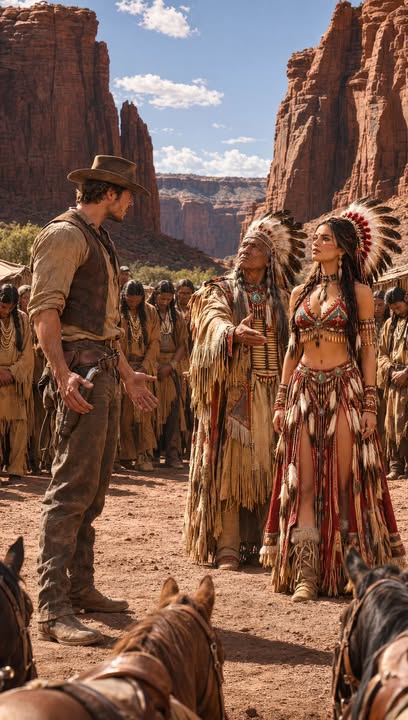
Part 5 – The Road They Chose
“Caleb knows who led the men to the ridge.”
The words remained on the scrap of paper after the aunt had read them aloud, as if the ink itself had refused to let the secret be put away again.
Ethan looked at the unfamiliar signature beneath his mother’s.
“Was this written before she died?” he asked.
The aunt turned the paper toward the light.
“The date is from the winter before her last illness.”
“Why would she have sent this to Nahimana’s mother?”
“She may not have sent it,” the aunt replied.
“It could have been a note she kept with the letters.”
Nahimana examined the margin, her face thoughtful rather than startled.
“Does it say Caleb led the men,” she asked, “or that he knows who did?”
“Only that he knows.”
Ethan read the sentence again.
His mother had not accused Rusk.
She had left a piece of knowledge behind, guarded by people who believed it needed to remain private.
The chief’s expression had grown grave.
“Could this be about the same men who attacked Nahimana?”
“I don’t know,” Ethan said.
“The date is years old.”
“Then perhaps it is separate from this trouble.”
“Perhaps,” Nahimana said.
“But it may explain why Caleb’s name appears in the old letters.”
The aunt placed the scrap beside the clasp.
“Your mother understood that a name can lead people toward the truth,” she said.
“She also understood that it can lead them toward the wrong person if they carry it carelessly.”
Ethan looked at the silver keepsake in his palm.
The old note changed nothing he could prove about Rusk’s part in the present attack.
It changed what he could pretend not to know.
The chief rose.
“We will speak with Caleb tomorrow.”
“Tomorrow may be too late,” Will said.
The young ranch hand had been quiet while the family letters were read, but now he stepped closer.
“I heard two riders talking before I left the Bar S,” he continued.
“They said the company men would reach the old road in three days.”
“What company?” the chief asked.
Will’s gaze moved to Ethan.
“Canyon Development.”
Ethan felt the pieces tighten into a shape he had hoped not to see.
“They have been asking about water rights and mineral claims,” he said.
“I heard they wanted to buy the old mine.”
“The mine is not the only thing they want,” Nahimana said.
She had seen the map’s marked trail, the line that skirted the village and continued east.
“They want a road they can use.”
Will nodded.
“Caleb said the company had an agreement with a territorial agent.
He said the agent would inspect the land after the riders cleared the eastern trail.”
“Cleared it of what?” Sani asked from the doorway.
No one answered at once.
The word might mean brush, a blocked path, or people.
It might mean nothing more than a convenient phrase used by men who wanted to sound certain.
But the timing was plain.
If the company’s riders arrived while the village and the neighboring band blamed each other, they might find the land divided before they even reached it.
The chief looked toward the eastern trail.
“Has the neighboring headman been told about the company?”
“Not yet,” Nahimana replied.
“Then he must hear it before anyone brings accusation to his door.”
“We will send a rider,” the chief said.
“I will go with the message,” Nahimana said.
Her father drew a breath, and Ethan saw the instinct to keep her close rise in him.
Then the chief let it go.
“You may go,” he said.
“Take Tiva, and return before dark.”
“I will.”
Ethan waited until the chief had finished speaking before he said, “I should ride to the Bar S.”
The words came out steadier than he felt.
The chief looked at him.
“To ask Rusk what he knows?”
“To find out what he intends to do next.”
“Will you return?”
Ethan almost answered too quickly.
He had spent so long treating departure as an ordinary thing that it felt strange to be asked whether he would come back.
“I intend to.”
“That is not what I asked.”
Ethan looked toward Nahimana.
She had turned away from the family chest and was watching him now.
If he rode to the ranch, he could speak to Rusk privately before a larger meeting made every answer defensive.
He could also disappear into the world he knew, carrying the old note and the broken spur with him, leaving the village to face whatever followed.
There was a safe route south to the settlement, where he could hand the evidence to a lawman and let others decide what to do.
He could choose that route and tell himself he had done his part.
The thought had come so naturally that he felt ashamed of it.
“I don’t know exactly what will happen,” he said.
“But I won’t leave without bringing back what I learn.”
Nahimana’s gaze did not soften.
“Do you mean that because you promised my father?”
“No.”
“Because of your mother’s letter?”
“No.”
“Then why?”
Ethan considered the easy answers and let them pass.
“Because the people who planned this are counting on everyone choosing the road that asks the least of them.”
For a moment, neither of them spoke.
Then Nahimana said, “I will ride with you.”
The chief turned to his daughter.
“You have just agreed to go east.”
“I will send the message first,” she replied.
“Then I will ride to the ranch.”
“It may be dangerous.”
“It may be.”
Her voice held no bravado, only resolve.
“I cannot ask the neighboring band to trust a warning I am not willing to follow myself.”
Ethan felt a familiar urge to tell her that she did not need to risk herself for his purpose.
He recognized the shape of it before he spoke.
He had mistaken protection for a right to choose.
“You should go only if you want to,” he said.
“Not because you think you have to prove anything to me.”
“I know.”
“Or to your father.”
“I know that, too.”
She studied him.
“Do you want me there?”
The question made him pause.
“I do.”
“Would you still go if I chose not to?”
“Yes.”
“Then I will choose for myself.”
The answer was not a promise to him.
It was not a declaration of what might come between them.
It was simply hers.
Ethan nodded.
“Then we go together.”
The chief’s sister stepped forward, taking the old paper from beside the clasp.
“This stays here,” she said.
“Your mother’s note does not belong on the road until you know what it means.”
Ethan looked at the silver keepsake.
“I should leave this with it.”
“That is your choice,” the aunt replied.
He closed his fingers around the clasp.
“For now, I’ll keep it.”
Nahimana watched the small movement.
“Your mother gave it to you,” she said.
“And gave it to my mother before that,” the aunt replied.
“Neither gift came with a claim.”
Ethan felt the sentence settle deeply.
The chief’s sister folded the note carefully and returned it to the chest.
“Then we will keep the story safe while you find out what Caleb knows.”
No one called their plan a rescue.
No one spoke of fate.
They spoke of trails, witnesses, letters, and the time it would take to ride.
By midday, Nahimana and Tiva had carried the message east.
The neighboring headman’s reply came back before dusk: he would meet the chief at the old boundary spring, and he would bring the two people who had seen the riders near the mining road.
He did not accuse the village.
That small restraint gave the chief room to breathe.
It also gave the truth a little more time.
Ethan and Nahimana left at first light the next morning, accompanied by Sani at the chief’s insistence.
Will remained in the village.
He had offered to guide them to the Bar S, but the chief asked him to stay where he could be reached if Rusk sent another message.
“I don’t like leaving you with that burden,” Ethan told him.
Will adjusted his hat.
“It isn’t yours to carry for me.”
The words sounded like something Ethan himself might have said.
He wondered where Will had learned to speak with such care.
The ride north took most of the morning.
The desert opened around them in long bands of gold and rust, while the distant hills held the last of the night’s coolness in their shadows.
Nahimana rode with her back straight, but Ethan noticed that she rested one hand against the reins more lightly than before.
“You have ridden this trail often?” he asked.
“Not this far north.”
“Are you tired?”
“I am thinking.”
“About the meeting?”
“About how many people will have to believe one another before anyone can be certain.”
“That is a lot to ask.”
“It is still less than asking them to trust the wrong story.”
He looked at the ground ahead.
The old spur in his saddlebag seemed heavier than it had the day before.
“Rusk was the first man at the ranch who treated me like I might be useful,” he said.
Nahimana kept her eyes on the trail.
“You trusted him because he earned it.”
“Yes.”
“That does not mean you were foolish.”
“What if I knew more than I admitted to myself?”
“Then you must decide what to do with what you know now.”
She spoke without trying to make the decision easier.
Ethan found comfort in that.
At the Bar S, the buildings stood in the afternoon heat as if they had not noticed the years or the trouble gathering beyond their fences.
The ranch hands had been working near the corral.
When Ethan rode in, several looked up, and one raised a hand in greeting.
The ordinary welcome made his stomach tighten.
He had once thought of the place as temporary, but memory had made a home of it in ways he had never acknowledged.
Caleb Rusk was standing outside the tack room.
He was a lean man in his fifties, with a weathered face and a careful way of watching before he spoke.
His gaze went first to Ethan, then to Nahimana, and finally to Sani.
“You came,” he said.
“You sent a map,” Ethan replied.
“I sent a warning.”
“You also sent a broken spur.”
Rusk’s expression did not change, but his eyes lowered briefly toward Ethan’s saddlebag.
“Where did you get that?”
“Will carried it in with the map.”
“Then Will has been careless.”
“He brought us what you wanted us to see.”
“I wanted him to speak with you alone.”
“You told him not to show the paper to the chief.”
Rusk looked toward Nahimana.
“That was not because I wanted to hide it from her.”
“Then why?” she asked.
“Because I knew the paper would be read as a threat before anyone asked what it meant.”
“And what does it mean?”
Rusk did not answer at once.
He motioned them toward the shade beside the tack room.
Sani remained outside with the horses.
Ethan and Nahimana followed Rusk into the cool darkness.
Rusk took a folded document from a shelf.
It was a survey map with the same trail marked in ink, but the line extended farther east than the one Will had brought.
Along the edge were notes in a narrow, unfamiliar hand.
“Canyon Development wants to reopen the old mine road,” Rusk said.
“They say it will bring work.”
“Who is the agreement with?” Ethan asked.
“A territorial land agent named Harlan.
He has promised the company a survey once the boundary is considered safe.”
“Safe from what?”
“Disagreement, according to the company.”
“People,” Nahimana said.
Rusk looked at her.
“I don’t know what they mean by safe.”
“Yet you kept the trail open.”
“I was asked to map it.”
“By the company?”
“By the agent.”
“Did you know they were bringing riders?”
“I knew there would be men checking the ground.”
“Were those men the ones who attacked her?”
“I don’t know.”
“You have the map and the spur,” Ethan said.
“You knew about the trail, and my mother’s note says you know who led men to the ridge.”
Rusk’s face changed then.
Not with surprise, but with recognition.
“You found that note.”
“It was in my mother’s things.”
For a moment, Rusk seemed to lose the practiced distance that had steadied him.
“Your mother kept too much,” he said.
“Or you told her too much.”
“I was younger than you are now,” Rusk replied.
“I worked for a survey crew that was hired to mark a road.”
“Who led the men to the ridge?” Nahimana asked.
Rusk looked down at the map.
“I did.”
The confession was quiet.
Ethan felt the blood leave his face.
“Was my mother there?”
“No.”
“Was Nahimana’s mother?”
“Not then.”
“What were the men doing?”
“Looking for a route through the eastern country.
The company wanted to move equipment without asking permission from the people who lived there.”
“Did you know that?”
“I knew they had no agreement with the village.”
“Then why lead them?”
Rusk’s hands rested on the map, fingers spread against the paper.
“I believed the road would be used whether I helped or not.
I thought I could keep them from taking a route through the village.”
“That is what you told yourself,” Nahimana said.
“Yes.”
“Did it make things safer?”
“No.”
The answer came without defense.
Rusk looked at her, meeting her eyes directly.
“I gave them a way to reach the ridge.
I thought I was steering them away from the homes below.”
“You did not know what they would do once they got there.”
“No.”
“And you did not ask.”
“No.”
The silence that followed was not empty.
It held the long cost of a choice made under the excuse that someone else would make a worse one.
Ethan recognized the shape of it.
Rusk had chosen the path that seemed least harmful to him, and had told himself the outcome was beyond his control.
“What happened to the men who came with you?” Ethan asked.
“They were not the same men who attacked Nahimana yesterday.”
“How do you know?”
“Because I know the one who hired them.”
Rusk looked toward the open door.
“An agent named Harlan has been moving between the company and the eastern band.
He tells each side that the other has accepted the survey.
He wants them to blame each other long enough for the company to establish a presence.”
The room seemed suddenly smaller.
“Did you help him?” Nahimana asked.
“At first.”
“Did you know he was using the feud?”
“No.”
“Do you know now?”
“Yes.”
Rusk met Ethan’s eyes.
“After the attack, Harlan told me the company would move in three days.
He wanted me to keep the eastern trail open.”
“Why did you send the map to Ethan?”
“Because I thought he could get it to the village without making it sound like a threat.”
“You could have sent it yourself,” Nahimana said.
“I should have.”
“Why didn’t you?”
Rusk’s gaze fell.
“Because I had spent years deciding that if I kept my hands clean enough on the surface, I could pretend I had not helped.”
Ethan thought of the old note, of his mother writing that Rusk knew who led the men to the ridge.
His mother had known him when he was young.
She had written his name, but she had not named him as guilty or innocent.
She had left him to live with the truth he had once refused to speak.
“Will the company bring armed men?” Ethan asked.
“Not a large force.
A handful of guards and surveyors.”
“Enough to frighten people who believe the other side is coming for them,” Nahimana said.
Rusk nodded.
“They want no fight.
They want the land to appear empty enough to measure.”
The answer made Ethan angrier than a direct threat would have.
It was not violence that the company counted on, but mistrust.
A broken peace could be used like an open gate.
“Can you testify to what Harlan has done?” Ethan asked.
“I can.”
“Will you?”
Rusk looked at him.
“If it means losing my job, I suppose I have earned that.”
“It may mean more than that,” Ethan said.
“It may mean giving up the chance to call your silence a mistake instead of a choice.”
Rusk’s eyes narrowed, but he did not look away.
“I know.”
Nahimana stepped closer to the map.
“The neighboring headman has agreed to meet us.”
“Then you should tell him the same thing you told us,” she said.
“Without asking us to carry the weight of your confession for you.”
Rusk bowed his head once.
“I will.”
Sani appeared at the doorway.
“There is a rider coming from the south,” he said.
Ethan went outside.
A dust plume marked the road beyond the pasture.
The rider was still too far away to identify.
Rusk came to stand beside him.
“That may be Harlan.”
“How long until the surveyors arrive?” Ethan asked.
“By nightfall, if they ride straight from the mine road.”
The chief’s sister’s warning came back to Ethan: bring facts, not fear.
The facts were now plain enough.
The company intended to use the old trail.
Rusk had helped it find a route.
An agent had encouraged suspicion between two communities so the survey could proceed without resistance.
The men who had attacked Nahimana might have been hired to keep her from warning the village.
But until Harlan’s men were identified, even that remained an inference.
Ethan looked south toward the safe road to town.
If he rode now, he could reach the territorial agent before the survey party.
He could carry the map, the note, and Rusk’s testimony.
He could likely get there faster than anyone else, and spare himself from waiting to see what the company would do.
He could also leave Nahimana and the chief to hold the village together while the armed men approached.
The easy road had appeared again.
This time it was not a habit he could pretend not to recognize.
“I should take the evidence to the territorial office,” Ethan said.
Rusk nodded.
“I can give you a statement.”
“That may not be enough.”
“The agent may be fair,” Nahimana said.
“May be,” Ethan replied.
“If we reach him before Harlan does, we can show him the full pattern.”
“And if you go south,” she said, “we remain here.”
“Yes.”
“Do you believe we can protect the village without you?”
“I believe you can decide what to do without me.”
“That is not what I asked.”
Ethan looked at her.
The distinction mattered.
He could not promise that no one would be hurt, or that the company would back down, or that the territorial agent would listen.
“I believe you are capable,” he said.
“But I do not believe you should have to face this alone.”
“Then why are you thinking of leaving?”
“Because the evidence might stop the company before it reaches the village.”
“And it might not.”
“No.”
“What would happen then?”
“I don’t know.”
The same answer had followed him through every decision since he had arrived.
This time, he understood that uncertainty did not excuse him from choosing.
Nahimana looked toward the trail that led back to the village.
“My father will want me to stay.”
“Because he is afraid for you?”
“Because he is afraid for everyone.”
“Would you stay if he asked?”
“I have spent too much of my life answering that question for other people.”
She turned back to him.
“I want to remain until the neighboring headman hears the truth.
After that, I will decide.”
Ethan nodded.
“And if you choose to go south?”
“I will go.”
“And if you choose to stay?”
“I will stay.”
The clarity of her answer did not make his own choice easier.
It made it more honest.
He could choose the road to town and trust her judgment.
He could also choose to stay beside her, without calling that choice a claim on her future.
“What will you do?” she asked.
Ethan looked at the southbound trail.
For years he had told himself that leaving first was freedom.
It had kept him from being beholden to anyone, but it had also kept him from being present when staying mattered.
“I’ll ride to the territorial office,” he said.
“If I can get the agent to act, it may give you more protection than another rifle at the village.”
Nahimana’s expression did not change.
“Is that your choice?”
“Yes.”
“Not because you think I need you to save me?”
“No.”
“Not because you believe I will wait for you?”
“No.”
“Then go.”
Ethan felt the answer as both permission and ache.
He had wanted her to ask him to stay.
The thought was selfish, and recognizing it did not erase it.
Nahimana had not asked him to prove his care by abandoning the work only he could do.
She had trusted him enough to let his decision be his own.
“I will come back,” he said.
“That is a promise you can make?”
“I can promise I will try.”
“Then try.”
Rusk brought out a narrow leather case and placed the maps and his written statement inside.
He signed the statement before witnesses, acknowledging his part in the earlier survey and what he had learned of Harlan’s plan.
Then he gave Ethan the name of the agent who had promised to review the company’s land papers.
“I’ll ride with you as far as the fork,” Rusk said.
“You should stay here and speak to the chief,” Ethan replied.
“I should have done that long ago.”
Rusk turned to Nahimana.
“I will answer every question the chief and the neighboring headman ask.”
She studied him for a moment.
“Do not ask them to trust you before they have heard the truth.”
“I won’t.”
Ethan mounted.
Nahimana did not reach for him.
She did not ask him to stay.
She stood beside the trail, her face turned toward him, golden eyes bright in the afternoon light.
He had once thought those eyes were the mystery that had brought him into her story.
Now he understood that the mystery was how easily people turned another person into a reason for their own choices.
“I’ll return before the surveyors reach the village,” he said.
“Do what you can,” she replied.
“That is all any of us can promise.”
He rode south with the evidence secured beneath his coat.
Behind him, Nahimana turned toward the road leading east, where the neighboring headman waited and the first fragile chance at peace had begun to form.
Ethan kept his horse at a steady pace, knowing that every mile carried him closer to the agent and farther from the people who had given him a reason to stop moving.
At the fork, he saw dust rising beyond the ridge.
A lone rider was coming from the south, headed toward the village.
Ethan drew rein.
The rider wore a territorial badge, and he carried no weapon in his hands.
He lifted one arm in greeting.
“Ethan Miller?” he called.
“That depends who’s asking.”
“Agent Harlan,” the man replied.
“I was told to find you.”
Ethan’s hand settled near the leather case beneath his coat.
The agent’s gaze moved to the road behind him.
“Caleb Rusk sent word that you were carrying evidence against the company.”
“He did.”
“Then I’m afraid you’re riding the wrong way.”
Ethan watched the agent’s expression.
“Why?”
“Because the company’s men are already at the village.”
A coldness passed through him.
“How many?”
“Enough to make a point.”
The agent’s eyes shifted toward the eastern trail.
“And they did not come alone.”
Ethan looked beyond him, toward the dust gathering on the horizon.
A second line of riders had appeared there, moving in the same direction as the first.
“Who is with them?” Ethan asked.
The agent lowered his voice.
“The neighboring band.”
Ethan’s fingers tightened around the reins.
The man riding beside them was the very headman who had agreed to meet Nahimana and her father.
Final∞
**–END OF PART 5–CLICK “NEXT” AT THE BOTTOM OF THE PAGE TO CONTINUE READING**
* * *
[PREVIOUS: PART 4](https://storyly.idolsgift.com/blog/part-4-the-question-no-one-could-answer-052) | [NEXT: PART 6(THE END)](https://storyly.idolsgift.com/blog/part-6-the-end-the-question-no-one-could-answer-052)
✓ Lynn R. Adams
Part 5 – The Road They Chose “Caleb knows who led the men to the ridge.” The words remained on the scrap of paper after the aunt had read them aloud, as if the ink itself had refused to let the secr…