PART 5: The Promise Beneath the Music 046
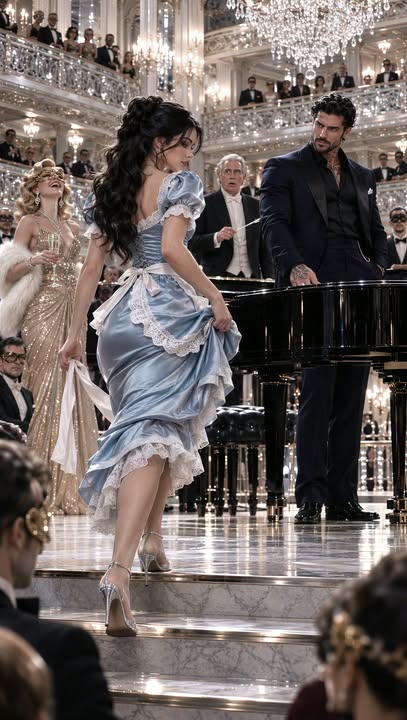
Part 5 – The Note She Had to Play
“Your father wrote the final movement for you,” I whispered.
Vincent’s gaze moved from my face to the letter in my hands.
“Do you want to read the rest?” he asked.
I lowered my eyes to the page.
The words swam for a moment, blurred by the tears I had refused to shed in the music room.
Then I took a steady breath and continued.
“My dearest Elena, if you are holding this, then I have waited too long to tell you the truth.”
My father’s handwriting leaned gently across the page, every letter familiar.
“I began this concerto before you were born. The opening came to me during a winter when I had almost forgotten how to hope. I finished the first movements later, after I heard you laugh for the first time.”
I pressed the paper flat against the table.
The room seemed to fall away, leaving only my father’s voice inside the words.
“Falk was my friend, and I trusted him with the score. He was a gifted arranger, and I believed he would help the music find its way into the world. When he put his name on it, I asked him to correct the record. I never asked him for money.”
Vincent stood very still beside me.
My father’s letter continued.
“Your mother was already gone, and I was afraid that if I fought publicly, I would lose the little life I had left with you. I told myself silence would protect you from the attention and the questions. I was wrong to let silence protect everyone else.”
I paused, swallowing against the ache in my throat.
He had written that he was wrong.
I had spent years thinking his silences were rooms he had closed against me.
Now I could see how much fear might have been waiting on the other side.
The next paragraph began with a line that made my fingers tighten around the page.
“The last movement is not a secret code, and there is nothing in it that can prove what a document cannot. But it is the ending I wrote before Falk changed the score. If it is played beside the original, no one who knew the music can mistake whose heart shaped it.”
I read the sentence again.
It was not proof in the legal sense, as my father had admitted.
But it could make the truth audible to anyone willing to listen.
I understood, at last, why he had warned me not to finish the concerto in front of a Moretti.
The final movement would expose not only Falk’s theft, but my father’s connection to the family that had accused him.
It would place Vincent’s father’s letter, the original score, and my own testimony before the world.
It would also make it impossible for the Morettis to retreat into the comfortable version of the past.
The last lines of my father’s letter were written more lightly, as if the pen had begun to tire.
“If the moment ever comes, do not play the ending because anyone demands it of you. Do not play it to punish Falk, or to make a stranger believe you. Play it only if you choose to let the music be heard. The last note belongs to you.”
I lowered the letter.
No one spoke for several seconds.
Rain tapped the dark window, and somewhere downstairs an old clock gave a measured tick.
Vincent’s mother had turned away, one hand covering her mouth.
Vivian stared at the open case.
Vincent remained beside me, his expression careful and grave.
“What are you thinking?” he asked.
“I’m thinking my father was still trying to protect me, even after he was gone.”
“Maybe he was also trying to give you a choice.”
I looked at him.
“That isn’t always the same thing.”
“No,” he said. “It isn’t.”
I folded the letter along its old crease.
“I don’t know if I can play it.”
“You don’t have to decide today.”
“Falk is still performing this concerto under his name.”
“Yes.”
“And my father’s score has been hidden here for years.”
“Yes.”
“If I stay silent now, I’ll be doing what everyone else did.”
Vincent’s mother moved closer.
“You would not be responsible for the choices they made,” she said.
“I know.”
But knowing did not make the choice easier.
It only made it mine.
I looked at the last page of the score, still covered beneath the linen.
For years, my father’s music had been a private comfort, a sound I could summon in the small Brooklyn apartment when the bills were too frightening and the rooms too quiet.
Playing it in public would turn that comfort into testimony.
It would invite strangers to examine the man I had loved, the family I had never known, and the life he had built around a secret.
I had spent so long trying to keep my father’s name from being reduced to an accusation.
I feared that a public performance might reduce him to the same story all over again.
“What if they say I learned the music from Falk’s score?” I asked.
“Then we show them the original and the fragment from the piano,” Vincent said.
“What if they say the letter is unreliable?”
“We have the handwriting, the photograph, and the paper authenticated.”
“And if they say my father copied the music?”
“We find the people who knew him and ask them to speak.”
“People may not want to.”
“Then we ask without demanding.”
He did not promise me that truth would win cleanly or quickly.
That, more than any grand assurance, made me trust what he was saying.
A knock sounded at the open door.
Vincent’s mother looked toward the corridor.
One of the household staff stood there, holding a telephone.
“Mr. Moretti,” she said. “Maestro Falk is on the line.”
Vincent’s expression changed.
“Did he say why?”
“He asked to speak with you privately.”
“I’ll take it here.”
The staff member handed him the telephone and withdrew.
Vincent listened without speaking.
I watched his face as Falk’s unseen words moved through him.
The first line made his shoulders stiffen.
The next caused his gaze to drop to his father’s letter.
When he finally answered, his voice was restrained.
“No.”
A pause followed.
“I said no, Maestro.”
He listened again.
“This is not a negotiation over a performance.”
Another silence.
Vincent’s eyes lifted to mine.
“I understand what you’re asking me to protect.”
He ended the call without raising his voice.
“What did he want?” I asked.
“He knows the score has been found.”
“How?”
“I don’t know. Someone must have told him we were searching the estate, or he guessed after seeing you at the gala.”
“What did he ask you to do?”
“He wants the letter and the manuscript returned to him so he can verify them privately.”
“Returned?” Vivian asked.
“He says the pages were entrusted to him for arrangement and that my father’s letter is incomplete.”
“That isn’t the same as asking to verify them,” I said.
“No.”
“What else?”
Vincent looked at his mother.
“He says if I release the documents publicly, I’ll be accusing my father along with him.”
The room went quiet.
The warning was not a threat of violence.
It was something more intimate and harder to dismiss: a reminder that the truth could damage people who were already gone, as well as those who remained.
“What did you say?” his mother asked.
“I said the documents would be authenticated.”
“And?”
“He told me not to confuse loyalty with honesty.”
I could hear the bitter irony in the sentence.
“He must have practiced that one,” Vivian murmured.
Vincent returned the telephone to the staff member when she appeared at the door.
Then he walked to the window and stared at the rain.
“I can keep the evidence secure,” he said. “I can put it in the hands of a lawyer and an archivist. But if I do that without telling the public what my father did, people may believe the Morettis are still hiding the story.”
“Would you be?” I asked.
He turned back to me.
“I don’t want to be.”
“That isn’t what I asked.”
“No,” he said. “It isn’t.”
He looked down at the letter.
“My father preserved the score, but he let your father carry the accusation. If I reveal only Falk’s theft, I make my father look like a distant witness rather than someone who helped the lie survive.”
His mother held the edge of the table.
“You loved him,” she said.
“I still do.”
“I know.”
“I don’t want to make him a villain just because I have to tell the truth about what he did.”
“Then don’t,” I said.
Vincent looked at me.
“Tell the truth about what he did, and let the rest remain complicated.”
The words came from somewhere I had not expected.
Maybe because I knew my father had also been complicated.
He had protected me by keeping the truth from me.
He had loved me, and he had chosen silence.
Both things were true.
Vincent’s father might have preserved the score because he felt remorse, because he was afraid, or because he hoped there would be time to repair what he had broken.
None of those possibilities erased the harm.
“I can say that he helped conceal the accusation and kept the manuscript safe,” Vincent said. “I can say he failed to return it to Thomas.”
“Then say exactly that.”
“What if the press turns him into a symbol of the whole family?”
“Then you correct them.”
“What if no one cares about the correction?”
“Then you keep saying it.”
Vincent studied my face.
“You’ve had to live with people simplifying your father.”
“Yes.”
“I don’t want to do that to mine.”
“Then don’t hide the parts that hurt.”
For a long moment, he did not answer.
Then he nodded, slowly, as if the decision had begun to take shape inside him.
“I’ll arrange for the papers to be authenticated and notify the authorities,” he said. “I’ll tell them the Moretti family was part of the concealment.”
His mother closed her eyes.
When she opened them, there was sadness there, but not resistance.
“I’ll stand beside you,” she said.
Vincent looked at her.
“You don’t have to.”
“I know.”
The words surprised him.
She placed one hand on his arm, her touch light.
“I loved your father, too. I will not help preserve a version of him he would have had to defend.”
Vincent lowered his head for a moment.
The movement was small, but I saw how much it cost him to accept her support.
The next hours passed in practical tasks.
Vincent called an attorney who had not been involved in the Moretti family’s affairs.
His mother contacted an archivist she trusted from a local university.
Vivian’s father agreed to provide a written statement about what he had been told and what he had never personally seen.
No one made speeches.
No one demanded that I perform.
The original score was photographed page by page, the letter placed in a protective sleeve, and the piano fragment stored separately.
I signed a statement confirming where I had found the music and what I remembered of my father’s playing.
Every time I wrote his name, I felt the same mixture of pride and grief.
By late afternoon, the rain had cleared.
The sky above the estate was pale and washed clean, but the day had left a weariness in my bones.
Vincent brought me a cup of tea in the music room.
He set it on the table beside the score.
“I’m sorry this happened in your life,” he said.
“Which part?”
“All of it.”
I lifted the cup but did not drink.
“I’m not sorry I found the music.”
“Even if it changes what you remember?”
“I’d rather remember him truthfully.”
“Would you?”
“I don’t know yet.”
He accepted that answer.
We sat in quiet for a while, separated by the open case and the stack of papers that had altered both our families’ stories.
At last, Vincent said, “The concert committee will meet tomorrow. Falk’s concerto is scheduled for their winter program.”
“Will they cancel it?”
“They’ll need to decide what to do with the evidence.”
“Will they ask you to keep quiet?”
“Probably.”
“Will you?”
“No.”
The certainty in his answer sounded different now.
It no longer seemed like the confidence of a man who had never doubted himself.
It sounded like a choice made by someone who understood what it would cost.
“What about the final movement?” I asked.
He looked at the closed score.
“That is your decision.”
“If I play it, everyone will hear the ending my father wrote.”
“Yes.”
“If I don’t, the papers still exist.”
“Yes.”
“But people can argue over papers.”
“They can.”
“They can say the notes are similar by chance, or that I learned them from my father after hearing Falk’s piece.”
“They can.”
“I might never get the chance to make them listen again.”
Vincent leaned forward, his hands clasped loosely.
“Then ask yourself whether you want to play because it will persuade them, or because you want the music to live.”
I looked down at the score.
The final movement was hidden beneath the sheet of linen, but I could feel its presence there as clearly as if the pages were beneath my fingertips.
“I want my father to be heard,” I said.
“That’s a reason.”
“It’s not the only one.”
“No.”
“I’m angry that he left me this choice without explaining it.”
“That makes sense.”
“I’m angry that your father kept the score but not the truth.”
“That makes sense, too.”
“And I’m afraid that if I play the ending, people will hear the truth and still choose the story that is easier for them.”
Vincent did not try to soften the fear.
“They might.”
“Then what would it change?”
“Nothing they choose to believe,” he said. “But everything we choose to tell.”
I met his eyes.
“You’ve been thinking about this.”
“I have.”
“What did you decide?”
“To stop asking what the truth will cost my family and start asking what it has already cost yours.”
The sentence settled between us.
I wanted to tell him that he could not repair the past by making one brave decision.
I also wanted to tell him that the choice mattered.
So I said both.
“You can’t undo what your father did.”
“I know.”
“But you can refuse to continue it.”
“I know.”
My phone rang.
The sound startled me in the quiet room.
I glanced at the screen and saw an unfamiliar number.
The message beneath it was a voicemail from the concert committee’s director.
“Miss Marlow, I was told the original score may have been recovered,” the director said when I played it aloud. “We need to discuss tomorrow’s program. Maestro Falk has asked that the concerto remain scheduled, though under review.”
The message ended.
A second notification appeared before I could respond.
It was an email from Falk himself.
He had attached a short, formal statement addressed to the concert committee.
In it, he described the manuscript as a collaborative work, accused no one directly, and said he would welcome a “responsible examination of the historical materials.”
The language was smooth, almost generous.
At the end, he wrote that he hoped I would not be drawn into “a public dispute that could cause lasting distress.”
I read the sentence twice.
It sounded like concern.
It also sounded like an attempt to make my choice seem reckless before I had made it.
“Do you think he knows what’s in the final movement?” Vivian asked.
“I don’t know,” I said.
Vincent read the statement over my shoulder.
“He has seen the score before.”
“He may have changed the ending because he wanted to.”
“Or because he believed he could.”
I looked at the music case.
The question of why Falk had altered the last movement remained unanswered.
Perhaps he had thought the new ending more dramatic.
Perhaps he had wanted to erase the part that returned to my father’s original melody.
Or perhaps he had feared someone would recognize it.
There was only one way to make the ending audible without relying on my memory.
I closed the email.
“I’ll play.”
Vincent did not answer immediately.
“Only if you’re sure.”
“I’m not sure.”
“That’s different.”
“I know.”
I looked down at my hands.
“I’m afraid I’ll lose my place. I’m afraid I’ll cry. I’m afraid I’ll finish and the room will still prefer the lie.”
“Those are all possible.”
“And I’m afraid that if I don’t play, I’ll spend the rest of my life wondering what would have happened if I had.”
Vincent stood.
“Then we’ll make sure the piano is ready.”
“I don’t want special treatment.”
“You won’t get it.”
“I don’t want you announcing that I’m the daughter of the composer.”
“I won’t.”
“Let the music speak before anyone explains it.”
He nodded.
“I can do that.”
The next day, the concert committee met in a small chamber attached to the hall where Falk’s work had been scheduled.
I arrived with the score’s authenticated copy and my father’s letter in a folder.
Vincent came with his mother, the attorney, and the archivist.
Vivian sat beside her father.
Falk was already there, calm and impeccably dressed.
He greeted me with a nod.
“Miss Marlow.”
“Maestro.”
“I hope you understand that I never wanted you caught between families.”
“I don’t know what you wanted.”
For the first time, his expression lost its careful warmth.
Then he turned to the committee.
The discussion lasted nearly an hour.
The archivist confirmed that the paper and handwriting were consistent with the period.
The photograph supported the connection between Thomas and Falk.
The original score bore Thomas’s name in a hand matching the fragment from the piano.
Vincent’s father’s letter was not treated as unquestionable proof, but its details aligned with the records.
Falk called the work a collaboration.
He said Thomas had given him permission to arrange it and that the published version had evolved through both their work.
When asked why Thomas’s name was absent, he said he had believed the matter would be corrected later.
“Why was Thomas accused of taking the manuscript?” the committee chair asked.
Falk folded his hands on the table.
“I cannot speak for Vincent’s late father.”
Vincent’s posture tightened.
“I can,” he said.
Everyone turned toward him.
“My father believed Thomas had taken the manuscript, even though he knew Thomas had been permitted to work with it. He concealed the original after Falk claimed Thomas had taken it.”
The room became silent.
Vincent continued.
“He did so to protect the concert program and the family’s standing. He kept the score, but he failed to return it or correct the accusation. That is the part of my family’s history I will not ask anyone to soften.”
Falk watched him without expression.
I could see what the statement cost Vincent.
He had not made his father into a monster or excused him as a man of his time.
He had simply told the truth.
The committee chair looked toward me.
“Miss Marlow, we understand that you may be willing to perform the original final movement. No one here expects you to do so.”
“I know.”
“Would you like time to consider it?”
“I’ve considered it.”
My hands were cold, but my voice did not shake.
“I will play the concerto through the ending my father wrote.”
Falk’s gaze moved to me.
“Are you certain you want to make the performance part of this inquiry?”
“No.”
The honesty seemed to catch him off guard.
“I’m certain I want the music heard.”
“That is not the same thing.”
“No,” I said. “It isn’t.”
The committee agreed to let the performance proceed, with the original score displayed only after the music had been played.
The hall would be open to the public, but no press conference would be held beforehand.
The purpose was not to stage a trial.
It was to let the music be heard and allow the evidence to speak afterward.
As I walked toward the stage, Vincent fell into step beside me.
“You can still change your mind,” he said.
“I know.”
“I won’t think less of you.”
“I know that, too.”
He stopped at the edge of the curtain.
“I’m proud of you.”
I looked at him.
“Don’t be proud because I’m doing what you would do.”
“I’m proud because you’re choosing for yourself.”
The answer quieted something in me.
I reached for the curtain but did not pull it aside.
“Whatever happens, don’t make this a promise you expect me to repay.”
“It isn’t.”
“Don’t make it a reason I owe you anything.”
“I won’t.”
“Then stay and listen.”
“I will.”
I stepped onto the stage.
The audience settled into their seats beneath the warm lights.
The black grand piano stood at the center, waiting.
Some faces were curious.
Some were skeptical.
Some looked at me with the careful sympathy people offer when they believe a person is about to lose.
I sat at the bench and placed my father’s score before me.
The first notes came as they always had, seven quiet sounds from the room where I had grown up.
I played the opening, then the first movement, keeping my eyes on the page.
The music was stronger than my fear, though not strong enough to erase it.
By the second movement, I began to feel my father’s phrasing in my hands.
His small pauses.
His tenderness.
The gentle insistence with which he brought a melody back after it seemed to disappear.
I reached the point where I had stopped at the gala.
The audience shifted in their seats.
Behind them, the committee watched in silence.
I could not see Vincent, but I knew he was listening.
The final movement waited on the page.
For a breath, my fingers hovered above the keys.
Then I thought of the last line of my father’s letter.
The last note belongs to you.
I began.
The first phrase was quiet, nearly fragile.
It did not sound like a challenge to anyone.
It sounded like a man returning to a room he had once left too quickly.
The music unfolded beneath my hands, drawing the opening seven notes into a fuller melody.
I understood why my father had feared this moment.
The ending carried his name more clearly than any title page could.
A few measures from the end, the music rose toward a final, searching chord.
I had rehearsed that passage twice.
On the page before me, a penciled note I had not noticed before stood beside the last line.
In my father’s handwriting, it said:
Elena, wait for the second note.
I stared at the words.
There was no second note in the written passage.
Not until I turned the page.
The final sheet was missing.
My hands stopped above the keys as the audience waited.
Then the stage door opened behind the curtain.
Vincent rose from his seat.
A woman stepped into the light, carrying a sealed envelope and a page of music.
“I’m sorry,” she said, her voice trembling. “Your father asked me to keep this until you were ready.”
She looked directly at me.
“But the last page isn’t the only thing you need to hear.”
**–END OF PART 5–CLICK “NEXT” AT THE BOTTOM OF THE PAGE TO CONTINUE READING**
* * *
[PREVIOUS: PART 4](https://echoesofstories.idolsgift.com/blog/part-4-the-promise-beneath-the-music-046) | [NEXT: PART 6(THE END)](https://echoesofstories.idolsgift.com/blog/part-6-the-end-the-promise-beneath-the-music-046)
✓ Lynn R. Adams
Part 5 – The Note She Had to Play “Your father wrote the final movement for you,” I whispered. Vincent’s gaze moved from my face to the letter in my hands. “Do you want to read the rest?” he asked….