PART 5: The Photograph in the Envelope 027
Part 5 – The Gift She Meant to Give
“Not the only message.”
The words rested on the page between Elena and me, small and certain in Arthur’s hand.
I traced the rough drawing beside them, careful not to touch the ink.
A paper star.
And a second shape folded into something I could not identify.
“What did she give you afterward?” Elena asked.
“I don’t know.”
I turned the page over again, hoping for another line, a date, anything that might explain the drawing.
There was nothing.
The message left me with a question that seemed to belong to the years when our daughter was still alive, a question Arthur had carried into the years after her death without finding the courage to ask me.
I set the page beside her note.
For a while, neither of us spoke.
The house held the soft sounds of a house in the afternoon: the clock above the stove, the distant hush of a car passing outside, the faint creak of the floor beneath Elena’s chair.
Then she said, “Perhaps the second shape is something she made for you.”
My eyes went to the blue tin.
It sat open on the table, its little collection of childhood treasures scattered beside it.
“I thought I knew everything in there,” I said.
“Sometimes we don’t see what we’re not ready to see.”
I glanced at her, but her expression held no judgment.
She was looking at the tin, not at me.
That kindness made it harder to answer.
I had spent years protecting the things inside that box from dust, from handling, even from my own curiosity.
I had told myself that I kept them because they were precious.
I had not admitted how much I feared that, once I examined them, they might turn into memories I could no longer bear.
“I need to find out what he meant,” I said.
Elena nodded.
“Then we can look together, if you want.”
I was not sure I wanted anyone beside me, but I knew I did not want to be alone with the old ache that had already begun to rise.
“Yes,” I said.
We returned to the hall closet.
The box marked with our daughter’s name remained on the floor, its lid leaning against the wall.
I had brought it out earlier and left it open, as if I had expected to find one answer and then put it away again.
Now I lifted each item with more care than before.
The blue sweater.
The drawings.
The paper plate crown, its painted stars faded to pale smudges.
A small wooden horse with one chipped ear.
I tried to remember which of these she had carried with her to the hospital, and which had waited at home.
There was no order to the box, only the way I had gathered things in the weeks after she died, wrapping some in tissue and placing others where they fit.
Elena stayed beside me without reaching in.
She understood, I thought, that these were not simply objects.
They were a room I had kept closed, even while I lived beside its door.
At the bottom of the box, beneath a folded blanket, I found a thin envelope.
It was cream-colored and soft at the corners.
My name was written across the front in a child’s handwriting.
The letters were uneven, the last one trailing upward.
My breath caught.
I lifted it out.
“I don’t remember seeing this,” I whispered.
Elena came closer, but she did not touch it.
“Would you like me to wait?”
“No,” I said. “Stay.”
The envelope had no date.
I opened it carefully, taking care not to tear the paper.
Inside was a small folded card, made from the blank back of a drawing.
On the front, someone had painted a yellow star with a blue crayon.
I unfolded it.
The message inside was written in the same unsteady hand.
“Mom, you can keep my blue button, but Matthew can have the star because he needs brave.”
I read it once.
Then again.
The words slipped out of focus, and I held the card against my chest.
Elena covered her mouth.
“Oh,” she whispered.
I had seen the blue button in the tin a hundred times.
It was round and glossy, with four little holes in the middle.
Our daughter had found it somewhere and carried it around for weeks, saying it was a moon button, though it was blue as a summer sky.
I had kept it because she had loved it.
I had not known there was a reason she wanted me to have it.
Or perhaps she had told me.
Perhaps I had been too tired, too frightened, too buried in the days to understand that she was arranging small things for the people she loved.
The card shook in my hands.
“She left me something,” I said.
“Yes,” Elena replied.
“She knew I would keep it.”
“I think she did.”
“And she wanted Matthew to have the star.”
“I think she did.”
For years I had held on to every object I could find, believing that keeping them all together was a way of keeping her close.
But she had not asked for everything to stay with me.
She had made a choice, even then, in the small clear world of a child.
The blue button for her mother.
The paper star for a frightened boy.
I looked toward the kitchen, where the star rested in Matthew’s wooden box.
I felt something inside me give way—not break, exactly, but loosen.
My daughter’s wish did not take her from me.
It belonged to her.
And keeping the star away from the world would not make her more mine.
Still, when I imagined placing it in a garden, exposed to rain and wind and the passing hands of strangers, fear rose in me so quickly I had to close my eyes.
“I can’t give her things away,” I said.
Elena’s voice was gentle.
“You don’t have to give everything.”
“But if I let the star go, what if I can’t bear the rest?”
“You can choose one thing at a time.”
“I have always chosen to keep all of them.”
“Because you loved her.”
“Because I was afraid.”
The admission left my mouth before I could soften it.
Elena did not rush to fill the quiet.
I looked at the blue button, then at the card.
The pain of choosing was not that one decision would erase my daughter.
It was that I had to decide what kind of love I could live with now.
I could take the star from Matthew’s box, return it to the tin, and close both away in the closet.
I could keep every object protected, untouched, unshared.
No one would blame me.
No one could tell me I had failed to honor her by holding on.
But the star had already been given.
Matthew had kept it through years I had never known, and after his death Elena had held it safe.
My daughter’s gift had traveled farther than I had allowed myself to imagine.
To bring it back now would not undo the giving.
It would only interrupt it.
I took a slow breath.
“Do you still want to make the garden?” I asked.
Elena looked toward the kitchen.
“If you do.”
“I don’t know if I’m ready.”
“You don’t have to be ready for the whole thing.”
“What if I regret it?”
“Then we will listen to that regret, too,” she said. “We won’t pretend it isn’t there.”
Her answer did not promise that the choice would be easy.
That was why I trusted it.
I turned the card over.
On the back, in my daughter’s hand, there was a little drawing of two flowers, one taller than the other.
Between them, a wobbly line might have been a path.
I had forgotten that drawing.
I had forgotten so much.
Or perhaps the memories had been there all along, waiting beneath the years I had spent trying not to open the boxes.
“I want to keep the button,” I said.
“That sounds right.”
“And the blue sweater.”
“Of course.”
“I want to keep some drawings. The ones I remember her making.”
Elena nodded.
“But the star was never mine to keep.”
“No,” she said softly. “It was hers to give.”
I folded the card along its old crease and returned it to the envelope.
This time I did not place it back in the box.
I held it between my fingers and let the paper rest there, light as a breath.
When we returned to the kitchen, Elena opened Matthew’s wooden box.
The star lay on top of the few things he had left behind.
I looked at it for a long moment.
“Would you bring it to the garden?” I asked.
Elena’s eyes shone, but she did not smile as though the decision were a victory.
“Yes,” she said. “I will.”
“Not today.”
“Not today.”
“I need to think about where it belongs.”
“Then we’ll think together.”
The word together felt unfamiliar in my mouth.
For years, grief had been something I held privately, even when Arthur sat beside me.
Now another person was offering to help carry one small piece of it.
I did not know how to accept that without feeling disloyal.
But I knew the feeling was not a reason to refuse.
I placed my daughter’s card beside the star.
For the first time, the two messages were in the same room.
The little girl who had written them had been trying to send something forward, not knowing how long it would take to arrive.
“I want the garden to be small,” I said.
“It should be.”
“No stone with a long inscription. No grand monument. Just a place where the children can be remembered.”
Elena nodded.
“Perhaps a few flowers, a bench, and something that can catch the light.”
I glanced at the paper star.
“Not the actual star outside,” I added. “It would be ruined.”
“We could keep it in a glass case, or place a copy in the garden.”
“I don’t want to make it look like a museum.”
“Then we can find another way.”
We were quiet again, but this silence felt different from the silence Arthur had left behind.
It did not press a decision upon me.
It gave me room to make one.
I looked at the photograph on the table.
Arthur stood beside Elena, and Matthew held the star between them.
At first, it had seemed like evidence of something my husband had kept from me.
Now I saw the boy’s hand curled around the paper, the careful way Arthur had rested his own hand on his shoulder, and Elena’s weary but patient smile.
The photograph was no longer a picture of a secret life.
It was a picture of a promise I had not been invited to share.
Both things remained true.
I could forgive the love that had motivated the promise without pretending that the secrecy had not hurt me.
I could begin to understand Arthur without making him right.
“I wish he had told me,” I said.
“So do I.”
“I wish I had known about Matthew.”
“Me too.”
“I wish our children had lived long enough to give each other more than one star.”
Elena’s eyes filled.
“So do I.”
For a moment, the room seemed to hold all four of us: Arthur and Elena as they had been, our daughter and Matthew as they had been.
Not as victims, not only as names attached to sorrow, but as people who had touched one another’s lives.
A little girl had seen a frightened boy.
She had made him something bright.
He had kept it.
Their parents had carried the memory long after the children could no longer speak for themselves.
I had spent years believing the story ended with the hospital doors.
Perhaps it did not.
Perhaps the story was still reaching for a place to rest.
The thought frightened me, but I let it remain.
That evening, after Elena left, I sat alone at the kitchen table with the two notes in front of me.
I put the blue button in my palm.
It was cool and smooth, its surface catching the light.
Then I laid my daughter’s card beside it.
The star remained in its wooden box, where Matthew had kept it.
I did not take it back.
That small decision made my heart ache, but beneath the ache there was something else, a thin thread of relief.
I had not abandoned her.
I had listened.
The next morning, I called my daughter and told her about the letters, the photograph, Elena, Matthew, and the star.
She listened without interrupting.
When I finished, she was quiet for a moment.
“Mom,” she said, “you don’t have to decide everything at once.”
“I know.”
“Do you want me to come over?”
I looked at the blue tin on the table.
“Yes,” I said. “I think I do.”
She arrived before noon, bringing a loaf of bread from the bakery and a small bunch of flowers wrapped in brown paper.
She looked at the photograph for a long time.
“I wish Dad had told you,” she said.
“So do I.”
“But it sounds like he was trying to honor what she wanted.”
“He was.”
“And you’re allowed to be angry with him.”
“I know.”
She reached for my hand.
“I’m proud of you for looking at it.”
I squeezed her fingers, grateful for the ordinary warmth of her palm.
“I’m not sure I’m ready to build anything.”
“You don’t have to be ready today.”
The words were familiar now, but they did not feel like an excuse to postpone my life.
They felt like permission to move at the pace I could manage.
My daughter helped me sort the things I wanted to keep.
We made three small piles: the objects I would carry upstairs, the papers I needed to read again, and the items that might one day become part of the garden.
The blue sweater went into the first pile.
So did the wooden horse and several drawings.
The yellow star was not among them.
I did not try to hide it from myself.
When Elena called that afternoon, I told her I wanted to meet her at the garden center the following week.
“We can look at plants,” I said. “Nothing has to be planted yet.”
“I’d like that.”
“And we can talk about the memorial.”
“Yes.”
I put down the phone and looked at Arthur’s handwriting on the old letter.
For the first time, I did not feel that I was simply discovering what he had kept from me.
I was deciding what to do with the truth he had left behind.
A few days later, Elena arrived at my house carrying the wooden box, and Daniel came with his little girl.
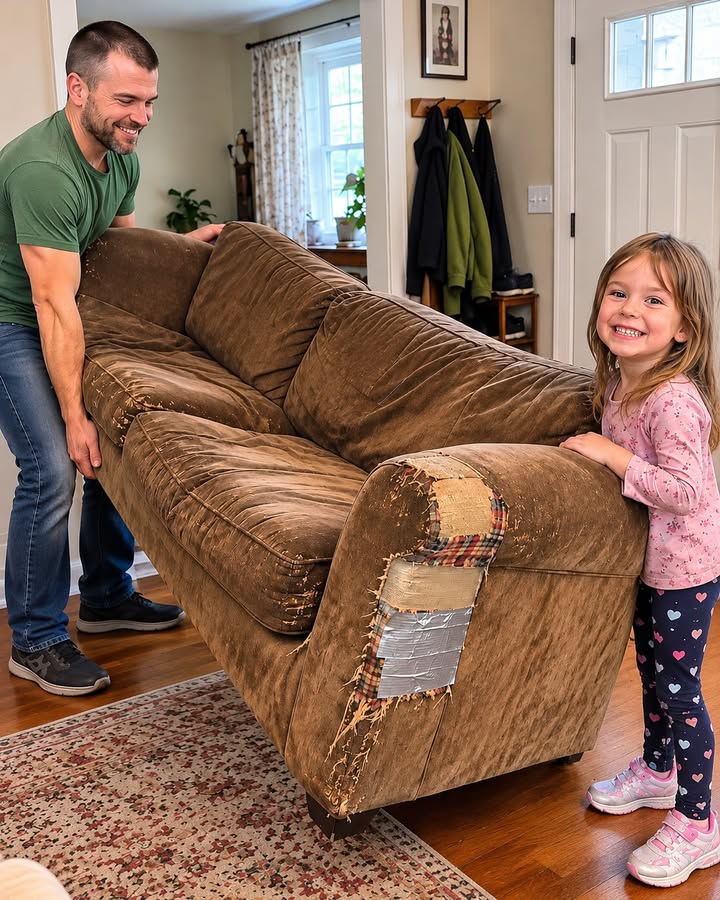
He had asked whether it would be all right to bring her, since she had wanted to know if the couch and I were both safe.
I told him she could come.
She stepped inside holding a small paper flower she had made with her father.
“I brought this for your garden,” she said.
The flower was green and pink, with one petal folded backward.
I smiled before I knew I was doing it.
“Thank you,” I said. “That’s a very kind thing to bring.”
She handed it to me, then looked at the photograph on the table.
“Is that your husband?”
“Yes.”
“Who’s the boy?”
“His name was Matthew.”
“Was he friends with your daughter?”
I looked at the wooden box.
“They were friends for a little while.”
The girl considered this, then nodded, accepting the answer as easily as a child accepts that friendship does not need to last forever to matter.
Daniel stood behind her, one hand resting lightly on her shoulder.
The sight of them brought back the morning they had carried the couch away, the little girl’s voice rising above the sagging cushions.
I had thought that selling the sofa meant losing one last piece of Arthur.
Now I understood that the couch had given us something, too.
A discovery.
A choice.
A beginning I had not yet learned how to name.
I placed the paper flower beside the photograph.
Then I took the star from Matthew’s box and held it in my palm.
The paper felt fragile, but it had already survived more years than I could have asked of it.
“I think we can make the garden,” I said.
Elena looked at me, waiting.
“Not today. But soon.”
She nodded.
“We’ll do it together.”
I closed my fingers around the star, then opened them again.
The yellow paper rested there between us, no longer something I needed to keep hidden or something I was ready to surrender without question.
I could let it become part of the garden.
I could keep the blue button and the sweater.
I could save one drawing in the hall closet and allow the rest of the story to move beyond my hands.
The choice did not take away my daughter.
It let me see what she had already chosen.
Then Daniel’s little girl leaned close to the photograph.
“That star looks like the one in my bedroom,” she said. “Did you make it?”
“No,” I told her. “My daughter did.”
The girl smiled at the paper star in my palm.
“Do you think she’d let me make one too?”
I looked at the little flower she had brought, then at the star, then at the faces in the old photograph.
For a moment, I could not answer.
Then Elena reached into her canvas bag and drew out a folded sheet of yellow paper.
“There’s something else,” she said, her voice unsteady.
She opened it carefully.
It was not the star Matthew had kept.
It was a second one, tucked inside a small envelope with Arthur’s handwriting on the front.
And beneath the envelope, Elena had found a line written in my daughter’s hand that none of us had seen before:
“Mom can have this one when she’s ready.”
**–END OF PART 5–CLICK “NEXT” AT THE BOTTOM OF THE PAGE TO CONTINUE READING**
* * *
[PREVIOUS: PART 4](https://puretales.idolsgift.com/blog/part-4-the-photograph-in-the-envelope-027) | [NEXT: PART 6(THE END)](https://puretales.idolsgift.com/blog/part-6-the-end-the-photograph-in-the-envelope-027)
✓ Lynn R. Adams
Part 5 – The Gift She Meant to Give “Not the only message.” The words rested on the page between Elena and me, small and certain in Arthur’s hand. I traced the rough drawing beside them, careful no…