PART 5: The Pawn That Could Not Be Saved 052
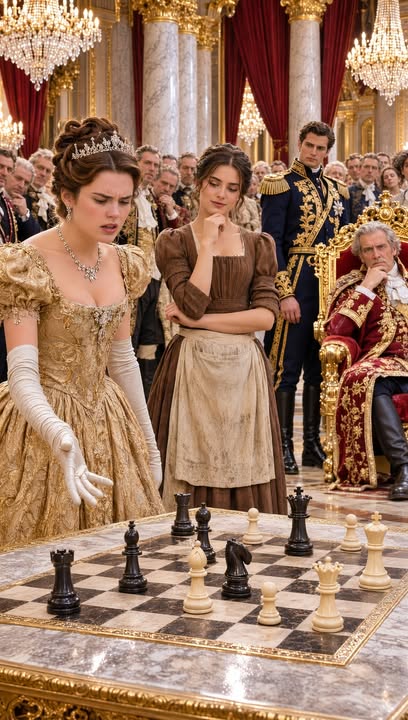
Part 5 – The Choice Before the Crown
“Thomas was right,” the king said. “The puzzle cannot be understood until I tell you what I asked him to test.”
The ballroom seemed to draw inward around his words.
The white pawn remained on the marble board, its small mark almost invisible beneath the chandelier light.
Eleanor looked from it to the king.
“Then tell us, Your Majesty.”
He turned toward the guests who had gathered at a respectful distance.
“Not here,” he said. “But soon, and before the whole court.”
The prince glanced at his father.
“Soon cannot mean another year.”
“No,” the king replied. “It cannot.”
The chief adviser gathered the papers Thomas had left, while the secretary carefully returned the old chess set to its velvet tray.
Eleanor watched the pawn disappear beneath the cloth, and felt as though a small piece of her father’s life had been carried away again.
The king noticed.
“The documents will remain under seal in the archive,” he said. “You may inspect them whenever you wish.”
“I would rather see them in the open,” Eleanor replied. “Where no one can quietly alter what they say.”
The king accepted the rebuke without protest.
“Then they will be read publicly.”
The prince stepped beside Eleanor.
“And the contest?”
The king looked at the chessboard.
“It will continue tomorrow.”
A murmur passed through the nearest guests, but the king raised one hand, and the room quieted.
“Tomorrow, the court will hear the history of the puzzle and the truth concerning Thomas Vale.”
Eleanor’s breath caught at the sound of her father’s name spoken plainly before the assembled nobles.
“Your Majesty,” she said, “you should not make that announcement conditional on whether I solve the position.”
“It will not be conditional.”
“Nor should restoring his name be presented as part of my reward.”
The king’s face tightened, not in anger, but with the effort of hearing what he had long avoided.
“You are right.”
The prince watched Eleanor with grave attention.
She could feel the eyes of the court upon her, though no one came close enough to interrupt.
Only a few hours earlier, the promise of a crown had seemed like an impossible story meant for someone else.
Now the reward stood between her and the truth, glittering with the same dangerous brightness as the chandeliers overhead.
“If I finish the puzzle,” she said, “the court may believe my father is being cleared because I have made myself useful.”
The king bowed his head.
“I will make clear that the two matters are separate.”
“People may still connect them.”
“They may,” he said. “But I cannot undo what they think. I can only speak honestly about what I did.”
It was not a perfect answer.
It was the first one Eleanor believed.
The prince’s hand rested on the edge of the table, close to hers but not touching.
The king dismissed the remaining guests with a promise that the contest would resume at the appointed hour the next day.
Some left reluctantly, turning back for one last look at Eleanor and the board.
Others whispered among themselves, their expressions troubled by the account they had only partly overheard.
Victoria lingered near the entrance.
Her fan was closed now, and she held it in both hands.
When Eleanor’s gaze met hers, Victoria gave a small, uncertain nod.
Eleanor returned it.
The gesture did not mend the hurt between them, but it left room for something to change.
Once the ballroom had emptied, the king remained beside the chess table.
The prince stayed with him while Eleanor stood at the board, studying the line Thomas had written down.
The final moves were still smudged.
She could make out the sequence’s purpose, but the last step remained hidden beneath the faded ink.
“Does it trouble you,” the prince asked, “that the reward was announced before you knew what it would mean?”
Eleanor considered the question.
“It troubles me that you were described as a reward at all.”
The prince’s expression shifted.
“You are right.”
“You did not make the announcement.”
“I did not object to it either.”
He did not try to excuse himself by saying he had been surprised or embarrassed.
Eleanor appreciated that, though it did not lessen the strangeness of the arrangement.
“I cannot promise what I will choose,” she said.
“I would not ask you to.”
“And if I refuse the prize?”
“Then it will be refused.”
The prince’s answer came without hesitation.
Eleanor searched his face.
“What would that mean for you?”
“That I would be disappointed by the circumstances, perhaps, but not entitled to your answer.”
The words were simple.
They gave her more room than the king’s announcement had.
The prince looked toward the pieces.
“I want the chance to know you,” he said. “But I do not want you to feel that solving the puzzle has bought you a place beside me.”
“Or that refusing it would prove I never cared.”
“Exactly.”
Eleanor lowered her gaze to the board.
For a moment, she imagined the life the court had placed before her: fine clothes, a seat near the throne, a future shaped by ceremonies and public expectations.
She imagined the servants who had shared their meals with her in the kitchen corridor, the quiet kindness of the old housekeeper, the room where she slept beneath a sloping roof.
She imagined her father’s small chessboard, long ago sent to storage because she had nowhere to keep it.
And she imagined a different future, one in which she could sit across from the prince not as the answer to a royal contest, but as herself.
The trouble was that she wanted to know what that future might be.
Wanting it did not make the king’s promise fair.
“You should go home tonight,” the prince said gently. “You have been asked to carry more than one person’s choices.”
“I have nowhere else to go.”
“Then I can have an attendant walk with you to the servants’ quarters.”
“I can find my way.”
“I know.”
He did not press her.
That restraint touched her more deeply than another declaration might have.
The king remained by the chessboard, his eyes fixed on the white king.
“Your father used to sit there,” he said.
Eleanor turned.
“Where?”
“At the side of the table nearest the windows. He would ask me what I thought the position was asking, and then wait while I gave the wrong answer.”
“You asked him to make this puzzle?”
“Yes.”
“Why?”
The king’s gaze remained on the board.
“I wanted a test of judgment. I had become surrounded by men who praised certainty and called hesitation weakness.”
The prince folded his arms.
“So Thomas created a position where forcing a victory would fail.”
“He created one where the best result could only be reached by understanding that victory was not the goal.”
“And when the advisers could not solve it,” Eleanor said, “you let them call it impossible.”
The king looked at her.
“Yes.”
“Why?”
“Because I was ashamed.”
The answer surprised her.
“Of the puzzle?”
“Of the fact that I had needed to ask for it. I believed a king should know how to judge without being tested. When the advisers declared the position unsolvable, I chose to accept their explanation rather than admit that Thomas had shown me something I had not understood.”
He rubbed his thumb over the carved edge of the table.
“Then the years passed, and the lie became easier to leave alone than the truth would have been to restore.”
Eleanor felt the familiar anger return, but beneath it was a sorrow for the man her father had chosen to protect.
“Did my father know you were ashamed?”
“He knew I was afraid.”
“And he accepted the blame because he believed you would correct it.”
“Yes.”
“Then I hope tomorrow you will do more than tell them you made a mistake.”
The king nodded.
“I will tell them what I did, who urged me to do it, and how Thomas was made to bear the cost.”
The prince looked at his father.
“That will alter how the court remembers you.”
“It should.”
The king’s reply came quietly, but it held a steadiness that had been missing before.
When Eleanor left the ballroom, she carried the shape of the puzzle in her mind and the weight of her father’s letter in her heart.
She did not sleep much that night.
At dawn, she returned to the west archive with the secretary and the chief adviser.
The papers were placed on a wide table beneath the high windows, where the morning light fell cleanly across every line.
The king joined them shortly afterward.
He had come without his crown, wearing only a dark coat and a plain white collar.
The absence of ceremony made him seem older, but also more present.
“We will make copies of every document,” he said. “The originals will remain in the archive, but the court will hear the contents.”
The chief adviser nodded.
“I have begun checking the names recorded in the margin against the old council rolls.”
“Do so,” the king replied. “No one should be accused without evidence, including men who are no longer here to answer for themselves.”
Eleanor glanced at him.
It was the kind of caution she wished he had shown years before.
The secretary arranged the notes Thomas had left beside the chessboard.
Eleanor read them again, comparing the faded final lines with the move sequence.
Her father’s handwriting was familiar enough to comfort her, yet the notation had been altered by time.
“Here,” she said. “This mark is not a move. It means the board must be turned.”
The chief adviser leaned over the paper.
“Why would the board be turned?”
“To see the position from black’s side.”
The prince, who had joined them, looked from the note to the chessboard.
“Because the final move belongs to black?”
“Possibly.”
Eleanor moved around the table and studied the arrangement from the opposite side.
The black pieces seemed different when viewed from there.
Their apparent control of the white king’s escape squares no longer looked like a plan to attack.
It looked like a set of barriers closing in on the black king’s own options.
The king came to stand beside her.
“So the final move is made by the side that believes it has won.”
“Or the side that believes it still has a choice,” Eleanor said.
The prince bent over the board.
“Then the black king must be the one with no legal moves.”
Eleanor examined the pieces.
“That would make the ending stalemate for black.”
“But the goal was to force a draw from the white side,” the chief adviser said.
“Both sides must be unable to move the king without entering check,” the prince observed.
Eleanor looked again at her father’s note.
The final move must not be made by the side that seeks to win.
She had first read it as a warning about ambition.
Now it seemed more literal.
The final move was made by black, not white.
The black side would complete the position that left its own king without a legal move, while the white king remained safe.
“Can we test it?” the king asked.
The chief adviser began to move the pieces according to Thomas’s recorded line.
At each step, Eleanor checked the squares.
The black rook shifted away from the file.
The bishop moved to cover the route the white king might have taken.
The pawn, which had seemed so vulnerable at the start, had altered the balance of the position.
A second pawn move forced the black side to close one of its own escape routes.
Then the white knight moved, not to attack, but to take away the black king’s final legal square.
The chief adviser placed the knight carefully.
They stopped.
The black king was surrounded.
The white king was not in check.
The black king had no legal move.
The chief adviser inspected the position once, then a second time.
“I can find no legal move for black,” he said.
The prince checked the squares himself.
“Nor can I.”
The king’s attention rested on Eleanor.
“Is that the answer?”
“It is the ending,” she said. “But I want to know whether the line is forced.”
They tested the most likely alternatives.
When black chose to take the pawn, the rook abandoned the file, and the white king gained the square needed to remain safe.
When black refused the capture, the pawn’s advance constrained the bishop.
When black attempted to check the white king early, the move left an escape square open for the black king later.
Again and again, the board returned to the same quiet conclusion.
No winning attack appeared.
No piece was swept aside in triumph.
The position ended with the black king unable to move, the white king untouched by check, and every force on the board held in place.
The chief adviser straightened.
“Thomas’s notation is sound.”
The king closed his eyes for a brief moment.
“Then the puzzle has a solution.”
“It has a draw,” Eleanor said.
The king opened his eyes.
“Yes. A draw.”
The word did not sound like defeat now.
It sounded like an answer the king had been afraid to accept.
The prince looked at Eleanor, and for a moment the pride in his face made her want to forget everything else.
But the papers remained open on the table.
Her father’s letter lay beside the board.
The public announcement had not yet been made.
The king gathered the documents into his hands.
“The court is assembled in the ballroom,” he said. “We should go.”
Eleanor looked at the solved position.
“Before we do, I need to ask something.”
The king waited.
“If you tell the court that I solved your puzzle, they will call the prize mine.”
“The prize was promised to whoever solved it.”
“And if I accept it immediately, the court may say your confession was only part of the celebration.”
The king’s expression grew solemn.
“I cannot control what the court will say.”
“No. But I can refuse to let my father’s name become the decoration on a reward.”
The prince stepped nearer, his voice low.
“Eleanor, you do not owe anyone a decision today.”
“I know.”
She did know.
That did not make the choice easy.
She had spent years imagining nothing beyond the next shift, the next room to clean, the next small task that would keep a roof over her head.
The prince had offered her something she had not dared ask for: not a throne, but the possibility of being known and chosen without pretending to be someone else.
She cared for him.
The truth of it had grown quietly through their questions, their shared attention to the board, and the care he had taken not to claim her answer.
But love could not make an unfair bargain fair.
The king looked at her with a regret she could neither erase nor carry for him.
“What do you want from me?” he asked.
“Restore my father’s name in public,” Eleanor said. “Tell the court that he created the puzzle and that he recorded its intended draw. Tell them you allowed him to be blamed because you were afraid of the truth.”
The king nodded.
“And after that?”
“After that, I will decide whether I want the reward.”
The prince’s face was unreadable for a moment, then softened.
“And if you decide you do not?”
“Then I will have said no.”
“Without losing my respect,” he said.
Eleanor looked at him.
“Would you still ask me to choose you?”
“I would ask you to consider me, someday, when no one is promising you a crown for it.”
His answer reached her more deeply than a grand vow could have.
The king lowered the papers.
“Then I will speak first,” he said. “The truth will come before the prize.”
The prince held out his hand to Eleanor, not as a claim, but as an offer.
She looked at it.
Then she placed her hand in his.
Together, they walked toward the ballroom.
The royal advisers were already gathered around the chess table, and the court filled the room beneath the crystal chandeliers.
At the far end, Victoria stood beside the other noblewomen, her expression composed but pale.
The king stepped onto the low dais before the throne.
The room fell silent.
He did not sit.
“My lords, ladies, and honored guests,” he began, “the position on this board was not created as an unsolvable test of brilliance.”
A whisper ran through the ballroom.
“It was devised years ago by Thomas Vale, a royal archivist whose work was dismissed and whose name was unjustly stained.”
Eleanor felt the prince’s hand still in hers.
The king continued.
“Thomas recorded the intended solution. It was a draw by stalemate, not a victory. I knew this. I also knew that he was asked to accept blame for an alteration he had not made.”
The room had gone utterly still.
“I permitted that accusation to stand because I feared what the truth would cost the Crown. My fear protected my pride and damaged an honorable man.”
The king looked toward Eleanor.
“Today, I restore Thomas Vale’s name publicly and accept responsibility for the years in which I failed to do so.”
For a moment, no one moved.
Then the chief adviser stepped forward and placed Thomas’s original record on the table.
“The archive confirms the king’s account,” he said. “The notation is authentic, and the recorded line reaches stalemate.”
The king turned toward the chessboard.
“Eleanor Vale found the path that the court had overlooked. She understood that the goal was not to preserve the white king by force, nor to defeat the opposing pieces, but to recognize the draw hidden in the position.”
The nobles looked at Eleanor.
The king’s next words carried the promise that had brought her into the ballroom.
“As announced, the reward belongs to the person who solved the puzzle. I offer Eleanor my son’s hand in marriage and the opportunity to become our future queen.”
The prince released her hand before the offer could become another kind of claim.
He stepped forward, facing the court.
“My father may offer me,” he said, “but he cannot give me away.”
A murmur rose through the ballroom.
The king looked at his son, then nodded.
“You are right.”
The prince turned to Eleanor.
“If you choose me, let it be because you wish to share a life with me, not because this room has made you an offer you cannot refuse.”
Eleanor felt the eyes of the court upon her, and beneath them the old familiar fear of being judged by what she wore, where she stood, and what she could afford to lose.
She thought of her father’s letter, asking only that she be free to make her own choices, even when they were inconvenient to the powerful.
The king had cleared his name.
The truth had been spoken.
Now the choice was hers, though no one had yet said aloud what would happen if she turned away from the crown.
Eleanor looked at the prince.
“I care for you,” she said. “But I cannot answer while the court still believes that love is the prize for solving a puzzle.”
The prince’s eyes held hers.
“Then do not answer yet.”
The king lowered his head.
“The offer is yours only if you want it,” he said. “It carries no debt.”
Eleanor looked once more at the chessboard.
The white king stood safe, the black king without a legal move, and neither side had won.
Then she turned toward the assembled court.
“Before I decide,” she said, “I need to know whether you are offering me a future—or asking me to help you make this past easier to forget.”
The king opened his mouth to answer.
But from the edge of the ballroom, Victoria stepped forward, holding a narrow paper in both hands.
“Your Majesty,” she said, her voice trembling despite her effort to steady it. “There is one more page in the archive, and it changes what you just told them.”
**–END OF PART 5–CLICK “NEXT” AT THE BOTTOM OF THE PAGE TO CONTINUE READING**
* * *
[PREVIOUS: PART 4](https://storyly.idolsgift.com/blog/part-4-the-pawn-that-could-not-be-saved-052) | [NEXT: PART 6(THE END)](https://storyly.idolsgift.com/blog/part-6-the-end-the-pawn-that-could-not-be-saved-052)
✓ Lynn R. Adams
Part 5 – The Choice Before the Crown “Thomas was right,” the king said. “The puzzle cannot be understood until I tell you what I asked him to test.” The ballroom seemed to draw inward around his wor…