PART 5: The Note She Kept 029
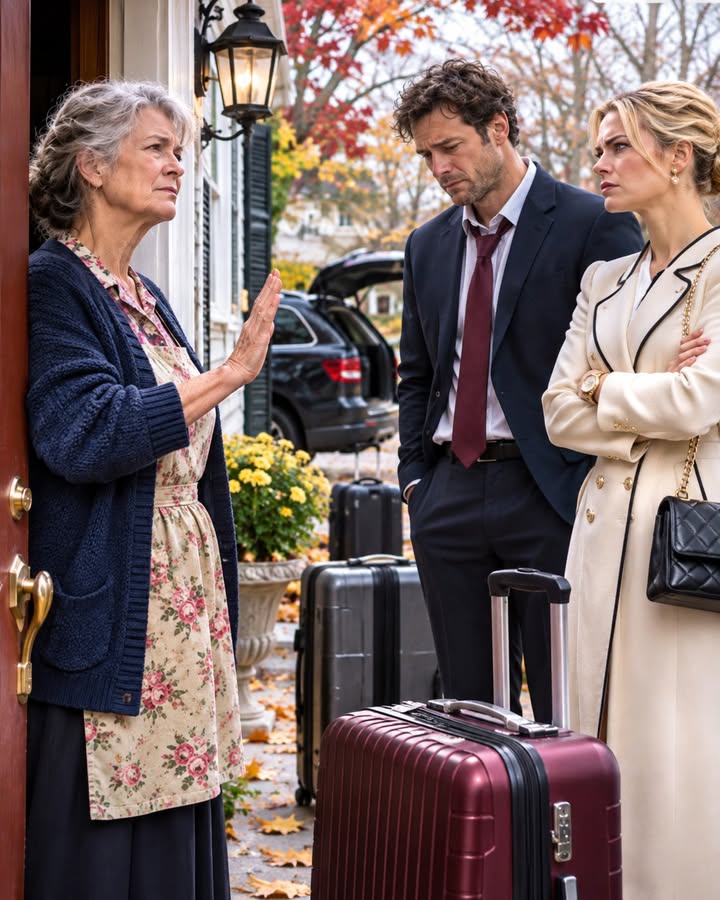
Part 5 – The Door I Would Not Open
The second deposit after my husband died.
I stood with the phone pressed to my ear, listening to Terrence breathe on the other end.
“I don’t remember putting money into that account,” I said.
“Neither do I,” he replied. “The bank record says it came from an account in Dad’s name.”
I looked at the old wooden box on my dresser, though I could not see it from the kitchen.
“Your father had a small account for household expenses,” I said. “He closed it when his health began to fail.”
“Could the money have been transferred before he died?”
“It might have been.”
“Mom, the date is three weeks after the funeral.”
The kitchen seemed to grow still around me.
“Could someone have sent it by mistake?” I asked.
“I don’t know. There’s no note, just a deposit and the account number.”
“Have you shown Mara?”
“Not yet. I wanted to ask you first.”
I closed my eyes and tried to remember that winter, the days when the house had been full of casseroles and condolence cards, when I had moved through my own rooms as if they belonged to someone else.
“I’ll look through your father’s papers,” I said. “But don’t assume the worst. There may be a simple explanation.”
“I’m trying not to.”
His voice sounded different from the frightened whisper in the hallway the night before.
He was still anxious, but he was beginning to understand that fear did not give him permission to turn uncertainty into a story.
“I’ll call Mara tomorrow,” he said. “I want her to help me verify the records.”
“That’s wise.”
“Mom, I’m sorry. I keep bringing you more questions.”
“You didn’t create every question just by finding it.”
“I made plenty of them by not paying attention.”
“Yes,” I said. “You did.”
Neither of us tried to soften that answer.
He said he would call when he knew more, and we ended the conversation.
I put the phone down and opened the wooden box again.
The bank papers lay in the order I had left them, the old transfer note from the Maple Street house beneath my letter to Terrence, and his ten-thousand-dollar deposit record tucked beside the photograph of him holding the keys.
There was no obvious paper explaining the later deposit.
I searched carefully through every envelope, stopping whenever a page looked as if it might belong to the account.
The house held many records that had seemed too ordinary to throw away and too personal to file anywhere else.
A receipt for a furnace repair.
A list of names and phone numbers written in my husband’s blocky handwriting.
A letter from the bank confirming that his account had been closed.
At the bottom of the box, I found a narrow envelope with my name on it.
The handwriting was his.
I had seen it on grocery lists, birthday cards, and the small notes he used to leave beside my coffee cup.
I had not opened the envelope before because it appeared to contain only an old statement.
Inside was a single page, dated just days before his death.
If you’re reading this, he had written, I must have forgotten to tell you something important.
I sat down on the edge of the bed.
The letter said he had transferred ten thousand dollars into Terrence’s savings account shortly before he went into the hospital.
He had wanted the money to remain there as a reserve, in case our son ever needed a quiet place to begin again.
My husband had written that he did not want me to feel responsible for distributing it or explaining it.
He only wanted me to know it was there.
At the bottom he had added, Terrence has a good heart, but he worries too much about disappointing us.
I held the page for a long time.
There was no mystery after all, only an act of love that had taken place when the family was already grieving.
My husband had not been sending money from beyond the grave.
He had prepared a small safeguard while he was still here, and then failed to tell me before he died.
I called Terrence.
“I found the answer,” I said.
“Was it Dad?”
“Yes.”
I read the letter to him slowly.
When I finished, he said nothing for several seconds.
“He did that for me?”
“He wanted you to have a reserve.”
“Did he say why?”
“He said you worried too much about disappointing us.”
Terrence let out a breath that sounded almost like a laugh, though there was no humor in it.
“That sounds like him.”
“He asked me not to feel responsible for explaining it. I think he meant for me to tell you when it became useful.”
“Was it useful?”
“I don’t know yet.”
“Would you let me use it?”
The question caught me off guard.
He had not asked me for money since the day he arrived with suitcases, but there it was, waiting between us.
The account belonged to him, though I had kept it safe.
“It’s your money,” I said. “We’ll have to confirm the balance and make sure the account is still in your name.”
“I don’t mean for the debt.”
“I know.”
“I mean for rent, if we need it.”
“We can talk about that after the account is verified.”
He was quiet for a moment.
“I won’t ask you to give me more than what Dad set aside.”
“Good.”
“And I won’t assume that means you’ll let us move in.”
“No,” I said. “It doesn’t.”
“I understand.”
I wanted to believe the sentence.
Not because he had said it with perfect certainty, but because he had allowed me to answer without arguing.
The next morning, Terrence called from his rental apartment.
Lennox had packed one suitcase and left the rest of her belongings in the spare room there.
She had asked him whether they could return to my house after the week ended.
He had told her he would ask me, though he already knew the answer might be no.
“I don’t want to put you in the middle,” I said.
“I’m the one asking.”
“Do you want to move back here?”
“I want the problem to stop being so large.” He paused. “That isn’t the same as wanting to live here.”
“Does Lennox want to?”
“She says it would help us keep expenses low while we figure out the business debt.”
“And what do you think?”
“I think it would make it easier for me to avoid deciding anything.”
I sat at the kitchen table and turned the old account statement over in my hands.
“That’s an honest answer.”
“I don’t know if it’s the whole answer.”
“It rarely is, at first.”
He told me he had arranged a meeting with a financial counselor, though the earliest appointment was several days away.
He had also spoken again with the business owner.
Dana confirmed that the business had failed to open its second location, and that the three-hundred-thousand-dollar loan was unlikely to be repaid quickly.
She was working with an adviser to determine what portion of the obligation could be settled and over what period.
“She says there may be equipment and inventory to sell,” Terrence told me. “But she won’t know what they’re worth until the accountant finishes the inventory.”
“Has she sent you the agreement?”
“She has.”
“Did Lennox sign personally?”
“Dana says she did. The final document has Lennox’s signature, but I’m having my own lawyer review what that means.”
“That’s sensible.”
“I still don’t know whether she understood it was a loan.”
“You may not know until you speak with her about it honestly.”
“I have.”
“And what did she say?”
“She said she thought the business would grow enough to pay it back before we needed the money.”
“That explains what she hoped. It doesn’t explain what she understood when she signed.”
“I know.”
He sounded exhausted.
I wished I could tell him that exhaustion was proof he was doing enough.
It was not.
“Have you found out about the other transfers?” I asked.
“Some of them. The credit cards and the car are clear. The furniture payment went to a supplier for Dana’s business, not to us.”
“Did Lennox tell you that?”
“She showed me the receipt.”
“Was it part of the investment?”
“She says it was.”
“Do you know?”
“No. We’re asking for the business records.”
He took a breath.
“I don’t want you to think I’m trying to blame her for everything.”
“I don’t.”
“But you think I’m responsible.”
“Yes.”
He did not protest.
“I am, aren’t I?” he asked.
“You signed documents you hadn’t read. You let decisions happen because you were afraid asking questions would create an argument. You can regret that without pretending Lennox made every choice alone.”
“I know.”
“And she has her own responsibility.”
“I know that too.”
The line went quiet.
I looked through the window at the rose bushes, their branches thin and bare now.
“Mom, I don’t know what happens to our marriage.”
“Neither do I.”
“Would you help her if she asked?”
“I would be willing to speak with her. That is not the same as helping with money.”
“I understand.”
“And if she wants to talk about staying here, I’ll answer her myself.”
He did not try to arrange a softer version of the question.
“All right,” he said.
That afternoon, Lennox came alone.
She called first and asked whether I would be willing to talk somewhere neutral.
I suggested the little café near the pharmacy, where the tables were set far enough apart that we could speak without feeling watched.
She arrived before me and had already ordered tea.
Without her coat, she looked less polished than she had on the day she came to my door.
There were faint lines of fatigue beneath her eyes, and her hair was tied back without the careful arrangement I was used to seeing.
“Thank you for meeting me,” she said.
“I wanted to hear what you had to say.”
She wrapped both hands around her cup.
“Terrence told me he spoke with you about us coming back.”
“He did.”
“I understand why you said no before.”
“Do you?”
“I know you felt used.”
“That isn’t all I felt.”
She looked down into her tea.
“I was angry,” she said. “I was ashamed, and I was scared. I came into your house thinking if I sounded certain, no one would notice I had no idea what to do.”
“I noticed.”
“I know.”
She did not ask me to forgive her for that, and I appreciated the restraint.
“Terrence says you want to come back here,” I said.
“We do. We could stay for a month or two, save what we can, and put the creditors off until we understand what’s owed.”
“That sounds like a request for shelter and help with your financial trouble.”
“It is.”
“You have a rental for now.”
“For a week. The deposit is gone, and the next place we can afford is farther from Terrence’s office.”
“There are other places.”
“We’ve called.”
“Then keep calling.”
She looked up at me.
“Bessie, I’m not asking you to solve all of it.”
“You’re asking to live in my home while you wait for the problem to become clearer.”
“Just temporarily.”
“That phrase has already meant more than one thing in the past few days.”
Her mouth tightened, but she did not look away.
“I know.”
“I gave Terrence forty thousand dollars because I wanted him to have stability. I did not give it so that either of you would have a permanent claim on my home.”
“I didn’t mean to say you owed us.”
“You said he had a right to stay.”
“I was panicking.”
“You were also certain.”
She turned her cup by its handle.
“I thought if we could get inside the house, we’d have time to think.”
“You were inside my house.”
“I know.”
“And I gave you one night.”
“I know.”
We sat with the words between us, not loud, not theatrical, but too large to step around.
At last, Lennox said, “I’m sorry I made you feel that your kindness was a debt.”
It was not an apology for striking me.
It was not enough to make the rest disappear.
But it was the first time she had named what she had done without adding a reason that would make it smaller.
“Thank you for saying that,” I replied.
She nodded, and her eyes grew moist.
“I thought the investment would save the business,” she said. “Dana had shown me the plans. The new location was supposed to open before the holidays. I thought if we could get it running, the money would come back and we’d have something of our own.”
“Did you understand you were signing a repayment agreement?”
“I understood there would be repayment. I didn’t understand how quickly the business could fail.”
“That is different from not knowing what the agreement said.”
“Yes.”
“Did Terrence know?”
“I thought he knew enough.”
“Did you show him?”
“No.”
“Why not?”
“I wanted to surprise him with good news. And I was afraid he’d say no.”
There it was, an answer that did not excuse the decision but did make it human.
“You were afraid of his answer,” I said.
“Yes.”
“So you made it without him.”
“I did.”
She pressed her lips together.
“I also thought he would be relieved if the debts were cleared,” she added. “The credit cards were worse than I told him. I was ashamed of how high they had gotten.”
“How high?”
“More than eighty thousand by the time the sale closed.”
I let that settle.
“Did you plan to pay them all off with the sale money?”
“I thought I could clear them and still have enough for the business and a new house.”
“But you spent on other things too.”
“Yes.”
“Why?”
“I wanted to feel like the money meant something good had finally happened. I bought things because I could. Some of them were gifts for my family, some were things I had wanted for years.” She stared at her hands. “I didn’t stop and add everything up.”
“Neither did Terrence.”
“No.”
“Both of you made choices.”
“Yes.”
She looked at me then, and I saw the humiliation she had been trying to cover with certainty since she arrived.
“I don’t expect you to trust me,” she said. “I don’t even know if Terrence should.”
“That is something the two of you will have to work out.”
“I’d like to.”
“Then start by telling him everything.”
“I’m trying.”
“Trying means showing him the records, even when they make you look bad.”
She swallowed.
“I can do that.”
“I hope you will.”
She rested her fingers against the rim of the cup.
“If we can’t move in here, would you help us pay for a rental?”
The question had been waiting beneath all the others.
I took a moment before answering.
“Not without conditions.”
“What conditions?”
“I would pay a landlord directly for a short term, not hand either of you cash. Terrence and I would write down how much, for how long, and what happens when the time ends.”
She glanced toward the window.
“And you would help us with the investment?”
“I would go with Terrence to meet Dana, if he wants me there, and I would help him find a financial counselor. I will not use my savings to cover the business debt.”
“What if they start calling?”
“They can speak to your lawyer.”
“I don’t have one.”
“Then you should get independent advice before signing anything else.”
Her expression changed at the word independent.
For a moment, she looked as though she might argue that Mara was already involved.
Instead, she asked, “You would pay for a rental, but not let us stay here?”
“Yes.”
“That seems backward.”
“It may feel that way to you.”
“Your house has an empty room.”
“It has a room that belongs to my life.”
She lowered her eyes.
“I see.”
“Do you?”
“I think I do.”
She did not sound convinced, but neither did she press.
When we parted, she thanked me for listening.
I walked home slowly beneath a sky the color of old silver.
By then I understood that my choice was not between helping and refusing to help.
It was between help that preserved everyone’s ability to make decisions, and help that quietly made me responsible for decisions I had not made.
That evening, Terrence came to my house with a folder.
He sat at the kitchen table and laid out the papers Mara had helped him organize: the sale closing statement, the bank transfers, the business agreement, and a list of questions for his lawyer.
He had brought the old savings-account statement too.
“I checked the account,” he said. “It’s still in my name, and there’s more in it now than Dad put there.”
“Because the money earned interest.”
“And because you put my ten thousand back after I sent it to you.”
“It was a savings account. It grew over time.”
“Dad’s deposit and mine are both there.”
“Yes.”
He turned the statement over, though he had already read it several times.
“I don’t want to use this money to keep pretending I’m fine.”
“You don’t have to.”
“I want to use some of it for the rental, if we need it. I can cover the deposit and the first month.”
“That seems reasonable.”
“And I’m selling the new car.”
“Have you spoken with Lennox?”
“I told her it wasn’t affordable.”
“What did she say?”
“She said we should wait until we know what the business can repay.”
“Is she wrong?”
“No. But I can’t keep driving a car we can’t afford just because it’s new.”
The decision sounded modest, but I knew it cost him.
He had wanted that car for years, and the smell of new leather still clung to the memory of the day he brought it home.
“You’re making a plan,” I said.
“I’m trying to.”
“Keep going.”
He placed his hand on the folder.
“Would you let me bring Lennox here tomorrow so we can talk about the rental?”
“Yes. But the plan will need to be clear and written down.”
“She may not agree.”
“Then she can choose another option.”
His face tightened with worry.
“I don’t want to lose her.”
“I know.”
“I also don’t want to keep making you carry what I should carry.”
I held his gaze.
“Those two wishes may not always fit together.”
“I know that too.”
The next day, we met in my kitchen.
Terrence and Lennox sat across from me, with the papers arranged in a neat stack between them.
The written plan was simple.
They would not move into my house.
I would pay the rental company directly for up to six weeks of temporary rent, within a fixed amount.
Terrence would sell the new car and use the proceeds to reduce their other expenses.
Both of them would attend the meeting with the financial counselor.
Terrence would continue working with his own lawyer, and Lennox would seek separate advice about the business agreement.
They would provide Mara with the records she had requested, but neither of them would expect her to represent them.
I would accompany Terrence to meet Dana, if he wanted me there, but I would not negotiate or guarantee repayment.
Nothing in the plan was generous enough to solve their troubles.
That was deliberate.
It was generous enough to give them time without handing them the responsibility I had spent my life trying to take away from them.
Lennox read the page twice.
“You would pay the rent directly?” she asked.
“Yes.”
“For six weeks?”
“At most.”
“And after that?”
“You will have a plan that belongs to you.”
She set the page down.
“What if the business creditors start contacting us before then?”
“You speak with your lawyer.”
“What if the counselor says we need more time?”
“Then you decide how to pay for more time.”
She looked toward Terrence.
He was not watching me.
He was watching her.
“I’m not asking for money,” he said. “I have enough for the first month if I use the savings Dad left me and sell the car. Mom’s offer would keep us from spending everything at once.”
Lennox’s eyes moved to the old account statement beside his folder.
“Your father left you savings?”
“He put money in the account before he died. Mom had saved some of it for me too.”
“Why didn’t you tell me?”
“I found out yesterday.”
She looked at me.
“You kept an account for him?”
“I did.”
“Why?”
“Because I wanted him to have something to fall back on.”
“And you never told either of us.”
“I didn’t think it was necessary.”
Her expression clouded.
“You kept money from us while we were trying to figure out how to buy a house.”
“I did not hold it over your head, and I did not expect either of you to pay me back.”
“That isn’t what I meant.”
“What did you mean?”
She lowered her voice.
“I don’t know.”
I understood the confusion.
The old savings account looked like a secret because it had been one, even though it had been kept for Terrence rather than against him.
“I should have told him,” I said. “I believed I was protecting him. Sometimes I protected him from things he had a right to know.”
Terrence looked at me.
“I’m glad you kept it,” he said. “I wish I’d known.”
“So do I.”
Lennox studied the paper again.
“I can’t accept your money if there are rules attached.”
“You can decline it.”
“You said that before.”
“And I mean it.”
“I don’t want to live by someone else’s rules.”
“Then arrange a rental without my help.”
Her face tightened, and the old certainty began to return.
“That sounds like you want us to fail.”
“No,” I said. “It sounds like I’m asking you to choose freely.”
Terrence shifted in his chair.
“Lennox, this is not a test.”
“It feels like one.”
“It’s a boundary,” I said. “You may dislike it without calling it a punishment.”
She stared down at the page.
“I’m not signing something that says you can decide when our help ends.”
“I’m not deciding when your life ends. I’m deciding how much of mine I can offer.”
“What if six weeks isn’t enough?”
“Then you will have to make another plan.”
“What if we can’t?”
“Then you will have to ask what choices remain.”
Her eyes shone, though she did not cry.
“I thought family meant there was somewhere to land.”
“Sometimes family is where you land,” I said. “Sometimes it is the voice that tells you to stand.”
She closed her eyes briefly.
“I can’t agree to this today.”
“That’s your choice.”
Terrence looked at her, his face drawn.
“We could sign it and still decide later that we don’t need the full six weeks.”
“We could,” I said. “But only if both of you understand the terms.”
Lennox pushed her chair back.
“I can’t do this.”
She stood, took her coat, and walked to the door.
Terrence remained seated.
“Lennox,” he said.
She paused with her hand on the knob.
“I’m not asking you to stay here,” he continued. “I’m asking you to tell me what you want to do.”
“I want not to be treated like a criminal in a family meeting.”
“No one called you that.”
“Everything is a document now. Every mistake is a record.”
“Because we need to understand what happened.”
“We can do that without your mother deciding how we live.”
“My mother isn’t deciding how we live. She’s deciding how she will help.”
Lennox looked at him, and for the first time I saw the hurt beneath her anger.
“I don’t know how to be married to someone who is waiting for me to fail again.”
“I’m not waiting for you to fail,” he said. “I’m trying to see what happened before we make another decision.”
She opened the door.
“I’ll call you.”
Then she left.
The door closed softly behind her.
Terrence stared at the written plan.
I did not reach for his hand or tell him that everything would be all right.
He had begun to understand that love could not make a promise on behalf of someone else.
After a while, he said, “I don’t know whether she’ll come back.”
“Neither do I.”
“If she doesn’t, I don’t know what I’ll do.”
“You will make the next decision when it arrives.”
He nodded and folded the plan.
He did not take it with him.
After he left, I remained at the kitchen table until the daylight faded.
The house felt painfully quiet, yet it also felt like mine again.
I had chosen not to let fear turn my home into a place where the consequences of other people’s choices could be postponed indefinitely.
That did not mean I was free of fear.
I worried about Terrence’s marriage.
I worried about the business debt and the rental costs.
I worried that the line I had drawn would harden into a distance neither of us knew how to cross.
Still, when I went upstairs to put the papers away, I did not take the written plan out of the folder.
I left it where Terrence had placed it.
A few minutes later, my phone rang.
His name appeared on the screen.
“I found the second statement,” he said.
“From the savings account?”
“Yes. It’s an old account notice Dad received, with a note in his handwriting.”
“What does it say?”
“He wrote that he had put the money aside for my future, but he asked you to keep the account quiet until I needed it.”
“I know.”
“That isn’t the strange part.”
I sat on the edge of the bed.
“What is?”
“There’s a withdrawal listed a few days after his deposit.”
My hand tightened around the phone.
“How much?”
“The same ten thousand dollars.”
“Was it transferred back to your father’s account?”
“No. It went somewhere else.”
“Where?”
“I’m looking at the recipient now.”
He stopped speaking.
“Terrence?”
“The account belongs to Lennox.”
The room seemed to tilt, though I was sitting still.
“Are you sure?”
“It’s an account in her name. The transfer date is the week after Dad died.”
“Did you know about it?”
“No.”
“Did she?”
“I don’t know.”
I heard paper shifting on his end of the line.
“There’s a note with the transfer,” he said. “I think Dad wrote it.”
“What does it say?”
Terrence read the words aloud, slowly, as if each one had to be carried carefully across the distance between us.
“Return the favor she did for him.”
My breath caught
**–END OF PART 5–CLICK “NEXT” AT THE BOTTOM OF THE PAGE TO CONTINUE READING**
* * *
[PREVIOUS: PART 4](https://puretales.idolsgift.com/blog/part-4-the-note-she-kept-029) | [NEXT: PART 6(THE END)](https://puretales.idolsgift.com/blog/part-6-the-end-the-note-she-kept-029)
✓ Lynn R. Adams
Part 5 – The Door I Would Not Open The second deposit after my husband died. I stood with the phone pressed to my ear, listening to Terrence breathe on the other end. “I don’t remember putting mone…