PART 5: The Note Beneath the Moon 041
Part 5 – The Kind of Safety We Choose
Behind me, Willa’s crayon rolled from the table and landed on the floor.
I ended the call without saying goodbye.
For a moment, I could only stare at the phone in my hand, hearing Reid’s last words again.
It has your name on it.
Willa bent to retrieve the crayon.
“Was that Dad?” she asked.
“Yes.”
“Is he coming here?”
“No, sweetheart.”
I put the phone facedown on the table, though the gesture did nothing to quiet my mind.
Gwen had gone still by the sink.
Elise’s envelope, the folder, my name.
Too many pieces had been kept apart, and every time I learned the shape of one, another appeared behind it.
“What did he say?” Gwen asked.
I looked at her.
“He said there’s another folder in the unit. It wasn’t included in the review.”
“Why not?”
“He says it was inside the envelope Elise brought.”
Gwen came nearer, but stopped short of the table.
“Does Elise know what’s in it?”
“I don’t know.”
Willa set the crayon beside her drawing.
“Is it about me?”
“I don’t know that either.”
She searched my face.
I took a breath and sat beside her, so she wouldn’t have to look up at me.
“Some papers belong to the adults,” I said. “If they concern you, I’ll explain them in a way that makes sense. You don’t have to solve this.”
“I don’t want to solve it,” she said.
She looked down at the moon she had drawn above the blue house.
“I just want everyone to stop making secrets.”
The simplicity of it hurt more than any accusation could have.
“I want that too,” I said.
My phone buzzed.
A message from Reid appeared on the screen.
The folder is still sealed. Elise says she never opened it.
I read the words twice, then called him back.
“Is Elise with you?”
“She’s in the car. I asked her to stay.”
“Put her on.”
There was a small pause, followed by the sound of the phone changing hands.
“Hannah?” Elise said.
“Reid told me there’s a folder with my name on it.”
“Yes.”
“Why didn’t the clerk review it?”
“I didn’t know it was there until we were leaving. It had slipped behind the cabinet drawer.”
“Have you opened it?”
“No.”
“Why not?”
“Because the review was limited, and because I didn’t know whether it was meant for the court or for you.”
I closed my eyes briefly.
“I need you not to decide that alone.”
“I understand.”
“Can you tell me anything about the outside?”
“It’s an old manila folder. Your name is written on the tab in Reid’s handwriting. There’s a date, but I can’t read it from where I’m sitting.”
“Could you take a picture of it without opening it?”
“I can.”
A moment later, my phone chimed.
The photograph showed a plain folder with a creased corner.
My name was written across the tab.
Beneath it was a date from several years earlier, long before the note had been tucked inside Willa’s shirt.
I enlarged the image.
The date was a week after the complaint that had cost me my cleaning job.
“What happens now?” Elise asked.
“We tell the judge it exists and let him decide how it should be handled.”
“I can bring it to the courthouse tomorrow.”
“Don’t take it out of the unit yet.”
“I won’t.”
I heard Reid shift in the background.
“Is there anything else?” I asked.
“No,” Elise said. “That’s all I know.”
“Thank you for telling me.”
There was a pause.
“I’m sorry I didn’t come forward sooner,” she said.
I looked at the photograph again.
“I hear you.”
It was not forgiveness.
It was not a promise.
But it was an answer I could give without pretending the past had been settled.
After the call ended, Gwen asked whether I wanted her to stay.
I looked at Willa, whose head had bent over her drawing again.
“Yes,” I said. “But I need you to sit with her while I call the clerk.”
My mother nodded.
No defense, no explanation.
She simply drew out the chair beside Willa and asked her about the stars.
I stepped into the hallway and called the court clerk.
She listened carefully as I explained that another folder had been found, still sealed, bearing my name.
“Do not open it or remove it,” she said. “I’ll notify the judge and ask whether it should be included in the review.”
“Will that delay the hearing?”
“Possibly, but the judge will decide what is relevant.”
I thanked her and returned to the kitchen.
Willa had added a small silver moon to the roof of the blue house.
“Is that our house?” I asked.
“It’s a house like ours.”
“Who lives there?”
“Me and you.”
She added another star, then looked toward Grandma.
“Grandma can visit.”
Gwen’s face softened.
“I’d like that.”
Willa set down the pencil.
“Can Dad visit too?”
The question was quiet, but the whole kitchen seemed to listen.
I sat beside her again.
“I don’t know what the judge will decide.”
“But do you want him to?”
I looked at the drawing.
There was space beside the house, a little line of path leading from the door to the edge of the page.
“I want you to be safe,” I said.
“Can I be safe and still see him?”
That was the question I had been avoiding since the photograph was lifted in court.
I had wanted the evidence to produce a clean answer, something firm enough to stop the uncertainty.
Instead, it had shown me a man who could pay for his daughter’s care and conceal it, who could long to be a father and still harm the people who stood between him and the image he wanted to protect.
The truth did not make him safe.
It did not make him beyond hope, either.
“I think those things can happen together,” I said. “But the visits would need rules, and adults who make sure you’re comfortable.”
“Would you be there?”
“Not at first.”
Her eyes lowered.
“Would I have to go if I didn’t want to?”
“No one should make you go just to keep an adult happy.”
“Would Dad be mad?”
“He might feel sad. That would be his feeling to manage, not your job.”
She absorbed that, looking at the moon she had drawn.
“I want to see him,” she said after a while. “But I don’t want him to tell me secrets.”
“Then that needs to be clear.”
“And I want him to tell the judge what he did.”
“I want that too.”
The words came from her with a steadiness that made my throat tighten.
Gwen set a hand lightly on the back of Willa’s chair.
“You shouldn’t have had to carry any of this,” she said.
Willa leaned into her for a moment, then returned to her drawing.
I sat at the table until the light outside thinned toward evening.
The sealed folder stayed on my phone screen, its tab bearing my name and a date that pulled at an old memory.
I remembered that week.
I remembered the office manager calling me in before my shift, his expression uncomfortable as he told me a complaint had been made about my work.
I remembered him saying the company had to protect its reputation.
I remembered walking home with my apron folded in my bag, trying to decide how to tell Willa that I would be home more often but would have less money.
At the time, I had believed the complaint had come from a client.
I had never known Reid had arranged it.
The folder could contain more proof.
It could also contain another attempt to shape the story in his favor.
I did not want to open it.
I wanted to know what was inside.
Those wants sat side by side, as uneasy as the truths I had already found.
The next morning, the judge resumed the hearing.
Willa waited with Gwen in a small room down the hall, drawing quietly while I sat at the table with the documents from the storage unit.
Reid sat across from me, his hands folded in front of him.
Elise had come as well.
She had been asked to answer questions about the records she found and the messages she had saved.
The judge read through the inventory, then asked Reid to explain the notes about my job and the apartment.
Reid did not look at me while he spoke.
“I believed I needed to show that I could provide more stability,” he said. “I told myself that the court should know about Hannah’s circumstances.”
“You did not merely provide information,” the judge said. “You contacted people connected to her employment and home.”
“Yes.”
“Were the statements you sought accurate?”
“Not all of them.”
“Did you know that at the time?”
Reid swallowed.
“I knew some of the claims were exaggerated.”
The judge glanced at the copies in front of him.
“You also made payments toward your daughter’s medical care.”
“Yes.”
“Why did you conceal those payments from her mother?”
“I wanted to help Willa without turning it into a dispute.”
“Did you consider that withholding the information would leave Ms. Hadley unable to make decisions based on the full picture?”
“No.”
“Did you consider how it would feel for your daughter to keep a secret between you?”
Reid’s face tightened.
“No.”
The judge let the silence settle before turning toward Elise.
She described finding the records, writing to Reid, and eventually deciding to preserve her messages.
She did not excuse her delay.
She said she had believed she could persuade him to withdraw his plan without involving the court.
When asked whether she would be willing to testify if the case required it, she said yes.
Reid stared down at his hands.
I had expected the hearing to feel like a victory, but it felt like watching a wall come down one brick at a time, each piece revealing what had been built behind it.
The judge then addressed the sealed folder.
He said the court had received notice that it still existed and would require it to be submitted without being opened.
The clerk would retain it until the judge determined whether it was relevant.
Reid nodded.
Elise nodded too.
I said I understood.
The judge turned to me.
“Ms. Hadley, based on the information before the court, I am prepared to issue a temporary order granting you primary custody while the matter continues.”
My hands went cold.
The relief I had wanted arrived, but it did not feel like triumph.
The order would protect Willa from being abruptly moved.
It would also shape the days that came after.
The judge continued.
“Mr. Hadley will be required to pay child support and to attend counseling before any request to expand visitation is considered.”
Reid did not object.
“Regarding contact in the meantime,” the judge said, “I am prepared to approve supervised visits through a neutral provider, with the child’s comfort considered at every stage.”
He looked first at Reid, then at me.
“Would you accept that arrangement?”
The room went quiet.
I looked at the papers before me.
The false complaint.
The medical payments.
The messages in which Reid had been urged to tell the truth.
The receipt Gwen had kept without my knowledge.
The note Willa had carried beneath the silver moon, hidden in the shirt I had bought her because I wanted her to feel cherished.
I could have asked the judge to stop all visits.
I could have said that Reid had used our daughter to keep a secret, had tried to weaken my life, and had made his love feel like something she had to protect.
Every reason for refusing him was real.
So was Willa’s question.
Can I be safe and still see him?
I had no perfect answer.
I had only a choice about what kind of safety I wanted to build for her.
“Your Honor,” I said, “I support the temporary custody order and the support requirement.”
The judge nodded.
“I also support supervised visits, but only if Willa is not pressured to go, and only if the visits are arranged around what she can manage.”
Reid looked up.
I kept my eyes on the judge.
“I want her father to take responsibility for what he did. I don’t want her to learn that loving him means keeping his secrets or pretending nothing happened.”
The judge’s expression softened slightly.
“That is a reasonable distinction.”
Reid spoke before the judge could continue.
“I’ll accept those conditions.”
The words sounded plain, almost small.
“Do you understand that accepting the visits means you must not discuss the litigation with Willa or ask her to keep anything from her mother?” the judge asked.
“Yes.”
“Do you understand that her comfort, not your preferred timetable, will guide the pace?”
“Yes.”
“Can you tell her the truth about the note and the papers without asking her to reassure you?”
Reid’s jaw moved.
“Yes.”
The judge looked at him for a moment longer.
“Then I will include those conditions in the temporary order.”
A breath left me that I had not realized I was holding.
The judge said the final custody decision would come after the court reviewed the remaining records and considered the testimony.
The temporary order would not decide everything.
It would give us time to make the next decisions carefully.
When the hearing paused, I stepped into the hallway.
Willa was sitting on the floor beside Gwen, arranging her pencils by color.
She looked up at me immediately.
“Did the judge decide?”
“Some of it.”
“Can I see Dad?”
“Yes, in supervised visits, if you want to.”
“Do I have to?”
“No.”
“Will he ask me to keep a secret?”
“He has been told not to.”
Willa considered that.
“Did he agree?”
“Yes.”
She returned to the pencils.
“Okay.”
It was not forgiveness.
It was not trust.
It was an opening so small that no one could mistake it for a promise.
Still, it was hers.
Gwen sat back on her heels.
“How are you?” she asked Willa.
“I’m tired.”
“Would you like to go home?”
Willa nodded.
I touched her shoulder.
“We’ll leave soon.”
Gwen looked at me.
“I can take her, if you need to stay.”
“Thank you.”
It was the first time I had asked for her help since her confession without feeling that I was swallowing my anger.
It did not mean the hurt was gone.
It meant I was willing to let her show me what she did with the truth now that it was no longer hidden.
Willa went with Gwen to the car.
I stayed in the courthouse to collect the temporary order and speak with the clerk about the next date.
Reid remained in the courtroom.
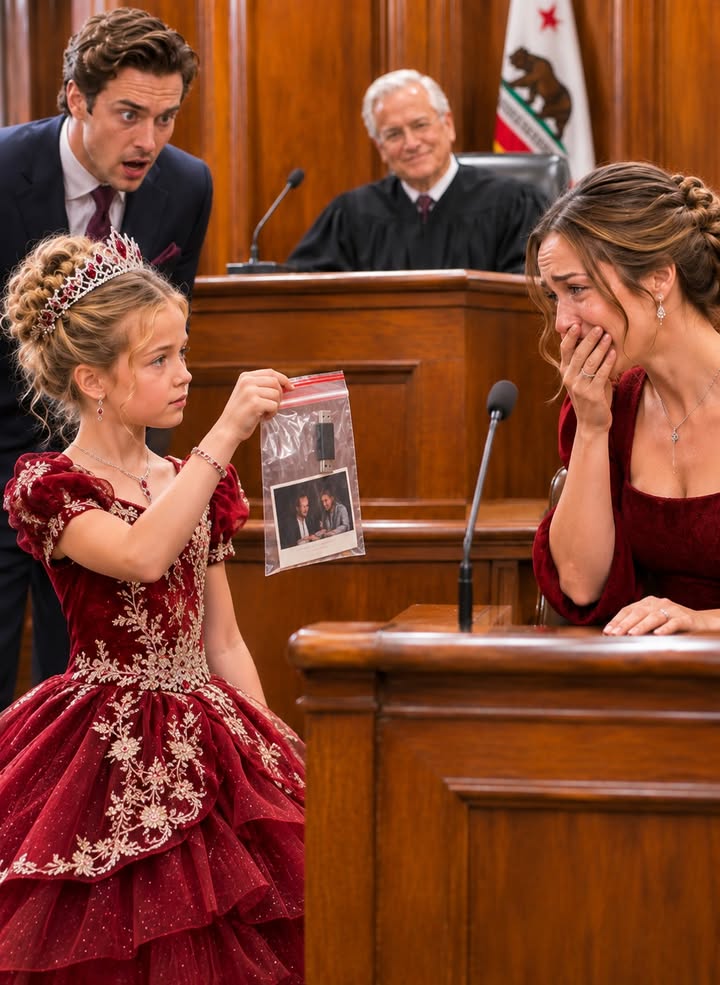
As I passed the open door, I saw him seated alone at the table where he had once smiled while his attorney held up the photograph of Willa’s shirt.
His watch caught the light when he moved his hand.
He was no longer smiling.
I could have kept walking.
Instead, I stopped in the doorway.
“Reid.”
He looked up.
“Willa agreed to consider a visit.”
His expression softened, but he did not stand.
“I know.”
“She doesn’t owe you comfort.”
“I know.”
“And she doesn’t owe you forgiveness.”
“I know that too.”
I studied his face, searching for the practiced answer beneath the words.
“What are you going to tell her?”
“The truth.”
“All of it?”
“As much as she asks, in words she can understand.”
“You can’t make her responsible for how you feel.”
“I won’t.”
His voice trembled slightly, but he held my gaze.
“I want to apologize,” he said. “Not because I expect it to change anything today. Because she deserves to hear it.”
“She does.”
“I’ll wait until the visit, if that’s better.”
“Ask the supervisor when it’s appropriate.”
He nodded.
I turned to go.
“Hannah,” he said.
I stopped, but did not turn around.
“I’m sorry I made you carry the consequences of things I was afraid to admit.”
For a moment, I heard only the quiet hallway and the muffled closing of a door somewhere behind me.
“I’m not ready to accept that apology,” I said.
“I understand.”
“But I heard it.”
I walked on.
The court clerk gave me a copy of the temporary order and a receipt for the folder, which had been sealed and secured for the judge’s review.
I asked whether there was any way to know what it contained.
“Not until the judge determines it can be opened,” she said. “The date and label will be part of the record.”
I looked at the folder’s inventory entry.
The date was the same week I lost my cleaning job.
The tab had my name.
I took the papers outside.
At the courthouse steps, the winter sun had broken through the clouds, bright enough to make me squint.
Gwen’s car was at the curb.
Willa was in the back seat with her moon shirt folded beside her.
I climbed in.
“How did it go?” Gwen asked.
“The judge granted me temporary primary custody. Reid’s visits will be supervised, and Willa can decide whether she’s ready.”
Gwen nodded slowly.
“That sounds fair.”
“It sounds careful.”
Willa picked up the shirt and held it in her lap.
“Can we fix the pocket?”
“Of course,” I said.
“Can you mend the moon too?”
“If you want me to.”
She ran one finger over the silver thread.
“I want to keep it like this. Just fix the part that came loose.”
“Then that’s what we’ll do.”
Gwen started the car.
As we pulled away, Willa leaned her head against the window.
I held the temporary order on my lap, the paper warm from my hands.
For the first time in months, there was a line the court had drawn around us.
It was not a permanent answer.
It was not a guarantee that Reid would change.
But it gave Willa a pause between the past and whatever came next.
My phone rang before we reached the main road.
The clerk’s number appeared.
I answered.
“Ms. Hadley,” she said, “the judge has reviewed the sealed folder.”
I sat straighter.
“Did he open it?”
“He did, under the court’s authorization.”
“What was inside?”
“A letter addressed to you, along with several pages of correspondence.”
My hand tightened around the phone.
“Can you tell me what it says?”
“The judge has instructed me to arrange a meeting before the next hearing.”
“Why?”
There was a small pause.
“Because the letter isn’t only about the custody case.”
The car moved through the pale winter light, and I looked at Willa’s reflection in the window.
The clerk’s next words were quiet.
“It’s about what Reid was planning to do before he met you.”
**–END OF PART 5–CLICK “NEXT” AT THE BOTTOM OF THE PAGE TO CONTINUE READING**
* * *
[PREVIOUS: PART 4](https://echoesofstories.idolsgift.com/blog/part-4-the-note-beneath-the-moon-041) | [NEXT: PART 6(THE END)](https://echoesofstories.idolsgift.com/blog/part-6-the-end-the-note-beneath-the-moon-041)
✓ Lynn R. Adams
Part 5 – The Kind of Safety We Choose Behind me, Willa’s crayon rolled from the table and landed on the floor. I ended the call without saying goodbye. For a moment, I could only stare at the phone…