PART 5: The Note Beneath the Moon 034
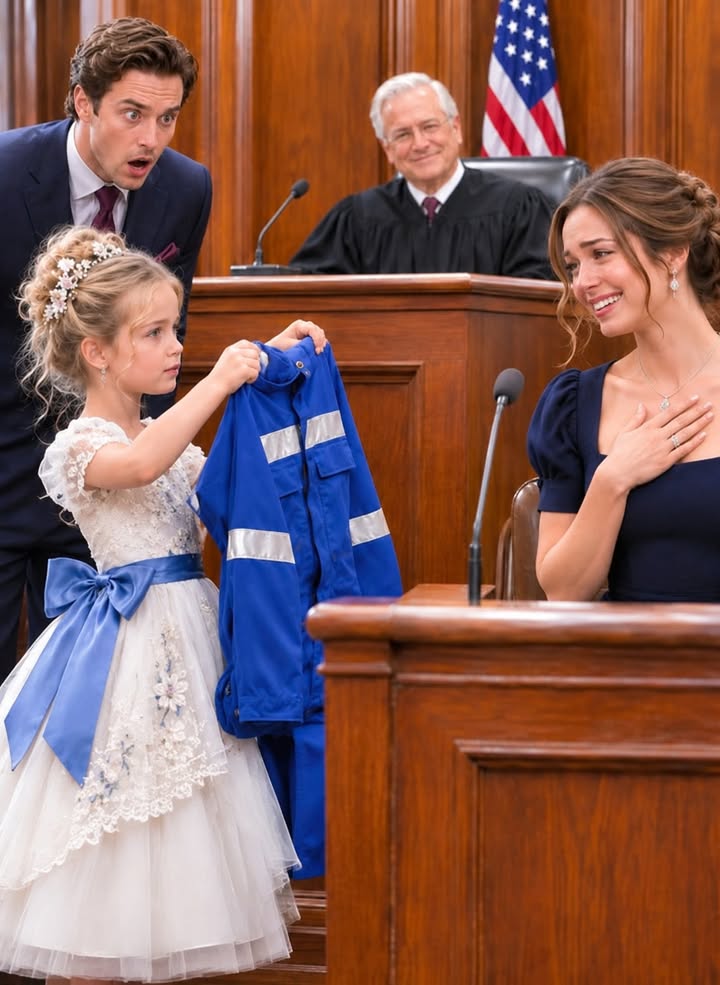
Part 5 – The Truth We Owed Her
“If you ever see this moon again, ask Reid what he promised me.”
The judge read the sentence aloud, then lowered the scrap of paper.
Reid closed his eyes.
For a moment, no one spoke.
The blue ink had bled across the thin paper, leaving the final words soft at the edges, but the message was clear enough.
The court reporter’s keys began again, each tap sounding louder than it should have.
The judge asked that the scrap be photographed and preserved with the other evidence.
Then he looked toward Reid.
“Mr. Hadley, do you know what promise this note refers to?”
Reid opened his eyes, but did not answer immediately.
His lawyer leaned toward him and murmured something I could not hear.
Reid shook his head once.
“I do,” he said.
The words came quietly, but they changed the air in the room.
The judge asked whether he was prepared to explain.
Reid glanced toward Willa’s empty chair, then toward me.
“I am,” he said. “But not in front of my daughter.”
Willa was with Gwen in the courthouse lobby, as we had agreed.
Still, hearing him say it made my throat tighten.
For weeks, every piece of this story had seemed to circle around what Willa knew, what she had seen, and what we feared she might misunderstand.
The judge considered Reid’s request and called another brief recess, directing both sides to discuss whether the testimony should continue that day.
Mercer pulled Reid aside.
I stayed at the table, staring at the sealed evidence bag.
The hidden paper had not given us a complete answer.
It had given us a question that only Reid could answer, and the knowledge that my grandmother had expected the question to be asked.
Gwen came into the courtroom from the lobby and sat beside me.
“Did you know what she meant?” I asked.
Gwen shook her head.
“I knew she helped his family. I never knew there was a promise.”
“Could she have meant something ordinary?”
“Maybe. But she wrote it down for a reason.”
I looked across the room at Reid.
He stood with his back partly turned, listening to Mercer.
His shoulders were drawn tight beneath his suit.
The expensive watch at his wrist caught the light when he moved his hand, but now it looked like an object he had forgotten he was wearing.
“I don’t know whether I want him to explain,” I said.
Gwen took my hand.
“You’re allowed to want the truth and be afraid of what it will cost.”
The recess ended.
Reid returned to his seat without Mercer, who remained standing near the counsel table.
The judge asked if he wished to testify.
“I do,” Reid replied.
Mercer rose.
“Your Honor, my client understands that his statements may affect the custody proceedings and other matters connected to this case.”
“I do,” Reid said.
The judge confirmed that Reid was choosing to speak voluntarily.
Then he asked him to explain the promise.
Reid folded his hands on the table.
“When I was a boy, my father lost his job,” he said. “We moved twice in one year, and there were weeks when we didn’t know where we would be living next.”
His voice remained controlled, but I could hear how carefully he was choosing each word.
“My mother tried to keep things stable for me. She didn’t tell me much about the bills. I only knew that she worried when the mail came.”
He looked down at the photograph of my grandmother and the boy beside her.
“Your grandmother lived near us,” he continued. “She saw my mother struggling to keep the garden alive behind our rental house.”
Gwen leaned forward.
Reid glanced at her, then at the judge.
“She offered my mother work in her garden and paid her for it. She also made sure we had groceries when my father was out of work.”
I thought of my grandmother’s hands, always smelling faintly of earth and mint.
She had planted tomatoes in every house she ever lived in, even when she had only a narrow strip of dirt beside the steps.
“She never told me she was giving us charity,” Reid said. “She made it feel like we were helping her. When I was old enough, I understood that she had been helping us.”
The judge asked what the promise had been.
Reid swallowed.
“I promised I would repay her kindness when I was grown.”
His eyes settled on the old photograph.
“She told me the best way to do that was to help someone else when I had the chance. She said not to turn it into a debt between us.”
The words sounded like my grandmother.
A small, familiar ache spread through my chest.
“What does that have to do with Willa’s shirt?” the judge asked.
Reid’s mouth tightened.
“It has to do with why I chose it.”
He turned toward me.
“I found out about the mark on the locket years ago. Your grandmother showed it to me before we were married.”
My mind searched back through the years, through family visits and quiet dinners, for a moment when I might have seen him holding the locket.
Nothing came.
“She told you about the photograph?” I asked.
“She showed me the picture that used to be inside it. She wanted me to know she had kept it all those years.”
“Why didn’t she tell me?”
“I don’t know. Maybe she thought it was your story to discover when you were ready.”
I looked at the faded photograph.
My grandmother had preserved the image of a boy she had helped, but she had kept the details to herself.
“Did you give Willa the shirt because of the locket?” I asked.
“Yes.”
The answer came without hesitation.
“I ordered it from a small shop that made custom embroidery. I asked them to copy the crescent from the locket.”
“And then you let Mercer say I bought it.”
Reid’s gaze lowered.
“Yes.”
A flush rose along my neck.
“Why?”
“Because I thought the shirt could draw attention to the mark and lead us back to the photograph.”
“You could have just told me.”
“I should have.”
“You could have spoken to the judge.”
“I should have done that too.”
His agreement left nowhere for me to direct my anger except back at him.
I held on to the edge of the table.
“Then why the note?”
Reid’s face tightened again.
“I did not write it.”
“Did you ask someone to sew it into the seam?”
“Yes.”
The courtroom seemed to contract around that answer.
The judge leaned forward.
“Who placed the note there?”
“A former school aide named Maribel Soto.”
I recognized the name from Willa’s elementary school.
She had helped in the library and sometimes stayed late with children whose parents were caught in traffic.
“Why would she do that?” I asked.
“Because I asked her to.”
Reid looked at me, but did not try to soften the admission.
“I had discovered that my business partner was using our company to create false complaints about people. At first, I thought it was only about damaging a competitor’s reputation. Then I learned he had been gathering information about families connected to a development deal.”
“Families?”
“People who lived near a property his company wanted. He wanted the complaints to make them look unreliable, so he could pressure them to move.”
The landlord’s messages returned to me.
He says he can make it worth your time if you support his version.
My hands tightened around the folder in my lap.
“You knew your partner was involved in this?”
“I knew he was falsifying complaints. I didn’t know the full plan at first.”
“And instead of telling me, you arranged for the landlord to make my home sound worse.”
Reid’s face changed.
“I didn’t tell him to lie about the apartment.”
“You paid him.”
“I paid him to document what he saw.”
Mrs. Alvarez’s messages sat in the court file, though no one had yet proved the exact arrangement.
“You knew he would exaggerate,” I said.
Reid’s silence answered before he did.
“I suspected he would.”
“So you used him anyway.”
“Yes.”
The word landed heavily.
I looked toward the judge, but he was watching Reid, giving him room to continue.
“Why?” I asked.
Reid took a breath.
“My partner had a contact in the school system. He was planning to have Willa moved out of state with his family, using a claim that our home was unsafe and that I had no role in her life.”
Mercer shifted in his chair.
“Reid,” he said quietly.
Reid raised one hand, asking him to let him finish.
“I knew something was happening, but I couldn’t prove the plan. My partner kept telling me I was overreacting. The more I asked questions, the more carefully he hid what he was doing.”
“And you decided to create a custody case,” I said.
“I thought if there was already a court order in place, Willa couldn’t be moved without the judge knowing.”
“You could have filed for an emergency review without making me look like a neglectful mother.”
“I know.”
“You could have told me about your partner.”
“I thought he was watching our communications.”
“So you used my landlord instead?”
Reid’s eyes met mine.
“I thought I could force everything into the open before he acted.”
“You didn’t force the truth into the open. You made me stand in court while your lawyer used a photograph of our daughter to humiliate me.”
“I know.”
His voice broke slightly on the last word.
I wanted to hate him cleanly, without complication.
It would have been easier if he had acted only out of greed or spite.
Instead, he had tried to protect Willa through deception, and in doing so he had made her carry the weight of choices she had never been meant to understand.
The judge asked about the dark marks on the shirt.
“The note came from Maribel,” Reid said. “She wrote it, then put it in the seam because she thought the symbol might be enough to make me explain.”
“Why did she use a child’s handwriting?” the judge asked.
“She didn’t deliberately imitate a child. She wrote quickly on a scrap of paper Willa had left in the classroom. The pencil was hers.”
“What caused the stains?”
“Maribel’s pen leaked while she was sewing the note in.”
I remembered the pale blue ink on the second scrap and the dark marks across the shirt in the photograph.
They had not been signs of neglect.
They had been evidence of a hurried secret.
But that did not make the secret harmless.
The judge asked Reid whether he had told Maribel to write the message.
“No,” he replied. “I asked her to sew a note in the seam. I wanted Willa to see it and ask me about the moon.”
“You intended your daughter to discover it without her mother knowing?”
Reid lowered his eyes.
“Yes.”
I could feel Willa’s small hand in mine again, cool and uncertain as she had confessed she was afraid we would fight.
“You asked her to carry a message between us,” I said.
“I thought she would ask me when we were alone.”
“She was eight.”
“I know.”
“She hid it because she was afraid of what we would do.”
Reid’s face crumpled for the briefest moment before he steadied it.
“I didn’t understand that she was keeping it to herself.”
“You didn’t ask.”
“No.”
The judge sat back, letting the silence settle.
Reid had admitted to arranging the landlord’s statement, giving Willa the shirt under false pretenses, and asking a school aide to hide a message inside it.
He had also described a genuine threat to Willa’s stability, one that might explain why he had panicked.
The explanation did not erase the harm.
It only made the choice before me more difficult.
The judge called another recess to allow the attorneys to discuss the implications of Reid’s testimony.
I stayed at the table.
Gwen touched my shoulder.
“Are you all right?”
“I don’t know.”
“That’s honest.”
“I keep thinking that if I expose all of this, Willa may lose the version of her father she still loves.”
Gwen’s eyes were gentle.
“She deserves the truth more than she deserves a perfect version of anyone.”
“I know.”
“But you don’t have to decide this second.”
I looked at Reid across the room.
Mercer was speaking to him with a tight, controlled expression.
Reid listened, then shook his head.
“I’m not taking it back,” he said, loud enough for me to hear.
Mercer replied, “You understand what the court may do with this.”
“Yes.”
“And what the company will do when it learns you’ve testified?”
“Yes.”
For the first time, I wondered whether Reid had understood that honesty might cost him more than custody.
He had built his life around a polished image of success, one in which money and control could keep trouble at a distance.
Now the facts were moving beyond his reach.
During the recess, I walked into the lobby.
Willa sat beside Gwen, sorting colored pencils into a small tin.
She looked up when she saw me.
“Did Dad tell them why he gave me the shirt?”
“He did.”
“Was it a good reason?”
I sat beside her.
“It was a reason he thought was good.”
“That isn’t the same.”
“No,” I said. “It isn’t.”
She put the blue pencil into the tin and rested the lid on top.
“Did he do something wrong?”
“Yes.”
“Was it because he didn’t love me?”
I took her hand.
“No. He loves you. But sometimes people who love us still make choices that hurt us.”
She studied my face.
“Does the judge know that?”
“I think so.”
“Will Dad still get to see me?”
“I don’t know what the judge will decide yet. But I will keep asking for you to have a safe relationship with both of us.”
Willa’s fingers closed around mine.
“I don’t want you to lie for him.”
“I won’t.”
“I don’t want you to make him sound worse than he is either.”
“I won’t do that.”
She seemed to take comfort in the promise, though it was not the kind of comfort that made everything easy.
“I want him to tell me himself,” she said.
“He should.”
“Not in court.”
“No. Not in court.”
She looked down at the pencils.
“Can he still be Dad if he tells the truth?”
“Yes.”
The answer felt important enough that I wanted to say it again.
“Yes, sweetheart. He can still be your dad.”
When I returned to the courtroom, the judge asked whether either party had a proposal for how to proceed.
Mercer requested that Reid’s statements be limited to the custody matter and that the court refrain from making findings about the business dispute until outside agencies could review it.
The judge said he would consider that request.
Then he asked whether I wished to respond.
I had spent years measuring every dollar, every hour, every sentence I sent Reid.
I knew how easily a word could be twisted when it was put before the court.
I also knew what it would mean to Willa if I agreed to keep quiet.
I stood.
“Your Honor, I want the entire record preserved,” I said. “I want the court to know that Mr. Hadley’s complaints about my home were not reliable, and I want the evidence about his business partner referred to the appropriate authorities.”
Reid watched me.
I continued.
“I also want the court to understand that Willa loves her father. I’m not asking to erase that relationship. I’m asking that it be rebuilt without secrets and without using her as a messenger.”
The judge nodded slowly.
Mercer asked whether I would consider a quiet agreement that allowed Reid to withdraw his request for sole custody and would keep the business allegations out of the public record.
He framed it as a way to spare Willa from more conflict.
I understood the appeal.
A private agreement could end the hearings sooner.
It could protect Reid from the consequences of his testimony.
It could also leave his false complaint and the landlord’s statement sitting in the record without a full explanation.
I imagined Willa older, learning that I had known what happened and chosen silence to preserve an easier version of her father.
I imagined her asking whether I had defended the truth or only the peace.
“I won’t agree to conceal the evidence,” I said.
My voice trembled, but I did not stop.
“Willa deserves to know that adults can make harmful choices and still be accountable for them. I will not make her responsible for protecting either of us from the consequences.”
The room remained still.
Reid lowered his head.
The judge thanked me and said he would take the matter under advisement.
He directed Reid to provide the name and contact information of his business partner, along with any documents that might support his account.
Reid agreed.
He also ordered the landlord’s statement to be reviewed alongside the neighbor’s messages before it could be treated as reliable evidence.
When the hearing ended, Reid approached us in the corridor.
Willa stood beside Gwen, her hand wrapped around the colored-pencil tin.
Reid stopped a few feet away.
“Can I talk to her?” he asked me.
I looked at Willa.
She nodded.
I stepped aside, but stayed close enough to hear.
Reid knelt so he was at her eye level.
“I’m sorry I put that note in your shirt,” he said. “I should never have asked you to discover a secret for me.”
Willa looked at him carefully.
“Were you trying to protect me?”
“Yes.”
“Then why did you make Mom look bad?”
Reid’s mouth opened, but no answer came quickly.
“I thought I could get the court’s attention before someone else moved you away,” he said. “I was scared, and I chose a wrong way to handle it.”
“You made me think Mom was bad at taking care of me.”
“I know.”
“And you told me the shirt was from you, but then you said you didn’t give it to me.”
Reid’s eyes filled.
“I was ashamed, and I tried to avoid the truth.”
Willa held the pencil tin against her chest.
“Are you going to do that again?”
“No,” he said.
She looked toward me.
I did not answer for her.
Willa turned back to Reid.
“You have to tell me the truth even if it makes you look bad.”
“I will.”
“Not just today.”
“Not just today.”
Willa did not rush into his arms.
She stood there, deciding what she could offer.
At last, she let him take her hand.
It was a small gesture, and it was not forgiveness.
It was simply a beginning she had chosen for herself.
Reid looked at me over her head.
“I’ll testify against my partner,” he said.
“You need to do that because it’s right, not because it will help you in court.”
“I know.”
“Then do it consistently.”
“I will.”
I wanted to believe him.
I also knew that belief would have to be earned slowly, by what he did next.
The deputy called us back into the courtroom to sign the evidence forms.
The judge had not yet ruled on custody, but he had ordered the case file preserved and the potential business fraud referred for review.
The landlord had not withdrawn his statement.
The company had not been investigated.
The story was still unfolding, and every answer seemed to open another door.
As the clerk brought out the evidence bag containing the shirt, Willa watched carefully.
The navy fabric looked smaller inside the clear plastic, its silver moon bright beneath the courtroom lights.
The folded note and the second scrap had been sealed separately.
The judge’s clerk held out the preservation form for me to sign.
I read the description slowly.
Two paper fragments.
One garment.
No further alteration.
Then I saw the final line on the attachment, a notation added by the technician after examining the stitching.
I looked up.
“Your Honor, what does this mean?”
The judge took the form from me.
His expression changed as he read the notation.
Reid stepped closer, and Mercer stopped speaking.
The judge’s voice turned serious.
“The technician believes the second scrap may not be the only item hidden in the seam.”
For the first time since Reid had confessed, his face went completely pale.
The clerk lifted the evidence bag toward the light.
Beneath the embroidered moon, behind the seam that had been opened and documented, a narrow shape pressed against the navy fabric.
It was not another piece of paper.
It was a tiny, sealed envelope with my grandmother’s handwriting on the front.
My name was written across it.
**–END OF PART 5–CLICK “NEXT” AT THE BOTTOM OF THE PAGE TO CONTINUE READING**
* * *
[PREVIOUS: PART 4](https://puretales.idolsgift.com/blog/part-4-the-note-beneath-the-moon-034) | [NEXT: PART 6(THE END)](https://puretales.idolsgift.com/blog/part-6-the-end-the-note-beneath-the-moon-034)
✓ Lynn R. Adams
Part 5 – The Truth We Owed Her “If you ever see this moon again, ask Reid what he promised me.” The judge read the sentence aloud, then lowered the scrap of paper. Reid closed his eyes. For a mome…