PART 5: The Name That Silenced the Ballroom 052
Part 5 – The Truth Ella Chose
“The arrangement,” Dr. Shaw said, “may refer to the promise that Mara’s identity could be reviewed when she came of age.”
Ella kept her eyes on the final line of the document.
“Reviewed by whom?”
“The King’s solicitor, most likely,” Dr. Shaw replied. “There is no signature beside the notation, and no later record that I can find.”
“So no one knows what was supposed to happen when she turned eighteen.”
“Not yet.”
The prince rested both hands on the table, careful not to touch the papers.
“Could the solicitor’s office have carried it out privately?”
“It could have,” Dr. Shaw said. “But the file contains no proof that anyone contacted Mara or Clara.”
Ella looked at Lady Margaret.
“Did you know about this arrangement?”
“I knew the King wanted the matter reconsidered when the child was older,” Margaret said. “I did not know those words had been placed in the file.”
“Did you reconsider it?”
Margaret’s gaze lowered to the document.
“No.”
“Why not?”
“I told myself Clara had built a life away from the palace, and that contacting her might bring the past back into it.”
“Did you ever ask Clara what she wanted?”
“No.”
The answer was simple, and that was what made it difficult to hear.
Ella had spent years imagining the palace as a place where her mother had once worked.
Now every record seemed to reveal another way the palace had made decisions about Clara’s life without asking her.
The prince straightened.
“We can’t let the same thing happen again.”
“Then we need to be careful,” Dr. Shaw said. “The placement record establishes that Clara raised Mara, but it does not tell us whether Mara knows the truth, whether she is still alive, or whether she wants contact.”
“I agree,” Ella said.
The prince turned toward her.
“Whatever we learn, she must have the choice.”
“And so do I.”
“Yes.”
“I don’t want to become a convenient part of this story,” Ella continued. “A palace servant discovers a hidden sister, the prince announces it, and everyone decides that means we have to become a family in public.”
“We don’t have to,” he said.
“I know you don’t mean to pressure me.”
“I might still do it without meaning to.”
Ella studied his face.
He had begun to understand that good intentions could not restore choices taken from others.
That understanding mattered, but it did not yet answer what he would do when the choice threatened the crown.
Dr. Shaw gathered the documents into a neat stack.
“The immediate question is what to do with the records,” she said. “They are now part of an active inquiry into the King’s private papers.”
“Keep them secure,” the prince said. “And copy everything.”
Mr. Vale nodded from beside the archive door.
“I’ll arrange both.”
Lady Margaret remained seated.
The morning light caught the silver at her temples and revealed a weariness she had spent decades teaching herself to hide.
“I have something else,” she said.
The others turned toward her.
“Before the King died, he gave me a letter for Clara. He asked me to see that it reached her.”
Ella’s fingers tightened around the pendant beneath her collar.
“Did it?”
“No.”
“Where is it?”
“In my private desk.”
The prince’s expression changed.
“You kept it all these years?”
“I did.”
“Why?”
“I told myself there would be a better time, when the palace was settled and the matter could be handled without consequence.”
“And then the better time never came,” Ella said.
“No,” Margaret replied. “It did not.”
The old woman looked at Ella, and this time her expression held no attempt to soften the truth.
“I made a choice for Clara, and then I kept making it for her each time I delayed.”
Ella felt anger rise, but it was not the clean, simple anger she had imagined she might feel.
It carried sorrow with it, and something like pity for the woman who had confused quiet with peace.
“Can I read the letter?” Ella asked.
“If you wish.”
“I want to.”
Margaret rose.
“I’ll bring it to you.”
“No,” Ella said. “I’ll come with you.”
The private rooms were in the older wing, beyond corridors Ella had dusted but never entered.
Margaret led her through a sitting room lined with family portraits and into a small study.
The room smelled faintly of cedar and old paper.
A writing desk stood near the window, its polished surface holding only a reading lamp and a silver-framed photograph of the late King.
Margaret opened a narrow drawer and removed an envelope softened by time.
The writing on the front was unmistakable.
**For Clara Brooks, when I can no longer say this to her myself.**
Ella stared at the name.
The envelope had been sealed and never opened.
Margaret held it out, but Ella did not take it immediately.
“You could have sent it,” Ella said.
“Yes.”
“You could have told my mother you had it.”
“Yes.”
“You could have told me.”
“Yes.”
Margaret’s voice did not falter.
“I have no explanation that makes those choices right.”
Ella accepted the letter.
The paper felt light in her hands, though the silence surrounding it felt heavy.
“Would you like me to leave?” Margaret asked.
Ella looked at her.
“Would you?”
“I think I should give you room.”
“That isn’t what I asked.”
A flicker of surprise crossed Margaret’s face.
“No,” she said. “I would rather stay, if you will allow it.”
Ella considered the request.
She did not owe Margaret comfort.
But there was a difference between sparing someone discomfort and choosing not to turn away from what had happened.
“You can stay,” she said.
Margaret sat in the chair by the window.
Ella opened the envelope.
Inside was a single sheet, folded twice, the King’s handwriting careful and unmistakably personal.
He wrote that he had asked Clara to care for his daughter because he trusted Clara’s kindness more than he trusted the palace’s ability to raise a child quietly.
He wrote that the girl, Mara, deserved a life not shaped by a title she had never chosen.
He also wrote that Clara should not have to bear the weight of his secret alone.
The final lines were brief.
**If she asks who I was, tell her I loved her from the first day I held her.**
**If she never asks, let her live without my name.**
Ella lowered the letter.
The words were tender.
They were also another decision made on Mara’s behalf, dressed in the language of love.
“Do you think he loved her?” Ella asked.
“I think he did,” Margaret said. “I also think he was afraid.”
“Those can both be true.”
“Yes.”
“And he left my mother to carry the consequences.”
“Yes.”
Ella looked down at the signature.
The King had written warmly to Clara, yet even in the letter he had placed the burden of deciding what Mara should know in someone else’s hands.
Margaret had failed to send the letter.
But the silence had begun before it reached her desk.
“Did Clara ever ask you to tell Mara the truth?” Ella asked.
“No.”
“Did she ask you to keep it from her?”
“No.”
“Then none of you knew what Clara would have chosen.”
Margaret’s eyes glistened, though she did not look away.
“No,” she said. “We did not.”
Ella folded the letter and returned it to its envelope.
“I want Dr. Shaw to keep a copy.”
“Of course.”
“And I want the original preserved, not hidden away again.”
“It will be.”
When they returned to the archive, the prince was waiting beside the tall windows.
He looked at the letter in Ella’s hand but did not ask what it said.
She told him.
He listened without interruption, his expression growing more troubled with each sentence.
When she finished, he looked at the page.
“My father wrote that he loved her,” he said.
“He did.”
“But he left other people to decide what that love meant.”
“Yes.”
The prince went to the window.
Beyond the glass, the gardens lay bright beneath the afternoon sun, their hedges freshly trimmed and their roses opening one by one.
“What happens now?” he asked.
Dr. Shaw closed the folder.
“That depends on whether the family wants to treat this as a private matter or a public one.”
The words settled over them with the weight of a door closing.
The prince turned.
“What would a public announcement mean?”
“It would mean acknowledging that the late King had a daughter before his marriage,” Dr. Shaw said. “It would raise questions about the circumstances of her birth, the private christening, and the absence of her name from the royal register.”
“Would it affect the succession?” Ella asked.
“Not necessarily,” Mr. Vale replied. “The relevant laws and the King’s marriage would need to be considered, but the existing line would not automatically change.”
“Could it create a constitutional dispute?”
“It could draw legal scrutiny and public debate.”
Lady Margaret stood near the desk.
“It would also expose the way I handled the matter,” she said. “The records would show that I knew about Mara, that I asked Clara to leave, and that I did not deliver the King’s letter.”
The prince looked at her.
“You’re willing to acknowledge that?”
“I should have acknowledged it years ago.”
He turned to Dr. Shaw.
“Could we confirm Mara’s identity privately before saying anything publicly?”
“We can search the solicitor’s records and the civil records available to us,” she said. “But we should not contact anyone until we know whether the person we find is the same Mara and can approach her respectfully.”
“And if the records lead nowhere?” Ella asked.
“Then we would have to decide whether the King’s acknowledgment alone is enough to make a public statement,” Mr. Vale said.
The prince looked down at his hands.
“If we make it public, the press will ask where she is.”
“They will ask more than that,” Dr. Shaw said. “They will ask why the records were concealed, who knew, and why the truth was not disclosed sooner.”
“They will ask about my grandmother,” the prince said.
“They should,” Ella replied.
His eyes met hers.
She knew he was not asking for sympathy.
He was measuring the cost of honesty against the ease of leaving the matter buried.
“My grandmother’s choices are hers to answer for,” Ella continued. “But if we keep the truth hidden because it may embarrass the family, then we are making another choice for Mara.”
“What if we expose her to attention she never asked for?” he asked.
“Then we don’t expose her name or her location,” Dr. Shaw said. “A public acknowledgment can be carefully framed without identifying her as a private person.”
“But the family would still be forced to speak about the past,” Mr. Vale added.
The prince looked toward the old royal portrait on the wall.
His father stood in formal dress, one hand resting on the arm of a chair.
The painted smile seemed almost serene.
“He used to tell me that a public duty was not a shield from private responsibility,” the prince said. “I thought he meant that I should make time for people.”
“Perhaps he meant more than one thing,” Ella replied.
He let out a breath.
“Perhaps.”
Lady Margaret moved to the table.
“If the truth becomes public, I will not ask you to protect me,” she said.
The prince’s face softened with pain.
“I’m not trying to protect you from the truth.”
“I know.”
“I’m trying to protect a woman we haven’t found from being turned into a headline.”
“That is a different fear.”
“Yes.”
Ella watched the two of them.
They were not arguing over whether truth mattered.
They were trying to understand who might be harmed by the way it was told.
That was a more difficult question.
“What do you want, Ella?” the prince asked.
She looked at him.
“I want the records opened. I want Clara’s part in the story told accurately. And I want Mara to have a choice before anyone starts speaking about her as if she belongs to the palace.”
“Do you want to be publicly recognized as Clara’s daughter?”
The question surprised her.
She had not thought of herself as someone who might be named in the announcement.
Her hand found the pendant.
“I don’t know.”
“You should not have to decide now.”
“I know. But I need to understand what public truth would mean for me.”
Dr. Shaw spoke carefully.
“The palace can acknowledge the existence of a private historical record without naming living people who have not consented to be identified.”
“But the story would still lead back to Clara,” Ella said.
“Yes.”
“And someone may realize I’m her daughter.”
“Possibly.”
The prince looked toward her.
“If you choose privacy, we can protect your name.”
Ella thought of the ballroom, where everyone had looked at her and demanded that she become an answer.
She thought of her mother’s letter, hidden in Margaret’s desk, and the years that had passed while every person in the palace waited for a better time.
She thought of the name Mara, once scratched out, now written clearly in the record.
“I don’t want to be hidden again,” she said.
The prince’s gaze held hers.
“That doesn’t mean you must make your life public.”
“No. But if the palace tells the truth about the King and his daughter, I don’t want them to speak as though Clara was just a seamstress who happened to be present.”
Margaret flinched slightly.
Ella continued.
“She raised Mara. She gave her a home. She left her work and the life she knew because the King trusted her with a child. That is part of the truth.”
“You’re right,” the prince said.
“I’m not asking the palace to make me royal. I don’t want a title.”
“You don’t need one to matter.”
The words reached her more deeply than she expected.
For years, she had measured herself against a world that had made everything important look expensive and distant.
Now the prince was telling her that the part of her life she wanted acknowledged did not need to be decorated with status.
She wanted to believe him.
“I want to be asked before anyone tells my story,” she said. “I want to stand beside you if my name has to be part of it, not be spoken about from behind a closed door.”
“You will be asked,” he said.
“And if I say no?”
“Then we find another way.”
“Even if it makes the announcement harder?”
“Even then.”
Lady Margaret watched them with an expression that held sorrow and something like relief.
“I should have offered Clara the same choice,” she said.
“Yes,” Ella replied. “You should have.”
Margaret accepted the answer.
The prince turned to the steward.
“Prepare a statement acknowledging that the royal archive contains evidence of the King’s daughter, but do not release it yet.”
Mr. Vale inclined his head.
“And the records?” Dr. Shaw asked.
“Preserve them, copy them, and make them available for independent review.”
Lady Margaret looked at him.
“You understand that this may become a matter for Parliament.”
“I do.”
“And that people will question the crown.”
“They should be able to.”
His voice remained calm, but Ella heard the strain beneath it.
It would be easy to say those words in an empty archive.
It would be harder when the public asked whether the crown had protected its own reputation at the expense of a woman who had never known she was owed a truth.
“Before anything goes out,” Ella said, “we need to find Mara.”
“We’ll try,” the prince replied. “Carefully.”
“And if she doesn’t want to meet us?”
“Then we respect that.”
“And if she doesn’t want her name made public?”
“We respect that too.”
Ella studied him.
This was the promise she needed him to understand, not because it was easy to make but because it might be difficult to keep.
He met her eyes and did not look away.
“I mean it,” he said.
For the first time, the possibility of trusting him felt less like a risk and more like a choice she could make gradually.
They spent the rest of the afternoon working through the solicitor’s papers.
Dr. Shaw found a receipt for funds sent to Clara several months after the christening.
The receipt named no destination, only a private account held in the county town of Ainsley.
Mr. Vale located an address on an old household list.
The property had since been sold, and the family named on the solicitor’s file had moved away decades earlier.
There was no reliable path to Mara yet.
Still, the documents provided a beginning.
As evening settled over the palace, the prince asked Ella to walk with him through the garden.
They took the path that curved behind the old chapel, where the roses grew in uneven beds instead of the carefully planned rows nearer the main entrance.
“My father came here often,” the prince said.
“Did he?”
“He said the gardens were the only place he could remember what he had been like before he became King.”
Ella looked at the rose bushes.
“Did he tell you about Mara?”
“No.”
“Did he tell you about Clara?”
“Not that I remember.”
She touched the pendant through the fabric of her uniform.
“Maybe he thought silence was kinder.”
“Maybe.”
“Do you think he was right?”
The prince considered the question.
“I think he was trying to protect a child. I don’t think that makes every choice he made right.”
Ella looked at him.
“You sound different when you talk about your father now.”
“I’m realizing that knowing someone lovingly is not the same as knowing everything they did.”
The words were quiet.
They carried the kind of grief that did not ask to be comforted.
Ella walked beside him for several steps.
“When I was little, my mother told me that people could love you and still fail you,” she said. “I thought she was talking about my father.”
“Do you know now?”
“I think she may have been talking about the palace.”
The prince stopped beneath an old rose trellis.
The branches above them were bare except for a few late blooms, their petals dark red in the fading light.
“Would you have come to the palace if you’d known?” he asked.
“I was brought here because I needed work. I don’t know whether I would have chosen it otherwise.”
“Do you wish you’d known sooner?”
“Yes.”
“Do you wish you had never known?”
Ella considered the question.
“No.”
The answer came with surprising certainty.
“I wish the truth had been given to me gently, when my mother was still here to explain it. But I would rather know a painful truth than live inside someone else’s careful version of my life.”
The prince nodded.
“I’ll remember that.”
“Don’t remember only the words,” she said. “Remember what they ask of you.”
He looked toward the palace.
“I will try.”
When they returned inside, Mr. Vale was waiting in the corridor with the draft statement.
It acknowledged that the King had privately recognized a daughter before his marriage, that the royal archive contained a record of her christening, and that the palace would review the surviving documents.
It did not name Mara.
It did not mention Ella.
It did not explain that Clara had raised the child.
“It’s accurate,” Dr. Shaw said after reading it. “But it says nothing about the decisions made afterward.”
“The first statement can be brief,” Mr. Vale said. “The details can follow once the records are verified.”
Ella read it again.
The words were careful enough to be harmless.
Perhaps too careful.
“They say the King had a daughter,” she said. “They don’t say what happened to her.”
“We shouldn’t reveal her circumstances without knowing whether she consents,” the prince replied.
“I agree. But if we leave out Clara, the palace will once again make her vanish from the story.”
The prince read the draft once more.
“What would you change?”
“I’d say the child was raised by Clara Brooks, a palace seamstress who left the household to care for her.”
“Would that identify Mara?” Dr. Shaw asked.
“It might, if someone has been looking for her.”
“Then the wording needs care,” the prince said.
Ella’s disappointment rose before she could stop it.
“You said we wouldn’t hide the truth.”
“I said we would tell it responsibly.”
“Is that what you mean, or is it what the palace means?”
He looked at her, and she saw the question land.
“I don’t know yet,” he said. “I don’t want to expose Mara. I also don’t want to hide Clara.”
“Then we need to find a way to say both.”
The prince took the statement from the steward.
“I’ll revise it.”
“Will you?”
“Yes.”
Ella searched his face.
She wanted to believe that he understood the difference between protecting someone and controlling the story around them.
She had watched her mother’s life shrink beneath other people’s good intentions.
The prince did not ask her to trust his promise.
He simply took the draft and went with the steward to a private office.
Ella remained in the corridor with Dr. Shaw and Lady Margaret.
The older woman spoke after a while.
“He listens to you.”
“He tries to.”
“He did not always know how.”
“Neither did I.”
Margaret’s gaze moved to the pendant.
“Did Clara ever tell you where it came from?”
“She said it was hers. That was all.”
“I gave it to her the night she left.”
Ella’s hand closed over the silver.
“Why?”
“I thought it was the only piece of the palace she would want to keep.”
“Did she ask for it?”
“No.”
“Then you decided that too.”
Margaret lowered her head.
“Yes.”
Ella’s voice softened, though the hurt did not.
“You couldn’t make the past right by giving her a pendant.”
“No,” Margaret said. “I see that now.”
“Did she know what it meant?”
“I told her the rose was an old Whitmore emblem.”
“Did you tell her it was connected to Mara?”
“No.”
The pendant had traveled with her mother through years of silence, carried as a beautiful object whose history had been kept from her.
Ella wondered whether Clara had ever sensed there was more to it.
Perhaps she had known exactly what the rose meant.
Perhaps the letter would say.
“What happens if the palace still decides that protecting itself matters more than telling the full truth?” Ella asked.
“Then you should not help it pretend otherwise.”
“And you?”
“I will give Dr. Shaw every record I have. I will answer the questions I avoided. I will not ask you to keep my choices private.”
Ella believed she meant it.
But belief did not erase consequence.
The prince returned with a revised statement in his hand.
He had added that the King’s daughter had been raised outside the royal household by Clara Brooks, a seamstress whose care and discretion had been entrusted with the child’s well-being.
He had also added that the palace would make no effort to locate or contact the woman without first considering her privacy and wishes.
Ella read the lines twice.
“You kept Clara in the story,” she said.
“Yes.”
“You didn’t name Mara.”
“No.”
“And the palace will release the records for independent review?”
“Yes.”
“Even the note about Lady Margaret asking my mother to leave?”
His gaze shifted to his grandmother.
“Every relevant record.”
Margaret nodded.
“I will not object.”
Ella looked again at the statement.
It did not tell everything.
It could not, not while Mara’s wishes were unknown.
But it did not erase Clara’s part.
The prince had changed the words after hearing her.
That mattered.
“Are you ready to release it?” Mr. Vale asked.
The prince looked toward Ella.
The gesture offered her no responsibility she had not asked for.
It simply acknowledged that the choice would touch her life as well.
“I’m ready,” he said.
Then he turned to Ella.
“But I won’t include your name without your consent.”
Ella felt the old fear of being hidden stir beside a newer fear of being seen.
“If I don’t let you name me,” she said, “the story may become another sealed page.”
“It may still be told without you.”
“And if I do?”
“People may connect you to Clara. They may ask questions you should never have to answer.”
“What would you advise me?”
“I would advise you to choose what you can live with, not what makes the palace’s life easier.”
He had answered without telling her what to do.
Ella looked down at the pendant.
The rose was small enough to disappear beneath her collar.
For years, it had been a private keepsake, the only object that made her feel her mother was still close.
Now it had become evidence of a history she had not chosen, and a reminder of everything the palace had allowed to be forgotten.
“I want them to know Clara raised Mara,” she said. “I don’t want the palace to pretend my mother was just a seamstress who happened to cross paths with the King.”
“That can be said without naming you,” Dr. Shaw replied.
“Then say it.”
The prince looked toward Mr. Vale.
“Add that Clara Brooks was the mother who raised the King’s daughter, and that the palace’s records will acknowledge the life she built with her.”
Mr. Vale nodded, writing the change down.
Ella glanced at Lady Margaret.
“Will you stand beside the prince when this is announced?”
“If he asks me to.”
“I’m asking you to stand there and answer for what you did.”
Margaret’s eyes filled, but her voice remained steady.
“I will.”
The prince looked at Ella.
“And you?”
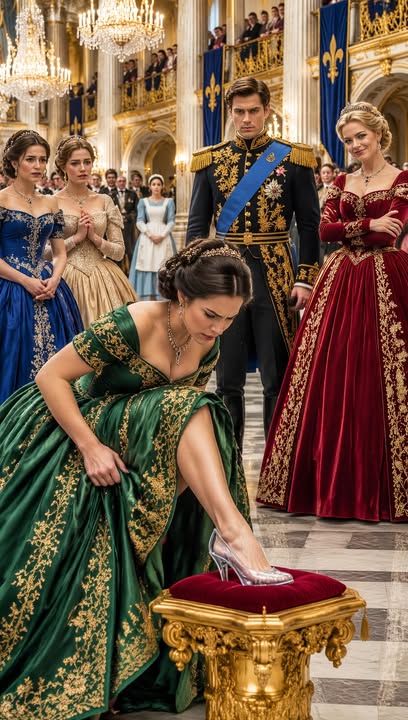
She thought of the ballroom and the slipper.
She thought of how close she had come to letting a royal tradition tell the world who she was.
She thought of her mother’s name, finally carried into the open, and of Mara’s name, waiting for a life beyond the archive.
“I will stand with you,” Ella said. “But you won’t speak for me.”
“I won’t.”
“If I change my mind, I leave.”
“You can.”
“If I say I’m finished, we stop.”
“We stop.”
“And if this becomes too much, we don’t turn it into a ceremony.”
The prince nodded.
“No ceremony.”
The decision was not an ending.
It was a door she had chosen to open, knowing she could still step away.
The announcement was scheduled for the following morning in the palace’s small council chamber, where a modest group of officials and journalists could hear it before any wider statement was released.
Mr. Vale left to make the arrangements.
Dr. Shaw returned the original papers to the archive vault.
Lady Margaret went to her private rooms to prepare, though she had said she would wear no royal jewels.
The prince remained beside Ella
**–END OF PART 5–CLICK “NEXT” AT THE BOTTOM OF THE PAGE TO CONTINUE READING**
* * *
[PREVIOUS: PART 4](https://storyly.idolsgift.com/blog/part-4-the-name-that-silenced-the-ballroom-052) | [NEXT: PART 6(THE END)](https://storyly.idolsgift.com/blog/part-6-the-end-the-name-that-silenced-the-ballroom-052)
✓ Lynn R. Adams
Part 5 – The Truth Ella Chose “The arrangement,” Dr. Shaw said, “may refer to the promise that Mara’s identity could be reviewed when she came of age.” Ella kept her eyes on the final line of the do…