PART 5: The Name on the Screen 008
Part 5 – The Room He Had to Make
The typed message ended halfway through the sentence.
The revised agreement is approved, subject to removal of the five—
Graham stopped reading.
He held the page beneath the worktable lamp, as if a change in the angle might bring the missing words back.
The bottom edge had been torn away cleanly, leaving only a narrow strip of paper.
“What does it say after that?” I asked.
“I don’t know.”
His voice was steady, though his fingers had gone white around the page.
Evelyn, who had arrived just before opening, leaned closer.
“Five-year exclusivity clause,” she said.
“Probably.”
“Claire may have been confirming the change.”
“Or asking the lawyer to confirm it before I signed.”
He looked at the handwritten line beneath the typed message.
For Graham, if I can’t tell him myself.
The words had seemed like a bridge when he first found them.
Now they looked like a road that had ended before reaching him.
“Can you call the lawyer?” I asked.
“His firm merged years ago,” Evelyn said. “The file may still exist, but it could take time to find.”
“How much time?”
“Days, perhaps. Longer if the archive was moved.”
Graham folded the paper with painstaking care and placed it back in the ledger.
The morning light spread across the shop, touching the petals of the roses he had helped me unpack the day before.
He looked as though he had been awake all night.
“Did Martin say anything else?” I asked.
“He remembered Claire asking him to wait until the agreement was final before he secured the funding.”
“Why?”
“She didn’t want to promise a project that the company might not be allowed to carry out.”
Evelyn took the coffee I had poured her.
“That sounds like Claire.”
“She was trying to keep the project alive,” Graham said. “And I thought she was making it difficult for me to grow the company.”
“You didn’t know what she was trying to protect,” I said.
“I should have asked.”
“Yes.”
He looked at me, and I didn’t soften the answer.
There was nothing cruel in it.
There was also no reason to pretend he had not missed chances he now wished he had taken.
After a moment, he nodded.
“I should have.”
The three of us stood together beside the worktable, the old ledger open between us.
For once, no one tried to hurry toward a conclusion.
Evelyn reached out and closed the cover.
“We can keep looking for the complete file,” she said. “But none of this tells you what to do now.”
Graham’s gaze settled on the ledger.
“No,” he said. “It doesn’t.”
The sale offer remained open until the end of the week.
That afternoon, Graham went back to his office to speak with the lawyers, and Evelyn returned with him.
Before he left, he asked whether he could keep the ledger for one more night.
I told him it was his to take.
He thanked me, but the gratitude in his face carried an unease I had begun to recognize.
He wanted certainty from a past that could no longer provide it.
By closing time, I had almost convinced myself not to worry about him.
Then my phone rang.
His name appeared on the screen.
“Are you still at the shop?” he asked.
“Yes.”
“Would it be all right if I came by?”
“Of course.”
He arrived twenty minutes later, carrying no box, no ledger, and no coat.
The evening air had turned sharp, and he rubbed his hands together as he stepped inside.
“Did you forget your coat?” I asked.
“I forgot it in Evelyn’s car.”
“Are you planning to walk back to the office?”
“I’m planning not to think about my coat.”
“That sounds like a poor plan.”
“It’s been a difficult day for plans.”
I smiled, and he managed a faint one in return.
He took the chair near the worktable but didn’t sit back.
“Evelyn found the original contract file,” he said.
“Already?”
“The company’s general counsel had a digital copy.”
“And the missing words?”
“‘Subject to removal of the five-year exclusivity clause.’”
“Did the amendment go through?”
“They think so.”
He glanced toward the dark windows.
“There’s a final version in the old archive, but they haven’t found it yet.”
“Then Claire may have managed to change the agreement.”
“Maybe.”
He sounded relieved and disappointed at the same time.
If the amendment had gone through, Claire had helped him keep the community project possible.
But a possibility was not the same as an answer, and the years between then and now remained untouched.
“What did the lawyers say about the sale?” I asked.
“They want a decision by Friday.”
“Is that what you came to talk about?”
“I don’t know.”
He looked down at his hands.
“I told Evelyn I needed more time.”
“Can she get it?”
“She can ask.”
“But?”
“But the buyer is ready to move ahead. Their offer is generous, and the company is worth more than I ever expected it to be.”
“Would selling it hurt the people who work there?”
“No. They would be taken care of.”
“Would it hurt the neighborhood project?”
“The project never existed beyond notes, meetings, and a few early commitments.”
“Then what would you lose?”
Graham was quiet.
“Perhaps nothing that can be listed in a contract.”
He rubbed the heel of his palm over his brow.
“Evelyn thinks we can build the initiative into the company. Martin is willing to advise us. A few of the organizations Claire spoke with are still operating.”
“That sounds possible.”
“It does.”
“But it isn’t certain.”
“No.”
“And you’re used to making decisions with numbers.”
“I’m used to making decisions because the numbers tell me which risk is worth taking.”
“What do they tell you now?”
“That the sale is the safer choice.”
“Is it the choice you want?”
He met my eyes.
“I don’t know what I want without asking what Claire would have wanted.”
“Maybe you can’t know that.”
“I thought you’d say that.”
“Then why ask me?”
“Because you don’t seem to confuse a hard truth with an answer.”
The shop had grown quiet around us.
I turned off the lights in the cooler, leaving only the warm lamps above the counter.
“Graham, I can’t tell you what Claire would choose.”
“I know.”
“And I can’t tell you to keep the company because you found a letter.”
“I know that too.”
“Her notes can help you understand what she hoped to do. They can’t make the decision for you.”
He lowered his head.
“That’s what scares me.”
“What part?”
“That there isn’t a message hidden in another box that will tell me I’m right.”
I came around the worktable and sat across from him.
“Maybe being right isn’t the point.”
“What is?”
“Choosing honestly, knowing you may never get perfect certainty.”
He looked at me as though he wanted to believe that was possible.
Then his phone vibrated.
He glanced at the screen and turned it face down without reading the message.
“Evelyn?” I asked.
“Probably.”
“You should check.”
“I’ll call her later.”
The old version of Graham might have said he had to answer.
Now he seemed to notice that his hand had moved toward the phone before he stopped himself.
He let it rest on the chair beside him.
“I’ve spent most of my life believing the next decision would make everything else easier,” he said.
“Has it?”
“Usually it made the next decision more important.”
“That sounds exhausting.”
“It has been.”
His voice softened.
“I think I’ve made a life where nothing can happen unless I’ve approved it, measured it, or built it myself.”
“Do you want to keep living that way?”
“No.”
The answer came without hesitation.
For a moment, the words seemed to surprise him.
“I don’t want to be careless,” he continued. “I don’t want to pretend the work doesn’t matter. But I don’t want every good thing to have to prove it can pay for itself before I let it into my life.”
I thought of the first time he had carried the delivery boxes into the shop.
He had asked for no credit and expected no reward.
He had simply seen that I needed help.
“Then don’t sell just because selling is the cleanest answer,” I said.
“And don’t keep it just because you’re afraid of letting go.”
“Yes.”
He held my gaze.
“You make it sound like both choices could be honest.”
“They could.”
“That’s not very reassuring.”
“It isn’t meant to be.”
He laughed quietly.
The sound eased the space between us, though it didn’t erase the decision waiting for him.
For several days, Graham returned to the shop between meetings.
Sometimes he helped with deliveries, and sometimes he sat in the back with the green ledger open beside him.
He and Evelyn spoke to Martin Vale, who remembered Claire’s determination and her habit of bringing a notebook to every meeting.
He agreed to advise them if they revived the project.
A neighborhood nonprofit offered to help identify small businesses that needed affordable workspace.
The company’s finance team prepared new figures, this time for the initiative rather than the sale.
None of it was simple.
The company would have to give up some short-term profit.
Graham would have to share decisions he had controlled alone for years.
The people he employed would need to understand why a profitable company was taking on work that could not promise quick returns.
He listened as Evelyn laid out the concerns.
He listened when the finance team disagreed with him.
He listened when Martin explained that some of the businesses they hoped to help would never look impressive in a report.
I watched him sit at my worktable one evening, reading through the proposal while a bundle of tulips leaned against his chair.
“You used to be good at making plans,” I said.
“I still am.”
“You used to be good at making them alone.”
“That I’m not sure about.”
He tapped the edge of the paper.
“Evelyn has spent years telling me I treat collaboration like a polite word for being outvoted.”
“Do you?”
“Sometimes.”
“And is she right?”
“Usually.”
The directness in his voice made me smile.
“What about now?”
“Now I’m trying to learn the difference between sharing responsibility and surrendering it.”
“That sounds like progress.”
“It sounds like something I should have learned twenty years ago.”
“People learn when they’re ready.”
“Do you believe that?”
“I have to. Otherwise, I’d spend too much time wondering why I didn’t learn certain things sooner.”
He looked at me for a moment.
Then he nodded, as if he understood the answer had come from somewhere personal.
I had begun to learn the same thing about Graham.
His silences were not always distance.
Sometimes they were the work of a man trying not to hide behind the first answer that came easily.
But the more carefully he moved toward the company decision, the more aware I became of the choice waiting for me.
A few weeks earlier, I had applied for a small retail space in Brookline.
The owner of the building had called to say my proposal had been accepted.
The space was brighter than my current shop and close to a cluster of independent businesses.
It had room for a larger cooler, a workshop table, and a small classroom where I could teach people to arrange flowers.
It would also require a substantial loan, long hours, and the possibility that a shop in a new neighborhood might fail.
I had not told Graham.
I had not told anyone except my accountant.
The opportunity had felt too fragile to share before I knew whether it was real.
Now it was real.
The landlord needed my answer by Monday.
On Friday evening, I asked Graham to walk with me after he finished reading the latest proposal.
We closed the shop and stepped onto the sidewalk.
The air smelled of wet pavement and the warm bread drifting from the bakery down the block.
For a while, we walked without speaking.
Graham kept pace beside me, hands in his coat pockets.
“I need to tell you something,” I said.
He turned his head.
“All right.”
“I’ve been offered a space in Brookline.”
His expression changed, not with surprise alone but with the effort of taking in what the news might mean.
“For another shop?”
“Yes.”
“Is that what you want?”
“I think so.”
“Then that’s wonderful.”
He said it immediately.
The sincerity in his voice made me look at him more closely.
“You’re not going to ask when I would leave?”
“No.”
“Or whether I could keep this shop open too?”
“I don’t know what you’ve decided.”
“I’m considering taking it.”
“Then you should.”
I searched his face.
“You’re not going to tell me I should stay?”
“No.”
“Why not?”
“Because it’s your life.”
The words were simple.
They did not come easily.
“I care about you,” he said. “That doesn’t give me the right to make your world smaller.”
We had stopped beside a shop window full of evening light.
A reflection of us looked back: Graham in his dark coat, taller than me by nearly a head, and me with my apron folded over one arm.
“You could ask me to build something with you,” I said.
“I could.”
“Would you?”
He took a slow breath.
“I want to.”
The admission was quiet enough that the city seemed to move around it.
“But I won’t ask you to choose the Brookline shop around me,” he continued. “And I won’t ask you to choose this shop around me either.”
“What if I want to be near you?”
“Then you can decide that when you know what you want for yourself.”
“You think I don’t know?”
“I think wanting me can make it harder to hear what you already know.”
The answer stung, not because it was unkind but because it was careful in exactly the place I had hoped he would be careless.
“You don’t get to decide that for me,” I said.
“No.”
“Then why are you doing it?”
“I’m trying not to turn your affection into another thing you have to manage.”
The honesty in his face took the anger out of me before it could settle.
“Graham, I’m not asking you to manage my life.”
“I know.”
“I can choose you and still choose my shop.”
“I hope you can.”
“But I haven’t decided what that looks like yet.”
“You shouldn’t have to decide tonight.”
The traffic moved past us, headlights sliding over the wet street.
His phone began to ring.
He took it from his pocket.
Evelyn’s name glowed on the screen.
This time, he answered.
“I’m here,” he said.
He listened, his expression tightening.
“What happened?”
I watched his eyes move toward the shop window, then back to the empty street.
“No,” he said. “Don’t sign anything.”
A pause.
“Where are you?”
Another pause.
“I’ll be there in fifteen minutes.”
He ended the call and looked at me.
“The buyer’s counsel sent over the final documents. They want to know whether we’re accepting the offer tonight.”
“Do you have to answer tonight?”
“Evelyn says we have until midnight.”
He checked the time.
It was just after eight.
“Then you have a few hours.”
“I have a few hours to decide whether I’m willing to let the company become something I don’t control.”
“Or whether you’re willing to sell the thing you’ve spent years carrying.”
He gave a tired smile.
“That’s a less elegant way to put it.”
“It’s a clearer one.”
He slipped his phone back into his pocket.
“I need to talk with Evelyn.”
“Go.”
He hesitated.
“I’ll come back after.”
“You don’t have to report to me.”
“I know.”
“Then come back if you want to.”
His eyes held mine for a beat.
“I want to.”
At the office, Evelyn had gathered the company’s leadership team in the large conference room.
There were no dramatic speeches and no surprise investors.
There were only the people who had spent years helping Graham build the company, sitting around a table with printed numbers, a revised plan, and the sale documents waiting at one end.
Graham listened to each person.
Some preferred the certainty of the sale.
Others wanted to give the initiative a chance, but worried about what it would ask of the staff.
Evelyn laid out the costs without softening them.
Martin’s advice, the nonprofit’s proposal, and the possible funding all had limits.
If they kept the company, the initiative could take years to become sustainable.
If they sold, the new owners would preserve the existing jobs, but the neighborhood project would almost certainly never be pursued in the way Claire had imagined.
The decision belonged to Graham.
No one else would make it for him.
When the meeting ended, he remained in the room with Evelyn.
“Do you know what Claire would have asked you to do?” he said.
“No,” she answered.
“You must have some idea.”
“I know what she hoped to build. I don’t know what she would want you to sacrifice for it now.”
He looked down at the sale papers.
“You were her friend too.”
“I was.”
“Does it feel wrong to let the company go?”
“It would feel wrong to pretend that letting go is the same as forgetting her.”
He looked up.
“And keeping it?”
“It could be an act of care. Or it could be another way to avoid making a different life.”
The words stayed with him.
“Would you stay if I kept it?”
“I’m not making this decision based on whether you keep the company.”
“Would you stay if I sold it?”
“I’m not making that decision based on whether you sell.”
He gave a faint smile.
“You sound like Lucy.”
“I’ve known her only a little while, but I like her.”
“Of course you do.”
Evelyn reached for the offer documents.
“Graham, I’ll work with you whichever way you choose. I just need you to choose because you can live with the choice, not because you think it will undo the past.”
He looked at the signature line.
For nine years, he had thought Claire’s silence meant she had been disappointed in him.
He could no longer believe that as easily.
But neither could he use a letter to pretend he knew everything she had hoped for.
He thought of the unfinished project.
He thought of the people who might use it if they built it with care.
He thought of his own life, which had become so full of work that he had mistaken its fullness for meaning.
Then he picked up the pen.
Evelyn stood very still.
Graham wrote a short note across the top of the offer, signing beneath it.
He was declining the sale.
The buyer could make another offer someday.
The decision could become costly.
The future of the company remained uncertain.
Still, once the ink dried, the years of waiting seemed to shift into something he could finally carry without letting them decide his whole life.
Evelyn let out a breath.
“Are you sure?”
“No.”
She looked at him.
“I’m sure I don’t want to sell tonight.”
“That’s enough.”
He leaned back in his chair.
“I’ll need to give up control of parts of the company if we’re going to build the initiative properly.”
“Yes.”
“You’ll have to tell me when I’m trying to take it back.”
“I already do.”
“You’ll have to keep doing it.”
“I will.”
He nodded.
“Then let’s begin.”
When he reached the shop, it was nearly ten.
I had been arranging flowers for the morning orders and had finished twice, then rearranged them because I could not settle my thoughts.
Graham came through the door with his coat over his arm.
“Well?” I asked.
“I turned down the sale.”
My hands stilled over the bucket of tulips.
“You chose to keep it?”
“I chose not to sell it tonight.”
“And the initiative?”
“We’re going to try.”
He looked tired enough to fall asleep standing, but there was a steadiness in him I had not seen before.
“Evelyn will share leadership. Martin has agreed to advise us. We’re meeting with the nonprofit next week.”
“That sounds like a beginning.”
“It is.”
He glanced toward the back room.
“I don’t know how long it will take.”
“You don’t need to know yet.”
“Or whether it will work.”
“Not yet.”
He smiled.
“You’re very good at letting things be unfinished.”
“Flowers are unfinished until someone takes them home.”
He lowered his eyes, then looked back at me.
“What about Brookline?”
“I have until Monday to answer.”
“Do you want to take it?”
“I’m still deciding.”
“Then keep deciding.”
“You really won’t tell me to stay?”
“No.”
“Even if I choose to go?”
“Especially then.”
His answer was quiet, but it carried no resignation.
It carried respect.
I stepped closer.
“You know I care about you.”
“I do.”
“And you care about me.”
“Yes.”
“Then don’t make a virtue out of being afraid.”
His face changed.
“I’m not.”
“Are you sure?”
He looked down at the space between us.
“I’m trying not to ask you for something you haven’t chosen freely.”
“You can ask.”
“I can’t ask you to give up an opportunity because I’m lonely.”
“You don’t have to.”
“I can’t ask you to build your life around a company I haven’t learned how to share.”
“You don’t have to do that either.”
“What can I ask?”
The question was softer than anything he had said all evening.
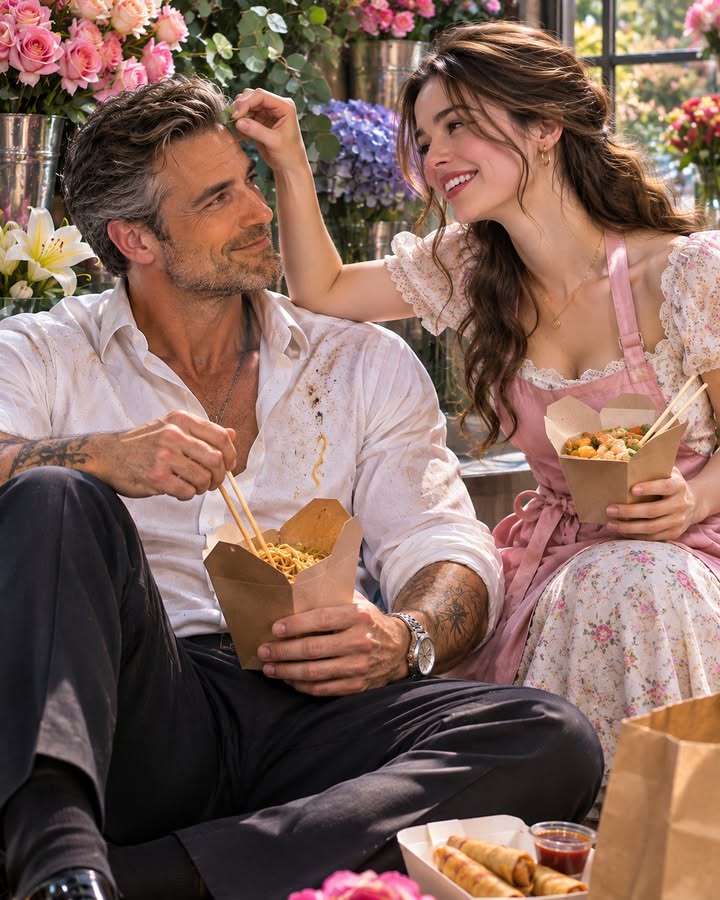
I thought about the shop floor, the takeout containers, the phone he had ignored, and the dinner he had once told himself he could not ask me to share.
“Ask me to dinner,” I said.
His eyes searched mine.
“Not because you think I’ll say yes?”
“Because I get to decide whether I do.”
For a moment, he didn’t speak.
Then he said, “Will you have dinner with me tomorrow night?”
“Yes.”
His smile was careful at first, then real.
“I’d like that.”
“So would I.”
His phone buzzed in his coat pocket.
He did not reach for it.
Instead, he asked, “Will you tell me what you decide about Brookline?”
“Yes.”
“And if you take it?”
“I’ll still tell you.”
“Good.”
He lifted his hand, then paused before touching mine.
I closed the distance myself.
His fingers wrapped gently around mine.
The shop seemed to grow still, not because the moment was the same as before, but because this time neither of us had to pretend not to know what it meant.
I gave him the answer I had not been able to give the night before.
“Yes, Graham,” I whispered. “I’ll choose dinner with you.”
His phone buzzed again.
This time, he looked.
The screen showed an unfamiliar number and a message from Evelyn.
We found the final amendment in the archive.
Beneath it was another line.
Claire’s funding was never meant to come from the company.
Graham read it twice.
Then the phone rang.
He answered, and Evelyn’s voice came through, unsteady for the first time since I had known her.
“There’s one more page,” she said. “It names the person Claire chose to build the initiative with.”
Graham looked at me, his hand still around mine.
“What does it say?”
Evelyn paused.
Then she said a name neither of us had heard before.
**–END OF PART 5–CLICK “NEXT” AT THE BOTTOM OF THE PAGE TO CONTINUE READING**
* * *
[PREVIOUS: PART 4](https://puretales.idolsgift.com/blog/part-4-the-name-on-the-screen-008) | [NEXT: PART 6(THE END)](https://puretales.idolsgift.com/blog/part-6-the-end-the-name-on-the-screen-008)
✓ Lynn R. Adams
Part 5 – The Room He Had to Make The typed message ended halfway through the sentence. The revised agreement is approved, subject to removal of the five— Graham stopped reading. He held the page b…