PART 5: The Name on the Paper 008
Part 5 – The Truth We Could Live With
“Was the voice memo part of the plan,” I asked, “or was someone trying to make me believe it was?”
Elena did not answer too quickly.
She turned the page toward the light, studying the handwriting without touching the ink.
“I can’t tell from this alone,” she said. “The note may be genuine, or it may have been added later. We need to establish where it came from and who had access to the folder.”
David was no longer in the room.
His chair stood empty beside the window, and the old promise lay between us like something fragile that had been handled too many times.
Rachel’s hand remained on my shoulder.
“Do you want me to stay?” she asked.
“Yes.”
I folded the paper along its original crease, then stopped, afraid of damaging it.
Elena slid a clear sleeve from her folder and placed it beside me.
“We’ll preserve the note exactly as it is,” she said. “You don’t need to decide what it means tonight.”
I looked down at the words again.
Use the old promise.
She’ll believe this is for us.
The handwriting appeared to be David’s, but appearances had become a poor substitute for certainty.
“What does the date mean?” I asked.
“It tells us when someone says the note was written,” Elena replied. “It doesn’t tell us when it was put in the envelope, or who placed it there.”
I nodded, though the distinctions felt painfully thin.
The old recording had been mine.
The promise had been David’s.
The note on the back might belong to either of us, or to neither.
For years, I had believed memory was the safest place to keep the beginning of our marriage.
Now even that place seemed to have a door someone else could open.
Elena closed the folder.
“I’ll have the handwriting reviewed and ask the production assistant to explain exactly how the materials were stored.”
“Will that prove anything?”
“It may help. It may not.”
I appreciated that she did not offer certainty as a comfort.
The baby slept beneath the soft nursery lights, unaware of the paper, the old words, or the lives being reconsidered around them.
I rested my fingertips on the photograph beside my bed.
“I don’t want this turned into another story about me,” I said.
“Then we’ll make choices that protect your privacy as much as we can,” Elena replied.
“Can we keep the legal process private?”
“Some parts, yes. There are records we can seal or limit, and we can ask that any contact with the baby follow clear rules. But if investigators ask for a truthful statement, I can’t advise you to hide evidence or give an incomplete account.”
“I don’t want to lie.”
“Then you don’t have to.”
I looked through the nursery window.
One of the nurses adjusted a blanket over the baby’s feet and checked the monitor before moving away.
“I want the baby to grow up without seeing every detail of this on a screen,” I said.
“We can take steps to limit public access,” Elena told me. “We can’t control every rumor, but we can refuse to feed them.”
Rachel squeezed my hand.
“You don’t have to tell the world anything.”
The thought should have comforted me.
Instead, it brought the choice into focus.
If I said nothing, David could keep presenting his version of the night, polished and simple.
If I spoke, the truth might travel farther than I wanted it to, carried by the same cameras that had watched me fall.
I did not want a public battle.
I did not want revenge.
I wanted the record to be accurate, the baby to be safe, and my life to belong to me again.
For several days, the hospital became the center of a smaller world.
The baby remained under observation, growing stronger with the steady care of the neonatal team.
I learned the rhythms of the unit: the soft alarms, the handwashing stations, the nurses who spoke to the baby before checking the monitors.
Each visit gave me another detail to hold on to.
The curve of a tiny ear.
The faint crease between the eyebrows.
The way one hand opened when I spoke softly.
David came when the hospital allowed him, and he followed the rules.
He asked before entering my room.
He did not take photographs without permission.
When the nurses said the visit was over, he left without arguing.
Those small acts did not rebuild trust.
They did, however, show me the difference between a boundary and a punishment.
I was not keeping the baby from him to make him suffer.
I was following the medical team’s guidance and protecting the quiet the baby needed.
Elena arranged for David’s contact to be supervised by the hospital staff while we were still there.
After discharge, she explained, any longer-term arrangement would be addressed through the court and based on the child’s needs.
“Not on what either of us wants to tell the public,” she said.
“Not on what the public thinks,” I replied.
“Exactly.”
I kept my first statement about the pool short.
I said that Sophia had pushed me into the water, that I had not agreed to a poolside birth or any filmed event, and that David had laughed after I fell.
I described what I remembered and marked what I did not know.
I did not claim that David had ordered Sophia to push me.
I did not say the video proved more than it showed.
Elena read the draft with me, line by line.
“This is complete,” she said when we finished.
“Is it enough?”
“It is truthful and specific. That is what matters.”
The legal process moved at its own pace.
The hospital preserved the medical inquiry.
The production assistant provided the run sheet, the messages, and the original video through the appropriate channels.
David’s office supplied emails showing that he had approved a filmed family reveal and asked his assistant to coordinate with Northline.
None of the messages showed him telling Sophia to shove me.
They did show he knew I had not been told the full plan.
They also showed that the production team had been instructed to keep the surprise intact, even though the event involved a pool, a camera crew, and my late-stage pregnancy.
The difference between what the evidence established and what I feared it might establish became its own kind of discipline.
I had to keep returning to what I knew.
I had been pushed.
I had fallen into cold water.
I had gone into labor.
A plan had been made around me without my consent.
David had helped make it.
That was enough to ask for accountability without inventing anything beyond it.
Two weeks after the birth, I was discharged with instructions to rest and to return for follow-up care.
The baby remained in the hospital for continued monitoring.
I stood beside the nursery window while Rachel packed my small overnight bag.
I had imagined leaving the hospital with a baby in my arms.
Instead, I left with a folded photograph in my coat pocket and a promise from the nurses that I could return the next morning.
David walked with us to the lobby.
He carried the bag, though Rachel had already reached for it.
Outside, a few people waited near the entrance.
They were not a crowd, and none of them approached.
Still, I felt the familiar pressure of being recognized.
I lowered my face and kept walking.
David saw it.
“I can ask the hospital to move us through a side entrance next time,” he said.
“Please don’t decide that for me.”
He stopped.
“You’re right. I should have asked.”
Rachel opened the car door.
I turned back to him.
“You can visit tomorrow at the time the nurse gives us.”
“I will.”
“And I don’t want pictures shared.”
“I won’t share any.”
I watched his face, not looking for the old tenderness, but for the answer he was choosing to give.
He nodded.
“I understand.”
It was not enough to repair what had happened.
It was enough to let me get into the car without another argument.
At home, I found the house quieter than I remembered.
The flowers from the hospital had begun to wilt on the kitchen counter.
A staff member had placed them in a vase, along with a card from David’s mother and a small knitted blanket from Rachel.
I set the baby’s photograph beside the blanket.
For the first time in years, I had a room in the house that no one else had arranged for me.
Rachel stayed the first night.
She made tea, brought me soup, and helped me sort through the instructions from the hospital without turning every page into a warning.
When I woke before dawn, I found her asleep on the sofa, one hand still resting on the list of medication times.
I covered her with a blanket.
Then I stood at the kitchen window and watched the sky lighten over the garden.
The house had once felt like a set built around my husband’s plans.
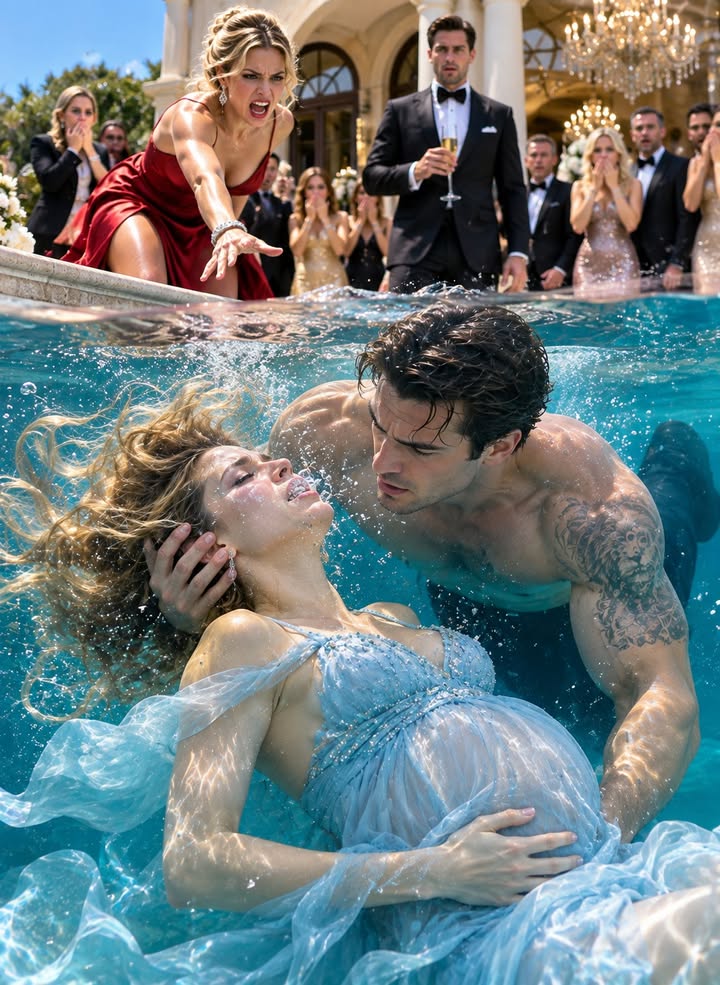
The pool beyond the glass looked unchanged, but I could no longer see it as a place for parties.
I could see the steps where I had tried to find air.
I could see Michael’s dark jacket falling beside the water.
I could see guests standing still, unsure of what to do.
And I could see the moment I had spoken the truth to the paramedic.
No.
I was pushed.
I had not known then that those words would become the first decision I made for myself in front of witnesses.
The next afternoon, David came to the house with Elena’s agreement that the visit would be brief and supervised until the hospital approved a different arrangement.
He stood at the doorway holding a small bag from the pharmacy.
“I brought the supplies the nurse said the baby would need when they come home,” he said.
“They aren’t coming home yet,” Rachel replied.
“I know. I wanted to make sure we had them ready.”
He set the bag on the table and looked at me.
“Would you like me to stay while you sort through them?”
“No.”
He accepted the answer without protest.
At the door, he turned back.
“I spoke to my attorney.”
“I expected you would.”
“He said the video and the production records could become public if the case is filed.”
“I know.”
“We can keep this private, Ava.”
“What does private mean to you?”
He glanced down at the bag.
“Your statement stays confidential. The production company agrees not to use the footage. I give up any claim to the media rights, and I cooperate with whatever review is needed.”
“And what do you want in return?”
“For us not to make a public accusation. For me to remain involved with the baby.”
The word involved landed awkwardly between us.
“You can be involved in the baby’s life without asking me to hide what happened.”
“I’m not asking you to lie.”
“You’re asking me not to say what’s true.”
“I’m asking you to think about what exposure could do to the baby.”
I looked at him.
“Who made the baby part of a media deal?”
His eyes dropped.
For a moment, I saw the answer before he gave it.
“I made a bad decision.”
“You made several.”
“I know.”
“Do you?”
He drew a slow breath.
“I wanted the project to bring us money and attention at a time when I thought we needed both. I told myself it was for our family. I didn’t ask whether it was what you wanted.”
“Why not?”
“I thought I knew what you would say.”
“That isn’t the same as asking.”
“No.”
He did not argue.
The silence that followed held more honesty than several of his apologies had managed.
“If I give up the rights and cooperate,” he asked, “would you consider keeping the matter private?”
I looked toward the table where the baby’s photograph stood beside the knitted blanket.
I wanted privacy.
I wanted the baby to have a life that was not built from footage of the worst night of mine.
I also knew that silence could become another kind of performance, one designed to protect David’s public image while leaving the facts untouched.
“I will not give interviews about this,” I said. “I will not post about it, and I won’t send private records to anyone who isn’t entitled to them.”
He waited.
“But if the investigators or the court ask me what happened, I will answer fully.”
His face changed.
“I hoped you’d choose a quieter route.”
“So did I.”
“Then we agree on that.”
“No,” I said, gently but firmly. “We agree that I want privacy. We don’t agree that privacy means silence.”
He held my gaze.
“I don’t know what to say.”
“You don’t have to say anything.”
He looked toward the photograph.
“Can I see the baby tomorrow?”
“When the nurse says it’s a good time.”
“All right.”
He left the bag on the table and went out.
Rachel closed the door behind him, then returned to the kitchen.
“Are you sure?” she asked.
“About not speaking publicly?”
“About giving a complete statement, even if it becomes public through the process.”
I considered the question.
“I’m sure I won’t lie.”
“That isn’t the same as wanting everyone to know.”
“I don’t want everyone to know.”
Rachel nodded.
“Both things can be true.”
They could.
I could want to protect my child from a spectacle and still refuse to help create a false story.
I could choose a private legal route and still tell the truth to the people responsible for deciding what happened.
I could let David see the baby under proper boundaries without pretending he had done nothing wrong.
The choice did not feel like triumph.
It felt like standing in a doorway with one hand on each side, knowing that neither path would give me everything I wanted.
The following week, Elena arranged a meeting with David and both of our attorneys.
The discussion was careful, documented, and difficult.
David offered to surrender his rights to the footage and to any future media deal connected to the event.
He agreed to provide his communications with Northline and to cooperate with the investigation.
In return, he asked that I refrain from speaking publicly about the party.
I agreed not to seek publicity.
I did not agree to restrict my truthful testimony.
The written terms reflected that distinction.
His counsel read the language twice.
David read it once, then looked across the table at me.
“Is this the best we can do?”
“It’s what I can honestly agree to.”
He signed.
So did I.
Nothing in the agreement made us friends again.
Nothing erased the fall, the birth, or the choices that had brought us there.
But the agreement set out what each of us had actually promised, without hidden conditions disguised as affection.
Afterward, Elena walked me to the hospital entrance.
“You held your boundary without turning it into a battle,” she said.
“I don’t know whether I held it well.”
“You held it clearly.”
I looked down at my hands.
“I used to think love meant knowing what the other person would do before they said it.”
“Sometimes love asks us to listen instead.”
“And sometimes it asks us to accept that the answer isn’t the one we wanted.”
Elena gave me a thoughtful nod.
“That’s true too.”
The investigation continued without an announcement or a parade of reporters.
The production company paused its project.
The hospital reviewed its privacy procedures and confirmed that no medical information had been released.
The video remained with the authorities and the attorneys, not on a public feed.
I did not see it again.
I had no need to watch myself fall in order to remember it.
Each day, I went to the hospital and sat beside the baby’s bassinet.
Some days, the nurses let me hold the baby against my chest for a few minutes.
The first time they did, I was afraid to move.
The baby’s warmth settled against me, and a tiny hand rested near my collarbone.
Rachel stood beside the chair, smiling through tears.
“This is the part you get to keep,” she whispered.
I closed my eyes and listened to the small breath against my skin.
“I’m keeping all of it,” I said.
The bad parts too, I understood, though I did not say it aloud.
They were mine to remember.
The baby grew stronger.
The monitors became less intrusive.
The doctors began discussing the possibility of discharge, though they reminded us that the timeline depended on the baby’s progress.
David came for his scheduled visits and followed the nurses’ instructions.
He asked before touching the baby’s blanket.
He did not reach for my hand.
I did not reach for his.
We spoke about feeding schedules, follow-up appointments, and the things the baby would need at home.
For the first time, our conversations were practical without pretending to be intimate.
One evening, after David had left the nursery, a nurse brought me a sealed envelope.
“This was delivered for you through the hospital’s legal office,” she said. “They asked me to give it directly to you.”
Elena’s name was printed on the corner.
I opened it carefully.
Inside was a copy of the handwriting review she had requested for the note from the production folder.
The report said the added sentence appeared consistent with David’s handwriting, but it could not establish exactly when the ink had been put on the paper.
A second page was attached: a message from the production assistant who had turned over the materials.
He had found the envelope inside a folder labeled “Ava—old recordings.”
The folder had come from David’s office.
I read the message again.
The voice memo and the note had been stored together.
That did not prove David had written the sentence recently.
It did not prove the producer had inserted it.
It did not tell me whether the words had been meant as a reminder, a warning, or an instruction.
At the bottom of the email, Owen had added one more detail.
The folder had been delivered to Northline two days before the party, along with a note from David’s assistant saying, “Please use these only as reference. Do not include them in the final cut.”
I held the pages without speaking.
Rachel stood beside me.
“What does it mean?” she asked.
“I don’t know.”
Elena had been right.
The evidence could narrow the possibilities without choosing one for me.
Then I noticed a second attachment, one I had not seen at first.
It was a scan of a message sent from David’s account to the production coordinator the night before the party.
The subject line read: “Ava’s original recording.”
The message contained one sentence.
“Please do not use the old promise unless she asks to hear it.”
I read it once.
Then I read it again.
The note on the paper seemed to say the opposite.
Someone had written that I would believe the event was for us.
David’s message said the old promise was not to be used unless I asked.
One of those records had been altered, or the two messages meant different things.
I looked through the glass at the baby, breathing quietly beneath the soft nursery light.
Then Elena’s phone rang.
She checked the number and answered.
“Yes,” she said. “I’m with Ava now.”
She listened, her expression growing more serious.
“Do you have the original email?”
A pause.
“Has David seen it?”
Another pause.
Elena looked at me.
“I understand. Don’t forward it to anyone yet.”
She ended the call.
“What is it?” I asked.
“The production assistant found a message thread he missed in the first review,” Elena said. “It was sent from David’s account to Northline the morning of the party.”
My fingers tightened around the papers.
“What did it say?”
“He hasn’t opened the attachment yet. He only saw the subject line.”
“What was it?”
Elena glanced toward the nursery, then back at me.
“‘Change the plan if Ava says no.’”
**–END OF PART 5–CLICK “NEXT” AT THE BOTTOM OF THE PAGE TO CONTINUE READING**
* * *
[PREVIOUS: PART 4](https://puretales.idolsgift.com/blog/part-4-the-name-on-the-paper-008) | [NEXT: PART 6(THE END)](https://puretales.idolsgift.com/blog/part-6-the-end-the-name-on-the-paper-008)
✓ Lynn R. Adams
Part 5 – The Truth We Could Live With “Was the voice memo part of the plan,” I asked, “or was someone trying to make me believe it was?” Elena did not answer too quickly. She turned the page toward…