PART 5: The Name on the Folded Paper 056
Part 5 – The Cost of the Truth
“He wrote, ‘Daniel’s signature was forged, but the person who did it was not the one whose credentials appear on the bank record.’”
I held the phone closer, as if the distance between us might have changed the words.
“Can you read the rest?”
“I can,” Elena said. “I’m not sure I should.”
“Because it names someone?”
“Because it explains what Richard knew, and I don’t want to mistake an explanation for proof.”
Her caution was earned.
“Would you be willing to bring it to the independent accountant?” I asked. “We can make a copy, document where it came from, and let the evidence speak for itself.”
“I’ll bring it to the bank tomorrow,” she said. “I want the chain of custody clear.”
“That’s sensible.”
“And I want to be there when it’s examined.”
“You should be.”
After we ended the call, I sat alone in my office with the bank records spread across my desk.
The old authorization, the false signature, Richard’s credentials, the vendor account, the letter Elena had not yet shown me: every piece pointed somewhere, but none of them formed a complete picture.
I had spent much of my career believing that if I gathered enough information, the right decision would reveal itself.
This time, the facts were still incomplete, and the decision could not wait until I felt certain.
Our counsel arrived before noon with a draft statement prepared for the board.
It described the discovery of an unauthorized transfer from the employee family fund, noted that an investigation was underway, and promised that the company would cooperate with the bank.
The language was careful, restrained, and clean of any admission that the company had failed the people it was meant to help.
“It’s accurate,” our counsel said. “It avoids assigning blame before the records are verified.”
“It also avoids saying that the company dismissed the employee who reported the discrepancy.”
“That’s a separate matter. We don’t yet know whether the transfer and her departure were connected.”
“They were connected in time, and she lost her job after raising concerns about the fund.”
“We have her account, and we have an old personnel summary that says she resigned.”
“She says she was dismissed.”
“I’m not disputing what she remembers. I’m saying we should verify it before we make a public claim.”
The caution was reasonable.
The draft still read like the company had discovered an accounting irregularity rather than an injury to people who had trusted it.
“What happens if we release this?” I asked.
“We preserve the company’s position while the investigation proceeds.”
“And if we don’t?”
“We could invite speculation, affect the company’s financing, and create unnecessary exposure.”
“Could the company recover from that?”
Our counsel gave me a careful look.
“The company would survive. The question is what other consequences we might trigger.”
He meant employees, investors, customers, and the families whose wages depended on our stability.
He was not trying to silence Elena.
He was trying to prevent an unverified accusation from harming people who had no part in the old decisions.
That was precisely why the choice was hard.
I asked him to give me the draft and an hour alone.
When he left, I looked at the five-dollar bill I had kept folded inside my wallet.
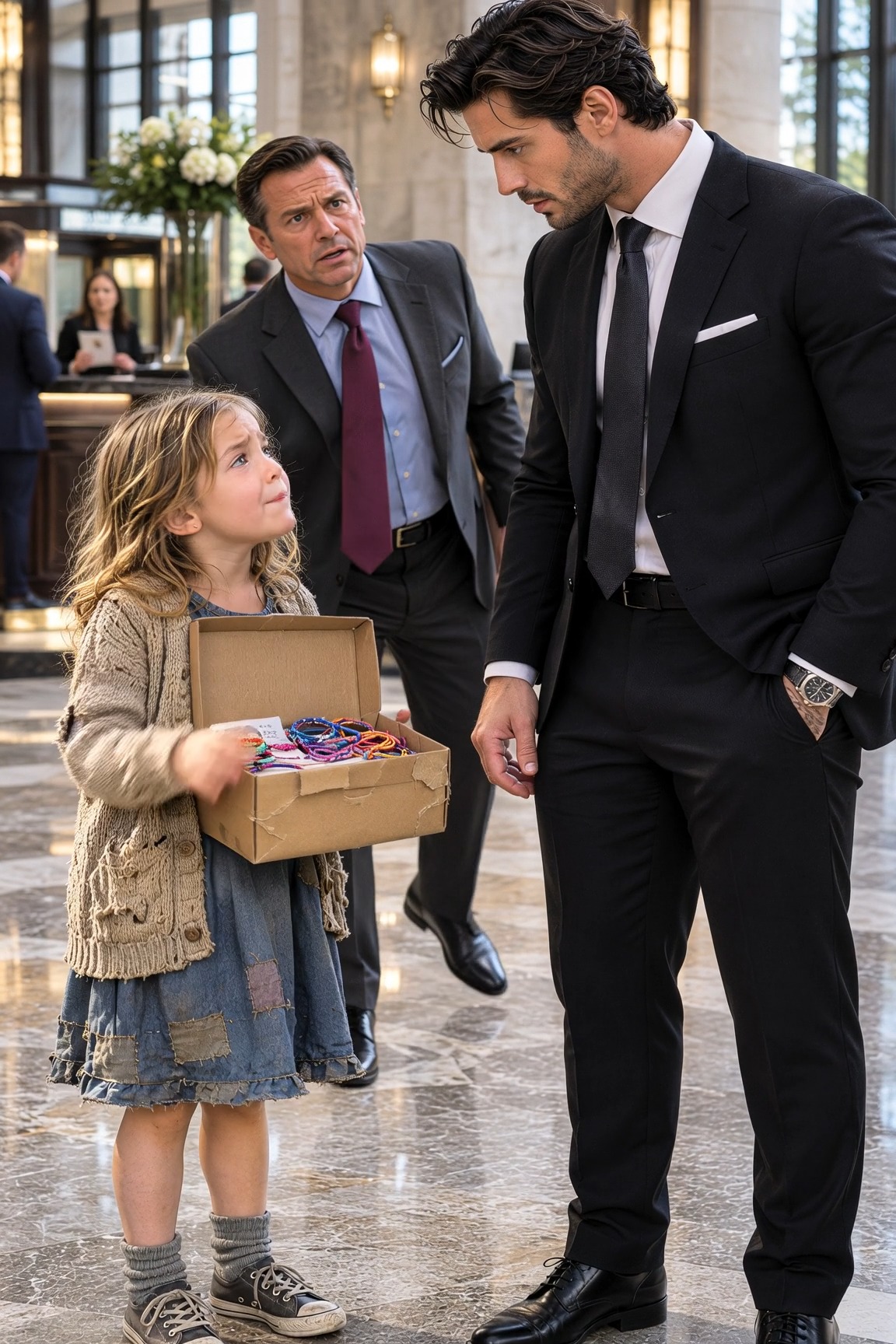
Chloe had accepted it for the blue bracelet, not as charity, not as a promise, but as payment for something she had made with her own hands.
Her insistence on a fair price had stayed with me.
She had not asked me to save her family.
She had asked whether I would buy a bracelet.
The help she needed was connected to the fund, but it could not be turned into a reason to hush the rest.
At three, I called Elena and asked if she and Richard would meet me at the bank after the letter had been examined.
She agreed to bring the letter.
Richard said he would come, but only if Elena wanted him there.
“I want him present,” she told me. “I’m done having other people explain what he meant.”
The bank’s fraud officer examined the letter in a small room while Ms. Patel recorded its condition and Elena watched.
The paper was old, but the ink had not faded much.
The signature at the bottom matched Richard’s handwriting on the earlier note.
Mr. Kim photographed both sides and logged the letter as material relevant to the investigation.
Elena kept the original in her possession.
When the examination was complete, she sat across from me with Chloe beside her.
Richard took the chair nearest the door.
No one spoke for a moment.
Then Elena unfolded the letter.
“I want the record to show that I found this behind the false bottom of the sewing basket,” she said. “I don’t know how long it was there.”
Ms. Patel noted the time and location in her file.
Elena began to read.
“Daniel’s signature was forged, but the person who did it was not the one whose credentials appear on the bank record.”
Her eyes moved to Richard’s name at the bottom.
The letter went on to say that the former chief financial officer had used a scanned signature from a legitimate company document to create the authorization.
Richard’s credentials had been used because he had been assigned to process a separate, legitimate payment that morning.
According to the letter, the former executive had asked Richard to sign into the system and review several pending transactions.
Richard had done so, then left the office for a meeting.
He learned later that the family fund payment had been added to the transaction list.
The letter did not prove everything.
It did, however, explain how a forged signature could appear alongside Richard’s credentials without showing that he had knowingly approved the transfer.
At the bottom, Richard had written that he would give Elena copies of the audit trail as soon as he could retrieve them.
Below that was a second paragraph, written in a smaller hand.
He admitted that he had made the company’s review harder by accepting responsibility for the authorization before the facts were understood.
He believed that if he took the blame, the inquiry would stay narrow and the families’ private applications would remain confidential.
He had not written that he took the money.
He had written that he had approved the authorization.
The distinction was real.
So was the damage it had caused.
“I wrote this after Elena showed me the first bank entry,” Richard said. “I thought I could prove who had redirected the funds.”
“Did you know the former CFO had forged my signature?” I asked.
“Not when I wrote it. I learned that later.”
“When?”
“After Elena was dismissed.”
“And you still said nothing.”
“I thought the records would be destroyed if I exposed the whole thing before I had copies.”
“Were they?”
“I don’t know.”
“Did you ever get the audit trail?”
“Some of it.”
“Where is it?”
“I gave it to Elena.”
She looked at him.
“No, you didn’t.”
Richard’s face shifted.
“I thought I had.”
“You gave me a list of account numbers and two payment summaries.”
“I thought those were the full set.”
“They weren’t.”
“I know that now.”
Elena folded the letter again, this time with more care than she had unfolded it.
“I don’t want this to become a story about Richard being either a hero or a villain,” she said. “He helped me, and he kept silent when the company called me a problem. Both things are true.”
Richard lowered his eyes.
“I should have corrected the record.”
“Yes,” Elena said.
“I thought protecting the fund meant keeping the investigation quiet.”
“Quiet for whom?”
He looked up, but had no answer.
“For the people who needed help?” she asked. “Or for the people who could afford to wait?”
Richard’s face tightened, not in anger, but in the discomfort of hearing a question he had once asked himself and never answered honestly.
“I thought I was protecting everyone,” he said.
“You were protecting the company from a scandal it might have survived,” Elena replied. “I was the one who lost my job.”
“I know.”
“And you knew I was being dismissed.”
“Yes.”
“Then say that plainly.”
Richard took a breath.
“I knew the company was preparing to dismiss you after you reported the discrepancies.”
“And you didn’t stop it.”
“I didn’t.”
The answer sat between them, unadorned.
I looked at Richard.
“Why did you stop me from letting Chloe open the box?”
“I recognized the authorization,” he said. “I had seen a copy years ago, and I knew it could make people assume Elena had carried company records out with her.”
“Did you think the paper would put her at risk?”
“I thought the company might treat it as evidence she had taken confidential material.”
“Or that she had been involved in the theft.”
“Yes.”
“Why didn’t you tell me that?”
“Because I wanted to know what it was before anyone saw it. I wanted to keep Chloe from being questioned, and Elena from being blamed again.”
“You could have said that.”
“I could have.”
“Instead you told me it was nothing.”
“Yes.”
He did not add that he had meant well.
He did not ask for credit for his fear.
For the first time, I could see the difference between the man I had trusted and the man he had tried to be.
Neither one canceled the other.
The letter gave us a clearer explanation of how the credentials had been used, but it was not the complete audit trail.
The independent accountant still needed the original system records, the vendor’s incorporation documents, and confirmation from the bank about the receiving account.
Our counsel had been right about that.
We could not present the letter as final proof.
We also could not pretend the company’s failure had begun only when the bank called us.
“We need to decide what to tell the board,” I said.
Elena looked at me.
“Tell them what you know, and tell them what you don’t.”
“And the public?”
“Why would you tell the public before you know the facts?”
“Because the fund belongs to the employees, and the company has already controlled the account of what happened to you.”
She watched me carefully.
“If you make a statement now, don’t use my name without asking.”
“I won’t.”
“Don’t call me a victim.”
“I won’t.”
“Don’t make Chloe’s medicine part of the announcement.”
“I won’t.”
“And don’t say the company has cleared Richard.”
“I won’t.”
Richard remained still beside the door.
“I won’t ask you to shield me,” he said.
Elena looked at him.
“Good.”
There was no forgiveness in the word.
There was a boundary, clear and necessary.
The board met by video that evening.
I shared the bank’s preliminary records, Elena’s account of her dismissal, and the letter Richard had written.
I was careful to distinguish what had been verified from what remained uncertain.
No one in the meeting tried to call the transfer an accounting mistake.
The figures did not allow that comfort.
Several directors asked whether we could wait until the investigation had finished before making a public statement.
One asked whether disclosure could endanger the fund’s current operations.
Another asked whether making a public admission would affect a financing agreement scheduled for review the following month.
These were not foolish questions.
If the company’s stock fell, employees could lose savings.
If a major contract was delayed, jobs might be affected.
If we named the wrong person, we could ruin a reputation without restoring anything to the people who had been harmed.
Our counsel recommended a narrow statement: the bank had identified a discrepancy, the company was reviewing historical records, and no conclusion had been reached about responsibility.
I listened to the discussion until the word discrepancy began to sound like a place to hide.
Then I thought of Elena being asked to defend herself against a report I had signed without ever meeting her.
I thought of the fund applications that had been frozen, and of Chloe carefully counting bracelets because her brother needed medicine.
I thought of Richard’s signature beneath the words I approved the authorization, offered as a shield that had ended up covering the company as well as the people he meant to protect.
“We should not name a suspect,” I said. “We should not declare the former CFO guilty before the audit is complete, and we should not say Richard is cleared.”
Our counsel nodded.
“But we should state that an unauthorized transfer occurred from the family fund, that the company’s own records failed to establish who directed it, and that an employee who raised concerns was dismissed under a record that the company now knows may be inaccurate.”
“May be?” one director asked.
“We know the report said she resigned. She says she was dismissed, and we have reason to question the report. We can say exactly that.”
“That will invite questions about who approved her dismissal.”
“I approved the paperwork.”
The line went quiet.
I had signed the separation summary.
I had not known the story behind it, but I had accepted the version that made the decision feel finished.
“I won’t ask the board to pretend that responsibility ends with the person who wrote the report,” I said. “I read it and approved it without speaking to Elena. That was my failure.”
Our counsel leaned forward.
“Daniel, I need you to understand what happens if you say that publicly.”
“I do.”
“Do you?”
“I understand that it could damage the company.”
“It could affect employees who had nothing to do with this.”
“Yes.”
“It could create legal exposure before the audit is complete.”
“Yes.”
“Then why say it now?”
“Because the company has already made a public record about Elena, even if the record was buried in a file most people never saw. If we wait until we know every detail, she may wait another decade for us to correct even the part we know is wrong.”
A director asked whether we should simply provide her with a private apology and restore her eligibility for the fund.
“That would help her,” I said. “It would not correct the record.”
“And if the facts change?”
“Then we correct the record again.”
The board did not agree unanimously.
It did not need to.
The chair authorized the independent audit and the restoration of the fund’s emergency assistance while the investigation continued.
The board also agreed to a public statement that would identify the company’s failure, acknowledge Elena’s report and the inaccurate account of her departure, and make clear that the investigation had not yet reached a final conclusion about who redirected the money.
Our counsel asked for one more night to prepare language that would not overstate what we knew.
I agreed.
The next morning, the company’s communications director brought me the revised statement.
The first paragraph said the bank had alerted us to a historic transfer of two hundred and forty thousand dollars from the employee family fund.
The second said an independent review had found that the transfer was unauthorized and routed through an outside vendor, while the identities and decisions of those responsible were still being verified.
The third acknowledged that Elena had raised concerns about the fund before she left the company, and that our internal record described her departure as a resignation despite evidence that she had been dismissed.
It said the company regretted that failure and would correct the record.
The final paragraph promised that the fund would be independently administered until the review was complete.
I read the statement twice.
Then I called Elena.
“I’m going to publish a statement today,” I said. “It won’t name you without your consent, and it won’t describe your family’s medical situation.”
“What will it say about me?”
“That you raised concerns before you left, that the company’s record of your departure was inaccurate, and that we are correcting it.”
“What about Richard?”
“It will say no conclusion has been reached about who directed the transfer. We won’t name him.”
“What about the former CFO?”
“We won’t name him either.”
“Are you going to say the money was stolen?”
“We’ll say the transfer was unauthorized and that the funds did not go to the families for whom they were intended.”
“Do you know how much of the fund was affected?”
“Not yet.”
“Then don’t suggest the two hundred and forty thousand was the entire loss.”
“I won’t.”
She was quiet for a few seconds.
“You’re not asking me to approve it?”
“No. I’m telling you what we plan to say.”
“Good.”
“I’d like you to review the wording about your departure.”
“I will.”
I sent her the draft.
She returned it with one change.
She struck the word “may” from the sentence saying the old record may have been inaccurate, and replaced it with “was inaccurate.”
I made the change.
Our counsel called to confirm the financing group had asked for a delay in its review after hearing that the company would disclose the investigation.
The delay did not threaten the company’s immediate stability, but it could cost us several months and make future negotiations more difficult.
He asked if I was certain.
I looked again at Elena’s correction.
“Yes.”
The statement went live shortly after noon.
There was no dramatic announcement, no press conference, and no performance of outrage.
It was a plain company statement, published where our employees and customers could read it.
It said we had failed to protect a fund created for families facing emergencies.
It said our records did not explain how the transfer had been made.
It said we had dismissed an employee who had raised concerns and then recorded her departure inaccurately.
It said we were sorry.
By midafternoon, questions began arriving from employees who had once submitted applications and never heard back.
The fund’s administrator received requests to review old decisions.
Our communications director asked whether we should limit comments until the investigation was complete.
“No,” I said. “We can respond carefully, but we should not make people wait just because their questions are difficult.”
A message arrived from one of our regional offices.
An employee wrote that his daughter had needed emergency treatment years earlier, and the fund had helped his family keep their apartment while he missed work.
He thanked us for restoring it.
Another employee wrote that her application had been denied without explanation.
She wanted to know whether anyone would look at it again.
I forwarded the message to the independent administrator.
For the first time, the fund felt less like a line in a company report and more like a collection of lives waiting to be counted properly.
That evening, I met Elena and Chloe at the bank.
The company’s office had offered to arrange Noah’s medicine through the restored fund, but Elena had asked to wait until the emergency application had been reviewed.
“I don’t want special treatment,” she said. “I want the fund to do what it was meant to do.”
“You’re entitled to apply,” I said. “Your family’s request will be reviewed by the independent administrator, not by me.”
“And if they decide Noah qualifies?”
“The fund will pay the pharmacy directly.”
“And if they decide he doesn’t?”
“Then they’ll explain why, and you can appeal.”
She looked at me for a long moment.
“Thank you for not promising me an answer you can’t guarantee.”
Chloe was arranging her bracelets on the table beside her.
She had brought a new batch, brighter than the ones she had sold at the bank, and a small card with a picture of Noah wearing one on his wrist.
“Are you selling them again?” I asked.
“Some,” she said. “Mommy helped me tie the knots this time.”
Elena smiled faintly.
“She’s teaching me to do it properly.”
“I was already doing it properly,” Chloe said.
“You were doing it your way.”
“That’s proper.”
“Fair point.”
I bought another blue-and-yellow bracelet.
This time, I let Chloe tie it around my wrist herself.
“Do you think they’ll find the money?” she asked.
“The accountants are looking.”
“Do you think they’ll find who took it?”
“I hope so.”
“Do you think Mommy will get her job back?”
Elena answered before I could.
“I don’t want the same job back, sweetheart.”
“Why not?”
“Because I want to choose what I do next.”
Chloe seemed to consider this.
“Can I choose too?”
“You always can,” Elena said.
The bank called the next morning with an update from the archive team.
The vendor company connected to the former CFO had been dissolved, but a second receiving account had been found in the transfer records.
The account was connected to another company, one that had received payments from the family fund for several months before the large transfer.
The independent accountant compared those payments with the fund’s approval records and found that several requests had been marked complete even though no matching payment had reached the families.
The pattern suggested the two hundred and forty thousand dollars was not the whole loss.
The review also showed that the former CFO had used several employees’ credentials over time, some with their knowledge and some without it.
Richard’s name appeared on more than one entry, but the records did not establish which payments he had personally approved.
I read the update at my desk, then walked to the conference room where Richard was waiting.
“You’re still on leave,” I said. “The review remains independent, and you’ll have to answer whatever questions the investigators ask.”
“I understand.”
“The new records don’t clear you.”
“I know.”
“They don’t prove you knew where the money was going.”
“I know that too.”
“Why did you keep working here without telling me what you found?”
“I thought I could recover the records first.”
“You had years.”
“I know.”
“You kept telling yourself the next file would make it safe to speak.”
“Yes.”
“Was that what you meant when you said you were protecting the families?”
“Partly.”
“And the rest?”
Richard stared at the table.
“I was afraid of losing the life I had built here. I was afraid the company would collapse under a scandal, and I was afraid I would be blamed for a transfer I hadn’t knowingly approved.”
“That fear makes sense.”
“It doesn’t excuse what I did.”
“No.”
“I should have told you.”
“Yes.”
Richard folded his hands.
“I’m willing to answer for what I did, not just for what the records say.”
“Then do that.”
“I will.”
The discussion ended without an embrace or a promise that our old trust would return.
It ended with something more useful: a clear account of what still had to be done.
That afternoon, Elena called to say the independent administrator had reviewed Noah’s application.
The fund could cover his next month of treatment and the medicine he needed, with payments made directly to the providers.
She was relieved, but she did not sound triumphant.
“It helps,” she said. “It doesn’t erase anything.”
“I know.”
“I’m not saying yes because the company made a public statement.”
“I understand.”
“I’m saying yes because Noah needs treatment and the fund was created for families like ours.”
“That’s what it’s for.”
“I want the decision documented.”
“It will be.”
“And I want the review to include the applications that were denied before I left.”
“I’ll make sure it does.”
She paused.
“You can’t make sure it changes every answer.”
“No. I can make sure the requests are examined.”
“That’s enough for now.”
A week after the statement, our independent accountant found a payment batch that had been approved under the former CFO’s administrator account.
The batch included a transfer to the outside vendor and three payments to families, two of which had never reached their listed recipients.
One payment was marked as complete for Elena’s application.
She had never received it.
The amount was smaller than the larger transfer, but its absence was harder to explain away.
The administrator who approved the batch was no longer with the company.
The record showed that the batch had been prepared from a terminal in the executive finance suite.
It did not show who had been in the room.
The bank’s archive had identified another credential connected to the final release of the funds.
It belonged to someone who still worked at the company.
Our counsel asked me not to contact that employee until the investigators could preserve the relevant records.
I agreed.
Then the employee called me before the investigators had made contact.
“I need to speak with you,” he said. “It’s about the family fund.”
“Did you approve a transfer?”
“I approved a batch.”
“Did you know the money was being sent to the vendor?”
“I thought the vendor was handling reimbursements.”
“Did you see the applications?”
“No.”
“Then why are you calling me?”
There was a brief silence on the line.
“Because I recognize the handwriting on the request that set the whole thing in motion.”
“Whose handwriting?”
“It’s someone who is still here.”
I looked through the glass wall of my office at Richard’s empty desk, then at the blue-and-yellow bracelet around my wrist.
“Who?” I asked.
The employee drew a breath.
Then he said a name I had never expected to hear.
**–END OF PART 5–CLICK “NEXT” AT THE BOTTOM OF THE PAGE TO CONTINUE READING**
* * *
[PREVIOUS: PART 4](https://storyly.idolsgift.com/blog/part-4-the-name-on-the-folded-paper-056) | [NEXT: PART 6(THE END)](https://storyly.idolsgift.com/blog/part-6-the-end-the-name-on-the-folded-paper-056)
✓ Lynn R. Adams
Part 5 – The Cost of the Truth “He wrote, ‘Daniel’s signature was forged, but the person who did it was not the one whose credentials appear on the bank record.’” I held the phone closer, as if the …