PART 5: The Name on the Card 046
Part 5 – The Price of the Truth
The name at the bottom of the page belonged to Adrian’s great-grandmother, Queen Helena.
For several seconds, the reading room seemed to hold its breath with me.
Elias kept one hand on the paper, as if the old sheet might slip away if he let go.
“She signed the order to invite Eleanor’s family back,” I said.
“Yes,” he replied.
“And the invitation was meant for the next royal bride selection.”
“It appears so.”
I looked toward the ballroom doors, where the candidates were assembling for the afternoon’s trials.
The palace had remembered my grandmother long enough to write down a promise, then forgotten it long enough for her family to arrive without knowing why.
“Was the place card part of that promise?” I asked.
“I believe it was the first attempt to honor it.”
“An empty chair is a strange way to keep a promise.”
Elias lowered his eyes.
“I agree.”
My mother stood beside the table, the folded fabric held in both hands.
“Perhaps Queen Helena thought the family would understand why it mattered,” she said.
“Perhaps,” Elias replied.
“But the invitation was never delivered.”
“Or it was lost.”
My mother looked at the page again.
“Either way, Eleanor never knew the palace intended to correct the record.”
“No,” Elias said.
“And neither did we.”
The truth had come to us in pieces: a ledger note, a scrap of fabric, Eleanor’s letter, and a promise written in the hand of a queen.
Each piece seemed to explain something, but together they revealed how much had been left undone.
My grandmother had created a pattern for women learning to sew.
Martin Vale had presented it as his work for the ceremonial wardrobe.
The palace had returned the design to the charitable program, but the review meant to restore Eleanor’s credit had never been completed.
And now the court was preparing to choose a bride beneath the same chandeliers that had once watched her leave.
“I want the record corrected,” I said.
Elias nodded.
“So do I.”
“But correcting a file in a locked room isn’t enough.”
My mother’s gaze found mine.
“No,” she said.
“It isn’t.”
The thought had been growing in me since I first read Eleanor’s words, though I had not yet been ready to name it.
“If the court is going to tell a story about me,” I said, “I don’t want it to leave her out.”
Elias folded the document carefully.
“Then you must decide when and how to speak.”
“Before the final selection?”
“That may be the only moment when the court and the public are gathered together.”
My mother’s fingers tightened around the cloth.
“And if she speaks publicly, people may misunderstand what happened,” she said.
“They may decide the pattern was stolen by our family,” I replied.
“Or that we are trying to use the competition for attention.”
“People can misunderstand anything they only half hear,” Elias said.
My mother looked at him.
“Then we need to be certain of the facts.”
“We are still searching for the review record,” he said.
“And we should continue.”
“But the final selection is in two days,” I said.
“The archive cannot promise it will find the missing papers before then.”
The silence that followed was more difficult than a disagreement.
My mother wanted the truth known, but she had spent her life watching how quickly people judged anyone who reached beyond the place they had been assigned.
Elias wanted the record to be complete before it became public.
I wanted both things, and the wanting did not make either more possible.
When I left the records room, Adrian was waiting in the corridor.
He did not ask what I had found.
He had learned to let me decide what belonged to me before asking me to share it.
“Do you have a moment?” he said.
“Yes.”
We walked toward a small gallery overlooking the inner garden.
The tall windows were open a few inches, and late-afternoon air carried the scent of rain and clipped hedges into the room.
Below us, gardeners moved between the flower beds, gathering fallen leaves from the paths.
Adrian rested his hands on the stone sill.
“I heard from Elias that he found the old order,” he said.
“He did.”
“I’m sorry the palace failed to keep its promise.”
“I’m not sure an apology from you can reach all the way back to my grandmother.”
“No,” he said.
“It can’t.”
He did not reach for a polished answer, and I was grateful.
“Do you know what you want to do?” he asked.
“Not completely.”
“Would it help to talk through the choices?”
“It might.”
He turned from the window.
“If you speak before the final selection, the court will have to examine the records openly.”
“And if I don’t?”
“The records can still be examined, but the decision may happen first.”
“So the court could choose me and apologize later.”
His expression tightened.
“It could.”
“Would that make the apology feel like a reward?”
“I don’t know.”
“Would it make people think the palace was only being kind because I might become part of the royal family?”
“I don’t know that either.”
His honesty brought no comfort, but it gave me something solid to stand on.
“I don’t want to be chosen because my grandmother was wronged,” I said.
“You shouldn’t be.”
“I also don’t want to be chosen in exchange for staying quiet.”
Adrian looked down at his hands.
“Neither do I.”
I studied his face.
“Do you know what the court expects from you if I speak?”
“They will expect me to keep the proceedings calm.”
“And what do you want?”
“To understand the truth before I ask anyone to trust the court again.”
“That could cost you.”
“Yes.”
He looked at me, and for the first time I saw the weight of the title settle visibly on him.
“But I cannot ask you to protect my position by hiding what happened to your grandmother.”
The words seemed to loosen something inside me.
I had expected him to tell me that the truth could wait.
I had expected him to say the public would not understand, or that the court needed time, or that his future would be difficult if the story became known.
Instead, he had left the choice with me.
“You could lose the chance to choose a bride,” I said.
“Then I would have lost a ceremony, not a person.”
“Your family might not see it that way.”
“My family will have to decide whether they want a fair court or a convenient one.”
He spoke quietly, without the certainty of someone who believed the answer would be easy.
It made me trust him more.
“I don’t want to use your support as another reason to speak,” I said.
“You don’t have to.”
“I need to choose it because I can live with what it costs.”
“I understand.”
He moved closer, then stopped before the space between us disappeared.
“We can care about each other’s choices without making them for one another.”
The words reached me more deeply than any promise of a crown could have.
I had spent my life around people who helped by deciding what I should want.
Adrian was offering support without claiming ownership of my answer.
“What if speaking ruins everything between us?” I asked.
“Then what we have was not strong enough to deserve your silence.”
My throat tightened.
He seemed surprised by his own words, but he did not take them back.
“I don’t want you to choose me because I stood beside you,” he continued.
“I want you to tell the truth because it is yours to tell.”
For a moment, I could not answer.
The garden beyond the window blurred in the soft light, and I blinked until the leaves came back into focus.
“I’ll speak,” I said.
“I don’t know exactly what I’ll say yet, but I’ll speak before the selection.”
Adrian nodded.
“I will make sure you are given the time.”
“Not by deciding what I’m allowed to say.”
“By keeping the floor open.”
“That’s all I’m asking.”
“Then that is what I will do.”
When I returned to the candidate wing, Vanessa was waiting in the sitting room.
She had taken off her gloves and was holding the fingers of one hand in the other.
“My father wants to see me,” she said.
“Did you ask him about the records?”
“I told him I had seen the note in the margin and that you had found Eleanor’s letter.”
“What did he say?”
“He asked whether the archivist had made a copy.”
“That sounds like something an official would ask.”
“It does.”
She glanced toward the open doorway, checking that no one was close enough to hear.
“Then he asked whether I had promised to say anything publicly.”
“What did you tell him?”
“I said I hadn’t decided.”
“Had you?”
“I think I had.”
Vanessa’s voice was calm, but her hands were not.
She folded one glove, then unfolded it.
“He told me the competition was already under strain, and that speaking now would make people question whether I had helped influence the trials.”
“Did you?”
“I don’t know.”
The answer came with a hint of anger, not at me but at the uncertainty itself.
“I know he expected the trials to suit me.”
“Did you know he had a hand in planning them?”
“I knew he offered recommendations.”
“Did you believe those recommendations were fair?”
“I didn’t ask.”
She looked down at the glove.
“I thought if the rules were written down, they must be fair.”
“Rules can still be shaped to favor someone.”
“I know that now.”
She lifted her eyes.
“I’ve spent years learning how to behave in rooms like this, how to speak without offending anyone and how to make people think I belong.”
“You do belong.”
“That’s not what I mean.”
She gave a small, rueful smile.
“I was taught that belonging meant never having to ask.”
I sat beside her.
“What do you want to tell them?”
“That I knew my father was involved.”
“Would that be enough?”
“No.”
She rubbed her thumb across the glove’s seam.
“I also have to say that I benefited from it, even if I didn’t know how much.”
“Do you think people will blame you?”
“Some will.”
“Does that change what you’ll do?”
“It shouldn’t.”
She spoke as if she were persuading herself as much as me.
“My father might never forgive me.”
“Do you believe that?”
“No.”
She paused.
“But I’m afraid he’ll see it as betrayal.”
“Could telling the truth also be a way of caring about him?”
Vanessa looked at me.
“I don’t know how to explain that to him.”
“Maybe you don’t have to explain it before you speak.”
Her expression softened.
“I hope I can remember that when the room is full of people.”
“You don’t have to be fearless.”
“I’ve been pretending to be fearless since I was thirteen.”
“Then perhaps it’s time to try something else.”
“What?”
“Being honest while afraid.”
She gave me a long look, then nodded once.
“That sounds harder.”
“It is.”
“Good.”
For the next day and a half, the palace seemed to grow quieter around us, although the candidates’ preparations continued.
Elias searched the older files for the missing review.
My mother returned home with Eleanor’s note and the fabric, but she left copies in the archive and promised to come back for the final proceedings.
She called me each evening.
We spoke about the search, then about ordinary things: the neighbor’s new dog, the loose button on her coat, what I might eat when I returned home.
In those small conversations, I could hear her deciding that the past did not have to take every room away from the present.
The final public selection was scheduled for Saturday afternoon.
The candidates would answer questions before the court and its invited guests, and Prince Adrian would name the woman he wished to pursue.
It was not legally a marriage contract, and the court’s rules said a candidate could decline.
Still, the ceremony carried the weight of expectation.
I found that I was less afraid of being rejected than of being chosen for the wrong reason.
The morning before the selection, Elias sent word that he wanted to meet with me.
I found him in the reading room with Vanessa and Adrian.
Several folders were spread across the table, along with the copied note from Eleanor and the palace secretary’s order.
“I found the final review,” Elias said.
My pulse quickened.
“What does it say?”
He turned a page toward us.
The review had been written several months after Eleanor’s dismissal.
It confirmed that the gold-vine design originated in the charitable sewing program and that Eleanor had supplied the first drawing.
The notes from the women who had helped her were attached, each bearing a name and a description of the stitches they had contributed.
The final paragraph stated that Martin Vale’s credit was to be removed from the official record.
“Was it removed?” I asked.
Elias reached for another folder.
“No.”
The paper inside contained a copy of the original commission, still bearing Vale’s name.
The correction had been drafted, signed, and filed.
But someone had placed a line beside it: amendment postponed pending confirmation from the designer’s family.
“Why was confirmation needed?” Vanessa asked.
“Because the court wanted to ensure Eleanor agreed to the correction,” Elias replied.
“Did they contact her?”
“The file contains no proof that they did.”
“Could they have written to her family?” I asked.
“The old order says they intended to invite the family back during the next bride selection.”
“So they waited for this moment.”
“That seems to be what Queen Helena intended,” he said.
“And yet the invitation never arrived,” my mother said from the doorway.
I turned.
She had come earlier than expected, still wearing her gray coat.
Elias stood to greet her.
“Mrs. Williams, I’m glad you’re here.”
“Did they ever correct the record?”
“Not in the official ledger.”
“Did they apologize?”
“No.”
My mother looked at the pages spread across the table.
“Then we know what needs to happen.”
Elias nodded.
“We can present the evidence before the selection.”
“Can we?” I asked.
He looked at me.
“Prince Adrian has authority to pause the ceremony and open a review.”
Adrian’s expression was measured.
“I can pause it.”
“And if you do?”
“The court may accuse me of allowing private matters to interfere with the selection.”
“They are not private if the court made them part of its record,” Vanessa said.
Adrian glanced at her.
“No,” he said.
“They are not.”
“Then we should speak,” she replied.
“Both of us.”
My mother looked at me.
“Are you ready?”
I thought of Eleanor’s note and the women whose names appeared beside hers.
I thought of the place card turned toward me, the empty chair removed before I could ask why it was there.
I thought of how easily the palace could have left that chair empty forever.
“I’m ready to tell them what we know,” I said.
Elias began organizing the documents.
He placed the ledger beside the original commission, then set Eleanor’s letter between the two.
The fabric itself would remain with my mother.
The copies showed the pattern clearly enough to compare it with the official design.
Vanessa studied her father’s name in the margin.
“Do we know whether he wrote this?” she asked.
“The handwriting is consistent with his later notes,” Elias said.
“Does it say he approved the theft?”
“No.”
“Does it show he knew about Eleanor’s authorship?”
“The records show that he signed the commission and that the review was opened while he was part of the household office.”
Vanessa closed her eyes.
“That’s enough for me to tell them what I know, but not enough to say what he intended.”
“That distinction matters,” I said.
“I know.”
She opened her eyes again.
“I will not claim more than the record proves.”
My mother reached for my hand.
“You don’t have to carry the whole story alone.”
“I know.”
“Say that like you believe it.”
“I’m trying to.”
Her thumb brushed my knuckles, the way it had when I was small and nervous before a school performance.
“You are allowed to be frightened and still speak.”
“I learned that from you.”
“Your grandmother taught me first.”
The final selection began beneath the palace’s largest chandelier.
The ballroom had been arranged in a semicircle around a low dais.
The members of the court sat in the front rows, with guests and reporters behind them.
The candidates waited together near the side of the room.
Vanessa stood beside me, her shoulders straight but her hands clasped too tightly.
Adrian sat at the center of the dais.
Lord Whitmore was seated near the judges, looking older than he had in the trial chamber.
When he saw Vanessa, he gave her a small nod.
She returned it.
The first candidates answered questions about service, family, and the future of the court.
Their voices carried clearly through the room.
I listened, but my thoughts were fixed on the documents in Elias’s care and the moment when my name would be called.
When the final candidate finished, the court’s secretary stepped forward.
“Prince Adrian will now announce his choice.”
The room became still.
Adrian rose.
“I have listened to each candidate,” he said.
“I have seen courage, intelligence, patience, and generosity.”
His gaze moved over the group, then paused on me.
“Before I make any announcement, I need to address a matter in the palace record.”
A rustle passed through the audience.
The secretary looked at him, surprised.
Adrian continued.
“The archive has uncovered evidence concerning Eleanor Williams, a seamstress who worked for the royal household decades ago.”
The room went completely quiet.
Lord Whitmore’s face did not change, but his hands had tightened on the arms of his chair.
Adrian turned toward me.
“Miss Williams, the floor is yours, if you wish to speak.”
I stood.
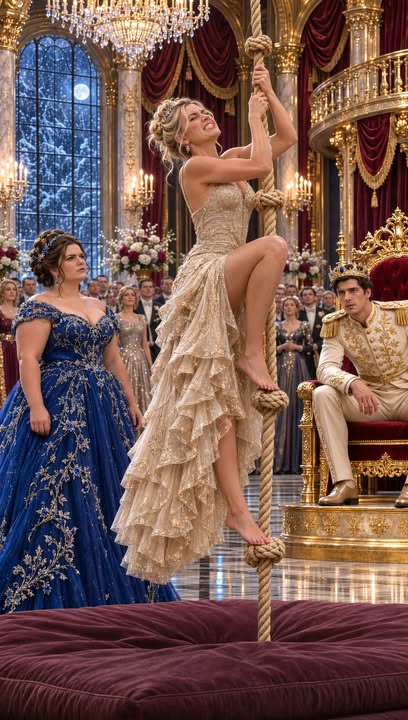
The space between my chair and the dais seemed longer than the rope had been.
Vanessa rose with me.
My mother sat behind the candidates, her face pale but steady.
Elias placed the copies on a small table near the dais.
I walked forward and stopped beside him.
The first time I had stood in this ballroom, people had laughed at the thought of me climbing a rope.
This time, they waited to hear what I would say.
“My grandmother, Eleanor Williams, was a seamstress in this palace,” I began.
“She designed a gold-vine pattern for a charitable sewing program that taught women to work with their hands and trust what they could make.”
I looked down at the copies.
“The palace record later described her design as a ceremonial pattern and credited it to Martin Vale.”
Lord Whitmore’s eyes remained on me.
“I do not know why the credit was changed, and I will not claim to know what any person intended.”
The restraint in my words felt important.
I had come to speak, not to turn uncertainty into accusation.
“But the archive holds my grandmother’s letter, the original pattern, the women’s notes, and a review confirming that she created the design.”
My voice trembled on the last sentence.
I let it.
“The review was never entered into the official record, and my grandmother was never told that the palace intended to correct it.”
I looked toward my mother.
“She kept the pattern because she believed the truth would matter to someone.”
My mother’s eyes shone.
“I am not asking to be chosen as a bride.”
A faint stir moved through the audience.
“I am asking the palace to correct the record while the evidence is here, in front of the people who have been asked to trust it.”
For a moment, no one moved.
Then the secretary looked toward Adrian.
Adrian did not speak for me.
He did not soften my words or explain what I meant.
He only waited.
Vanessa stepped forward.
“My father was an assistant in the household office when Eleanor worked here,” she said.
“He later advised the selection committee that designed this competition.”
Lord Whitmore’s gaze shifted to her.
“I knew he had influence over the trials, but I did not ask enough questions about how that influence was used.”
Her voice faltered, then steadied.
“I cannot say what he knew about Eleanor’s work. I will not accuse him beyond the evidence.”
She glanced at me.
“But I also cannot pretend my family had no connection to the records.”
The room remained still.
“My father expected me to benefit from the competition,” she continued.
“I did not understand how much the trials reflected what I had been trained to do and what other candidates had never been given the chance to learn.”
She lifted her chin.
“I was proud to be here. I still am. But I do not want to win by rules that only look fair from where I stand.”
Her father’s expression had softened, though pain remained in it.
Vanessa looked at him, and I saw how difficult it was for her to keep speaking.
“I love my father,” she said.
“That does not mean I should hide what the records show.”
Her words were quiet, but they reached the far side of the ballroom.
For a moment, the court seemed to have no answer.
Then Lord Whitmore rose.
He did not look at Vanessa first.
He looked at the papers on the table.
“I recognize the note in the margin,” he said.
His voice was steady, though his hands were not.
“I wrote it when I was an assistant in the household office.”
A breath went through the room.
“What did it mean?” Adrian asked.
Lord Whitmore looked toward the prince.
“It was a reference to my office’s review, not a statement of authorship.”
He paused.
“I was asked to help locate the person responsible for the original design.”
“Did you find Eleanor?” I asked.
“No.”
“Did you try?”
“I searched the household rolls.”
His answer came slowly.
“The records listed her as dismissed, not as part of the charitable program.”
“Did you know the review confirmed her work?”
“I did not see the final review.”
“Why not?”
“I was transferred before it was completed.”
Vanessa’s face held no relief, only a sorrowful attention.
“Did you know the pattern was hers?” she asked.
“I knew she had worked on the program.”
He looked at the record.
“I did not know she had drawn the original design.”
“Why didn’t you ask her?” I said.
“I thought someone else was responsible for making contact.”
The answer was not enough to undo what had happened.
But it was not a confession of a scheme, either.
It was an account of a system that had allowed each person to believe someone else would finish the work.
Adrian rose from the dais.
“The court will suspend the selection until the archive can verify the record and the family has been heard.”
The secretary leaned toward him, speaking quietly.
Adrian listened, then looked back at the room.
“This is not a rejection of the candidates or a conclusion about any person’s guilt.”
“It is an acknowledgment that we cannot ask the public to trust a record we have not finished correcting.”
The words were careful, and I understood why.
He was choosing to pause the ceremony without pretending the matter had been settled.
Then he turned to me.
“Miss Williams, the court will make no offer of marriage contingent on your silence.”
“Thank you,” I said.
It was all I could manage.
I had not expected to feel relief.
Instead, I felt the floor shift beneath the future I had been imagining, even if I had never admitted I was imagining it.
The selection had not gone forward.
Adrian had not chosen me.
I had not been asked to choose him.
Whatever had begun between us remained possible, but it was no longer sheltered by ceremony or expectation.
That felt honest.
It also felt frightening.
As the court began to move, the secretary approached Adrian with a folded document.
He read the first line, and his expression changed.
“What is it?” I asked.
“It was delivered from the central archive during the proceedings.”
“About Eleanor?”
He did not answer at once.
His eyes moved toward Lord Whitmore, then Vanessa.
The secretary leaned in and whispered something.
Adrian turned the document over.
“Who sent it?” Vanessa asked.
“The palace legal office,” he said.
“Is it another review?”
“No.”
His gaze returned to me.
“It is an old notice of compensation approved for Eleanor Williams after her dismissal.”
My breath caught.
“She never received it?”
“The notice says it was returned as undeliverable.”
“Then the palace may still owe your family a debt,” my mother said.
“Not just money,” Adrian replied.
“An explanation.”
He read the paper again, then looked toward Elias, who had gone very still beside the archive table.
“Is there something else?” I asked.
The secretary extended the folded sheet.
Adrian glanced at the final line.
“Eleanor’s signed response is attached,” he said.
My mother gripped the back of the chair in front of her.
“What did she say?”
Adrian held my gaze.
“She declined the compensation.”
“Why?”
The secretary placed the attached letter beside the notice.
Adrian read the first sentence aloud.
“‘I cannot accept payment for work the palace still credits to another person.’”
The ballroom quieted around us.
Below her signature was a final line in Eleanor’s hand.
“If the palace is ready to restore my name, invite my granddaughter—not as a candidate, but as a witness to what you have promised.”
**–END OF PART 5–CLICK “NEXT” AT THE BOTTOM OF THE PAGE TO CONTINUE READING**
* * *
[PREVIOUS: PART 4](https://echoesofstories.idolsgift.com/blog/part-4-the-name-on-the-card-046) | [NEXT: PART 6(THE END)](https://echoesofstories.idolsgift.com/blog/part-6-the-end-the-name-on-the-card-046)
✓ Lynn R. Adams
Part 5 – The Price of the Truth The name at the bottom of the page belonged to Adrian’s great-grandmother, Queen Helena. For several seconds, the reading room seemed to hold its breath with me. Eli…