PART 5: The Messages Hidden in a Blink5 025
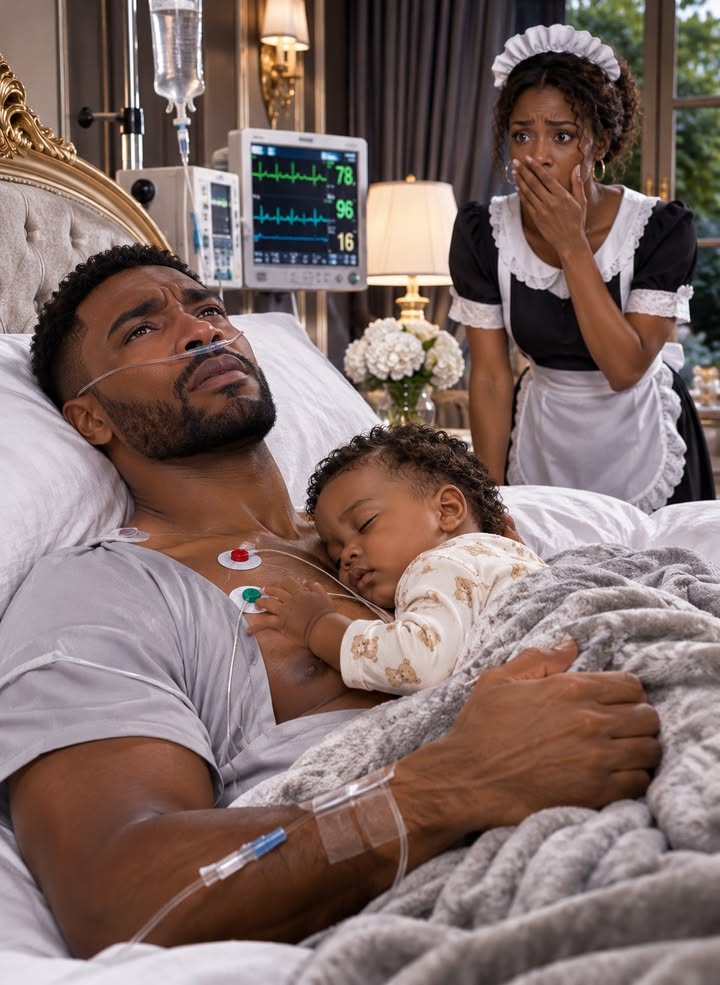
Part 5 – The Choice to Tell the Truth
Grant’s finger remained raised, trembling above the sheet as he pointed toward the locked drawer.
I followed his gaze, then looked back at him.
“Is the other promise inside?”
One slow blink.
I tried the drawer, but it was locked.
“Do you know where the key is?”
Grant’s eyes shifted toward the dresser, where a small brass key lay beside Evelyn’s framed photograph.
I picked it up and returned to the bedside.
The lock turned with a soft click.
Inside were a few folded documents, an old fountain pen, and a photograph of my mother standing beside Evelyn in a sunlit garden.
My mother looked younger than I remembered her, her dark hair swept back and one hand resting on the handle of a wicker basket.
Evelyn was seated on a bench, smiling up at her.
Grant stood behind them, his expression serious but unmistakably tender.
I lifted the photograph carefully.
“You kept this all these years.”
Grant blinked once.
At the bottom of the drawer, beneath the papers, lay a cream-colored envelope.
Evelyn’s handwriting crossed the front in looping blue ink: For Grant, when he is ready to keep the promise.
I glanced at him.
“Is this the promise she meant?”
One blink.
I opened the envelope.
Inside was a folded note, a copy of a clinic’s old registration form, and a small card bearing my mother’s name.
The note was brief.
Grant,
Mariana’s mother has accepted your help, but she will not ask for more.
If you mean what you told me, do not let your promise end with a bill paid quietly.
Be there when she needs someone to remember her name.
And when she has a child, make sure that child grows up knowing she was loved.
Evelyn
I read the words again, slowly.
The room seemed to grow smaller around me.
Grant’s eyes stayed fixed on my face.
“Did you ever send this to my mother?”
Two blinks.
“Did you know she wanted you to stay in touch?”
One blink.
“Then why didn’t you?”
His mouth moved, but the effort made his breathing uneven.
I reached for the water sponge and moistened his lips.
He tried again.
“Shame,” he whispered.
I waited, afraid I had misunderstood.
“Your mother… stopped needing help.”
“She still needed people,” I said.
His eyes closed, then opened.
One blink.
“I was busy,” he rasped. “Then… too late.”
I lowered the letter.
I had spent years believing that my mother had simply chosen to keep her life small, that she had preferred to carry every burden alone.
Now I understood that someone had offered help, and then left the door open only a crack.
Grant had paid her bills but failed to keep showing up.
My mother had accepted the support and then protected me from knowing how much she had needed it.
Neither of them had meant to leave me with an absence.
Still, the absence was there.
“I can’t make her answer you now,” I said.
Grant’s eyes glistened.
“I know.”
“And I can’t tell you it was all right.”
He blinked once, slowly.
“I know.”
I set the note beside the photograph.
Leo had crawled to the edge of his play mat and was rubbing one sleepy fist against his cheek.
I lifted him, then settled into the chair by the bed.
For a while, the three of us stayed quiet.
The afternoon light softened the room, touching the photographs and the pale folds of the blanket.
I thought of the first night I had come in with a crying baby, only wanting a few minutes of calm.
I had laid Leo against a man I believed could no longer feel anything.
Instead, he had held on.
Now I was holding the parts of his past that he had been unable to say aloud.
“Julian deserves to hear the truth about his father,” I said at last.
Grant’s eyes shifted toward Evelyn’s photograph.
One blink.
“But hearing the truth won’t undo what you did by keeping it from him.”
One slow blink.
“And it won’t make the medication safe.”
His eyes returned to mine.
One blink.
I took out my notebook and turned to the page where I had written down the pharmacy initials, the dates of Barragan’s visits, and each change in Grant’s breathing.
The evidence was incomplete, but it was no longer only suspicion.
I had the torn label, Nia’s account of Julian entering the locked medication room, and Grant’s confirmation that the drug was not part of his proper treatment.
I had the records of the unusual payments and the dates.
I had the old vial’s name from the discarded packaging I had quietly photographed after Barragan’s visit.
And I had my own notes, made each day before fear could blur what I remembered.
I still had no proof that would make a police officer believe a caregiver with a notebook over a doctor with credentials.
But a specialist could test the medication.
An investigator could look at the pharmacy records.
The truth could be checked by people who did not live in this house.
I took out my phone and opened the message thread with Nia.
She had sent me the name of a neurologist who had once consulted on her son’s case, a specialist at a nearby hospital who was known for taking difficult referrals.
Beside the name, she had written: He will listen if you tell him exactly what you observed.
I read the message twice.
Calling the hospital would change everything.
If I brought in a specialist without Julian’s agreement, I could lose my job, the room where Leo slept, and the only steady income I had.
If I waited for permission, Grant could grow weaker while everyone discussed what was appropriate.
My fear had always spoken in practical terms.
It reminded me that rent was due, that Leo needed food and medicine, that a single mother could not gamble with the little stability she had managed to build.
Those facts were true.
They were also not the only truth.
I looked at my son.
He was asleep with one cheek pressed against my shoulder, his small hand resting near my collarbone.
I could not promise him that our lives would remain easy.
I could promise that I would not teach him to call silence safety when someone depended on me to speak.
I called the hospital.
A coordinator answered after several rings.
I gave my name and explained that I was caring for a patient who had been diagnosed with a severe neurological decline, but whose symptoms had changed in a way that concerned me.
I did not accuse anyone.
I described what I had witnessed: a sudden loss of movement, faint responses, unusual medication handling, and a drug label that did not appear on the treatment chart.
The coordinator asked whether Grant had a legal representative.
“His nephew manages his care,” I said. “But I’m asking for guidance because I’m worried the current diagnosis may be incomplete.”
There was a pause.
“Has the treating physician approved another assessment?”
“Not yet.”
“Then I can’t promise an immediate consultation, but I can connect you with the hospital’s patient safety office.”
“That’s all right.”
I wrote down the number and thanked her.
The person who answered the safety line listened carefully, asked when Grant had last been examined, and requested that I preserve the notes and any packaging I had found.
“Do not remove anything that belongs to the patient’s medical records,” she said.
“I won’t.”
“Can you safely speak with the family representative?”
“I’m not sure.”
“Then don’t put yourself or the patient at greater risk. If you believe there’s an immediate medical danger, call emergency services.”
Her words were calm, not dramatic.
They gave me a path that did not require me to decide everything alone.
When the call ended, I sat with the phone in my hand, feeling as if I had crossed a narrow bridge and could no longer pretend I was standing on the same side.
Grant watched me.
“I’ve contacted a hospital specialist,” I said.
His eyes opened a little wider.
“They may need to alert the proper authorities before they can examine you.”
One slow blink.
“Are you sure?”
One blink.
“Even if Julian finds out?”
Grant’s gaze held mine.
One blink.
The answer cost him effort.
I took his hand.
“You don’t have to protect everyone from the truth anymore.”
His fingers remained still, but his eyes glistened.
A soft knock came at the door.
I slipped the old note into my notebook and put the notebook away.
Julian entered carrying a folder.
“I’ve arranged for the second opinion,” he said. “Dr. Barragan has agreed to send the latest scans and treatment notes.”
I looked at him.
“Who is the specialist?”
“Dr. Naren at Westbridge Medical. He can review Grant’s case by tomorrow afternoon.”
The name meant nothing to me.
“Is he independent?”
“He’s not connected to Barragan or our family.”
That was more than I had expected.
“Thank you,” I said.
Julian rested the folder on the dresser.
“I asked Barragan to hold off on changing the medication until the review.”
My chest loosened, but only slightly.
“Did he agree?”
“He said he’d continue the current supportive care.”
“That isn’t quite the same as holding off.”
“No,” Julian admitted. “It isn’t.”
For a moment, we stood in the quiet room, both looking toward Grant.
Julian’s gaze moved to the open drawer and the letter beside the photograph.
“Is that Evelyn’s handwriting?”
“Yes.”
He picked up the photograph of my mother and Evelyn, careful not to disturb the note.
“I’ve never seen this.”
“Neither had I.”
He studied my mother’s face.
“She looks like you.”
“She was my mother.”
“I know,” he said softly. “I meant the way you’re standing. Like you’re making sure everyone else has what they need before you let yourself sit down.”
I had no answer.
Julian returned the photograph to the dresser.
“Did the letter say what Evelyn wanted Grant to do?”
“It said he should keep his promises by staying present, not only paying bills.”
Julian looked at Grant.
“Did you?”
Grant’s gaze remained on the ceiling.
One blink.
Julian’s expression tightened, though he did not look surprised.
“She used to say people could make a mess by trying to spare one another,” he said. “I thought she meant me.”
“Maybe she meant all of you.”
He looked toward the note.
“Did you find anything else?”
I could have told him about the voicemail.
Instead, I chose to tell him enough to begin repairing the silence.
“Evelyn said your father had taken money from the company.”
Julian went very still.
I watched the words reach him.
“She said Grant knew, and chose not to bring charges.”
Julian’s mouth parted slightly, then closed.
“Is that what the recording said?”
“Yes.”
“And he never told me?”
“No.”
Julian’s eyes shifted toward Grant.
“Why?”
Grant struggled to move his lips.
I leaned close enough to hear him.
“Protect… family.”
Julian let out a short breath.
“You protected my father from being charged, then let me believe you had destroyed him.”
Grant’s eyes moved toward him.
One blink.
It was not an excuse.
It was an admission.
Julian looked away, toward the window.
“My father told me you made sure he lost everything,” he said. “He said you turned your back when he needed you.”
“I’m sorry,” Grant whispered.
The words were so faint they seemed to vanish almost as soon as they were spoken.
Julian’s shoulders lifted and fell.
“I don’t know what to do with that.”
“You don’t have to do anything with it today,” I said.
He looked at me.
“Why are you telling me now?”
“Because Evelyn asked for the truth, and because you deserve to know it.”
“And the rest?”
I glanced at the bed.
“The rest is why I called an outside specialist.”
Julian’s attention sharpened.
“What does that mean?”
I took my notebook from my pocket and held it against my chest.
“I’ve recorded the medication visits and the changes I observed. I found a torn pharmacy label that Grant says came from a private pharmacy you use. Nia told me she saw you in the locked medication room.”
Julian’s face went pale, but he did not interrupt.
“I don’t know what happened in that room,” I continued. “I don’t know who ordered the medication or what Dr. Barragan put into the line. That’s why I want someone independent to examine Grant and review the records.”
Julian stared at the notebook.
“You think I gave him something?”
“I think there’s enough that I can’t keep this inside the family.”
His gaze moved from the notebook to Grant.
“I never gave him a paralytic.”
I heard no anger in his voice.
Only a stunned kind of hurt.
“I don’t know whether that’s true,” I said. “I hope it is.”
He closed his eyes briefly.
“Barragan told me the medication was necessary to manage the progression.”
“Did you see the prescriptions?”
“He handled the medical side.”
“Did you authorize orders from your pharmacy?”
“I paid for some of the household prescriptions. I didn’t choose the drugs.”
His answer came quickly, then slowed.
“I may have signed forms without asking enough questions.”
It was not a confession.
It was not reassurance, either.
I thought of the torn label, the locked drawer, and the way he had admitted paying Nia without hiding it.
“Those records will show who ordered what,” I said.
Julian nodded once.
“Then we should give them the records.”
The words surprised me.
“Are you agreeing to a police report?”
“I’m agreeing that an independent doctor should see him. If the doctor believes the records should go to the authorities, I won’t stop that.”
It was not the clear choice I had needed from him.
But it was a step.
“Thank you,” I said.
Julian looked at Grant.
“I should have asked more questions.”
Grant’s eyes held his.
One slow blink.
Julian turned back to me.
“I’m going to call Barragan now and ask him to preserve every medication record and pharmacy invoice.”
“Please put the request in writing.”
He paused, considering the suggestion.
“Why?”
“So no one can later say they misunderstood.”
A faint, troubled smile touched his mouth.
“You’ve learned not to trust a promise without a record.”
“My mother’s letter taught me that.”
Julian nodded.
“I’ll write it down.”
He left with the folder.
I watched him go, unsure whether he would do what he had promised.
The room felt different after he was gone.
Not safe, exactly.
But open to the possibility that truth could enter it.
That evening, Dr. Barragan arrived alone.
He carried his usual leather bag, though he did not set it beside the bed.
Julian was in the study, and I was feeding Leo at the small table near the window when the doctor stopped at the doorway.
“Mariana, could we speak for a moment?”
I lifted my eyes.
“Of course.”
He glanced at Leo.
“Would you mind if I checked Mr. Sterling first?”
“I’d rather stay.”
Something in my tone made him pause.
Then he nodded.
“Very well.”
He went to the bed and examined Grant’s pupils, pulse, and breathing.
I watched his hands as carefully as I had the first time, but now I knew what I had seen before could not be explained away as simple nerves.
“His condition appears stable,” Barragan said.
“Has the medication changed?”
“I’ve continued the prescribed treatment.”
“Did you receive Julian’s request to preserve the records?”
Barragan looked at me.
“I did.”
“Will you send them to the specialist?”
“Of course.”
“Will you provide the vial information and pharmacy records?”
His expression became guarded.
“The specialist will receive the relevant medical records.”
“I’m asking whether the medication is on the chart.”
“It is.”
“Then you won’t mind an independent review.”
“Not at all.”
He closed the chart.
“Mariana, I understand your concern. But it’s important not to let a difficult situation turn into an accusation without evidence.”
“I’m asking for evidence.”
“Yes,” he said. “So am I.”
His answer was reasonable enough to unsettle me.
He looked at Grant and adjusted the blanket near his shoulder.
“You have my word that his care will remain unchanged until the specialist has reviewed the case.”
The phrase sounded familiar.
My mother’s letter had warned me about promises that could be written down and promises that asked someone to stay.
“Please put that in the records,” I said.
Barragan’s eyes narrowed slightly.
Then he gave a small nod.
“I will.”
He left without opening his bag.
I waited until his footsteps faded before I returned to the bedside.
Grant’s eyes were open.
“Did he tell the truth?” I whispered.
One blink.
“About keeping your care unchanged?”
Grant’s gaze shifted to the IV.
Two blinks.
The answer chilled me.
“Do you think he’ll still try to give you something?”
Grant’s eyelids lowered and lifted.
One blink.
I took the notebook from my pocket and wrote down the time Barragan had arrived, what he had said, and the way he had touched the line.
I wrote that Julian had agreed to an independent review.
I wrote that I had called the patient safety office.
I wrote that I needed to send the records to the specialist as soon as I could.
Then I looked at the phone in my hand.
The safety officer had given me a secure address where I could send the notes and the label photograph for preliminary review.
They had also told me that if the medical team found credible evidence of deliberate harm, they would be required to notify the appropriate authorities.
If I sent the records, I would not be able to pull them back.
Julian might lose control of the estate’s decisions.
Barragan might lose his position.
The police might come into a house where I still lived with my baby.
And if I was wrong, I would have placed an entire family under suspicion based on a frightened patient’s blinks, a torn label, and the testimony of a former nurse who had taken money.
I looked down at Grant’s still hand.
“Do you want me to send it?”
His eyes opened wider.
One slow blink.
I turned to Leo.
He had finished his bottle and was rubbing his cheek against my shoulder.
His breathing was soft and steady.
My mother’s old words came back to me from the letter.
Being cared for does not always feel like being loved if the person never comes back.
For two months, everyone in this house had been coming and going while Grant listened from inside his body.
I could not leave him there because the truth might become inconvenient.
I sat at the desk and opened the secure message window.
I attached the photograph of the pharmacy label.
I attached the pages from my notebook, making sure to leave out anything that was only a guess.
I included the dates of Barragan’s visits, the reported change in Grant’s breathing, Nia’s account of the medication room, and the words Grant had whispered about Julian’s private pharmacy.
I added the name of the outside specialist Julian had arranged.
Then I paused over the last field.
Please describe why you believe this matter requires immediate review.
My fingers hovered above the keyboard.
I thought of Grant’s face when Leo slept against him.
I thought of my mother’s photograph in the drawer, her smile caught between two people who had loved her in imperfect ways.
I thought of how easy it would be to keep working, keep quiet, and hope the specialist arrived before anything changed.
I typed: The patient may be aware and unable to communicate. His condition appears inconsistent with the current explanation. I am concerned that the medication could be contributing to his decline.
I reread the message.
Then I pressed send.
The screen confirmed that the records had been received.
I sat back, my hands trembling.
The choice had not made me brave.
It had only made the next step unavoidable.
The phone rang before I could put it away.
The hospital’s patient safety officer was calling.
I answered.
“Ms. Ruiz, we’ve reviewed the information you sent.”
My mouth went dry.
“Is Grant going to be all right?”
“I can’t tell you that yet. We’ve contacted the specialist, and we’re arranging an urgent medical review.”
“Should I call emergency services?”
“Not unless his breathing worsens or he becomes unstable. For now, stay with him and don’t change any treatment yourself.”
“I won’t.”
The officer paused.
“There’s one other matter. The pharmacy label in your photograph appears to come from a compounding pharmacy. The initials match a batch number, not a patient name.”
I gripped the phone.
“Can you tell who ordered it?”
“We’re checking that now.”
A message appeared on my screen as she spoke.
The hospital had sent a preliminary record from the pharmacy’s distribution log.
I opened it.
The listed prescriber was Dr. Ruben Barragan.
The authorized pickup contact was Julian Sterling.
Beneath those names, a second line showed that the compound had been prepared for Grant Sterling, with instructions that were not included in his standard treatment chart.
I read it once.
Then I read it again.
The safety officer’s voice continued in my ear.
“Ms. Ruiz, are you still there?”
I looked at Grant.
His eyes were open, and he was watching me.
“Yes,” I whispered.
The officer asked whether Julian was in the room.
Before I could answer, the message updated with a new detail from the pharmacy record.
The order had not been placed after Grant became immobile.
It had been prepared three weeks earlier.
And the person who had approved the first dose was not Julian.
**–END OF PART 5–CLICK “NEXT” AT THE BOTTOM OF THE PAGE TO CONTINUE READING**
* * *
[PREVIOUS: PART 4](https://puretales.idolsgift.com/blog/part-4-the-messages-hidden-in-a-blink5-025) | [NEXT: PART 6(THE END)](https://puretales.idolsgift.com/blog/part-6-the-end-the-messages-hidden-in-a-blink5-025)
✓ Lynn R. Adams
Part 5 – The Choice to Tell the Truth Grant’s finger remained raised, trembling above the sheet as he pointed toward the locked drawer. I followed his gaze, then looked back at him. “Is the other p…