PART 5: The Message She Carried 052
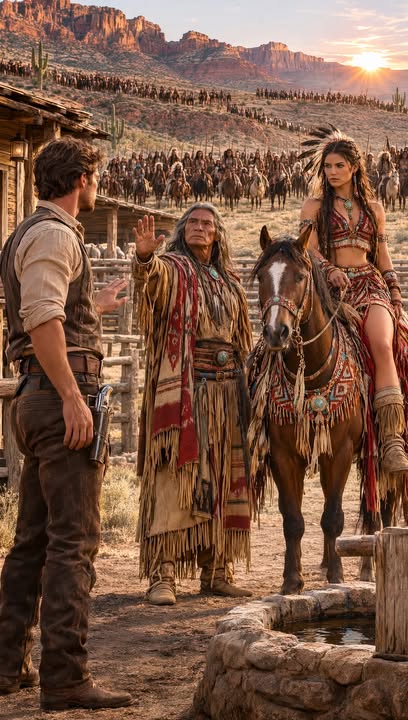
Part 5 – The Road to Judgment
The pencil words seemed to deepen beneath the lantern’s glow.
**Found alive.**
Nantan reached for the page, then stopped, her fingers hovering above the fragile paper.
“Is that his writing?” she asked.
Corvin bent closer, though he had already recognized the cramped letters.
“I can’t be certain.”
“You know the hand.”
“I know the way he made the capital F. He used to mark his maps the same way.”
Taza studied the line beneath Luta’s name.
“Could it mean he found her after the raid?”
“Or before it,” Corvin said.
The possibility unsettled him more than either of them wanted to show.
Nantan lowered her hand.
“If he found her alive, why did no one bring her back to us?”
“I don’t know.”
“Why was her name written beneath a message about moving families away?”
“I don’t know.”
The answer felt like a door shutting, but Corvin could not force it open by pretending to know what lay beyond.
He placed the page beside the ledger, careful not to crease it.
“We need to find the original patrol records,” he said. “And the people who were led west that night.”
“If any are still living,” Nantan replied.
“If they are, they may remember where the children went.”
Taza looked toward the doorway, where darkness had gathered over the ranch yard.
“Voss will not wait while we search.”
A distant hoofbeat sounded beyond the fence, then faded.
No one moved.
The ranch had become a place of listening: for hoofbeats, for a call from the scouts, for anything that might tell them how soon the intruders would come.
Corvin slipped the route copy into the ledger and shut the cover.
“If Voss learns we have this page, he may come for it.”
“He already knows what he wrote,” Nantan said.
“Not that I found it.”
“Then we must decide what to do before he realizes.”
Taza gave a quiet instruction to one of the men outside, and the rider disappeared into the night.
Corvin carried the ledger to the chest beneath the bed, then stopped with it in his hands.
He could take it out the back and ride alone to the territorial town.
The thought came with the old, familiar ease of escape: leave before anyone could ask him to stay, outrun the danger, carry the evidence where it might do some good.
But the ledger would not protect the families by the river.
And if Voss came to seize the valley, those who stayed behind would have to face him without the proof Corvin had spent years keeping.
He looked at Nantan.
“If I ride for town now, I might get the ledger in front of a judge before Voss can take it.”
“And leave the valley?”
“I could be back with help.”
“Could you?”
“I don’t know.”
“How long would it take?”
“Two days, perhaps. Longer if the road is watched.”
“Then the families would be alone while you rode.”
“They would have Taza and the others.”
“They would have one another,” she said. “That is not the same as having you.”
He heard no plea in her voice, only an honest account of what his choice would mean.
“That makes it harder,” he said.
“It should.”
Outside, Taza entered the room and closed the door behind him.
“Voss has sent a rider,” he said. “He wants to speak with Corvin.”
“When?” Corvin asked.
“Now.”
Nantan looked toward the dark window.
“Where?”
“The western track. He says he will come with two men and no guns in their hands.”
“That does not make the meeting safe,” Corvin said.
“No,” Taza agreed. “But refusing may tell him we have something he wants.”
Corvin glanced down at the ledger.
Nantan’s expression had gone still.
“If you meet him, do not give him the book,” she said.
“I won’t.”
“Do not let him persuade you to ride away alone.”
“I won’t.”
“Do not mistake a calm voice for an honest one.”
“I have already made that mistake.”
For a moment, she studied him.
Then she nodded once.
“I will go with you.”
“You should stay here.”
“I will decide where I am needed.”
The words were familiar, but the weariness beneath them was not.
Corvin could have argued.
Instead, he asked, “Can you ride?”
“Yes.”
“Can you keep your wound from reopening?”
“I can try.”
“That is not the answer I wanted.”
“It is the answer you have.”
Taza took the lantern from the table.
“We will meet Voss at the low rise, where the ground is open and the scouts can watch from both sides.”
Corvin placed the ledger in the chest and turned the key.
He kept the little brass disc in his pocket, along with the folded page that bore Voss’s message.
The evidence weighed almost nothing.
It made his coat feel heavy.
When they rode out, Nantan kept pace beside him, her posture straight despite the pain in her side.
Taza followed with two riders, while others remained hidden along the slope.
The moon had risen, turning the rocks pale and the valley silver.
At the low rise, a man waited beside a bay horse.
Corvin knew Elias Voss at once, though the years had sharpened his face and silvered his hair.
Two men sat their horses behind him.
Neither carried a weapon in hand.
Voss looked first at Corvin, then at Nantan.
“Corvin,” he said. “I had hoped you would come alone.”
“I didn’t.”
“I see that.”
Voss’s gaze lingered on Nantan, but he offered no greeting.
She returned the look without speaking.
“You asked to talk,” Corvin said. “Talk.”
Voss glanced at the scouts’ shadows along the ridge.
“I want to avoid a misunderstanding.”
“Then you should have brought the papers you claim give you this land.”
A small crease appeared between Voss’s brows.
“So you have seen the claim documents.”
“I have heard enough about them.”
“The valley has been abandoned for years.”
“It has not.”
“People have moved away.”
“Some have.”
“And the government records show the land was left unused.”
“The people who live here do not become absent because your papers say so.”
Voss’s expression remained composed.
“Those records were filed properly.”
“By whom?”
“By people authorized to file them.”
Corvin felt the old instinct to let the question go, to keep the conversation calm by refusing to press where it hurt.
He had spent too many years mistaking quiet for safety.
“Did you change my route notes?” he asked.
Voss’s eyes flickered once toward the fold of Corvin’s coat.
“I don’t know what you mean.”
“The patrol’s route was altered after I submitted my report.”
“Orders changed.”
“My ledger says the correction was made in another hand.”
“Then your ledger is mistaken.”
“My copy says the families had to be gone before the patrol arrived.”
Voss’s face went still.
Nantan shifted in the saddle beside Corvin, but she did not speak.
Voss looked past them toward the valley.
“I see you have convinced yourself that an old tragedy explains every present difficulty.”
“It explains why the patrol went through the settlement.”
“You were the guide. You provided the route.”
“I provided a route around the homes.”
“And yet the patrol passed through them.”
“Because someone changed what I gave them.”
“You were not there when they made their decision.”
“I was there when you told me the settlement was empty.”
Voss’s eyes returned to him.
“You were tired. It was a long night.”
“I remember what you said.”
“So do I.”
For an instant, Corvin saw the younger man he had known years ago: quick with maps, assured in his judgments, always ready to describe a difficult choice as if it had already been made by someone else.
Then the image passed.
“Why was Luta’s name on your note?” Corvin asked.
The question changed Voss’s expression more than the accusation had.
He did not answer immediately.
Nantan’s hand closed around the reins.
“Where is she?” she asked.
Voss looked at her.
“I don’t know.”
“You wrote her name.”
“I wrote many names.”
“Why?”
“I was trying to keep an account of those who left the valley.”
“Why did your note say she was found alive?”
The two men behind Voss exchanged a glance.
Voss turned his face away.
“That page is old.”
“Did you find her?” Nantan asked.
“I said I don’t know where she is now.”
It was not an answer.
Corvin felt his pulse beat hard in his throat.
“Was she alive after the raid?”
Voss looked at him again.
“I saw a child being carried west.”
“By whom?”
“A woman from the settlement.”
“Was it Luta?”
“I don’t remember.”
“You wrote her name.”
“I wrote down what I was told.”
“By whom?”
Voss’s jaw tightened, not with anger so much as with the strain of holding his expression in place.
“You want a clean account of a night that was chaos.”
“I want the truth.”
“The truth is that I did not order the patrol to enter the settlement.”
“But you changed the route.”
“I made a correction based on information I believed was reliable.”
“You knew families were still there.”
“I was told they had left.”
“By whom?”
Voss did not answer.
Nantan watched him, her face pale in the moonlight.
“Did you see my aunt?” she asked.
Voss’s gaze dropped.
“I don’t know your aunt.”
“Her name was Ishta.”
“I did not know her.”
“You knew Luta.”
“I may have seen the child.”
“Then you knew enough to write her name.”
Voss breathed out slowly.
“What happened was wrong,” he said. “But we cannot undo it by opening old wounds now.”
“Old wounds are still wounds,” Nantan replied.
“I came to prevent another disaster.”
“You came to take the valley.”
“I came to secure land that has no registered owner.”
“It has families.”
“It has people who cannot prove ownership by the standards of the territorial office.”
“Then your standards are too small to hold what happened here.”
The words were quiet, but they seemed to reach beyond the rise and into the valley below.
Voss looked toward Corvin.
“You understand what happens if you take this to town. The authorities will ask why you waited so long to report it.”
“I’ll tell them.”
“They will ask why you guided the patrol.”
“I’ll tell them that too.”
“They may decide you were responsible.”
“They may.”
“You could lose your ranch.”
“I know.”
“You could be arrested.”
“I know.”
“Then why risk it?”
Corvin looked beyond Voss, toward the dark folds of the valley.
He thought of the families who had begun to gather their belongings beside the river.
He thought of Nantan returning to his well after barely surviving the journey, not to demand payment for the water, but to warn the people who lived there.
He thought of the child beneath the blue blanket, alive in the uncertain space between a faded note and a missing name.
“Because keeping quiet has not protected anyone,” he said.
For the first time, Voss’s composure faltered.
Only slightly, but enough for Corvin to see.
“You don’t know what you’re bringing down on yourself.”
“I do.”
“No,” Voss said. “You know what you regret. That is not the same thing.”
Corvin held his gaze.
“You used my route to make the patrol go where you wanted.”
“I did not make them do anything.”
“You changed the map.”
“I corrected it.”
“You knew the correction would lead them past the settlement.”
“I knew the patrol would clear the area.”
“You knew people were still there.”
Voss looked away.
That was answer enough.
Nantan’s breath caught, small and quiet.
Corvin felt anger rise in him, but beneath it lay something more difficult: the recognition that Voss had not become a stranger through one great transformation.
He had simply made one compromise, then another, each one described as necessary.
Corvin had done something similar by choosing not to ask questions after the raid.
The difference was that he could still choose what to do now.
“Give us until morning,” Voss said. “Take your ledger and leave the valley. I’ll see that no one follows you.”
“You want the book.”
“I want the matter settled.”
“By removing the evidence?”
“I want to avoid a needless conflict.”
“There need not be a conflict.”
“Then leave.”
Corvin looked at Nantan.
Her face was composed, but he could see the pain of what Voss had admitted, and the fear that he might still vanish before the truth could be made official.
The valley below them was quiet.
It was not safe.
“People have been asked to leave their homes once already,” Nantan said. “I will not tell them to disappear so that your papers can be called true.”
Voss shifted in his saddle.
“You cannot defend every household.”
“We do not have to,” Taza said from behind them. “We have to keep them from being surprised.”
His voice was low, and his words held no promise of violence.
They carried the certainty of a leader who had already chosen his responsibility.
Voss looked from Taza to the riders along the ridges.
“You have assembled a force large enough to frighten the entire territory,” he said.
“We have assembled people who know where their homes are,” Taza replied.
Corvin understood then that every person present was waiting on his decision.
He could still ride out alone with the ledger.
He could preserve the evidence, perhaps, but leave Nantan and the valley to bear the risk in his absence.
Or he could remain, knowing that Voss might find another way to destroy what they had uncovered.
Neither choice offered safety.
Only one let him stop pretending that fear was the same as caution.
“I’m not leaving tonight,” Corvin said.
Voss’s mouth tightened.
“Then you’ve chosen your side.”
“I’ve chosen to tell the truth.”
“You think those are different things?”
“I hope they are.”
Voss turned his horse.
“By dawn, you’ll wish you had taken my offer.”
“Maybe.”
The man looked back once, as if expecting Corvin to add something.
Corvin did not.
Voss rode west with his two companions.
They did not raise their hands to their weapons.
Neither did the people watching from the ridges.
The meeting ended without a shot, but the silence it left behind felt heavier than before.
Nantan looked toward the place where Voss had disappeared.
“He knew Luta was alive.”
“He knew a child was alive.”
“Do you believe it was her?”
“I don’t know.”
“That is not what I asked.”
Corvin considered the words scratched into the note.
“Part of me believes it was.”
“And the rest?”
“The rest is afraid to hope.”
She nodded, as if she understood the distinction.
They rode back to the ranch with Taza and the others.
The night air had cooled, and the stars stood bright above the valley.
At the well, Nantan swung down from her horse without accepting help.
Her breath caught as her boots touched the ground.
Corvin reached toward her, then stopped, remembering that concern could become another kind of command if he was not careful.
She saw the motion.
“I am standing,” she said.
“I can see that.”
“Then let me.”
He lowered his hand.
“All right.”
Taza joined them beside the porch.
“Voss will move before morning,” he said. “He knows we have evidence, even if he does not know what.”
“He may come for the ledger,” Corvin said.
“Then we should decide what to do with it.”
Corvin looked toward the darkened house.
“I’ll take it to the territorial town myself.”
Nantan’s gaze sharpened.
“Alone?”
“If I ride at once, I can reach the road before his men close the pass.”
“And the families?”
“Taza can guide them beyond the river bend.”
“I can,” Taza said.
“Then you should go,” Nantan told Corvin.
The certainty in her voice surprised him.
“You want me to leave?”
“I want the truth to reach people who can protect the valley by law, not only by watchfulness.”
“You said the families would need me.”
“They will need you more if your evidence reaches town.”
“Then I’m taking you with me.”
“I am not leaving my people.”
“Voss knows we have the page. If he comes here—”
“Then I will be here.”
“That is exactly what worries me.”
“You do not get to choose my risk because you are afraid of losing me.”
The words struck close enough to make him look away.
She had not said he was wrong to worry.
She had reminded him that fear could disguise itself as care.
“I’m sorry,” he said.
“Do not apologize. Decide.”
Taza watched them quietly, giving them the privacy of his silence.
Corvin looked back at the house, at the locked chest beneath the bed, at the ledger that held the one piece of proof he could not replace.
“If I take it to town, I may not be able to come back quickly.”
“If you stay here, Voss may take it before it reaches anyone,” Nantan replied.
“Then I should go.”
“Yes.”
“And you’ll stay.”
“I will.”
He had thought the choice would feel like cowardice or courage.
Instead, it felt like leaving someone he had begun to trust in the hands of a danger he could not control.
He went inside and retrieved the ledger.
The brass disc and the folded route copy were tucked between its pages.
He wrapped the book in oilcloth and tied it behind his saddle.
Nantan stood at the gate while he tightened the last strap.
“Take the main road,” she said. “Do not cut through the dry wash if you are carrying the ledger.”
“I know.”
“Tell the town clerk the valley has families living there.”
“I will.”
“Tell them the land was never empty.”
“I will.”
“Tell them my name.”
“I’ll tell them.”
She stepped closer.
“And if they ask whether I gave you permission to speak for my people?”
“I’ll say I don’t speak for you.”
Something in her expression softened.
“That is the first answer that will help.”
He climbed into the saddle.
The ranch yard looked different from horseback, even in the dark.
The well stood at its center, the fence ran crookedly along the eastern side, and the house sat behind him with its single lit window.
He had called the place lonely for so long that he had mistaken the absence of company for the absence of belonging.
Taza raised one hand in farewell.
The riders along the ridges remained where they were, holding their quiet line around the valley.
Corvin turned his horse toward the south road.
Then a lone rider appeared on the eastern trail.
He came fast but not recklessly, his horse foaming at the neck.
Nantan stepped away from the gate.
The rider pulled up beside her and spoke in a rush.
Taza answered him, then looked toward Corvin.
“What is it?” Corvin asked.
The scout’s face was drawn with exhaustion.
“A woman has come to the river settlement,” Taza said. “She says she knows the child named in the note.”
Corvin tightened his grip on the reins.
“Who is she?”
The scout looked from him to Nantan.
“She says Luta is alive,” he replied. “And she is waiting for Corvin Torne.”
**–END OF PART 5–CLICK “NEXT” AT THE BOTTOM OF THE PAGE TO CONTINUE READING**
* * *
[PREVIOUS: PART 4](https://storyly.idolsgift.com/blog/part-4-the-message-she-carried-052) | [NEXT: PART 6(THE END)](https://storyly.idolsgift.com/blog/part-6-the-end-the-message-she-carried-052)
✓ Lynn R. Adams
Part 5 – The Road to Judgment The pencil words seemed to deepen beneath the lantern’s glow. **Found alive.** Nantan reached for the page, then stopped, her fingers hovering above the fragile paper….