PART 5: The Message Hidden in the Hem 069
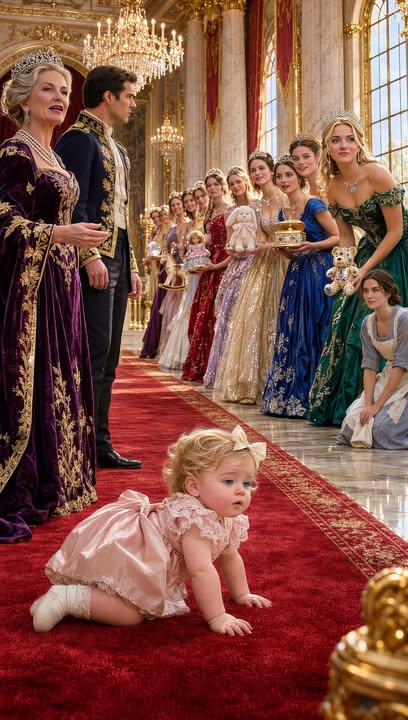
Part 5 – The Price of Silence
The envelope bearing Harcourt’s name remained in the hidden compartment, its red wax seal unbroken.
Alexander did not reach for it.
The last letter Eleanor had written to him rested in his hand, and the words at its end seemed to echo through the quiet nursery.
If you cannot find me, look where Lily’s earliest things were kept.
The Queen drew closer to the open chest.
“Perhaps she meant this,” she said. “Perhaps the envelope is only a message she never sent.”
“Then we should learn what it says,” Alexander replied.
He examined the seal without touching it.
There was no date, no explanation, and no sign that Eleanor had intended anyone to find it except the person whose name she had written.
Sophia stood beside the window with Lily against her shoulder.
The baby’s face was turned toward her, peaceful and unaware of the old grief gathered around the chest.
“Would Eleanor have wanted us to open it?” Sophia asked.
Alexander looked down at his wife’s letter.
“She wanted the truth to be found,” he said. “But that doesn’t necessarily mean she wanted every private word exposed.”
The Queen studied him.
“You are right to remember that distinction.”
He had once believed leadership meant knowing what to do before anyone else did.
Now he was beginning to understand that some choices required him to admit what he did not know, and to listen before deciding whose comfort mattered most.
“We will preserve the envelope and have it examined,” he said. “No one will open it until we know whether it was meant to be sent.”
“Your Highness,” Mrs. Bell said, “I can secure the chest and its contents.”
“Please do. And make no changes to the compartment.”
Mrs. Bell nodded.
The Queen’s gaze rested on the hidden space.
“Mr. Harcourt must be told that we have found it.”
“Not yet,” Alexander said. “We should first establish what is in the letters and what records remain.”
His mother’s expression tightened, though she did not disagree.
“Then let us be careful not to make a decision in his absence that would be different if he were here.”
Alexander heard the fairness in her words.
He also heard the fear beneath them.
The next morning, he asked Harcourt to meet him in the Queen’s study.
He did not summon him before the court or call the household together.
The matter was too serious for spectacle, and Eleanor had never wanted her private distress turned into palace entertainment.
The Queen sat beside Alexander at a small table.
The packet and letters lay between them, secured in a leather folder.
Sophia had not been asked to attend.
Alexander had told her she should not be made responsible for a conversation that belonged to the royal household, and she had accepted the decision without protest.
Still, he knew she would be waiting to hear whether the truth brought her any closer to justice—or pushed her farther away from a home she had never expected to enter again.
Mr. Harcourt arrived at the appointed hour.
He was a composed man in his late sixties, with silver hair and a familiar air of quiet competence.
For years, Alexander had trusted him to manage difficult arrangements without drawing attention to himself.
That trust had made the letters harder to face.
“Your Highness,” Harcourt said, bowing to Alexander and then to the Queen. “You asked to discuss a matter concerning the old nursery records.”
“We have found a packet written by Princess Eleanor,” Alexander said.
Harcourt’s expression remained composed, though a flicker of recognition crossed his eyes when Alexander placed the sealed envelope on the table.
“Where did you find that?”
“In a hidden compartment beneath the lining of the nursery chest.”
Harcourt looked at the envelope, then at the Queen.
“I was unaware that such a compartment existed.”
The Queen’s voice was level.
“The envelope bears your name.”
“It does.”
“Do you know what is inside?” Alexander asked.
“No.”
“Did Eleanor ever give you a sealed packet?”
Harcourt paused.
“I remember carrying a number of letters and household papers during that period. It was a difficult time, and the palace was managing many matters at once.”
“That is not the same as answering the question,” Alexander said.
“No,” Harcourt replied. “I do not recall receiving this particular envelope.”
Alexander opened the leather folder and removed copies of Eleanor’s notes.
He did not hand them over.
“Eleanor wrote that she had asked to see Dr. Mercer and was told the physician had approved more rest.”
Harcourt’s eyes moved to the page.
“She also wrote to the Queen and asked for a private visit,” Alexander continued. “That letter never reached her.”
The Queen’s hands were folded tightly in her lap.
“Did you handle either request?”
“I cannot say without reviewing the records.”
“Do you remember a clerk reporting that a nursery keepsake was missing at the same time Sophia’s assignment ended?”
Harcourt’s attention shifted toward the name in the ledger.
“I remember the missing rattle.”
“Did you believe Sophia took it?”
“I had no proof that she did.”
“Was she told there was no proof?”
Harcourt lowered his eyes.
“I cannot recall what she was told.”
The answer hurt more than Alexander expected.
Not because Harcourt had admitted to an accusation, but because he spoke as if the young woman’s departure had been one minor detail among many.
“She was removed from her position,” Alexander said. “She was left to believe the household considered her dishonest, and she was never given an explanation.”
“I did not intend to injure her.”
“Did you arrange her departure?”
Harcourt’s silence lasted a moment too long.
“I signed the instruction ending her nursery assignment.”
The Queen’s face went pale.
“Why?”
“Because I believed a change in the staff was necessary.”
“On what grounds?” Alexander asked.
“The missing rattle was one concern. There were also questions about whether she had been given access to private correspondence.”
Sophia’s name seemed to enter the room even though she was not present.
“Was she accused of taking letters?” the Queen asked.
“Not formally.”
“Did she take them?”
“I do not know.”
Alexander felt anger rise, then forced it back into a question.
“Were there any letters missing?”
Harcourt looked at the documents.
“I cannot remember.”
“Then why did you treat her as though there were?”
“I was responsible for keeping the household orderly.”
The words were not a defense so much as a confession of the belief that had governed him.
Alexander leaned back.
“Order is not the same as truth.”
“No, Your Highness.”
“Eleanor’s requests to see her physician were not relayed.”
Harcourt’s expression changed.
“I was not told she had asked to see him.”
“She wrote that she was told he had approved rest.”
“Then someone may have misunderstood the message.”
“She wrote to the Queen and asked for a private visit. The letter did not arrive.”
“I did not see such a letter.”
“Could it have passed through your office?”
“Of course. Much of the correspondence did.”
The Queen turned toward him.
“If it came through your office, why was it not delivered?”
“I do not know.”
“You were the senior officer responsible for it.”
“I was.”
For a moment, the room held only the faint ticking of the clock.
Harcourt did not raise his voice or deny the documents.
He looked like a man who had spent years trusting the importance of the systems he managed and had only now begun to see the people those systems could leave behind.
Alexander wanted to believe that was all it was.
He wanted to believe Eleanor’s letters had been delayed by confusion, Sophia dismissed through excessive caution, and a young mother’s distress overlooked by an institution that had mistaken quiet for wellness.
But Eleanor had feared that her words were being changed before they reached the people she trusted.
And now an unopened envelope, hidden in the nursery, bore Harcourt’s name.
“We need to open this,” Alexander said.
The Queen nodded.
Harcourt looked toward the seal.
“If it was addressed to me, perhaps it should be read privately.”
“It was written by my wife in a room where she believed her messages were not reaching us,” Alexander replied. “It was hidden with a packet meant for our daughter. We cannot treat it as an ordinary private letter.”
“Then I will not object.”
Alexander broke the seal.
Inside was a single folded page.
Eleanor’s handwriting began near the top, steady and unmistakable.
Mr. Harcourt, if you have received this, then I have not managed to speak with Alexander or the Queen.
I understand you have a difficult duty, and I do not wish to make your work harder.
But I ask you to let my words reach the people I have named.
I am afraid that my illness is being treated as a matter of appearances.
A line had been drawn beneath the next sentence.
Please do not decide that my silence means I am well.
Alexander’s grip tightened on the page.
He read on.
I have asked for Dr. Mercer.
I have asked to see the Queen.
I have asked that Sophia remain near Lily because she calms the child and because I trust her.
If you believe any of those requests should be refused, please tell me why, and speak with me directly.
Do not let other people answer for me.
The letter ended without a signature, though Eleanor’s name appeared at the bottom in her own hand.
The Queen pressed her fingers to her mouth.
Harcourt’s face had lost its composure.
“I remember this letter,” he said.
Alexander set it on the table.
“You just told us you did not recall receiving it.”
“I did not recognize it until you read it.”
“You remember it now?”
“I remember that she asked me to keep Sophia away from the nursery.”
The Queen leaned forward.
“Eleanor wrote that she wanted Sophia to remain near Lily.”
“I know.”
“Did you receive the letter?”
“Yes.”
“Then why did you say you did not?”
Harcourt closed his eyes briefly.
“Because I had convinced myself I had not received it from her. I thought it had come through an attendant.”
“Did it?”
“No. Princess Eleanor gave it to me herself.”
Alexander looked at the date.
It was two days before the unsigned notice that had told Dr. Mercer further visits were unnecessary.
“Why did you keep it?”
“I thought I was protecting her.”
“From what?” the Queen asked.
“From pressure. From the household. From the court’s concern over every change in her condition.”
“By preventing her from speaking to us?”
“I believed she was tired and frightened. I thought the physician’s advice was to let her rest.”
“He did not give that advice,” Alexander said.
“I know that now.”
The admission came quietly.
It did not undo the delay or restore Eleanor’s lost days.
But it was the first time Harcourt had spoken without sheltering behind uncertainty.
“Why was Sophia sent away?” Alexander asked.
Harcourt looked down at his hands.
“Eleanor had asked that Sophia stay near Lily. I believed that request would encourage rumors.”
“Rumors of what?”
“That the princess was too weak to care for her child. That a maid had taken on duties ordinarily performed by family or the nursery staff. The household was already under strain.”
“So you removed the person Eleanor trusted because you feared what people might say.”
“I thought I was reducing pressure on her.”
“She was the one asking for Sophia,” the Queen said.
“I understand that.”
“No,” the Queen replied, and her voice trembled. “I do not think you did.”
Harcourt looked at her.
The Queen’s anger was not sharp or triumphant.
It was grief, sharpened by the knowledge that she had accepted his reports without questioning them.
“I approved the household arrangements,” she said. “I trusted you to bring me the facts. But I did not ask whether Eleanor’s own voice was being heard.”
“You were not told—”
“And I did not ask.”
The room fell silent.
Alexander understood then that Harcourt’s actions had not been driven by hatred or a desire for personal gain.
He had seen himself as the guardian of the palace’s calm.
When Eleanor’s requests threatened to disturb that calm, he had translated her fear into fatigue, her insistence into confusion, and her trust in Sophia into a risk to be managed.
He had not set out to hurt her.
He had decided, again and again, that he knew what she needed better than she did.
That made his choices no less serious.
“What do you want from me?” Harcourt asked.
“The truth,” Alexander said. “Every record you handled, every message you received, and every person you instructed to keep quiet.”
Harcourt nodded once.
“I will provide what I can.”
“And Sophia will receive a formal correction of the accusation against her.”
“I agree.”
“Her employment here will not depend on her silence.”
“I agree.”
The answer came quickly.
Too quickly.
Alexander studied him.
“You understand that this will not end with a private apology.”
“I do.”
“The letters raise questions about the care Eleanor received and about how the household handled her requests.”
“The palace will be hurt by this.”
“The palace is not the person who was hurt.”
Harcourt looked down.
“No, Your Highness.”
The Queen’s voice softened, though she did not offer forgiveness.
“We have not yet decided what must be made public. But we will not hide the facts to preserve appearances.”
Harcourt lifted his eyes.
“There is a way to settle this without exposing the letters.”
Alexander said nothing.
“If you keep the correspondence private, I will resign,” Harcourt continued. “The matter can be described as a failure of procedure. No one need hear the details of Eleanor’s illness or see her private words.”
The offer was presented gently, even sorrowfully.
It was not a threat.
Harcourt seemed to believe he was offering the least painful solution available.
The Queen looked toward her son.
“What would that accomplish?”
“His resignation would protect the household from a public argument about Eleanor,” Harcourt said. “I am willing to accept responsibility for the administrative failures.”
“Would it make the failures understandable?” Alexander asked.
“It would prevent the palace from being judged for something that happened years ago.”
“Would it make Sophia’s dismissal right?”
“No.”
“Would it tell the court that Eleanor asked for help and did not receive it?”
“No.”
“Would it correct the record of the physician’s care?”
“No.”
Harcourt lowered his head.
“It would spare the family more pain.”
Alexander looked at the letters.
Eleanor had written to her mother because she was afraid.
She had written to Sophia because she trusted her.
She had written to him because she believed he might understand if only he knew.
Now Harcourt was asking him to protect them from the knowledge she had tried to give them.
The offer had weight because it could be made to sound compassionate.
If Alexander accepted it, the palace might remain calm.
His mother would be spared public criticism.
Eleanor’s private words would stay private.
Sophia might be allowed to work near Lily again, provided she did not speak of what had happened.
It would be easy to call that mercy.
It would also ask Sophia to live inside the same silence that had already cost her a year of her life.
“I cannot promise to publish every private letter,” Alexander said. “Those words belong to Eleanor and to the people she addressed.”
Harcourt nodded.
“But I will not hide the truth that her requests were withheld,” Alexander continued. “And I will not let your resignation become a substitute for answering what happened.”
“Then the court will know.”
“The court will know what it needs to know.”
“And if it damages the Queen?”
The question struck the room more deeply than Harcourt might have intended.
The Queen’s face remained composed.
“If I accepted reports without asking whether my daughter had been heard,” she said, “then I must answer for that.”
Alexander looked at his mother.
He could see how difficult the words were for her.
He could also see the resolve beneath them.
Harcourt turned back to the prince.
“Your Highness, there is another consequence.”
“Tell me.”
“If the letters become part of an inquiry, the palace will have to acknowledge that the household’s procedures failed. The physician may be questioned. Staff will be asked about private matters. People who had no intention of doing harm may be named.”
“Then they should be treated fairly,” Alexander said. “But we cannot decide that silence is kinder than truth.”
Harcourt’s shoulders lowered.
“I understand.”
Alexander wanted to ask whether he truly did.
He wanted to know what Harcourt had felt when Eleanor handed him the letter, whether he had read it before placing it aside, and whether he had ever wondered if she was telling the truth when she said she was not getting better.
But answers would not alter the choice before him.
He had to decide what kind of family Lily would inherit.
A family that kept every difficult truth folded away for the sake of a calm household, or one that learned to face the hurt without turning it into a spectacle.
“I will ask the palace council to review the records,” he said. “The Queen and I will make a public statement about the inquiry. We will share only what is necessary, but we will not conceal the fact that Eleanor asked for help and that her requests were not properly relayed.”
Harcourt bowed his head.
“And Sophia?”
“She will be told plainly that the theft accusation was unsupported and that her departure was handled unfairly.”
“I will sign the correction myself.”
“You will also answer the council’s questions.”
“Yes, Your Highness.”
The meeting ended without raised voices.
Harcourt left the room carrying no papers, and the envelope remained on the table.
The Queen did not move.
“Are you certain?” she asked.
“No.”
“Neither am I.”
Alexander looked at the letters.
“I only know what the easier choice would cost.”
His mother reached for his hand.
“Eleanor would have wanted us to choose carefully, not simply bravely.”
“I know.”
“I also know she would not have wanted her private words displayed for strangers.”
“I won’t let them be.”
The Queen nodded, though her eyes remained wet.
“Then we must find a way to tell the truth without making a show of her pain.”
The words stayed with him as he left the study.
He found Sophia in the nursery, seated beside Lily’s crib.
The baby had fallen asleep with one hand wrapped around the edge of the small cloth book.
Sophia looked up as Alexander entered.
“Was it Harcourt?”
“Yes.”
“Did he know about the letters?”
“He remembered receiving one of them after I read it to him.”
Sophia’s face tightened.
“What did it say?”
“That Eleanor asked him to make sure her words reached us, and that she wanted you to remain near Lily.”
Sophia looked down at the sleeping child.
“Did he let me stay?”
“No. He believed it would cause rumors.”
A deep sadness crossed her face, but it did not surprise her.
“He was wrong,” Alexander said.
“He may have believed he was protecting the palace.”
“That doesn’t change what it cost.”
“No.”
Alexander stood beside the crib.
“His actions will be reviewed. The record will be corrected. You will not be asked to leave, and your place with Lily will not depend on keeping quiet.”
Sophia’s hands rested in her lap.
“Will the letters be made public?”
“Not in full. Eleanor’s private words should remain hers. But we will tell the truth about the decisions that kept her from the people she asked for.”
“The court will say the family failed her.”
“The family did fail her.”
The honesty surprised them both.
Alexander lowered his voice so he would not wake Lily.
“I failed her too. I believed she was only tired because she told me she was only tired. I should have asked more.”
Sophia watched him with an expression he could not quite read.
“You cannot take responsibility for a message you never received.”
“I can take responsibility for not knowing her fear was real.”
“She loved you,” Sophia said. “She would not have wanted you to spend the rest of your life punishing yourself for not seeing what she hid.”
“I’m not trying to punish myself.”
“What are you trying to do?”
“Make sure I don’t use love as an excuse to stop listening.”
Sophia’s gaze softened.
For a moment, neither of them looked away.
Then she turned toward Lily.
“Do you know what will happen to me now?”
“That depends on what you want.”
The answer seemed to surprise her.
Alexander continued before he could let his courage retreat into politeness.
“You can stay with Lily if you wish. You can return to another post, or leave the palace if that is what feels right. I won’t make your future a reward for caring about my daughter.”
Sophia studied him carefully.
“I have never wanted to be a replacement for Eleanor.”
“You are not.”
“I won’t be treated as one.”
“You shouldn’t be.”
“And I don’t want Lily’s first word turned into a promise about whom you must marry.”
Alexander felt the old embarrassment of his announcement return.
He had made a spectacle of a child’s affection and called it a decision.
“I was wrong to say that,” he said. “A baby cannot choose a wife for her father.”
Sophia’s shoulders relaxed slightly.
“Thank you for saying so.”
“I will make clear to the court that the presentation is over and that no one was chosen.”
“Will you tell them why?”
“I will tell them Lily needs people who care for her, not a competition.”
“That may disappoint the princesses.”
“They will survive the disappointment.”
Sophia gave the smallest hint of a smile.
It vanished when she looked back at the crib.
“I want to stay near her,” she said. “For now. Not because Eleanor asked me to become anything. Because I love this child, and because she seems to know me.”
“You may stay.”
“But I need to know I can leave without being called ungrateful.”
“You can.”
“And I need you to tell her about Eleanor.”
“I will.”
“Not only that her mother died.”
“Tell her what?”
“Tell her Eleanor laughed loudly when something pleased her. Tell her she worried over small things and still found ways to make people feel seen. Tell her she wanted Lily to know she was loved.”
Alexander looked at the handkerchief in Sophia’s apron.
“I will tell her all of that.”
Sophia touched the pocket where the hidden note rested.
“Then I’ll stay.”
The choice was hers, given freely.
It did not resolve every hurt between them, nor did it make them family in an instant.
But something fragile and honest had begun to grow where the old suspicion had been.
That evening, Alexander and the Queen met with the palace council.
They did not read Eleanor’s letters aloud.
They did not name Sophia or describe Lily’s first word.
They stated that a review had uncovered failures in the handling of the late princess’s requests, including a delay in relaying medical and personal messages.
They announced that Harcourt had been placed on leave while the review continued.
They also acknowledged that Sophia’s dismissal from the nursery had been based on an unsupported concern about a missing keepsake, and that the household would formally correct the record.
The announcement moved through the palace with painful speed.
Some people called it an admission of failure.
Others called it a private family matter.
A few asked why the prince had not simply accepted Harcourt’s resignation and let the matter end quietly.
Alexander did not answer those questions publicly.
He spent the next morning with Lily, helping her stack wooden blocks while Sophia sat nearby.
The Queen arrived later with a small silver rattle.
It had been found in a storage cupboard in the old nursery, tucked inside a basket of winter blankets.
Its polished handle was dulled by age, but there was no doubt it was the missing keepsake.
Sophia looked at it in silence.
“So it was never stolen,” Alexander said.
“No,” Mrs. Bell replied. “It must have been packed away by mistake.”
The Queen held the rattle in her palm.
“For a year, a suspicion was enough to remove you from the nursery.”
Sophia shook her head gently.
“Finding it now does not make me feel better about leaving then.”
“No,” the Queen said. “It should not.”
She stepped closer.
“I am sorry I accepted the explanation without asking you what had happened.”
Sophia was quiet for a moment.
“Thank you for saying that, Your Majesty.”
“I cannot ask you to forgive me today.”
“I would not ask myself to.”
The Queen nodded, accepting the answer without trying to soften it.
Lily reached toward the silver rattle.
The Queen gave it to her, and the baby shook it once, then looked up at the sound.
A small, clear ring moved through the nursery.
Alexander smiled despite himself.
For a moment, the past seemed to loosen its grip.
Then Mrs. Bell entered with a sealed document.
“Your Highness,” she said, “this came from Mr. Harcourt’s office. He asked that it be delivered directly to you.”
Alexander took the envelope.
The seal was fresh, and the paper inside was not Eleanor’s.
It was a formal resignation, signed by Harcourt, along with a brief note.
I accept responsibility for the mishandling of Princess Eleanor’s requests.
I ask only that her letters remain private and that the household not be made to suffer for my decisions.
Alexander read the note twice.
The words sounded like the same bargain Harcourt had offered in the study, only now written as an act of contrition.
The Queen came to stand beside him.
“He has resigned.”
“Yes.”
“Will you accept it?”
“Not until the review is complete.”
The Queen looked at the note.
“If we accept, he may believe the matter is finished.”
“And if we refuse, he may believe we want to punish him.”
“We have to be clear that neither is the purpose.”
Alexander folded the note.
He looked toward Sophia, who was sitting with Lily on the rug.
The child had dropped the silver rattle and was reaching for Sophia’s hand.
Sophia took it, smiling as Lily’s fingers curled around hers.
Alexander remembered the choice he had been offered.
Silence, and the appearance of mercy.
Truth, and the risk of hurting people who had already suffered.
He had chosen truth, but now he had to prove it would not become another instrument of power.
“We’ll complete the review,” he said. “Then we’ll decide what accountability requires. Harcourt’s resignation cannot be the only answer if the system that allowed this is still in place.”
The Queen met his gaze.
“And the letters?”
“They will remain protected. We will
**–END OF PART 5–CLICK “NEXT” AT THE BOTTOM OF THE PAGE TO CONTINUE READING**
* * *
[PREVIOUS: PART 4](https://storyly.idolsgift.com/blog/part-4-the-message-hidden-in-the-hem-069) | [NEXT: PART 6(THE END)](https://storyly.idolsgift.com/blog/part-6-the-end-the-message-hidden-in-the-hem-069)
✓ Lynn R. Adams
Part 5 – The Price of Silence The envelope bearing Harcourt’s name remained in the hidden compartment, its red wax seal unbroken. Alexander did not reach for it. The last letter Eleanor had written…