PART 5: The Message Behind the Mirror 047
Part 5 – The Price of the Truth
“I’m here,” I told Elena.
The words came out steadier than I felt.
“I’ll come to you,” she said. “Please don’t bring Marcus.”
“I won’t.”
“And don’t bring Sophie into it.”
“She’s asleep.”
“I know. I can hear her.”
The tenderness in Elena’s voice made the silence that followed feel heavier.
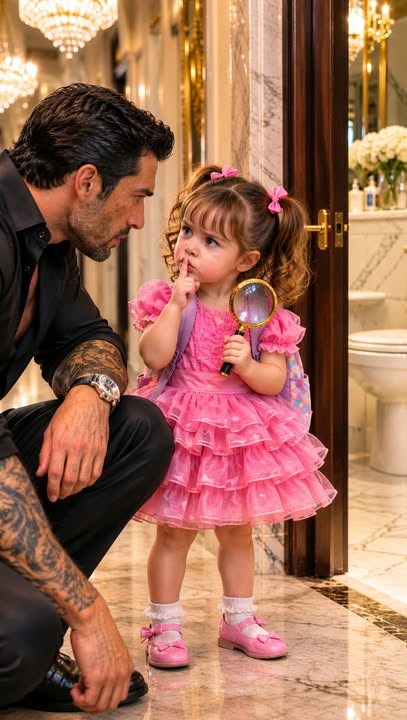
I glanced toward the sitting room, where Sophie lay curled beneath her blanket, one pink ribbon resting against her cheek.
“Where are you?” I asked.
“In the kitchen.”
“I’m coming.”
I ended the call and looked at Raphael and Isabella.
“Elena has a letter from my father.”
Raphael’s expression changed, but he did not ask the question that had risen in all of us.
“She said Marcus mustn’t know,” I continued. “And she said there’s a reason she kept it from me.”
Isabella stood slowly.
“Do you want me with you?”
I hesitated.
There were several answers I could give, and none of them felt honest enough to be easy.
“Yes,” I said at last. “But I don’t want you to feel you have to stand between me and whatever I learn.”
“I won’t.”
Raphael closed the document case.
“I’ll stay with Sophie and monitor the house.”
“Keep the archive copies with you,” I said. “Don’t send them through the security office.”
“I won’t.”
He looked toward Isabella, then back at me.
“Dante, Marcus has asked for a private meeting.”
“When?”
“Just now. He sent a message while we were reviewing the register.”
“Where?”
“His office.”
“Did he say why?”
“He said he wants to offer you a choice before this becomes bigger than it needs to be.”
Isabella’s face tightened.
“That sounds like he knows what we found.”
“Or he knows we’re asking questions,” Raphael said. “Those aren’t the same thing.”
I thought of the room beneath the west wing, the old papers, the missing box, the payment records bearing a company connected to Marcus’s operation.
The evidence was incomplete.
So was my trust.
“What do you think he wants?” Isabella asked.
“I think he wants me to hear his side before I decide what to do.”
“Will you?”
“Yes.”
Her gaze held mine.
“Alone?”
“I need to know whether he’ll tell me the truth when there’s no one in the room to reassure him.”
“That isn’t the same as going unprotected.”
“I know.”
Raphael set the document case on the library table.
“I’ll stay nearby and keep a secure line open. No one needs to be alone in a dangerous sense just because they’re alone in a room.”
That was the kind of distinction I had once dismissed as unnecessary.
Now it felt like wisdom.
I looked at Isabella.
“Come with me to Elena first,” I said. “Then I’ll meet Marcus.”
She nodded.
We found Elena in the kitchen, standing beside the table with her hands wrapped around a cup of tea she had not touched.
The housekeeper’s uniform was still neat, but her face had lost its usual composure.
When she saw me, she stood.
“I’m sorry,” she said.
“You don’t need to apologize yet.”
“I should have told you years ago.”
“Why didn’t you?”
“Because your father asked me to wait.”
“Until I was ready?”
“That’s what he said.”
I pulled out the chair across from her.
“Tell me what he wrote.”
Elena looked toward the doorway, where Isabella had paused.
“Is she safe to hear it?”
The question hurt more than I expected.
“She’s here because she found the records and brought them to me.”
Elena lowered her eyes.
“I know.”
For a moment, I thought she might say more.
Instead she sat down, her fingers tightening around the untouched cup.
“When your father got sick, he became worried about what would happen after he was gone,” she said. “Not about the organization. He knew that would carry on. He was worried about you.”
“He never told me.”
“He said you were too young to understand the difference between being protected and being controlled.”
I looked at Isabella.
She did not move.
“Did he tell you that Marcus would be responsible for my safety?” I asked.
“He said Marcus was the person he trusted most to keep you out of danger.”
“That sounds like the guardian arrangement in the file.”
“Yes.”
“Did my father give Marcus authority over the security operation?”
“No. He told him to watch over you and keep you informed. He was very clear that the organization would remain yours to lead when you were ready.”
The typed summary in the archive seemed to rise before my mind.
Marcus would manage certain security expenses and keep Dante informed of any material risk.
Not my father’s words.
Someone had expanded them, then written Marcus’s name beneath them.
“Do you know who prepared that summary?”
“I don’t.”
“Did your father ever mention a person named Calder?”
Elena shook her head.
“He gave me the letter two weeks before he died. He asked me to keep it in a safe place and bring it to you when the time was right.”
“And you decided when I was ready?”
“No,” she said softly. “I let him decide for me.”
“That isn’t an answer.”
“No. It isn’t.”
She pressed her lips together, trying to gather herself.
“After he died, Marcus told me the letter was probably a personal note that would upset you. He said your father had written it when he was unwell, and that it was better to wait until you were older.”
“Did you believe him?”
“I did. At first.”
“What changed?”
“Nothing changed all at once. You grew older, and I kept hearing the same explanation from Marcus. Then, a few years later, he asked whether I still had the letter.”
The room seemed to narrow.
“What did you tell him?”
“I told him I didn’t.”
“Why?”
“I realized he was afraid of what it said.”
“Did he ask to see it?”
“No. He asked if I’d given it to you. When I said I hadn’t, he told me to keep it hidden.”
Isabella looked at Elena.
“Did he tell you not to show Dante?”
“Yes.”
“Why didn’t you tell Dante then?”
Elena’s gaze dropped to the table.
“Because I thought I was protecting him. And because Marcus had spent years taking care of this house and the people in it. I didn’t want to believe he would use my trust to keep something from Dante.”
I felt no anger toward her.
Only a familiar ache at the ease with which fear could dress itself as loyalty.
“Where’s the letter now?” I asked.
“At my apartment.”
“Why not here?”
“Because I was afraid someone would search the house.”
“Did Marcus search it?”
“No. But after I told him I still had the letter, he asked where I kept my important papers.”
The answer came with quiet shame.
“I lied,” she said. “I told him I’d thrown everything out.”
“When did he ask?”
“Two years ago.”
Raphael’s words returned to me.
The documents could be changed.
The people who knew about them could be pressured, not with force, but with the familiar weight of old favors and the fear of being the one who made trouble.
“Can you get the letter tonight?”
“Yes.”
“Will you?”
Elena looked toward the sitting room.
“Sophie is asleep.”
“Raphael can stay with her.”
“I don’t want her waking up alone.”
“She won’t.”
Elena’s gaze softened with gratitude, but the hesitation remained.
“Dante, if you read that letter, you may learn things about your father that you can’t take back.”
“I know.”
“And Marcus may not be the only person named in it.”
The old phrase, the forged summary, the missing box, the movement lists: each clue seemed to circle back to my father’s last years.
I had spent so long thinking the past was settled that I had mistaken silence for peace.
“Bring it,” I said.
Elena closed her eyes briefly.
Then she rose.
As she left the kitchen, Isabella moved toward the window.
I stood near the table, listening to Elena’s footsteps fade through the hall.
“I’m sorry I doubted her,” I said.
“You don’t have to apologize to me for that.”
“I do.”
She turned.
“I came back into the house believing the worst about you.”
“You had reason to suspect me.”
“Not enough reason to decide I already knew the truth.”
Her expression softened, but she did not rescue me from the admission.
“I understand why you were frightened,” I continued. “I don’t want to use that understanding to excuse what I did.”
“I appreciate that.”
“I should have asked before I watched you.”
“You did ask, eventually.”
“After I’d already decided what I was looking for.”
A faint, sad smile appeared.
“Sometimes people ask questions only after they’ve chosen the answer they want.”
I accepted that.
The truth was becoming difficult to bear not because it was mysterious, but because everyone in the room had made a choice they believed was protective.
Elena had kept a letter.
Isabella had hidden evidence.
I had watched them both from a distance rather than trusting them enough to listen.
Marcus had done whatever he had done with the same word—protect—as his explanation.
“Do you still want to be with me?” I asked.
The question surprised us both.
Isabella looked down at her hands.
“I don’t know what I want yet.”
The answer was painful.
It was also fair.
“I won’t ask you to decide tonight.”
“I don’t want to leave you alone in this.”
“That isn’t the same as wanting to stay.”
“I know.”
She raised her eyes.
“I cared about you before I knew there were records with my name in them. I cared about you before I knew Marcus had described our meeting in a file. But I also need to know that you can hear something you don’t like without turning the person who tells you into the danger.”
“I have to prove that.”
“Yes.”
“I will.”
“I hope you do.”
She did not say she believed me.
I did not ask her to.
Elena returned forty minutes later, carrying a narrow wooden box tucked beneath her arm.
Her eyes moved from me to Isabella and then to the hallway, where Raphael stood watch near the sitting room.
“I brought it.”
The box was polished dark wood, with a small brass clasp.
It looked ordinary enough to contain a lifetime of secrets.
Elena placed it on the table.
“I never opened the letter,” she said. “I only moved it when I thought the hiding place wasn’t safe.”
“Where did you keep it?”
“Inside a tin in the back of my linen cupboard. No one would think it mattered.”
She undid the clasp.
Inside lay a cream-colored envelope, its edges softened with age.
My name was written across the front.
For Dante.
The handwriting was unmistakably my father’s.
I lifted the envelope, but did not open it.
For years I had wanted one more conversation with him.
Now the chance to hear his words made me afraid.
“What did Marcus say about it?” I asked Elena.
“He said your father may have been confused near the end.”
“Was he?”
“He was tired. He was ill. But he knew who he was and what he wanted.”
I looked at the sealed flap.
“Why didn’t you give it to me when I was younger?”
“Because I believed Marcus when he said it might hurt you. Then I waited so long that every year made it harder to explain why I had waited the year before.”
Her voice broke on the last words.
“I’m sorry, Dante.”
“I know.”
That was all I could offer without pretending that forgiveness had already arrived.
I broke the seal.
The letter contained three folded pages.
The first began with my father’s name for me, the one he had used when he wanted me to stop acting like a child and start listening.
Dante—
If Elena has kept this for you, then I asked her to wait until you were old enough to choose your own life.
I sat down.
The first page described my father’s decision to ask Marcus to protect me from a rival organization that had begun following the family.
He had trusted Marcus to keep me safe, but not to take my place.
Marcus was to safeguard information, manage security details only while I was too young to direct them, and tell me the truth when I was ready.
He was not to become my guardian in every matter.
He was not to decide who I trusted.
He was not to use my name or my father’s memory to hold power over me.
The lines were plain, without accusation.
My father had not believed Marcus would betray him.
He had simply understood that trust needed boundaries.
The second page contained a list of people who had been part of the protection arrangement.
My father had written that a rival organization had learned about my movements and that he suspected someone inside his business had been leaking information.
He had not known who.
He wrote that he hoped Marcus would be honest with me, even if the truth became difficult.
At the bottom, he had added the words:
Quiet harbor means only this: if you are afraid, come home and speak to someone who loves you. It is not a password. It is not an order. No one else can use it to decide what you should do.
I read the passage again.
The phrase in the archive had been used like a mark of authority.
My father had meant it as an invitation.
The third page was shorter.
He said he had asked Marcus to watch over me, not to make me dependent on him.
He had asked Elena to keep the letter safe because Marcus might feel ashamed if he believed my father doubted him.
He had not wanted me to inherit suspicion along with the family.
My father had not known whether Marcus would misuse the trust.
He had only known that no one should be allowed to turn protection into ownership.
I lowered the pages.
“Does the letter identify the person who was leaking information?” Isabella asked.
“No.”
“Does it say anything about the payments?”
“No.”
Raphael joined us at the table.
“Does it confirm the guardian arrangement?”
“It says my father asked Marcus to protect me while I was young. Nothing more.”
The letter did not prove the movement lists were Marcus’s work.
It did not prove the payments were tied to the tracking.
It did not explain who had added the coded phrase to the summary.
But it changed the shape of everything.
The old note had not been an endorsement of Marcus’s authority.
It had been a warning against allowing that authority to grow beyond its purpose.
My father’s trust had been real.
So had its limits.
I laid the letter beside the copied records.
For a moment, I saw the life I could preserve if I chose not to act.
Marcus would remain in charge of security.
The organization would keep its routines.
The people who depended on those routines would not be forced to face uncertainty.
I could call the evidence incomplete, because it was incomplete.
I could tell myself the payments were ordinary and the handwriting belonged to someone else.
I could protect the stability of my father’s organization by keeping quiet.
Or I could give the evidence to Raphael, allow an independent review, and accept whatever followed.
The choice was not between loyalty and betrayal.
It was between loyalty to a person and loyalty to the truth that person had been trusted to protect.
“I’m meeting Marcus,” I said.
Isabella’s shoulders stiffened.
“Tonight?”
“Yes.”
“Will you tell him about the letter?”
“I’ll tell him what it says.”
Raphael leaned against the table.
“Do you want me there?”
“No. I want you close enough to hear if I call.”
“I can arrange that.”
I turned to Elena.
“Stay here with Sophie. Raphael will make sure the house is secure, but nobody needs to tell her anything until she wakes.”
Elena nodded.
“And Isabella?”
“I’ll stay,” she said.
She had made no promise about tomorrow.
That was enough.
The drive to Marcus’s office was quiet, but it was not empty.
I brought my father’s letter in a folder and left the copied payment records with Raphael.
If Marcus offered a reasonable explanation, I would listen.
If the records pointed to him, I would not hide them.
When we arrived, Marcus was waiting in the conference room.
He had removed his jacket and rolled his sleeves to the elbow, as he often did when he wanted a conversation to feel personal rather than official.
He stood when I entered.
“I’m glad you came.”
“I wanted to hear what you had to say.”
His eyes moved to the folder in my hand.
“You found the second box.”
“Elena had the letter.”
His expression changed.
Only briefly, but I saw it.
“You read it?”
“Yes.”
“What did Vincenzo say?”
“That you were asked to protect me, not to control what I knew.”
Marcus looked away.
“I never controlled you.”
“You kept my father’s letter from me.”
“I didn’t have it.”
“You knew Elena did.”
“She told me years ago that she had a letter. I thought it would do more harm than good.”
“Did you know what it said?”
“No.”
“Did you ask?”
He hesitated.
“I asked what your father had written.”
“And when Elena said she wouldn’t tell you?”
“I let it go.”
“You told her to keep it hidden.”
“I was trying to prevent you from reading something written when Vincenzo was ill.”
“My father knew what he wanted.”
“I’m not disputing that.”
“You’re saying the letter would have harmed me without reading it.”
“I’m saying your father was dying, and he may have written things he didn’t mean in the way they sounded.”
The excuse was not cruel.
That made it harder to dismiss.
It was exactly the kind of argument I had once made for him in my own mind.
I placed the letter on the table.
“My father said you were to protect me from a rival organization. He said you were not to make me dependent on you, and not to decide who I could trust.”
Marcus lowered his eyes to the paper.
“Those were his words?”
“Yes.”
“I did protect you.”
“I believe you did.”
He seemed to have expected a different answer.
“I was there when your father died,” he said.
“I know.”
“I was there when you had to take over.”
“I know.”
“I kept the organization together when you were still trying to understand what you’d inherited.”
“I know that too.”
“Then you know I didn’t do it for myself.”
I remembered the empty house after my father’s funeral, Marcus sitting beside me in the kitchen, his hand firm on my shoulder.
I believed that moment had been real.
Perhaps it had.
But a real kindness could become a reason someone believed he was owed something.
“I’m not saying you did,” I told him.
He sat down slowly.
“What are the records you found?”
“Messages tracking my movements. Payment records through Northline. Notes related to my schedule. An old summary that gave you authority my father never gave you.”
“Have you verified the payments?”
“Not yet.”
“Have you verified the handwriting?”
“Raphael is doing that.”
“Then you don’t know that I had anything to do with the messages.”
“No.”
“Or the payments.”
“No.”
“Then what do you want from me?”
“The truth.”
“I’ve told you the truth.”
“Have you?”
He looked at me, and for the first time that evening, the weariness in his face seemed to be more than an act.
“I believe there were times when I kept things from you,” he said. “I thought I was managing the risk.”
“You thought I couldn’t handle the truth.”
“I thought you were carrying enough.”
“That wasn’t your choice to make.”
“No,” he said, after a moment. “It wasn’t.”
I felt the answer reach somewhere beneath the anger.
It did not repair anything.
It did make it harder to turn him into a villain simple enough to hate.
“Marcus, did you arrange my meeting with Isabella because you wanted me dependent on her, or because you believed we might help each other?”
He did not answer at once.
“I wanted you to have a life outside this work,” he said. “I wanted you to have someone who could see you as more than your name.”
“Did you put her name in a file?”
“Yes.”
“Did you pay her?”
“No.”
“Did you track her after you introduced us?”
“No.”
“Did you use her to get information from me?”
“No.”
The answer came firmly.
I believed he believed it.
That was not the same as knowing it was true.
“Why did the archive door get left open?”
“I don’t know.”
“Why was the access panel disabled?”
“There was a renovation.”
“Not in that hallway.”
“I’ll check the records.”
“Why was my father’s box stored under your name?”
“I moved it so it wouldn’t be discarded during the renovation.”
“Why didn’t you tell me?”
“Because it was personal.”
“It was mine.”
“Yes.”
He pressed his hands together on the table.
“I didn’t think you were ready to read it.”
“Again, you decided that for me.”
He looked down.
I thought of the letter in my folder, and the years it had waited in Elena’s linen cupboard.
“Did you know about the company’s payments?” I asked.
“I approved Northline’s general budget.”
“Did you approve payments for route coverage and schedule review?”
“I don’t remember those entries.”
“Did you ask anyone to collect information about my movements?”
“No.”
“Did you ask anyone to do it without telling me?”
“No.”
“Did anyone else have authority to approve those expenses?”
“Two regional supervisors. The finance director. And me.”
“Who had access to my schedule?”
“Your office staff, security, and anyone you told.”
“Some of the movements in the notes were never on my schedule.”
Marcus was quiet.
“Then someone was close to you,” he said.
“Three people knew about one of the meetings.”
“Who?”
“Raphael. You. Me.”
“Then the leak may have come from someone who overheard you.”
“That doesn’t explain the payments.”
“No,” he said. “It doesn’t.”
The room seemed to tilt around that admission.
I had been prepared for him to deny everything, to call the papers fabricated, to tell me Isabella had manufactured them.
Instead, he was acknowledging the questions while refusing their answer.
It was reasonable.
It was also maddening.
“Dante,” he said, “whatever you decide to do, don’t release incomplete information as though it were proven.”
“I won’t.”
“Then let me investigate it.”
“No.”
His face tightened.
“Why not?”
“Because you’re part of the records we’re investigating.”
“Being part of the security operation doesn’t make me guilty.”
“No. It makes you conflicted.”
“You think Raphael isn’t?”
“Raphael isn’t named in the payment records.”
“He knew your father.”
“So did you.”
Marcus pushed his chair back, but he did not rise.
“This is how organizations fracture, Dante. People hear half a story and choose sides before they know what happened.”
“I’m not asking anyone to choose sides.”
“You’re removing me from the investigation.”
“Temporarily.”
“Without telling the people who depend on me?”
“I’m telling them the operation is under review.”
“That will create uncertainty.”
“Then we will manage it.”
“You’ll weaken the organization.”
“If we can’t survive an honest review, it was already weaker than I thought.”
A long silence followed.
Marcus looked toward the window.
Outside, the city was dark, the glass reflecting us back at ourselves.
“I built that system for you,” he said.
“You helped build it.”
“I kept people safe.”
“I know.”
“Your father trusted me.”
“He did.”
“Then don’t let one paper erase everything I’ve done.”
“It doesn’t erase it.”
“Doesn’t it?”
The question held no anger.
Only hurt.
I thought of the first years after my father’s death, the difficult decisions Marcus had made, the nights he had sat with me when the house felt empty.
I thought of the letter, where my father had written that trust should not become ownership.
I could not erase Marcus’s goodness.
I could not use it to erase the evidence either.
“I’m going to give Raphael the records,” I said. “I’m going to have an independent group review the payments, the access logs, and the archive documents.”
“You’ll need to tell the board.”
“Yes.”
“Some of them will ask for my removal.”
“Then I’ll make sure the review is fair.”
“And if the review finds nothing?”
“Then I’ll say so.”
“And if it finds something?”
“I’ll say that too.”
Marcus’s hands relaxed, then tightened again.
“You would put the organization through all of this over a set of copied papers?”
“I would put the organization through this because someone may have been using its resources to track me, and because the evidence touches the person in charge of security.”
“What about Isabella?”
“What about her?”
“She found the papers in the archive, copied them, and hid them in your home. How do you know she wasn’t trying to force you into a decision?”
I felt the familiar pull of suspicion.
Then I let it pass without obeying it.
“I don’t know everything she did,” I said. “I know she brought the evidence to me because she feared I would react before I could understand it. I know I made that fear more reasonable by watching her instead of asking her.”
Marcus looked at me as if I had offered him a confession he could use.
“Do you love her?”
“That isn’t the question.”
“It is if she’s influencing you.”
“She isn’t deciding what I do.”
“Then why are you defending her?”
“I’m not defending her secrecy. I’m refusing to make it proof of guilt.”
He lowered his gaze.
For a moment, we were not the head of an organization and the man who had helped raise him.
We were two people who knew each other well enough to recognize where the other was most afraid.
“I wanted you to have what your father had,” Marcus said. “A life that wasn’t built entirely around danger.”
“You wanted that for me?”
“Yes.”
“Then why did you keep the letter?”
“I thought it would make you question everything.”
“It has.”
“Exactly.”
“And now I know that my father trusted you to protect me, but not to decide what I could know.”
Marcus looked away again.
“I never wanted to replace him.”
“Then don’t use his trust
**–END OF PART 5–CLICK “NEXT” AT THE BOTTOM OF THE PAGE TO CONTINUE READING**
* * *
[PREVIOUS: PART 4](https://echoesofstories.idolsgift.com/blog/part-4-the-message-behind-the-mirror-047) | [NEXT: PART 6(THE END)](https://echoesofstories.idolsgift.com/blog/part-6-the-end-the-message-behind-the-mirror-047)
✓ Lynn R. Adams
Part 5 – The Price of the Truth “I’m here,” I told Elena. The words came out steadier than I felt. “I’ll come to you,” she said. “Please don’t bring Marcus.” “I won’t.” “And don’t bring Sophie in…