PART 5: The Mark in the Photograph 041
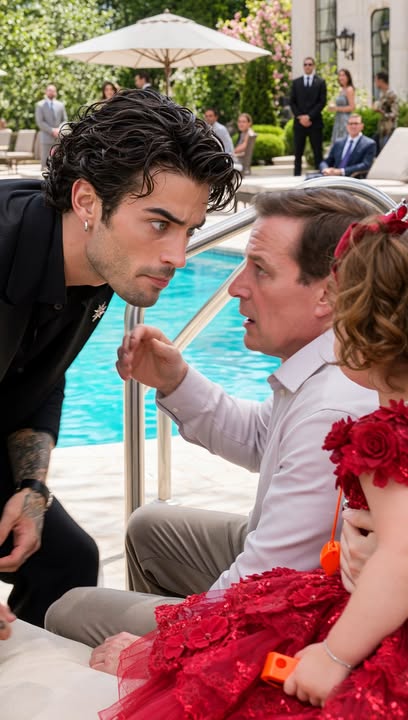
Part 5 – The Choice to Let the Truth Breathe
For a moment, Vincent could not make himself look away from the name on the adoption record.
His mother.
Rosa stood beside him, one hand resting on the back of Sophie’s chair, while the little girl leaned against Vincent’s knee and examined the silver leaf brooch.
“What does it say?” Rosa asked.
Vincent read the line again, though the letters remained unchanged.
“It lists my mother as the birth mother.”
Rosa’s face had gone still.
“But that can’t be right,” she said.
“I don’t know what it means yet.”
Sophie tugged at his trouser leg.
“Dada, leaf.”
Vincent lowered the record to the table and crouched beside her.
“It’s Rosa’s special leaf.”
“Pretty.”
“It is.”
Sophie looked up at Rosa.
“Your mommy?”
“Yes, sweetheart,” Rosa said, gathering her composure. “It belonged to my mother.”
Sophie touched the brooch with one careful finger, then turned to Vincent.
“Your mommy too?”
The question, asked with the plain curiosity of a child who saw no reason a family could not be shared, brought Vincent’s attention back to the record.
He brushed a curl away from Sophie’s forehead.
“My mother was your grandma,” he said gently. “Rosa’s mother was her grandma too.”
Sophie considered this for a moment.
“Two grandma?”
“That’s right.”
“Good.”
She smiled and returned to the brooch.
Vincent stood, his gaze meeting Rosa’s across the table.
Neither spoke until Sophie had wandered toward the window to watch Marco crossing the garden.
“Could the record be wrong?” Rosa asked quietly.
“It could be incomplete, misfiled, or misunderstood.”
“Or the name could refer to someone else.”
“It could.”
Vincent kept his voice measured, though the paper in his hand seemed heavier than it should.
“An old record is a lead, not proof.”
Rosa nodded, but her eyes remained fixed on the line.
“My mother told me her sister gave birth to a child.”
“She may have known only part of what happened.”
“Why would the record name your mother?”
“I don’t know.”
The answer was difficult to say because the unknown pressed against everything he had believed about his family.
His mother had died before Sophie was born, leaving behind photographs and a handful of stories, but no hint of this.
He had never heard her speak of Elena’s adoption.
He had never imagined she might have been involved.
Rosa pulled the chair out and sat down slowly.
“If this is true, then my mother’s sister was Elena’s birth mother, but your mother arranged for Elena to be adopted.”
“Or the record has placed her name in the wrong field.”
“Either way, the truth is different from what Elena believed.”
“Perhaps.”
Vincent looked down at the document.
A small notation near the bottom indicated that the copy had been produced from a ledger held in the neighboring town’s archives.
There was no signature from his mother, no explanation, no account of how the adoption had been arranged.
Only a name, typed into a space that could change the shape of every family story around it.
“Who sent this?” he asked Marco.
“The counselor’s office,” Marco said. “They found the archive reference and requested the copy with your authorization.”
“Did they see the original?”
“They say this is a certified extract, but they recommended verifying it in person.”
“Then we do that before we draw conclusions.”
Rosa looked at him.
“You’re going to the archive?”
“I’m going to ask what the record actually says, who created it, and whether there are other documents.”
“And if it says the same thing?”
“Then we still ask what it means.”
The answer did not comfort either of them, but it gave the uncertainty a direction.
Sophie wandered back, carrying the little notebook with her drawings.
“Look,” she said.
She showed them a page covered in circles, each one colored differently.
“That’s everyone?”
“Everyone,” Sophie declared.
She tapped one circle, then the next.
“Dada. Rosa. Dan. Me.”
Vincent glanced toward the record.
There was already a new person waiting beyond the boundaries of the page: his mother, whose name had appeared where it should not have been.
He gently closed Sophie’s notebook.
“That’s a lovely family picture.”
“More people?”
“Maybe,” he said. “There are always people who love us.”
Sophie accepted this answer and climbed onto his knee.
Rosa watched them, her face carrying a sorrow that made Vincent’s own anger feel suddenly misplaced.
Whatever his mother had done, Rosa had lost a mother too.
And Elena had lived her whole life believing the roots of her story were missing.
Vincent had wanted certainty for his daughter, a clean account he could give her when she was old enough.
Instead, the more they learned, the more careful the truth required them to be.
That evening, Vincent invited Daniel and Mrs. Bellini to the mansion.
He asked Rosa to join them and placed Elena’s letter, the photograph, the brooch, and the adoption record on the study table.
Sophie stayed upstairs with Marco, who was reading her a book about a rabbit with a red scarf.
“I want everyone to see the same things,” Vincent said. “No private versions, no assumptions passed along as facts.”
Mrs. Bellini sat with her hands folded, visibly shaken by the new record.
“I never knew your mother’s name was on anything,” she said.
“Neither did I,” Vincent replied.
Daniel leaned over the copy, careful not to touch it.
“Could there have been another woman with the same name?”
“My mother’s name was uncommon,” Vincent said. “But we’ll check.”
Rosa looked at the photograph.
“I remember Elena asking about my mother’s sister,” she said. “She wanted to know whether the baby had survived and whether the family had ever been told where she went.”
“Did she tell you what record she found?” Mrs. Bellini asked.
“No. She said she had found a connection, but not enough to be certain.”
“And this document might be what she found,” Daniel said.
“Or a different part of the same trail,” Vincent replied.
He set Elena’s letter beside the certified extract.
“She wrote that she had found a photograph and a name, but not enough to know what they meant.”
Rosa studied the handwriting.
“She never told me your mother’s name.”
“No,” Vincent said.
“Perhaps she didn’t know it.”
“Or perhaps she did and chose not to write it.”
Mrs. Bellini’s expression turned thoughtful.
“Elena might have been trying to protect someone, not only herself.”
Vincent looked at her.
“Do you think she knew my mother was involved?”
“I don’t know.”
Mrs. Bellini did not rush to fill the silence.
“I remember your mother being a kind woman to the staff. But I never saw her involved in an adoption, and I would not want to turn a memory into evidence.”
Her answer echoed the caution they had all begun to share.
Vincent picked up the document.
“Tomorrow I’ll speak with the archive directly and ask to see the ledger, if they can make it available.”
“The counselor offered to go with us,” Daniel said.
“Then we’ll ask her to come.”
“And until then?” Rosa asked.
Vincent looked at the family gathered around the table.
“Until then, we keep this within the people who need to understand it.”
“What about your relatives?” Daniel asked.
“They don’t need to know yet.”
Rosa’s shoulders relaxed a fraction.
“Not because you want to hide it?” she asked.
“Because there is no confirmed story to tell.”
Vincent met her gaze.
“I won’t make Elena’s uncertainty into gossip, and I won’t let anyone treat Sophie’s history as property of the family.”
Mrs. Bellini’s eyes softened.
“That sounds like what Elena hoped for.”
“I hope it is.”
The next morning, the counselor joined Vincent and Rosa at the neighboring town’s archive.
The building was modest, its records room lit by tall windows that turned the dust in the air into a soft gold haze.
A staff member brought out the ledger and explained how adoption information had been recorded at the time.
The certified extract had copied the name exactly as it appeared in one column.
But the column heading, faded in the original volume, was not “birth mother.”
It read “responsible party.”
Vincent leaned closer.
The word was difficult to make out, but the archivist confirmed it.
“It could mean the person who arranged or authorized the placement,” she said. “It does not necessarily identify the child’s birth parent.”
Rosa exhaled.
“So the record doesn’t say Elena was born to Vincent’s mother.”
“No,” the counselor replied. “It says she was listed as the responsible party in the adoption process.”
Vincent felt relief, then the sharper unease beneath it.
“My mother may have helped arrange the adoption.”
“That is one possibility,” the counselor said. “There may have been a legal or charitable role, or she may have been recorded as the person who delivered the paperwork.”
“Can you tell from this ledger?”
“Not by itself.”
The archivist turned a fragile page with gloved hands.
A second entry had been written in the margin, almost hidden by the binding.
The name of a local charitable trust appeared there, followed by the initials of a caseworker.
The counselor made a careful note.
“This gives us another avenue to follow,” she said. “It does not settle the relationship.”
Rosa looked at the faded page.
“My mother’s sister may still have been Elena’s birth mother.”
“Yes,” the counselor said. “But this record can’t confirm that.”
Vincent listened as they discussed possible next steps: searching for surviving records, contacting the trust’s successor organization, and determining whether any living relatives could offer reliable information.
There was no dramatic answer hidden in the ledger.
There was only a trail that might lead somewhere, and the responsibility to follow it without deciding what it had to mean.
On the drive home, Rosa sat beside him in the back of the car.
For a long while, neither spoke.
Then she said, “I’m sorry I let you believe the mark proved something.”
“I believed that before you said anything.”
“You thought it came from Elena.”
“I wanted it to.”
Rosa turned toward the window.
“I wanted it to be simple too.”
Vincent watched the city pass in the fading afternoon light.
“Why didn’t you tell me your mother had tried to find her sister’s child?”
“I didn’t know she had tried until after Elena died.”
“When?”
“Years ago, I found a note among my mother’s things. She had written down the name of the town and a date.”
“Why didn’t you show me?”
“Because I didn’t know if it was connected to Elena.”
“And you were afraid of what might happen if it was.”
“Yes.”
Rosa spoke with no defensiveness.
“I had spent my life watching people with influence make decisions for people who had none. I didn’t want Elena’s story or Sophie’s story to become something the powerful could claim.”
Vincent absorbed that.
“You thought I might do the same.”
“I thought you might try to protect Sophie by deciding what she was allowed to know.”
He looked at her.
“That is fair.”
Rosa’s eyes widened slightly.
“I don’t mean it as an accusation.”
“I know.”
He rested his hands together.
“I’ve spent most of my life believing that keeping control is the same thing as keeping people safe.”
“And now?”
“Now I’m trying to understand the difference.”
The car rolled to a stop at a red light.
Rosa looked at him, and the years of trust between them seemed to return in small, careful pieces.
“I should have told you the moment Elena asked me,” she said.
“Yes.”
“I was afraid.”
“I understand.”
“Do you forgive me?”
“I’m not sure yet.”
She nodded, accepting the answer.
“I don’t want a quick apology to erase what it cost you,” she said.
“Thank you.”
“And I don’t want you to think I ever cared for Sophie less because I was keeping this secret.”
“I never thought that.”
Vincent looked toward the mansion as the car turned onto the private drive.
“Whatever the records say, you are part of her life because you love her.”
Rosa’s eyes glistened.
“And you’re part of hers because you’re her father.”
The words were simple, but they eased something neither of them had known how to name.
That evening, Vincent received a call from a relative he had not spoken to in several months.
His cousin, Paul, had heard that the family had requested old adoption records.
He did not ask about the details.
He did not threaten to reveal anything.
Instead, he spoke with the polished concern of someone trying to make a private matter sound like a family duty.
“People are already asking questions,” Paul said. “It might be wise to keep the paperwork under control until we know what it says.”
Vincent stood by the study window, his hand resting near Elena’s photograph.
“Who is asking?”
“People who hear things.”
“Then tell them nothing.”
Paul sighed.
“I’m only trying to prevent a problem.”
“There is no problem.”
“There could be, if a story gets out before the family can agree on what to say.”
Vincent’s face tightened.
“The family does not get to agree on Sophie’s story for her.”
“I didn’t mean it that way.”
“I know exactly how you meant it.”
There was no anger in Vincent’s voice, only a firmness he had not needed to use in years.
He told Paul that the record was incomplete, that no conclusions had been reached, and that Sophie’s private history would not be discussed outside the people directly involved.
“Understood?” he asked.
After a pause, Paul said, “Understood.”
Vincent ended the call and stood still for several breaths.
The old reflex returned: secure every paper, close every door, make sure no one could turn uncertainty into danger.
He could have moved the records into a private office and kept them beyond the reach of anyone else.
He could have told the counselor to stop contacting the archive.
He could have made sure no one learned his mother’s name appeared in the ledger.
It would have been easy.
It might even have looked like protection.
But Elena had written that she wanted the truth preserved, not buried.
Sophie could not choose what to learn yet, but Vincent could choose whether to give her the chance to decide later.
He called the counselor the next morning.
“We’ll continue with the records,” he said. “Keep the search within the legal process, and tell us what can be verified.”
“I will.”
“And if the information becomes uncomfortable for my family, that doesn’t change what we do.”
There was a brief pause on the line.
“Understood.”
When he ended the call, he opened Elena’s letter again.
He read the final lines, the ones he had not yet shown Rosa or Daniel.
*If there is more to learn, let Sophie meet it in a way that leaves her room to be herself.*
Vincent folded the page and carried it to the sitting room.
Rosa sat on the rug with Sophie, helping her arrange crayons into a line of colors.
Mrs. Bellini and Daniel had come to visit, and the four of them made a quiet circle around the child’s drawing.
“I’ve decided we won’t stop the search,” Vincent said.
He placed the letter where everyone could see it.
“We’ll keep the records, the photograph, and the family accounts together. We’ll let the counselor help us verify what can be verified, and we won’t pretend we know what we don’t.”
Rosa looked up.
“And your relatives?”
“They will hear nothing unless it becomes necessary for Sophie’s safety or wellbeing.”
Mrs. Bellini nodded.
“That seems right.”
Vincent turned to Rosa.
“I’m sorry I made you feel that silence was the only way to protect Elena.”
Her eyes brightened.
“I’m sorry I made you carry the silence alone.”
“I don’t know if I can promise I’ll never feel betrayed by what happened.”
“I don’t expect you to.”
“But I know you were trying to honor Elena’s wishes.”
Rosa lowered her head for a moment.
“Thank you.”
Sophie stopped coloring and looked between them.
“Rosa sad?”
Rosa smiled through the emotion in her face.
“Not now, sweetheart.”
“Dada sad?”
“Not now,” Vincent said.
Sophie considered their answers, then held out a crayon to each of them.
“Draw.”
Vincent accepted the green one.
Rosa took the yellow.
Sophie handed Daniel the red, then gave Mrs. Bellini the blue.
“All draw.”
They did.
Vincent drew a crooked rose.
Rosa drew a small house with a garden beside it.
Daniel drew a whistle with a looped cord.
Mrs. Bellini drew a little star.
Sophie looked over the page, pleased.
“Family.”
“Yes,” Vincent said.
The word no longer felt like a claim on the past.
It felt like a promise to let the people in front of him belong to one another, even when the reasons were still unfolding.
That afternoon, Vincent met privately with the pediatrician and the counselor to discuss what Sophie might need as she grew.
They agreed that there was no need to explain uncertain details to a two-year-old.
For now, she could have simple answers, honest ones: families could be formed in more than one way, she was loved, and nothing about a record or a birthmark changed who cared for her.
Vincent wrote the guidance down and placed it beside Elena’s letter.
He did not want to make the conversation a secret that frightened Sophie later.
He wanted it to become a truth she could receive when she was ready.
A week passed before the counselor called again.
The trust listed in the old ledger had been dissolved long ago, but its remaining papers had been transferred to a legal archive.
Some were sealed.
Others could be reviewed by a qualified researcher with permission from the family.
The counselor explained that they could request access, though the process might take time.
Vincent asked what would happen if the papers contained information about living relatives.
“They would be handled privately,” she said. “No one has to publish anything.”
“What if someone in my family wants them concealed?”
“The legal process is not controlled by one family member.”
Vincent looked at Elena’s letter on his desk.
“That is what I wanted to know.”
When he told Rosa, she listened without interruption.
“Do you want to go ahead?” she asked.
“Yes.”
“Even if the answer changes how you remember your mother?”
“I want to understand what she did, not invent a reason for it.”
Rosa nodded.
“And if the truth belongs partly to your mother’s family and partly to mine?”
“Then we learn it carefully.”
He reached for the old photograph.
“For years, I looked at Elena’s mark and thought it was something she had passed to Sophie.”
“What do you think now?”
“I think it may be a clue.”
“And if it isn’t?”
“Then it is still a mark on my daughter’s wrist.”
Rosa smiled faintly.
“That sounds like progress.”
“I hope so.”
A few days later, the counselor brought a sealed response from the archive.
It was addressed to Vincent and marked confidential.
Rosa sat with him in the study while Daniel and Mrs. Bellini waited in the adjoining room.
Vincent opened the envelope.
Inside was a short letter explaining that the archive had located a second file, one kept separately from the adoption ledger.
It contained a handwritten note from Vincent’s mother, submitted shortly after Elena’s adoption.
The note could be released to the family, the counselor wrote, but the archive required one additional signature acknowledging that the family would respect the privacy of any other person named in it.
Vincent read the final sentence twice.
He had expected the file to contain an answer.
Instead, it presented another choice.
He could sign and allow the note to be shared with Rosa and Daniel, the people who had helped carry Elena’s question.
Or he could ask the archive to keep it sealed until they knew more about the names it contained.
Rosa watched him carefully.
“You don’t have to decide this second.”
“I know.”
“Vincent, if the note includes something painful about your mother, you can take time.”
He looked at the signature line.
The instinct to protect his mother’s memory rose beside the instinct to protect Sophie.
He could keep the page closed and preserve the story he had always known.
But Elena’s words returned to him: *Do not let anyone rush her into a story, not even me.*
He realized the choice was not between exposing his mother and protecting her.
It was between pretending the unanswered question did not exist and preserving it for the day when Sophie might ask.
Vincent signed the acknowledgment.
The counselor’s office arranged for a secure copy to be sent to her, and she promised to open it with them present, not alone.
Rosa placed her hand over his for a moment.
“Thank you.”
“I’m not sure I’ve done the right thing.”
“Neither was Elena, I think.”
A week later, they gathered in the study again.
The copy of the handwritten note arrived in a sealed folder, delivered directly to the counselor.
Vincent, Rosa, Daniel, and Mrs. Bellini sat around the desk while the counselor opened it.
The first page contained a brief account of the adoption arrangement.
It confirmed that Vincent’s mother had helped with the placement, but it did not explain why.
The final paragraph had been written in a hurried hand.
The counselor began reading aloud, then paused.
“There’s a name here that may be important.”
Vincent leaned forward.
“What does it say?”
The counselor looked from the page to him.
“It says your mother believed Elena’s birth mother had come back to ask for her child.”
Rosa’s hand found the edge of the desk.
“Did she get to see her?”
The counselor read the line again, then shook her head.
“The note says she did.”
Vincent’s breath caught.
“She met Elena?”
“No,” the counselor said. “The note says the woman saw the baby before the adoption was completed.”
Rosa’s eyes filled.
“Who was she?”
The counselor turned the page.
A name had been written beneath the paragraph, partly obscured by an ink stain.
Vincent leaned closer.
The first name was clear.
The surname was not.
Then, from the hallway, Sophie’s small voice called, “Dada?”
Vincent stood.
“Here, sweetheart.”
She came into the study holding a new card, its front covered in uneven red hearts.
“For you,” she said.
Vincent accepted it and kissed her curls.
“Thank you, Captain.”
Sophie glanced at the paper on the desk.
“Letter?”
“A family letter,” he said gently.
“Good letter?”
“We’re still learning.”
She nodded, satisfied, and leaned against his side.
The counselor looked again at the stained surname.
“I may be able to recover the rest from the original.”
Vincent held Sophie close, his eyes fixed on the name.
The first name was familiar.
It was the name of the woman who had raised him.
But the note referred to a different person—and the surname beneath the stain began with a letter he recognized from Elena’s sealed letter.
He looked at Rosa.
“Do you know anyone in your family who used this name?”
Rosa stared at the page, her face paling.
“I do,” she whispered. “But she was supposed to have died before Elena was born.”
**–END OF PART 5–CLICK “NEXT” AT THE BOTTOM OF THE PAGE TO CONTINUE READING**
* * *
[PREVIOUS: PART 4](https://echoesofstories.idolsgift.com/blog/part-4-the-mark-in-the-photograph-041) | [NEXT: PART 6(THE END)](https://echoesofstories.idolsgift.com/blog/part-6-the-end-the-mark-in-the-photograph-041)
✓ Lynn R. Adams
Part 5 – The Choice to Let the Truth Breathe For a moment, Vincent could not make himself look away from the name on the adoption record. His mother. Rosa stood beside him, one hand resting on the …