PART 5: The Mark in the Oak 046
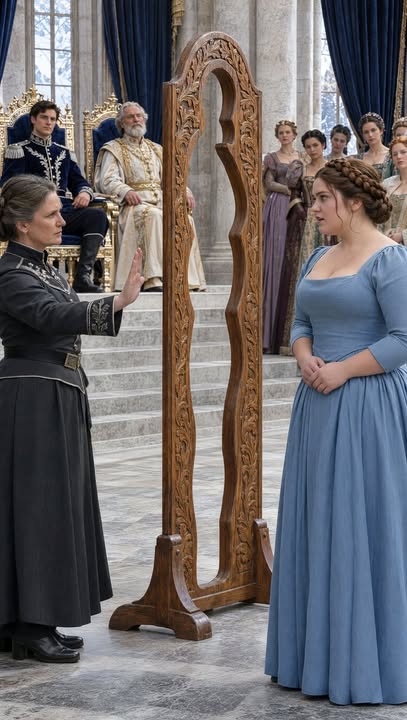
Part 5 – The Choice in the Hall
“I wanted to know whether the mark was still there,” Lord Harrow said.
His answer lingered in the room, neither explanation nor denial.
“Why did that matter?” I asked.
Harrow glanced at the carved flower, then at the letter in my hands.
“Because if it had survived, it might have proved that Queen Eleanor had once promised your mother she would be remembered.”
The words landed softly, but the silence after them was not soft.
Alexander’s face changed.
“You knew about the promise?”
“I knew there had been one,” Harrow said. “I did not know the letter had been hidden in the frame.”
“Then you understood the frame could bring the past back,” I said.
“I understood it might.” He paused. “I thought the mark would be nothing more than an old mark.”
“And you believed that would be enough to make me uncomfortable.”
Harrow did not answer at once.
“I thought the test would be brief,” he said finally. “I did not consider that you might recognize the flower.”
“You knew my mother’s name was on the candidate list.”
“I recognized it after the list was circulated.”
“And you still chose the frame.”
“I thought the old matter was settled. I thought bringing the frame into the hall might remind the prince of his mother.”
His gaze shifted to Alexander.
“I did not intend to embarrass Miss Carter.”
“Intent does not erase what happened,” Alexander said.
“No,” Harrow replied. “It does not.”
The lack of argument left me with nowhere easy to put my anger.
I had expected a defense, perhaps even a denial.
Instead, Harrow stood before us with the weary posture of a man who had confused silence with resolution for so long that he no longer knew the difference.
“Will you help us find the reliquary?” I asked.
“Yes.”
“Will you correct the record about my mother?”
“I will support whatever the king decides.”
“That is not the same as helping.”
His eyes met mine.
“No,” he said. “It isn’t.”
He turned to Alexander.
“I will gather every record I can find about the inquiry and the transfer of the frame. Your Majesty should review them.”
“You will do that today,” Alexander said.
“Yes, Your Highness.”
“And you will not remove anything from the archive.”
Harrow inclined his head.
“I will not.”
When he had gone, Mr. Vale gathered the letter and the linen wrapping.
“I’ll make a secure copy before this is taken to the king,” he said. “The original should remain here until His Majesty has read it.”
“Keep it with you,” I told him.
He understood the request beneath my words.
“I will.”
Alexander waited until Mr. Vale had left the room.
Then he looked at me.
“I need to tell you something.”
The steadiness in his voice made me wary.
“What is it?”
“My father has asked to see me tonight. He wants me to attend a private supper with Lady Helena and her family.”
I recognized the name from the candidate proceedings.
She had been graceful and self-assured, with an ease around the palace that suggested she had been raised among its expectations.
“Why?”
“He says a public understanding between us would strengthen an alliance with her father’s country.”
I studied his face.
“An engagement?”
“He has not used that word yet.”
“But he intends to.”
“I think he does.”
The room seemed suddenly colder, though the windows were closed.
“What will you say?”
“I don’t know.”
The answer hurt more than I expected.
I turned back to the frame, focusing on the fine lines in its grain.
“Yesterday, you said you would ask for the truth.”
“I will.”
“And today you’re unsure whether you’ll choose an alliance over it.”
“I’m trying to understand what the alliance means for the country.”
“I know.”
The trouble was, I did know.
A prince’s choices were not made in private, no matter how quietly a king asked him to make them.
The king had a duty to the people whose lives depended on stable relations with neighboring nations.
Alexander had a duty to his country.
But my mother had also been part of that country, even if the palace had written her name in a ledger and left the rest of her story to disappear.
“I don’t want to be used as the price of your decision,” I said.
“You wouldn’t be.”
“You don’t know that.”
He moved closer, then stopped just beyond arm’s reach.
“I won’t promise you something I haven’t decided.”
“I’m glad.”
“But I want you to know the truth.”
“Then tell me this: if your father gives you the choice between challenging the court and securing the alliance, which one do you think you’ll choose?”
He looked at the letter in Mr. Vale’s empty place on the table.
“I don’t know.”
I drew a slow breath.
“I can’t ask you to choose me.”
“I know.”
“And I won’t let anyone call this a romance made out of gratitude.”
“I would never—”
“You might not mean to. But people will say I arrived as a candidate, discovered an old wrong, and ended up with the prince.”
His expression tightened, not with anger but with the recognition that I had named a truth he would rather not face.
“They will say I was rewarded for what my mother suffered,” I continued. “They’ll turn her courage into a story about my good fortune.”
“I won’t let them.”
“You cannot control what everyone says.”
“No,” he admitted. “But I can control what I do.”
I wanted to believe that would be enough.
I wanted to believe the man who had listened beside the frame would stand beside me when the room was full and the choice cost him something.
But wanting and knowing were not the same.
“I need time,” I said.
“Of course.”
“And so do you.”
He looked as if he might reach for my hand, but let his own fall back to his side.
“I’m sorry I made you carry this with me.”
“You didn’t make me.”
“I asked you to stay.”
“I chose to.”
We stood together in the old west wing, surrounded by the remnants of other people’s choices.
The oak frame had once held children measured against its marks.
The letter had been hidden behind it.
The truth had survived, but only because someone had found a place for it where no official ledger would look.
I thought of my mother’s handkerchief folded in my bag.
I thought of the small stitched flower and the woman who had chosen to protect a kitchen maid even when she knew the palace might punish her for it.
“Your mother believed a promise was worth keeping,” I said.
“So did yours.”
“Then perhaps the two of them understood something the rest of us keep forgetting.”
“What is that?”
“That a promise matters most when keeping it is inconvenient.”
He absorbed the words without answering.
A knock sounded at the door.
A palace messenger entered and bowed to Alexander.
“His Majesty requests your presence in the blue salon, Your Highness.”
“Now?”
“He said it was urgent.”
Alexander glanced at me.
“I’ll come with you,” I said.
“You don’t have to.”
“I know.”
We followed the messenger through the west wing and into the main palace.
The corridors were bright with early evening lamps, though the snow-dark windows made the place feel enclosed.
A servant opened the doors to the blue salon.
King William stood beside the fireplace, one hand resting on the mantel.
Lord Harrow was there, as was the steward.
A small wooden case sat on the table between them.
The king’s face softened when he saw me, though his eyes looked tired.
“Miss Carter,” he said. “I asked Alexander to come, but I hoped you would join us.”
“What is the case?”
“Lord Harrow has found an inventory entry that may identify the keepsake.”
Harrow stepped forward.
“The royal correspondence box contained a note from Queen Eleanor, separate from the letter you found. It referred to a silver reliquary kept in a chest during the west wing renovations.”
He opened the case.
Inside lay a small silver object, darkened with age but intact.
The reliquary was no larger than my palm.
Its lid bore a delicate engraved flower.
I looked at the carved oak frame in my mind, then at the design on the silver.
The same five uneven petals.
“The item was recovered from a storage trunk,” Harrow said. “It had been placed with the tools used during the renovations.”
“Who placed it there?” Alexander asked.
“We do not know yet.”
The king studied the reliquary.
“Queen Eleanor wrote that it was to be returned to the family chapel once the work was complete. The note says she had been told it was misplaced, not stolen.”
“My mother’s letter says she saw Lord Harrow’s assistant put it away,” I said.
Harrow lowered his eyes.
“That assistant died many years ago.”
“And my mother was still dismissed.”
“Yes,” he said. “She was.”
The plainness of his answer did not comfort me.
But it was the first time I had heard him say the words without trying to put a softer name to them.
King William turned to the steward.
“Have the letter and the ledger copied. We will review every surviving record before making a public statement.”
“Your Majesty,” I said, “my mother’s name is already in the ledger.”
“I know.”
“Then it should not remain there without the truth beside it.”
“It will not.”
His promise sounded sincere.
It also sounded private.
I looked at the prince.
He understood before I spoke.
“You said you wanted the truth made right,” I said.
“I do.”
“Will you stand by that when people are watching?”
His father’s gaze settled on him.
The room became very still.
Alexander did not answer immediately.
The king folded his hands.
“There is no need to force a public decision tonight,” he said. “The record can be corrected quietly, and the matter can be handled without turning it into a dispute between families.”
“Quietly,” I repeated.
“The harm was done quietly,” the king said. “It need not be repaired through spectacle.”
“That is true,” Alexander said.
I looked at him.
He met my eyes, then turned to his father.
“But the accusation was not quiet. It was placed in a ledger, and my mother’s dismissal became part of the palace record. If we correct it in private, the false account remains the only one the public can ever see.”
“Public attention may put pressure on relations we have spent years trying to strengthen,” the king replied. “You know what an agreement with Lady Helena’s family could mean.”
“I do.”
“Then you understand that a public challenge may cost more than the reputation of one official.”
“It may,” Alexander said. “But a reputation is not the only thing at stake.”
The king’s jaw tightened.
“Your duty is not to make every wrong in the past a test of your character.”
“No,” Alexander said. “My duty is to ask whether the palace’s comfort is being purchased with someone else’s silence.”
I watched the king take in his son’s words.
He did not look cruel.
He looked like a man who had spent years measuring the cost of every decision and was now being asked to measure the cost of avoiding one.
The king glanced at me.
“Miss Carter, I will clear your mother’s name. I will make certain the record is corrected and that you receive a formal apology.”
“Thank you.”
“I will also ensure that the family of the kitchen maid is informed, if we can locate them.”
“That matters.”
“But I cannot promise that this needs to become a public matter.”
I understood the offer.
It would give my mother the truth in the palace’s own records.
It might even bring a private apology.
But the people who had judged her would never know they had been wrong.
“You’re offering to restore her name where no one can see it,” I said.
“I am offering to correct an injustice without creating a larger one.”
“Perhaps those are the same thing to you.”
The king’s expression shifted.
“Do you believe I am trying to silence you?”
“I believe you are trying to prevent a difficult truth from disturbing a useful arrangement.”
He looked at Alexander.
“And you?”
Alexander’s gaze remained on the reliquary.
“I believe both things can be true.”
His father waited.
The silence asked for a choice.
The king stepped closer to his son.
“Lady Helena and her family will arrive tomorrow. I need you to attend the dinner and allow the engagement discussions to proceed.”
“Father—”
“The alliance matters. The northern border has remained peaceful partly because we have kept our promises to one another.”
“I know.”
“Then be careful not to treat duty as though it were a private burden you can simply set aside.”
Alexander looked down at the reliquary.
“I don’t.”
The king’s voice softened, though its meaning did not.
“If you proceed with a public accusation against Lord Harrow, the talks may end. If the talks end, there may be consequences beyond this palace.”
“And if I accept the engagement?”
“Then we can repair Miss Carter’s mother’s reputation quietly, and the alliance will move forward.”
The offer was not a threat.
That made it harder to refuse.
It was the king presenting his son with a path that protected thousands of people from uncertainty while asking one family to accept a correction no one else would see.
I understood why he believed it was the sensible choice.
I also understood why Alexander might choose it.
The thought hurt more because it was reasonable.
“I should go,” I said.
Alexander turned toward me.
“Emily.”
“I can’t stand here while you decide whether the truth is worth the cost of telling.”
“I don’t want you to leave because of this.”
“I’m not leaving because you haven’t chosen yet.”
I gathered my gloves from the chair.
“I’m leaving because the choice belongs to you, and I won’t become one of the things you weigh against your country.”
The king watched me with an expression I could not read.
“I will have a carriage called,” he said.
“Thank you.”
Alexander moved as if to follow, then stopped himself.
That restraint hurt too, though I could not have told him why.
Perhaps because I wanted him to ask me to stay, even while knowing I would have to refuse until he had answered the question for himself.
At the door, I looked back once.
The reliquary sat open on the table, its flower catching the firelight.
The king stood beside it.
Alexander stood opposite him.
Between them lay the choice.
The carriage waited in the courtyard.
Snow fell softly through the lamps, gathering along the dark stones and the iron gates.
I was fastening my gloves when Alexander came through the entrance hall.
He had put on his coat, but had not brought a hat.
“Emily,” he said.
I stopped beside the carriage step.
“What have you decided?”
He looked past me, toward the road.
“If I challenge the record publicly, the alliance may fail. My father has asked me to attend the dinner tomorrow and allow the engagement to proceed.”
“And you?”
“I have not answered him.”
I nodded once.
“I won’t ask you to choose me.”
“I know.”
“I won’t ask you to choose a life with me before you know whether you can stand beside me when it is difficult.”
“I understand.”
“Do you?”
“I think I’m beginning to.”
The quiet in his voice sounded more honest than any promise would have.
I wanted to touch his hand.
I wanted him to reach for mine.
Neither of us moved.
A footman came through the inner doors carrying a sealed envelope.
“Your Highness,” he said. “His Majesty asked me to give you this before Miss Carter’s carriage departs.”
Alexander broke the seal.
His eyes moved over the page.
Then he read it again, slower.
“What is it?” I asked.
He looked up at me, and all the uncertainty had left his face.
“My father has made the choice for me,” he said.
The carriage horse shifted in the snow.
“What does the letter say?”
Alexander held out the page.
The formal wording named Lady Helena and her family, confirmed the royal dinner, and referred to an intended announcement of their engagement.
At the bottom, beneath the king’s signature, was a final sentence in a different hand.
“If you cannot agree, your cousin Beatrice will be asked to stand in your place.”
My breath caught.
Alexander looked back toward the palace.
“Beatrice doesn’t know.”
The footman lowered his eyes.
A second messenger hurried across the courtyard, carrying another sealed letter.
He held it out to Alexander.
“From Lord Harrow’s office, Your Highness.”
Alexander opened it.
The color drained from his face as he read the first line.
“What is it?” I asked again.
He turned the page toward me.
It was a copy of a household record, newly found among the papers in the king’s cabinet.
Beside the entry for the silver reliquary, a name had been written in Queen Eleanor’s hand.
Not Margaret Carter.
Not the kitchen maid.
The name belonged to the person the palace had protected all these years.
**–END OF PART 5–CLICK “NEXT” AT THE BOTTOM OF THE PAGE TO CONTINUE READING**
* * *
[PREVIOUS: PART 4](https://echoesofstories.idolsgift.com/blog/part-4-the-mark-in-the-oak-046) | [NEXT: PART 6(THE END)](https://echoesofstories.idolsgift.com/blog/part-6-the-end-the-mark-in-the-oak-046)
✓ Lynn R. Adams
Part 5 – The Choice in the Hall “I wanted to know whether the mark was still there,” Lord Harrow said. His answer lingered in the room, neither explanation nor denial. “Why did that matter?” I aske…