PART 5: The Mark Beneath the Frame 046
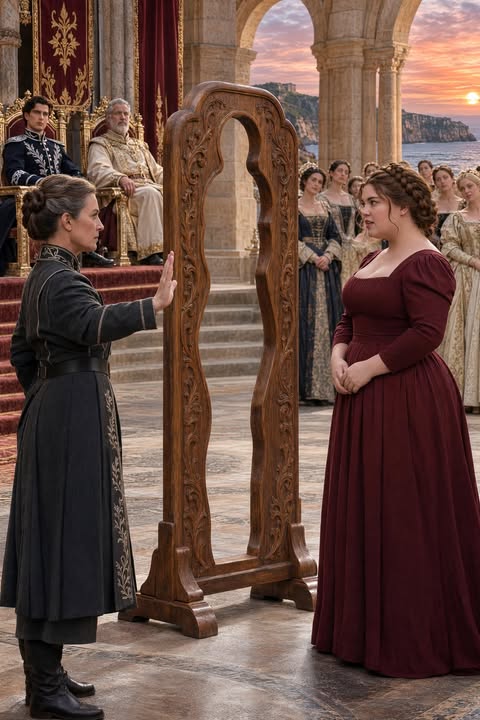
Part 5 – The Truth in the Hall
“If the frame is ever used again, let it ask whether the candidates will obey a rule that has been changed without their consent.”
The king lowered the letter.
For a moment, none of us moved.
The words seemed to settle over the throne hall, reaching into every corner the old test had occupied.
Alexander read them again, this time silently.
“So the frame was meant to expose a rule that had been changed,” he said. “Not to reward the person who obeyed it.”
“That is what the queen believed,” the king replied.
“And Eleanor built it for that purpose.”
“We have not found her instructions, only the queen’s note.”
“But the plate says she made it.”
Alexander turned toward the brass inscription.
The maker’s name was visible again beneath the stand, clear and unadorned.
Eleanor Carter, maker.
I had spent days trying to decide whether that name belonged to someone in my family.
Now it seemed to belong to a story bigger than any one of us, a story the palace had remembered incorrectly because forgetting was easier than asking what the frame had been built to say.
The king looked at the letter in his hand.
“My wife’s note suggests the test was preserved to remind the court of what happened to Eleanor.”
“What happened was that she refused a marriage chosen for her,” I said.
“Yes,” the king replied. “And the queen helped her leave.”
“Was the test meant to prevent the court from doing that again?”
“I don’t know.”
Alexander’s voice was quiet.
“Then we should not pretend we know.”
The king glanced at him, and for once the look held no rebuke.
“No,” he said. “We should not.”
The archivist gathered the fragile papers into their protective folder.
“I’ll continue searching for the original account of the test,” he said. “There may be something in the private papers that clarifies its purpose.”
“Please do,” the king answered.
The archivist bowed and left us with the frame.
I looked at the pale marks on the floor, then at the stand resting between them.
Someone had written an instruction to move it after each candidate.
Someone had chosen its final position.
And someone had kept quiet about why the test existed at all.
The frame had not changed.
The meaning had.
The palace secretary arrived before I could say more.
He spoke to the king in a low voice, then turned toward Alexander.
“Your Highness, Lord Harrow asks that the council meet this afternoon. He says the court has begun to hear rumors about the competition.”
“What rumors?” Alexander asked.
“That Miss Carter’s family is connected to the frame.”
I felt the old, familiar tightening in my stomach.
The king’s face hardened.
“Who told him?”
“The steward cannot say. Lord Harrow believes the information may spread further unless the palace addresses it.”
“Does he propose an address?” Alexander asked.
“He has prepared a statement for the council.”
The king held out his hand.
The secretary passed him a folded paper.
As the king read, his expression grew still.
“What does it say?” I asked.
He folded the statement again.
“It says that the test was conducted according to established practice, that the frame’s position was adjusted for safety, and that any historical connection to Miss Carter’s family is unverified.”
“Was it adjusted for safety?”
“The conservator found no need for it to be moved.”
“Then the statement is not accurate.”
“It is carefully worded,” the king said.
“Carefully worded can still mislead.”
Alexander looked at the folded paper in his father’s hand.
“Lord Harrow is trying to settle the matter before the facts are known.”
“He says he is preventing a rumor from becoming a scandal.”
“By presenting his own explanation as fact.”
The king did not answer at once.
His eyes moved from the statement to the old frame.
The secretary waited by the doorway, uncertain whether to leave.
“Tell Lord Harrow the council will meet,” King William said at last. “But no statement will be issued until we have reviewed the evidence.”
The secretary bowed and withdrew.
Alexander turned to me.
“You should know that the council may ask about your family.”
“I expected that might happen.”
“You do not have to answer anything you don’t want to answer.”
“Will they let me leave the room if I refuse?”
The king met my eyes.
“Yes.”
“Will they continue the competition without me?”
“That has not been decided.”
I looked at the brass plate.
The question was no longer whether I belonged in the competition.
It was whether I could remain in a place that might turn my family’s history into an argument about my worth.
“I want to know what the council plans to say before they say it,” I told him.
The king nodded.
“Then you may attend.”
The meeting took place in a smaller chamber off the council hall, where the long windows faced the hills instead of the sea.
It was a formal room, but not an imposing one.
A handful of advisers sat around the table, each with papers arranged before them.
Lord Harrow stood at the far end, his hands resting lightly on the back of a chair.
He was a silver-haired man with a courteous manner and a voice that never needed to rise to command attention.
He greeted the king, then Alexander.
When his gaze reached me, he offered a polite bow.
“Miss Carter.”
“Lord Harrow.”
“I understand this has been a confusing few days for you.”
“It has.”
“I hope you will agree that the palace must distinguish between what we know and what we suspect.”
“I do.”
His expression softened, as though he had expected a different answer.
“Then we are in agreement on the important point.”
“We may be,” I said. “But we haven’t discussed what we know.”
One of the advisers shifted in his chair.
Lord Harrow placed a copy of the proposed statement on the table.
“The frame was used as it has been used for many years,” he said. “Its position was corrected between candidates to keep the test consistent.”
“The attendant was told to move it after every candidate,” Alexander said. “But the frame was not returned to a consistent position.”
“The attendant may have misunderstood the floor marks.”
“She has testified that she followed the written instruction.”
“And that instruction has no signature.”
“The ledger records the instruction days before the test.”
“It records a line in an unidentified hand.”
The king glanced toward the archivist, who sat near the window with his notes.
“Is that accurate?” he asked.
“The handwriting has not been identified,” the archivist said. “But the entry predates the test.”
Lord Harrow inclined his head.
“Then we are all agreed that the authorship remains uncertain.”
“The authorship remains uncertain,” Alexander said. “The movement of the frame does not.”
Lord Harrow turned to him.
“I have never denied that the frame was moved.”
“Then why does your proposed statement say it was adjusted for safety?”
“Because the stand must be set squarely before it is used.”
“The conservator says it was stable.”
“And a conservator can speak to the condition of the wood. He cannot speak to how a test is meant to be conducted.”
“The queen’s note can,” Alexander said.
The king looked toward him.
The paper had not been shared with Lord Harrow.
The adviser’s gaze sharpened.
“What note is this?”
“The late queen wrote that the frame should ask whether candidates would obey a rule changed without their consent,” the king replied.
Lord Harrow absorbed the news without visible surprise.
That was the first thing that unsettled me.
“Then the frame was designed to measure judgment,” he said after a pause.
“It was designed to make candidates notice when the rule changed,” Alexander replied.
“That is one interpretation.”
“It is what the note says.”
“The note says what the queen wished the frame to ask. It does not say the test was administered incorrectly.”
“The frame was moved after each candidate.”
“And the written instruction may have been intended to restore it to its proper position.”
“Which position?” I asked.
Lord Harrow turned toward me.
“The marked position on the floor.”
“Then why did the stand end up outside it?”
“I have no explanation for that.”
“Did you arrange its final placement?”
“I inspected the hall before the test began.”
“That isn’t what I asked.”
He regarded me carefully.
“I arranged for the frame to be placed where the court believed it belonged.”
“Did you know the attendant would move it after every candidate?”
“I knew she had been given the setup instructions.”
“Did you know the test was meant to reveal whether the frame’s position had been changed without the candidates’ consent?”
“The old purpose of the test was not known to me.”
“Did you ask?”
A stillness spread through the room.
Lord Harrow did not seem offended.
He seemed to be considering the question as if it were a practical one.
“No,” he said. “I did not.”
Alexander leaned back from the table.
“Why not?”
“Because the frame had been used for years as a simple test of composure and adaptability. I saw no reason to disrupt a process that appeared to serve its purpose.”
“Could the candidates have been told the purpose?” I asked.
Lord Harrow folded his hands.
“If they had been told what the test measured, it might have affected their responses.”
“That is true,” I said. “But they could have been told that the frame was not to be moved between turns.”
“Then the test would have measured nothing.”
“Perhaps it would have measured whether the court could follow its own rule.”
The advisers exchanged glances.
Lord Harrow’s expression remained composed.
“The palace cannot function if every instruction is questioned by those subject to it.”
“Then the palace should be careful about which instructions it gives.”
King William’s gaze rested on me, but he did not interrupt.
I felt the room’s attention gather around me, and the old urge to make myself smaller rose up.
I thought of my mother’s note tucked inside my luggage.
Being chosen is not the same as choosing.
I looked toward the brass plate, though it was not in the room.
“I’m not claiming I know why Eleanor built the frame,” I said. “I don’t know whether she was my grandmother. I don’t know what my mother knows. I don’t even know why the plate was hidden beneath the stand.”
Lord Harrow’s eyes stayed on mine.
“But I do know the frame was moved. I know candidates were expected to walk through it without being told the rules had changed. And I know someone in the palace believed that was an acceptable way to judge us.”
The king’s hands tightened on the table.
“Miss Carter,” he said, “you are not required to defend the test.”
“I’m not defending it.”
“Then what are you asking?”
“That we tell the truth about it before we decide what it means.”
The room fell silent.
Lord Harrow looked down at his proposed statement.
“The court will want to know whether Miss Carter’s family connection gave her an advantage,” he said. “The fact that she recognized the initials may be relevant.”
“I recognized a letter because it looked like my mother’s handwriting.”
“That is still a connection.”
“It is a resemblance. The maker’s mark belongs to Eleanor Carter, and no one has proven who she was.”
“Would you tell the court if you learned she was your grandmother?”
I felt Alexander shift beside me, but he did not answer for me.
“Yes,” I said.
“Even if that connection meant you had been presented with a test your family designed?”
“I didn’t design it.”
“Your ancestor may have.”
“That does not mean I knew the answer.”
Lord Harrow’s voice remained courteous.
“But it may mean you entered the test with an advantage.”
“An advantage would mean I knew what to look for. I didn’t.”
“You recognized the initials.”
“After the frame had already been moved.”
“And you noticed the floor marks.”
“So did other candidates.”
“None spoke.”
“Some thought the attendant was following a custom.”
“Then perhaps they were being tested on whether they could follow a custom.”
“Perhaps,” I said. “But if that was the test, it should not have been changed without our knowledge.”
Lord Harrow’s gaze held mine.
“You believe a candidate has a right to understand the rule?”
“I believe a candidate has a right to question it.”
“And if questioning it costs her the chance to be chosen?”
“That would tell me something about the choice.”
Alexander’s expression changed, though he said nothing.
I could feel the cost of the answer settle over me.
I had come to the palace because I wanted to meet him.
I had stayed because the conversations between us had begun to feel real.
But I could not ask him to choose me while the court was deciding whether my questions made me unfit.
Lord Harrow rested his hands on the table.
“Then we must be candid about the conflict. Miss Carter’s family may be connected to the maker of the frame. She recognized the initials. She was the first candidate to draw attention to the plate. The competition cannot proceed as though that information is irrelevant.”
“Then it cannot proceed as though the frame was handled properly,” Alexander said.
“I agree that the handling must be reviewed.”
“Will your statement say that?”
“I can revise it.”
“Will it say that the test’s original purpose was not known to the candidates?”
“Once we establish that purpose.”
“The queen’s note establishes it.”
“The queen’s note tells us what she wished. We still need to learn how the test was applied.”
“By asking the people who took it,” I said.
Lord Harrow turned to me again.
“Would you like the court to hear your account?”
“Yes.”
“And would you permit me to mention your mother’s name?”
“No.”
“Even if your family’s connection becomes central to the matter?”
“My mother’s privacy is not evidence.”
The king spoke then, his voice quiet but firm.
“Miss Carter is right. We will not disclose her mother’s name without her consent.”
Lord Harrow bowed his head.
“Of course, Your Majesty.”
He did not argue.
That made the moment more difficult, not less.
I could not dismiss him as a man who simply wanted control.
He believed the competition needed to be orderly.
He believed the court needed a clear account.
And he believed my family’s connection could undermine the legitimacy of the process.
There was sense in some of what he said.
But sense was not always fairness.
The king looked at the council members.
“We have two matters before us. The first is whether the competition may continue under a process that has been compromised. The second is whether we can determine what happened without turning Miss Carter’s family into a spectacle.”
“And the adviser’s role?” Alexander asked.
“That is part of the investigation.”
Lord Harrow inclined his head.
“I will answer whatever questions the council puts to me.”
“Then you will answer one now,” Alexander said. “Why did you arrange the final position of the frame?”
“I believed it had been placed improperly.”
“By whom?”
“I did not know.”
“Did you ask?”
“No.”
“Why not?”
“Because I assumed the attendant had not finished preparing the hall.”
The words sounded reasonable.
They also sounded familiar.
A rule had been followed because someone believed it was proper.
A question had not been asked because someone assumed the answer.
The king closed the proposed statement.
“No statement will be issued today.”
Lord Harrow’s shoulders lowered by the smallest measure.
“Your Majesty, the court is already discussing Miss Carter’s connection.”
“Then we will tell them only what we know,” the king said. “The frame was moved during the test. Its original purpose was not explained. We are reviewing the process.”
“And Miss Carter?”
“She has agreed to speak about what she observed. Her mother’s identity will remain private.”
The adviser nodded.
“Very well.”
The meeting ended without an announcement or a verdict.
As the council members gathered their papers, Alexander remained beside the table.
His father waited until Lord Harrow had left.
Then he spoke to Alexander in a low voice.
“I should have asked where the frame came from.”
“Yes,” Alexander said.
“I should have asked why it was used.”
“Yes.”
“I did not.”
The king looked older than he had the day I first saw him on the dais.
“I thought the competition was a way to give you a choice while still fulfilling what the kingdom required.”
“Did it give me a choice?”
“I thought it did.”
“That isn’t the same thing.”
“No,” the king said. “It isn’t.”
The words were nearly the same ones Alexander had given me in the conservatory.
For a moment, father and son stood with that shared truth between them.
The king reached out as if to touch his son’s shoulder, then stopped himself.
“Your mother believed the frame mattered,” he said. “I should have known more about why.”
“Perhaps she wanted you to ask.”
“Perhaps.”
I left them in the council chamber and went back to the rooms reserved for the candidates.
The others had gathered in the west sitting room, waiting for news.
When I entered, conversation thinned.
The woman in blue silk stood from her chair.
“Are they going to continue the competition?”
“I don’t know.”
“Did they decide the test was unfair?”
“They are still reviewing it.”
“Did you tell them about your family?”
“I told them what I knew.”
The woman watched my face.
“And what do you know?”
“That an Eleanor Carter built the frame. That the queen wanted it to ask whether candidates would notice when a rule changed without their consent.”
“Was the woman your grandmother?”
“I don’t know.”
A murmur passed through the room, quiet and uncertain.
The woman in blue lowered her voice.
“And if she was?”
“I still don’t know.”
She nodded, as if the answer made more sense than the one she had hoped for.
A few minutes later, a palace secretary entered with an announcement.
The king would address the candidates in the throne hall before evening.
No one was required to attend.
I went.
The hall had been arranged much as it had been on the day of the test, though the frame stood to one side instead of in the center.
The pale marks on the floor remained visible.
King William stood before the dais.
Alexander waited at his right, no longer above the candidates but among them.
The chief adviser stood near the wall, his expression composed.
The king spoke plainly.
“The competition has been paused because the frame used in the final test was moved between candidates. We do not yet know who gave the instruction or why.”
He let the words settle before continuing.
“We have also found an old note indicating that the frame was originally meant to test whether candidates would recognize a rule that had been changed without their consent. That purpose was not explained to you.”
The candidates listened without moving.
“I cannot say today whether the remaining stages of the competition can be conducted fairly. I will not ask you to proceed until we know.”
A woman at the back raised her hand.
“Does that mean the test was meant to trick us?”
“No,” the king said. “It means the test was meant to ask whether you would accept a changed rule without question. The way it was conducted may have altered that purpose.”
“Are we to be judged for passing through it?” another candidate asked.
“No,” the king said. “Not for that.”
His answer seemed to ease something in the room.
He turned toward me.
“Miss Carter noticed the plate beneath the frame and has agreed to speak about what she observed. Her family’s private history is not part of the court’s inquiry.”
A few faces turned in my direction.
I felt the weight of them, but I did not look down.
The king continued.
“No candidate will be required to discuss her family or to remain in this competition. Each of you may decide whether to continue once we have completed the review.”
It was the first time anyone had offered us a choice without wrapping it in a test.
After the king finished, the candidates began to leave in small groups.
Alexander stayed near the frame.
I approached him when the hall had mostly emptied.
“You said we wouldn’t be required to continue.”
“We won’t.”
“Does that mean the competition is ending?”
“I don’t know yet.”
“Would you want it to?”
He glanced toward the high windows, where the evening light had begun to thin.
“I want whatever comes next to be a decision, not a performance.”
“That sounds harder.”
“It is.”
“Do you want to be king?”
He was quiet for a moment.
“I want to serve the people who have to live with the choices made here.”
“That isn’t quite the same answer.”
“No,” he said. “It isn’t.”
He looked at me with a tired honesty that made it difficult to hide behind courtesy.
“I want to ask you to stay,” he said. “But I don’t want you to think that staying would mean you were rewarding me for doing what I should have done.”
“I don’t.”
“And I don’t want to ask because the court needs a queen.”
“Then why would you ask?”
“Because I trust what you notice. Because you tell me when an answer is incomplete. Because I feel more like myself when I speak with you.”
He paused.
“But I won’t ask you to choose before you know what you’re choosing.”
The words did not sound like a proposal.
They sounded like an opening he was willing to leave unfilled.
I was grateful for that.
“I’m not ready to answer,” I said.
“I know.”
“And I don’t know whether I want to stay in the competition.”
“You don’t have to know tonight.”
I looked at the frame.
The brass plate had been uncovered now, and the inscription shone under the lamps.
Eleanor Carter, maker.
“I need to talk to my mother,” I said.
“Of course.”
“Before I decide anything.”
“Take the time you need.”
He did not reach for my hand or ask me to promise I would come back.
Instead, he stepped aside so I could leave the hall without passing through the frame.
That small gesture stayed with me longer than any grand declaration might have.
I wrote to my mother that night.
I told her what the old records said.
I told her that the woman named Eleanor Carter had built the frame and that the late queen had helped her leave the kingdom after she refused an arranged marriage.
I told her the palace had uncovered a note explaining the test.
Then I wrote the question I had avoided since her first letter arrived.
Was she your mother?
I sealed the envelope and sent it through the palace secretary.
By morning, I had begun to regret the directness.
By afternoon, I had begun to hope she would answer plainly.
The reply arrived just before sunset, brought by a messenger who seemed surprised that I recognized the handwriting.
My mother had used the same pale blue stationery she kept in the top drawer at home.
I opened the letter at the writing desk.
Emily,
I told you not to trust the palace’s version because the palace remembers what was convenient to remember.
Eleanor Carter was my mother.
She built the frame, and the late queen helped her leave.
The brass initials are hers, not mine.
I stopped reading.
The room had gone very still.
My mother continued:
I never knew the whole story. Eleanor told me only enough to keep me from believing that a court, a title, or a family name could decide what a person owed her own life.
I had kept quiet because I wanted you to meet Alexander without carrying my history into the room before you had a chance to know him.
I did not want the palace to make your choice for you, either.
I read the letter twice, then folded it carefully along its original crease.
My mother had not been the craftswoman.
She had been the child who inherited the silence.
And I had been standing in the middle of that silence, wondering whether it was a secret or a gift.
A knock sounded at the door.
The palace secretary stood in the corridor, holding another envelope.
“His Majesty asks you to come to the throne hall,” he said. “The council has reached a decision.”
I tucked my mother’s letter into my pocket.
“Is the competition continuing?”
The secretary’s expression gave nothing away.
“I was asked to bring you before the king makes his announcement.”
I followed him through the corridors, past the windows where the evening had turned the sea to dark glass.
When we entered the hall, King William stood beside the frame.
Alexander was on the other side of it.
Lord Harrow waited near the dais, holding a document in both hands.
The king looked at me first.
“Miss Carter,” he said. “Before the council can decide whether the competition will continue, Lord Harrow has asked to make a statement.”
The adviser lifted the paper.
“I believe the court should know the full connection between Miss Carter and Eleanor Carter.”
My hand closed around my mother’s letter.
Lord Harrow turned toward the assembled council members.
“Miss Carter’s great-grandmother built this frame,” he said. “And I have reason to believe she knew precisely what the test was meant to reveal.”
Alexander stepped forward.
“Lord Harrow, you agreed her family’s identity would remain private.”
“I agreed we would not disclose her mother’s name,” Lord Harrow replied. “But the connection is now relevant to the fairness of the process.”
King William looked at me.
“Miss Carter, the council will not compel you to speak.”
Lord Harrow set the document on the table.
“Then I will,” he said. “The question is not whether Miss Carter deserves privacy. It is whether the rest of the candidates deserve to know that she may have entered this test with knowledge none of them could possess.”
My mother’s letter pressed against my palm.
Alexander met my eyes, but did not move closer.
For once, the choice was entirely mine.
And the court was waiting to hear whether I would tell them the truth.
**–END OF PART 5–CLICK “NEXT” AT THE BOTTOM OF THE PAGE TO CONTINUE READING**
* * *
[PREVIOUS: PART 4](https://echoesofstories.idolsgift.com/blog/part-4-the-mark-beneath-the-frame-046) | [NEXT: PART 6(THE END)](https://echoesofstories.idolsgift.com/blog/part-6-the-end-the-mark-beneath-the-frame-046)
✓ Lynn R. Adams
Part 5 – The Truth in the Hall “If the frame is ever used again, let it ask whether the candidates will obey a rule that has been changed without their consent.” The king lowered the letter. For a …