PART 5: The Mark Beneath the Crown 057
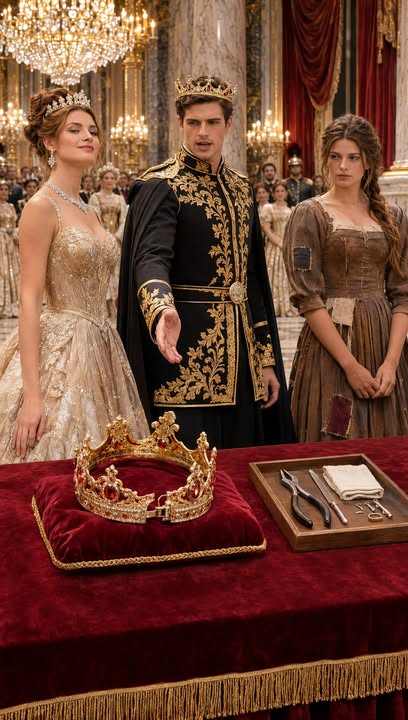
Part 5 – The Price of a Name
“And the next line began, ‘The person who mishandled it was…’”
Elara stopped reading.
The words blurred beneath her eyes, and the thin paper trembled in her hands.
Adrian did not reach for the letter.
He stood beside the desk, giving her the quiet she needed, while the lamplight fell across the open wooden box and the mending cloth inside it.
Elara drew a careful breath and looked at the line again.
“The person who mishandled it was Lord Haverford,” she read. “He had been asked to carry the crown to the fitting room and did not know the fastening had been left open.”
She paused.
The letter continued in the same neat hand.
“He was embarrassed by what had happened, and I chose not to make a public matter of his mistake. Mara devised a way to make the clasp secure, and the jeweler agreed to enter the work under his own account so the ceremony would not become a story about a foolish accident.”
Elara lowered the page.
The room seemed smaller than it had moments ago.
“Lord Haverford was your grandmother’s patron?” she asked.
“His family was among the oldest at court,” Adrian replied. “His son now holds the title.”
“Does he still have influence?”
“Some. His family has served the crown for generations.”
Adrian’s expression had grown still, though not cold.
The letter did not excuse the old decision.
It made it understandable, which was harder.
His grandmother had been trying to protect someone from embarrassment and the ceremony from gossip.
She had also allowed Mara’s name to disappear behind the jeweler’s.
“Read the rest,” Adrian said gently.
Elara looked down.
“My dear Mara,” the letter continued, “I hope you understand that the choice was made to protect the household, not to diminish your work. Your design has made the crown fit as it should, and I will remember that even if the records do not.”
Elara’s thumb rested beside the final sentence.
“And I must ask you not to tell anyone who caused the damage. He has apologized to me, and I would rather this be remembered as a repair than as a fault.”
The letter ended with a simple signature: Anne.
Adrian’s grandmother had written it.
Elara returned the page to the desk, but she did not release it.
“So she asked my mother to keep quiet,” she said.
“It appears she did.”
“And Mara agreed?”
“We cannot know from this letter alone.”
Elara read the words again, searching for something she had missed.
The request was gentle.
The reason was not unkind.
Still, it had asked a craftswoman to bear the cost of protecting a nobleman’s reputation.
“Did my mother have a real choice?” Elara asked.
Adrian’s gaze lowered to the paper.
“I cannot say.”
“If she was paid, she might have felt she could refuse.”
“She might have.”
“Or she might have known that refusing would cost her future work.”
“Yes.”
Neither answer made the old silence simpler.
Elara folded the letter along its original creases.
She thought of Mara reading it years ago, perhaps at a table much like the one in their kitchen, with the day’s work waiting beside her.
Had she felt proud that the crown fit?
Had she been relieved to receive payment?
Had she resented that someone else would receive the credit?
Or had she understood the reason and chosen, as her mother often did, to preserve what mattered without asking anyone to praise her for it?
Elara could not answer for her.
Adrian reached for the letter, but stopped before touching it.
“I will not use this to claim that your mother consented to everything,” he said. “It does not tell us enough.”
“Thank you.”
“I also will not pretend my grandmother’s intentions make the record fair.”
Elara looked at him.
He seemed to be struggling not with the truth itself, but with what the truth required of him.
His grandmother had been someone he loved.
She had made a private choice that protected the household and left a craftswoman unnamed.
Both things could be true.
“I do not want her remembered as a villain,” Elara said.
“I do not want that either.”
“But I do not want her kindness to become an excuse.”
“It should not.”
Elara set the letter beside the old work order.
The two documents told the story from different sides: a quiet request to protect the household, and a public record that credited the workshop.
Between them lay the fact that Mara had made the clasp.
“The crown can be restored,” Adrian said after a moment. “Master Orin believes he can shape a matching fastener from a small amount of original gold.”
“Then the design can be preserved.”
“Yes.”
“And the public account?”
Adrian’s eyes went to the window.
Rain had begun again, light against the dark glass.
“I have to decide what to say when the repair is complete.”
Elara heard the weight in his voice.
The crown would be displayed at the opening of the royal archive gallery in two days.
The event had been planned for months.
Invited guests would see the restored regalia, and the palace intended to publish a short account of the crown’s history.
If Adrian chose to correct the record, he would have to do so publicly.
The royal jeweler’s descendants would learn that their family had received credit for a design made by someone else.
Lord Haverford’s family might be asked about an old incident they had long forgotten, or preferred not to remember.
The royal household would have to admit that its official account had left out a name.
“You could wait,” Elara said.
“I could.”
“Or say only that the clasp was repaired under the jeweler’s supervision.”
“I could.”
“Would that be true?”
“Yes.”
“Would it be complete?”
“No.”
Adrian’s mouth tightened slightly.
Elara understood why he wanted to postpone the decision.
A public correction would not be a simple act of generosity.
It could turn Mara into a symbol, reduce her life to a story about a prince’s conscience, and place questions upon her family that they had never asked to carry.
It could also preserve the old omission because changing it was uncomfortable.
“I am not asking you to make my mother’s name a royal announcement,” Elara said.
“I know.”
“I do not want the palace to praise her in a way that makes the silence disappear. ‘She was valued privately’ is not the same as being credited for what she did.”
Adrian listened without interrupting.
“And I will not repair the crown under a story that calls the clasp the jeweler’s design,” she added. “I can help with the work, but not if the account is going to repeat what we now know is false.”
“I would not ask you to.”
“I know you would not. But I need to say it plainly.”
The words were steady, though Elara felt her heart beating hard beneath them.
This was no longer only about what her mother had made.
It was about what Elara was willing to lend her own hands to.
Adrian bowed his head once.
“Then I will not ask you to.”
The next morning, Master Orin laid out the crown and the tools in a quiet workroom off the archive.
He had brought a narrow piece of old gold, carefully weighed and marked.
It was enough to make the fastener, but only if the metal was shaped precisely.
“The replacement must follow the original curve,” he explained. “If it is too broad, it will strain the hinge. If it is too small, the band may shift.”
Elara stood opposite him, her hands clasped behind her back.
The prince had asked her to observe the process, not to work on the crown before the public account was settled.
Master Orin did not appear troubled by that boundary.
“Your mother’s design is clever,” he said as he studied the hinge. “The clasp is made to adjust without asking the band to bend. It is a repair that respects the original shape.”
Elara felt a small ache behind her ribs.
“She taught me to work that way.”
“Then she taught you well.”
Adrian entered with a folded statement in his hand.
He had spent the morning with the royal secretary and the keeper of the records.
“I have a draft for the gallery announcement,” he said.
“Does it give Mara credit?” Elara asked.
“Yes.”
He handed her the page.
The statement explained that the crown’s fastening had been devised and repaired by Mara, a craftswoman employed by the household, with the royal jeweler supervising the fitting.
It also noted that the public account had credited the workshop without naming her.
There was no mention of Lord Haverford.
Elara read the statement twice.
“It says the record was incomplete,” she observed.
“It was.”
“Will the archive preserve the original letter?”
“Yes, alongside the work order and my grandmother’s notes.”
“And the old public account?”
“It will remain in the archive, but a correction will be attached to it.”
Elara looked up.
“That is better than replacing the record and pretending it never existed.”
“That is what I thought.”
She returned the statement.
“Why is there no explanation for the omission?”
Adrian paused.
“The letter explains that my grandmother wanted to protect the household and the nobleman involved.”
“It also says she asked Mara to keep quiet.”
“I did not include that detail.”
“Why not?”
“Because I do not know what Mara agreed to, or what she was told.”
Elara studied the page.
It was a careful choice, but she could not yet tell whether it was careful enough.
“Will you say publicly that the reason remains uncertain?”
“Yes.”
“Then say that plainly. Otherwise people may assume she chose silence freely.”
Adrian took the page back and marked the margin.
“I will add it.”
Master Orin turned from the table.
“Before I begin shaping the fastener, I need the decision about the original gold.”
Adrian set the statement aside.
“Use what is needed to restore the clasp.”
“It will permanently alter the small piece from which I take the material.”
“I understand.”
Elara watched the sliver of gold on the work surface.
It was part of the crown’s original metal, a piece that could not be replaced once reshaped.
The same dilemma seemed to repeat itself in another form: preserving the past exactly as it was, or changing it carefully so it could serve again.
“Would the crown have to lose part of its original design?” she asked.
“Only a small amount,” Master Orin said. “The metal is sufficient, but I cannot promise the new fastener will be invisible.”
“It should not be invisible if hiding it means making the clasp weaker.”
Master Orin gave her a thoughtful look.
“No,” he agreed. “It should be sound before it is seamless.”
Adrian glanced at her.
The words were not a demand for recognition.
They were only a practical truth.
The fastener could be made to match the crown’s function without pretending nothing had ever happened.
Before he could answer, the royal secretary entered carrying a sealed notice.
“Your Highness, the jeweler’s family has replied to the request for its old workshop records.”
Adrian broke the seal and read the short letter.
His face changed.
“Is there a problem?” Celestine asked from the doorway.
She had arrived with the revised gallery program, and now stepped inside.
“The family’s representative asks that the public announcement retain the traditional attribution,” Adrian said.
“On what grounds?” Elara asked.
“They say the royal jeweler supervised the work and that changing the account could unfairly suggest he took credit for another person’s design.”
“Did he?”
“The records show that he entered the work under his account. They do not tell us what he said publicly, or whether he was the one who requested the omission.”
Celestine read the letter over Adrian’s shoulder.
“They are not wrong that the supervision matters,” she said. “But that does not make the design his.”
“No,” Adrian replied.
The jeweler’s descendants had not accused anyone.
They had simply asked the palace not to diminish their ancestor’s role.
That, too, was understandable.
Master Orin set down his measuring tool.
“The original jeweler may have been the one who kept the crown from failing at the ceremony,” he said. “If he supervised the fitting, his work deserves to be recorded accurately.”
“And Mara’s design deserves to be recorded accurately,” Elara said.
The two claims did not cancel each other.
A careless announcement could turn recognition into a contest over who mattered more.
Celestine set the gallery program on the table.
“Then the correction should name both contributions, and state which work belonged to whom.”
“Would that be enough?” Adrian asked.
“It would be honest,” she said. “It may not be enough for everyone.”
Adrian glanced at the letter from the jeweler’s family.
“If I publish the correction, their descendants may feel the palace has damaged their name.”
“If you do not,” Celestine replied, “Mara’s name remains absent because the palace is afraid to trouble a family that has already held the credit.”
Her voice was calm, but the words carried more than anger.
They carried recognition of her own family’s position.
Celestine’s father had wanted the marriage to strengthen their influence at court.
A public disagreement with another powerful family could complicate those plans.
She knew it.
Adrian knew it too.
“You understand this could cause difficulty for your family,” he said.
“I do.”
“Your father may not thank you for urging me to correct the account.”
“He may not.”
She took a measured breath.
“I once believed influence meant being able to secure a place for myself beside the throne. I am beginning to think it should also mean being willing to tell the truth when the truth is inconvenient.”
No one answered immediately.
Celestine looked at Elara.
“I cannot undo what I said in the ballroom,” she continued. “And I cannot decide what your mother would have wanted. But I do not think the palace should keep the old account merely because changing it is awkward.”
Elara’s resentment did not vanish.
It had never been simple enough to vanish in a moment.
But she could hear the honesty in Celestine’s words.
“Thank you,” she said.
Celestine nodded, accepting no more than that.
Adrian returned to the draft.
“I will issue the correction at the gallery opening,” he said. “The crown’s account will name Mara as the designer of the adjustable clasp and the royal jeweler as the person who supervised its fitting. It will preserve the fact that the public record credited the workshop alone, and acknowledge that the reason for the omission cannot be fully established.”
Elara felt the room settle around the decision.
Not relief exactly.
The choice carried consequences, and none of them could make those consequences disappear.
“Then I can help with the restoration,” she said.
Master Orin looked to Adrian.
“I would like Elara to direct the fit of the replacement fastener,” the prince said. “With you responsible for shaping and securing it.”
The goldsmith nodded.
“That seems right.”
Elara stepped closer to the table.
Her mother’s design lay beneath the crown’s band, shaped by hands no one had named.
She could not bring those hands back.
She could not know whether Mara had wanted the palace to speak of her work.
But she could make sure the repair followed the principle Mara had left behind: understand the mechanism before asking it to move.
Master Orin began to shape the small piece of gold.
He worked slowly, warming it, measuring its curve, then filing away a thin edge at a time.
Elara watched the fastener take form.
When he asked her to check its alignment against the hinge, she did so without touching the crown.
“Turn it slightly toward the inner edge,” she said. “The pin will sit more naturally there.”
Master Orin made the adjustment.
The fastener settled into the groove.
He did not close the clasp.
“Not yet,” Elara said.
The goldsmith stopped.
She examined the pin, then the edge of the band.
“The fit looks right, but we should test the movement before fastening it permanently.”
Adrian nodded.
“Then we test it.”
Master Orin moved the clasp through its range with a slender probe.
The hinge turned without catching.
The new fastener held the pin within its channel, while the band remained open.
“Sound,” the goldsmith said. “But not ready to wear until it has been secured and checked again.”
Elara released a breath she had not realized she was holding.
The crown was closer to whole, but it was not finished.
That evening, Adrian sat with Elara and Celestine in the small archive room while the palace secretary prepared the public statement.
The doors remained open to the corridor.
The old documents had been laid out in chronological order, each placed in a protective sleeve.
The repair order.
The private payment.
The note from Adrian’s grandmother.
The record that had credited the workshop.
The correction would be placed beside them, not in their place.
Adrian read the statement aloud.
Mara had devised the crown’s adjustable clasp and repaired it after the earlier ceremony, working with the royal jeweler, who supervised the fitting.
The palace’s public account had credited the workshop without naming Mara.
The surviving letters showed that the omission had been made to avoid a scandal over the damaged fitting, but did not establish whether Mara had agreed to remain unnamed.
The crown’s later restoration had been carried out under Elara’s direction, with Master Orin assisting as royal goldsmith.
Elara listened carefully.
“Add that the palace regrets leaving her contribution out of the public record,” she said.
The secretary looked toward Adrian.
He considered the sentence.
“Put it in.”
The secretary wrote it down.
Celestine’s eyes rested on the final version.
“Will the correction be displayed with the crown?”
“It will be displayed beside it,” Adrian said.
“Not in a book visitors have to ask for?”
“No.”
Elara felt her chest tighten again.
This time, the feeling was closer to relief.
She still had no answer about what Mara would have wanted.
But the palace would no longer make the decision to remain silent on her behalf.
The next morning, the gallery was prepared for the opening.
The crown rested in a glass case on a dark blue cushion.
Its clasp had been secured with the new fastener, and Master Orin had tested it carefully.
The repair was sound.
The new piece of gold showed a faint difference in color where it met the older metal.
It did not pretend the crown had never been damaged.
Adrian stood beside the case as the first guests arrived.
Elara remained near the doorway, invited as a member of the restoration team rather than presented as an ornament to the story.
She wore a clean, simple dress borrowed from the household stores, its cuffs carefully mended by her own hand.
Celestine stood nearby in a soft silver gown, less elaborate than the champagne-gold dress she had worn at the ceremony.
She had asked to help review the gallery labels, then had spent the morning making sure the correction would be visible to every guest.
When she saw Elara watching, she gave a small nod.
The family of the royal jeweler had arrived.
Their representative, a dignified woman in her sixties, paused before the crown and read the label.
Her face revealed little.
Adrian approached her.
“Lady Renwick,” he said, “I appreciate you coming.”
“Your Highness.”
“I want to be clear that the correction does not diminish your ancestor’s work. He supervised the fitting and helped ensure the clasp was safe for the ceremony.”
Lady Renwick’s gaze moved to the line naming Mara.
“And the design?”
“The surviving records identify Mara as its maker.”
“Do they show that she objected to the attribution?”
“No.”
“Do they show that she accepted it?”
“No.”
The woman studied him.
“You are willing to leave the question open.”
“I am willing to say what the documents show, and no more.”
Lady Renwick looked again at the label.
“My family will need time to consider this.”
“I understand.”
“I cannot promise they will agree with your wording.”
“I would not ask you to.”
There was no easy reconciliation in the exchange.
Only the beginning of one, perhaps, built on the refusal to claim certainty where none existed.
The doors opened wider.
More guests entered the gallery, including Celestine’s father, whose expression grew careful when he saw his daughter standing near the crown.
He did not call her aside.
She did not look away.
When the room had filled, Adrian stepped forward.
The voices faded.
His speech was brief, but he did not hurry through the difficult part.
He described the crown’s adjustable clasp and the work that had made it fit safely.
He named Mara.
He named the royal jeweler who had supervised the fitting.
Then he told the guests that the public record had credited the workshop alone, and that the palace regretted leaving Mara’s contribution unacknowledged.
He did not say that she had freely agreed to the silence.
He did not accuse his grandmother of cruelty, nor use her kind intentions to excuse the omission.
He said that the surviving letters revealed a private choice made to protect the household from scandal, but did not establish what Mara herself had wanted.
The truth, as the record held it, was incomplete.
The palace would preserve that uncertainty rather than fill it with a convenient story.
Elara listened as the name passed through the gallery.
Mara.
Not “a craftswoman.”
Not “an assistant.”
Her mother’s name, spoken in the room where the crown had once been treated as more important than the hands that saved it.
A few guests turned toward Elara.
She felt their attention, but it did not feel like the challenge in the ballroom.
Adrian did not call her forward as proof of the story.
He did not ask her to smile or speak.
He let the work stand on its own.
When the applause came, it was restrained and genuine.
Celestine stood at the edge of it, her hands folded quietly before her.
Her father watched her, then gave a small, unreadable nod.
The moment had not made her family’s plans disappear.
It had simply made her choice visible.
After the speech, the guests moved through the gallery.
Lady Renwick returned to the crown and read the label once more.
Then she turned to Elara.
“Was your mother proud of the work?”
Elara searched for an answer that would not pretend to know more than she did.
“She kept the note thanking her,” she said. “But she never told me she made the clasp.”
“Perhaps she wanted to keep it private.”
“Perhaps.”
Lady Renwick glanced at the crown’s new fastener.
“It is a careful repair.”
“Master Orin shaped it,” Elara said. “I helped check the fit.”
The woman nodded.
“I hope the record can hold both things: that your mother made the design, and that the jeweler helped carry it out.”
“So do I.”
Lady Renwick’s expression softened.
“I will tell my family what I saw today.”
It was not an apology, nor a promise to accept every word.
It was enough to leave the conversation open.
Later, after the last guests had moved toward the reception rooms, Adrian joined Elara beside the gallery windows.
The crown shone quietly behind its glass.
Its repaired clasp was visible, if one knew where to look.
“I was afraid you would think the statement was too cautious,” he said.
“I would rather it be cautious than false.”
“Even if some people say it does not go far enough?”
“Some may.”
“And others may say it goes too far.”
“Then they will have to answer the documents, not me.”
Adrian smiled faintly.
“You should not have to carry the argument for the palace.”
“I know.”
He looked at her, then at the crown.
“The repair is sound.”
“Master Orin said it still needs another inspection before the next ceremony.”
“It will have one.”
Elara’s gaze remained on the tiny line of gold at the clasp.
“My mother made something that could adjust,” she said. “It was never meant to be forced.”
“No.”
“And the record has to adjust too, I suppose.”
Adrian considered that.
“Only if we are willing to let it.”
The gallery doors opened behind them.
A young archivist approached carrying a slim portfolio.
“Your Highness, Lady Renwick asked me to give you this before she leaves.”
Adrian accepted the portfolio.
Inside lay a letter from the royal jeweler’s family archive, newly found among papers that had not been included in the earlier records.
The ink was faded, but the date was clear.
Adrian read the first lines, and his expression changed.
“What is it?” Elara asked.
He turned the page so she could see.
The letter was written by the royal jeweler after the ceremony, addressed to Adrian’s grandmother.
It thanked her for allowing him to supervise Mara’s work, then continued:
“I must confess that I did not design the clasp, nor did I ask that Mara’s name be withheld. The arrangement was made before I arrived, at the request of the person whose mistake caused the damage.”
Elara looked at the final line.
There, in a careful hand, was a name.
Adrian went still.
Celestine had come back to the gallery and now stood beside them, reading over his shoulder.
“Who asked for the silence?” she whispered.
Adrian turned the page toward the light.
The name belonged not to Lord Haverford, but to the person who had written the letter asking Mara to keep quiet.
**–END OF PART 5–CLICK “NEXT” AT THE BOTTOM OF THE PAGE TO CONTINUE READING**
* * *
[PREVIOUS: PART 4](https://storyly.idolsgift.com/blog/part-4-the-mark-beneath-the-crown-057) | [NEXT: PART 6(THE END)](https://storyly.idolsgift.com/blog/part-6-the-end-the-mark-beneath-the-crown-057)
✓ Lynn R. Adams
Part 5 – The Price of a Name “And the next line began, ‘The person who mishandled it was…’” Elara stopped reading. The words blurred beneath her eyes, and the thin paper trembled in her hands. Adr…