PART 5: The Mark Beneath the Carpet 046
Part 5 – The Price of Silence
Adrian stared at the name in the margin as if the ink had opened a door he had spent his life believing was part of the wall.
“My grandmother,” he said.
The words were almost too quiet to hear.
Vanessa looked from him to the paper.
“Did she order the frame locked?”
“I don’t know.” Adrian’s gaze stayed on the signature. “She was young when this was written. She may have been acting for the household, or someone may have used her name.”
“Either way, it doesn’t tell us what she knew,” I said.
“No,” he replied. “It tells us what we still need to find out.”
He sounded composed, but his hands had closed around the edge of the table.
I wanted to comfort him, yet I could not offer him the easy assurance that his family’s name meant nothing.
The paper did not prove that his grandmother had intended harm.
It did prove that someone within the royal household had kept the frame fixed after my grandmother warned that it could change.
And the record had been tucked away where generations of people could fail to find it.
Adrian drew a slow breath and released the table.
“Mr. Bell should preserve this document, and the archive should verify the signature.”
Elin nodded.
“I’ll arrange a secure copy and a proper examination.”
“Please do not circulate it beyond the people responsible for the inquiry,” Adrian said. “We should understand the record before we tell anyone what it means.”
His caution was reasonable.
It also sounded like the first step toward keeping the truth private.
I looked at the chart in my hands.
Do not let them say the frame cannot change.
My grandmother had written it as a warning, perhaps even as a hope.
The court had spent years allowing the frame to tell a story its maker never intended.
If we found the truth and locked it away again, what would that make us?
“What happens to the candidates?” Vanessa asked.
Adrian looked at her.
“The selection remains suspended until the inspection is complete.”
“And after that?”
“I don’t know.”
Vanessa’s mouth tightened.
“People are already asking whether the test will continue.”
“Then we should give them an answer when we have enough evidence to give one honestly.”
“That may take time.”
“Yes.”
“And while we wait, people will decide what they think happened.”
“They will,” Adrian said. “I cannot prevent that.”
Vanessa glanced at the chart.
“Then perhaps we should make sure they have something more reliable to consider than rumors.”
The words carried no accusation, but Adrian heard their weight.
“So should we,” he said.
The archive assistant carefully placed the pages into a protective folder.
For a while, the four of us said little.
The old workroom seemed to hold the quiet of all the objects stored there: furniture once used for ceremonies, tools no longer remembered, plans separated from the purposes they described.
At last, Adrian turned toward me.
“Mara, would you come with me to speak with the household steward?”
I looked at the signature again.
“Will he know who ordered the frame locked?”
“He may know what the record refers to.”
“Then yes.”
Vanessa rose from her chair.
“I’ll come too.”
Adrian nodded.
“You’re entitled to hear any explanation concerning your attempt.”
She gave him a careful look.
“I’m not asking for special treatment.”
“I didn’t think you were.”
We left the storage room with Elin carrying the documents and the household keeper walking ahead to open the corridor doors.
As we crossed the old workrooms, I felt the distance between the palace’s grand halls and its quieter rooms more sharply than before.
The ballroom displayed polished tradition.
The workroom held the evidence of how traditions were made, repaired, and sometimes altered.
I thought of my grandmother spending her days here, carrying out careful work while the court moved around her.
Had anyone listened when she said the frame was wrong?
Or had they thanked her for the repair, paid her, and returned to the ceremony as though nothing had changed?
The household steward received us in a small office near the west gallery.
His name was Mr. Fenwick, and he was a careful, middle-aged man whose silver hair was combed neatly back from his forehead.
He studied the copied page for several moments without touching it.
“I have seen this signature before,” he said.
Adrian leaned forward.
“Can you identify it?”
“It resembles Her Royal Highness’s hand, though I cannot confirm it from a copy.”
“Do you know why the order was made?”
Mr. Fenwick folded his hands on the desk.
“I was not employed here at the time. The household records I inherited describe the frame as a ceremonial standard.”
“Was there an instruction to lock its base during selections?” Vanessa asked.
“I have found no current instruction of that kind.”
“But the frame was locked,” I said. “The record says so.”
“It appears to have been.”
“Why?”
Mr. Fenwick’s expression showed regret, not evasion.
“I cannot tell you. The later inventories repeat the phrase ‘fixed for ceremonial use,’ but none explains what that meant or who requested it.”
“Could the frame have been adjusted before each selection?” Adrian asked.
“Possibly, though the surviving records do not describe such adjustments.”
The answer left us with no certainty, only another gap in a long chain of omissions.
Adrian picked up the copied sheet and studied the signature.
“My grandmother is alive,” he said. “I will ask her directly.”
“Would she remember?” I asked.
“I don’t know. She was young then.”
“You should ask before deciding what the record means.”
His gaze met mine.
“I will.”
Mr. Fenwick opened a drawer and removed a small folder.
“I also found a note among the ceremony files this morning. It was attached to a list of candidates, but it appears to have been placed there by mistake.”
He laid it on the desk.
The paper bore the royal crest and a recent date.
Its message was brief.
A private resolution may be offered to Miss Williams, provided she agrees not to challenge the frame’s standing in the court.
My stomach tightened.
Vanessa read the note over my shoulder.
“Who wrote this?”
“The message was delivered to my office without a signature,” Mr. Fenwick said. “I do not know who prepared it.”
Adrian’s face had gone hard.
“Was this meant to be shown to Mara?”
“It was addressed to the household. I thought Your Highness should see it.”
I looked at the words again.
A private resolution.
The phrase was dressed in courtesy, but its meaning was plain.
I could accept an outcome that favored me, so long as I helped preserve the story that had made the test unfair.
“Does the note explain what the resolution would be?” I asked.
“No,” Mr. Fenwick said. “It only says one may be offered.”
Vanessa’s voice was low.
“A place in the selection.”
“Perhaps,” I said.
“Or a quiet exception,” Adrian replied.
His eyes remained fixed on the paper.
“Whoever wrote this believes the problem can be resolved by making one person an exception.”
I felt the sharp pull of temptation before I could hide it.
An exception could sound like a door opening.
I had spent years hearing that certain doors were not made for people like me.
If the court offered to open one, how quickly would I be expected to forget the hinge?
Adrian turned toward me.
“You do not have to respond now.”
“I know.”
“I would never ask you to accept it.”
“I know that too.”
But knowing did not remove the choice.
It only made the choice mine.
We left the steward’s office and went to the small conservatory adjoining the west gallery.
There, sunlight rested on broad leaves and pale stone, and the windows blurred the palace grounds into a wash of green.
Adrian stood by the glass while Vanessa sat at a narrow table.
I remained near the doorway, the unsigned note folded in my hand.
“Whoever sent this may think they are protecting the palace,” Adrian said.
“Or protecting the selection,” Vanessa replied.
“Either way, it puts the cost on Mara.”
He faced me.
“I will reject it.”
“Not yet,” I said.
His brow furrowed.
“If we reject it before learning who offered it, the person may simply try again through someone else.”
“And if you accept it?”
“I’m not going to.”
The certainty in my answer sounded stronger than I felt.
I unfolded the note and smoothed its crease against the table.
There were no words about the original purpose of the frame, or the alteration of its records, or my great-grandmother’s name.
There was only an offer to resolve my place in the selection quietly.
A private pass, in exchange for silence.
“I know what they want,” I said. “They want to make me the proof that the test can be generous.”
Adrian’s face softened.
“You would not owe them that proof.”
“Maybe not. But if I take the offer and let the ceremony continue, the next candidate will stand where I stood, believing the frame can judge her.”
Vanessa looked down at her hands.
“And the one after her.”
“Yes.”
The thought pressed on me until I could not draw a comfortable breath.
I had wanted to be seen.
I had wanted to step forward in that ballroom and show the people who laughed that their judgment did not define me.
But the discovery had changed the question.
The choice was no longer whether I could fit through the opening.
It was whether I would help the court keep pretending that anyone’s worth could be measured there.
Adrian crossed to the table.
“If you speak publicly, the selection may end.”
“I understand.”
“The court may accuse you of using the discovery to advance your own position.”
“I understand that too.”
“I can speak in your place.”
“Not about what my grandmother knew.”
He stopped.
I placed my palm on the folded chart, feeling the thin paper beneath it.
“They may listen differently if I speak,” I continued. “They will still question me, but at least they will have to hear the words from the person whose family kept them.”
“You should not have to carry this alone.”
“I’m not alone.”
I looked at him.
“You’re here. Vanessa is here. Mr. Bell is checking the records. But I have to decide whether the truth stays in this room.”
Vanessa rose from the table.
“I’ll stand beside you.”
“You don’t owe me that,” I said.
“No,” she replied. “I know.”
Her gaze was steady now, though there was no performance in it.
“I failed in that ballroom, or the frame failed me, or both. I don’t know yet. But I know I don’t want another woman to be made to believe that a machine designed to provide room is a machine designed to deny it.”
I felt something loosen inside my chest.
Not every wound had disappeared.
Not every apology had been spoken.
But she had chosen to stand beside the truth, even when it could not give her a victory.
“Thank you,” I said.
Vanessa gave a small nod.
Adrian’s eyes rested on me.
“I invited the candidates here because I wanted a different kind of choice,” he said. “I thought I could change the court by choosing someone who had lived beyond its expectations.”
“And now?”
“Now I see that choosing one person would not change what the court asks of everyone else.”
His confession seemed to cost him.
He had imagined a private choice could become a public correction.
Now he understood that one woman’s acceptance would not repair the rules that judged her.
I stepped to the window.
Beyond the glass, the gardens lay in ordered rows, each hedge trimmed to a shape the gardeners had chosen.
The view was beautiful.
It was also controlled.
“I don’t want to be chosen because I exposed the frame,” I said.
“I don’t want you to be chosen for any reason that makes you feel obliged to the court.”
“What do you want?”
Adrian was quiet for a long moment.
“I want to know you without a test between us.”
My heart gave a small, painful turn.
“That might not be possible if the test remains.”
“No,” he said. “It might not.”
The honesty of it hurt more than a promise would have.
For a moment, I let myself imagine a different evening: Adrian and me walking through the garden, speaking without the weight of the court around us.
Then I remembered the red light, the laughter, and my grandmother’s words on the old chart.
Do not let them say the frame cannot change.
I folded the note again.
“If I speak, I may lose the chance to know you,” I said.
Adrian held my gaze.
“You may.”
“And the court may close the selection.”
“It may.”
“I may be remembered as the woman who brought this scandal into the ballroom.”
“You may.”
He did not soften the truth to make my decision easier.
That was another kind of respect.
I glanced toward the door.
Beyond it lay the ballroom, where the guests had gathered for the announcement that the test would resume.
The ceremony had been paused, not ended.
People were waiting.
Some would have come because they cared about the candidates.
Others had come to see the prince choose a bride.
The household had prepared a statement declaring the frame safe after routine maintenance.
If no one challenged that account, the test could continue before the original documents were fully understood.
“I want the original plans brought into the ballroom,” I said.
Adrian’s expression shifted.
“And the repair records.”
“And my grandmother’s chart.”
“Mr. Bell should confirm which documents are authentic.”
“He can confirm what he knows. But I don’t want the court to hide behind a perfect certainty it does not possess.”
Vanessa joined us by the window.
“What will you say?”
“The truth we can prove. And the questions we still cannot answer.”
Adrian looked toward the corridor.
“Then we should be ready for them to ask you questions.”
“They can ask.”
“Some may not be kind.”
“Then I will answer what I can and refuse what I cannot.”
He held out his hand, not to take mine, but to offer the unsigned note.
I accepted it.
The paper felt lighter than the decision.
We returned to the ballroom together.
The great room had filled again, though the laughter and music of the previous evening were absent.
Guests sat in the gold chairs arranged along the walls.
The frame stood at the center of the floor, its brass wheel uncovered.
The official who had reached toward it was present, but he remained near the far doorway under the quiet observation of two attendants.
He looked tired.
When he saw me, he lowered his eyes.
I did not know whether he had tried to alter the frame or simply meant to inspect it.
The evidence did not tell us.
The court had gathered because the household intended to announce that the test would proceed after a preliminary inspection.
Mr. Bell stood beside a table covered in linen.
The original plans were beneath the cloth.
Adrian walked to the front of the room.
“Before the ceremony resumes, Miss Williams has asked to address the court.”
A murmur moved through the seats.
I looked at my mother.
She sat near the front with both hands clasped in her lap.
Her eyes were bright, but her face was calm.
I drew the folded note from my sleeve and placed it on the table.
Then I stepped beside the frame.
“Last night, I was asked to pass through this opening,” I said. “Before I could begin, I saw an official reaching for the adjustment wheel.”
The official shifted, but did not interrupt.
“I do not know why he reached for it,” I continued. “The inspection found fresh scratches around the wheel and marks beneath the carpet. It also found that the frame could shift by nearly an inch.”
The room grew still.
“We have not proved who moved it, or when. I will not accuse someone when the evidence does not support an accusation.”
The official looked up.
For the first time, his expression held something other than defensiveness.
It might have been relief.
It might have been shame.
I could not know.
“But we have found another truth,” I said.
Mr. Bell drew back the linen.
The old plans lay in careful order, their faded lines visible beneath the bright ballroom lights.
“Those plans show that the frame was made by my great-grandmother, Eleanor Wren, a craftswoman who worked for the royal household.”
A few people leaned forward.
“The frame was designed to adjust to the person or object brought before it. Its indicators recorded where something needed more room. They were never meant to tell anyone whether a person was worthy.”
The quiet deepened.
“This frame was made to help things fit. It was not made to decide who belongs.”
I saw Vanessa near the front, standing with her hands clasped at her waist.
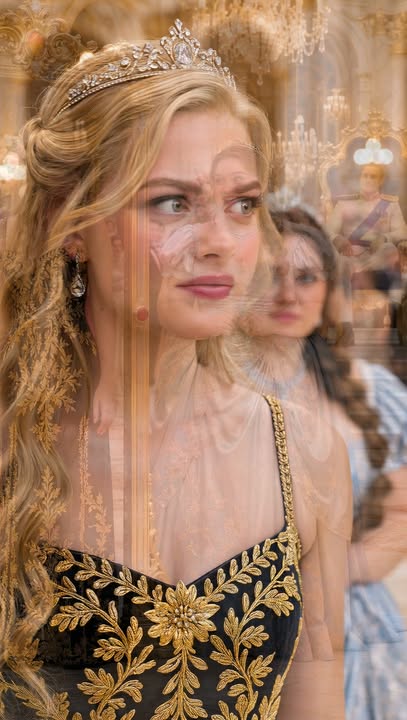
Her black-and-gold gown seemed different beneath the stillness of the room.
“The court changed the frame’s purpose,” I continued. “The records do not yet tell us who first made that change, or why. They do show that the adjustable base was locked for royal selections, and that my grandmother preserved the original measurements.”
I opened the chart and showed the line in her handwriting.
“Do not let them say the frame cannot change.”
The words travelled through the room, though I spoke them gently.
I looked at the assembled guests.
“I was offered a private resolution if I agreed not to challenge the frame’s place in the court.”
A few people turned toward Adrian.
He did not step in front of me or try to soften what I had said.
He remained at my side.
“I have declined,” I said. “Not because I am certain I would pass through the frame, and not because I believe the test would make me more worthy if I did. I declined because no one should have to accept a private exception in exchange for keeping a public injustice quiet.”
A low, unsettled murmur rose through the ballroom.
I let it pass.
“The test should not continue until the frame’s history and purpose are properly understood. And even if the mechanism is repaired, we must ask whether a body-based test belongs in a search for a life partner at all.”
The words left my mouth with more steadiness than I felt.
I turned toward Adrian.
The court waited for him to speak.
For one heartbeat, his expression seemed divided between the crown he wore and the person beneath it.
Then he stepped forward.
The selection schedule lay on a stand beside him.
He lifted the page, folded it once, and set it face down.
“No candidate will be asked to enter the frame,” he said. “The selection is suspended until the records are examined and the court has addressed the meaning this ceremony has been given.”
His voice carried through the room without force.
“I approved the test because I believed it was an old tradition. That belief was not enough. I should have questioned what it required of the people who stood before it.”
No one moved.
“I cannot promise that this decision will spare the household embarrassment,” he continued. “I can promise that the evidence will not be concealed to protect an appearance.”
The court remained quiet, but I could feel the consequence of his words gathering.
He had chosen to stand beside the truth.
He had also chosen to let the truth reach beyond us.
A woman near the back rose from her chair.
She was elderly, dressed in a deep violet gown, and supported herself with a polished cane.
Adrian’s face changed when he saw her.
“Grandmother.”
The woman’s eyes moved from him to the old plans on the table.
“I wondered how long it would take,” she said.
The room turned toward her.
Adrian took one step closer.
“You knew about the frame.”
“I knew it had been altered.”
My hands went cold.
The elderly woman approached the table slowly, her gaze fixed on the chart I held.
“I was the one who ordered it locked,” she said. “But I did not understand what I was signing.”
She turned to me, and the sorrow in her face was not the sorrow of someone caught in a lie.
It was the sorrow of someone who had carried a secret for far too long.
“Your grandmother tried to tell me what the frame was meant to do,” she said. “I dismissed her.”
The words fell gently, but they changed the air in the ballroom.
Adrian’s hand tightened at his side.
“Why?” he asked.
His grandmother looked down at the old measurements.
“Because I believed the court’s advisers when they told me the ceremony could not be changed.”
She looked back at me.
“And because I thought I was protecting the family from a scandal.”
A hush spread through the room.
I could hear my mother’s breath catch.
The old woman reached into the pocket of her gown and drew out a small, folded paper.
“I have kept the original order all these years,” she said. “But there is another name on it, written beneath mine.”
She unfolded the paper.
Her gaze met Adrian’s, then mine.
“The person who persuaded me to lock the frame was not a court adviser.”
Her voice trembled, though she did not look away.
“It was someone who is here tonight.”
**–END OF PART 5–CLICK “NEXT” AT THE BOTTOM OF THE PAGE TO CONTINUE READING**
* * *
[PREVIOUS: PART 4](https://echoesofstories.idolsgift.com/blog/part-4-the-mark-beneath-the-carpet-046) | [NEXT: PART 6(THE END)](https://echoesofstories.idolsgift.com/blog/part-6-the-end-the-mark-beneath-the-carpet-046)
✓ Lynn R. Adams
Part 5 – The Price of Silence Adrian stared at the name in the margin as if the ink had opened a door he had spent his life believing was part of the wall. “My grandmother,” he said. The words were…