PART 5: The Letter Beneath the Silence 046
Part 5 – The Truth Before the Crown
“Helena,” Mr. Bell repeated, his finger resting beside the crossed-out name.
William had not moved.
Eleanor watched the color leave his face, not all at once but in a slow, unmistakable retreat, as if the name had reached him before he could brace himself against it.
“My mother received the deposition?” he asked.
“The register suggests it,” Mr. Bell said. “The original entry is unclear. The name was crossed out, and the delivery mark is incomplete.”
“Then we should not treat it as proof,” Eleanor said, though her own pulse had begun to race.
“No,” Ashcombe agreed. “But it is a lead we must follow.”
Frederick looked from the register to William.
“Your mother never told me she had received anything.”
“Perhaps she didn’t know what it contained,” William said.
“Perhaps she did.”
The possibility settled over the room without accusation, yet William’s hands had tightened at his sides.
Eleanor wanted to reach for him, but she could not tell whether he needed comfort or the space to absorb the idea that his mother had been part of a secret carried through their family.
Mrs. Rook leaned toward the ledger.
“The crossed-out name may have been corrected later,” she said. “The ink is different from the original entry.”
“Can you determine when?” Ashcombe asked.
“Not without examining it under proper light. I will arrange for that.”
Frederick’s gaze stayed on the name.
“If Helena received the packet, she may have known the queen survived.”
“She may have known only that the nurse had taken a child,” William said. “We don’t yet know what was inside.”
“Nor why the name was crossed out,” Eleanor added.
Mr. Bell closed his notes.
“I will make a formal record of the entry and its condition. The examiners can verify it alongside the deposition.”
The room began moving again, but Eleanor felt the discovery had changed its center.
Until now, the questions had gathered around Frederick: what he had ordered, what he had known, and why he had kept silent.
Now the past seemed to have another witness, one who had been beloved and absent, and whom William could not ask to explain herself.
He looked at Eleanor.
“I need a moment.”
She nodded.
He walked to the far end of the records room, stopping before a narrow window that overlooked the courtyard.
Eleanor remained beside the table.
No one spoke while he watched the garden.
When at last he turned, the composure he had worn through the inquiry was gone.
“I thought I knew what my mother had kept from me,” he said. “I thought it was mostly grief.”
“You were a child when she died,” Eleanor replied.
“I know.”
“You couldn’t have asked her what she never chose to tell you.”
“But I could have asked my father.”
Frederick accepted that without protest.
“You could have,” he said.
William looked at him.
“Did you tell her the queen had survived?”
“I did not know that she had.”
“Did you tell her you believed a child had escaped?”
“I may have.”
“May have?”
“It was years ago, William. I remember speaking to Helena about the household. I cannot remember whether I told her about the child.”
William looked away again.
“I don’t want to turn my mother into another mystery because I can’t bear the uncertainty.”
“You don’t have to,” Eleanor said.
He gave her a tired, grateful look.
“But I don’t want to pretend there is nothing to find, either.”
“No,” she said. “Neither do I.”
Mrs. Rook carried the ledger away for examination, accompanied by one of the appointed examiners.
Ashcombe gathered the verified copies of the deposition and placed them in a separate folder.
“The court will need to be informed that the inquiry has reached this point,” he said. “The signed order, the nurse’s account, and the correspondence register cannot remain private indefinitely.”
“Then we should call the court together,” William said.
Frederick’s shoulders lowered.
“I had hoped to have more time.”
“So did I,” William replied. “But the court will learn it from the records. Better to hear it from us.”
The king looked toward Eleanor.
“What do you want the court to hear?”
She thought of her mother’s letter, its plea for protection, its incomplete address and unfinished signature.
She thought of the stories that had been told instead: an executed family, a burned carriage, an ended line.
“I want them to hear what the records say,” she answered. “And what they do not say.”
Frederick nodded.
“Then that is what I will tell them.”
The court assembled before sunset.
Word had already traveled through the palace, but the rumors that filled the hall were no longer shaped like laughter.
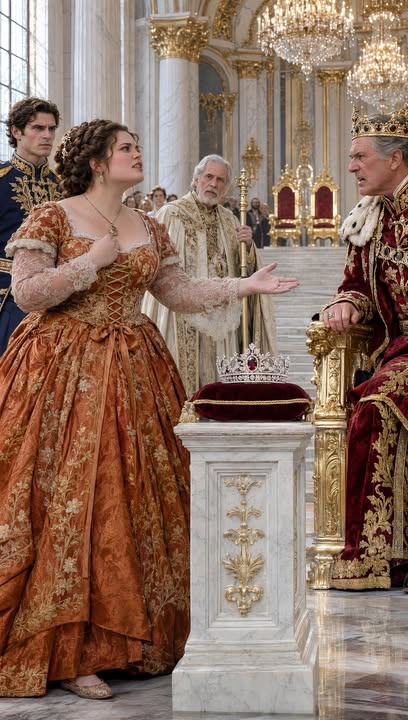
The Crown of the First Empress remained on its red velvet cushion, its hidden compartment closed beneath the ruby.
The royal advisor stood beside it with the verified papers arranged on a table.
At Frederick’s request, the examiners and the archive registrar stood nearby to explain the condition of the documents and the limits of what they proved.
William stood beside Eleanor.
Not in front of her, as he had the day before, but at her side.
The distinction mattered.
Ashcombe addressed the court first.
“The birth record presented yesterday has been examined by two independent specialists, and both confirm that its seal and format are genuine,” he said. “The deposition is incomplete, but a sealed copy has now been located in the council records.”
The gathered nobles listened in a silence more attentive than the silence of the previous day.
“The copy records that a nurse carried an infant from the palace before a carriage was prepared,” Ashcombe continued. “It says the child was not placed in the carriage. The carriage held travel chests and garments belonging to the royal household.”
A whisper rose and died.
“The deposition does not identify the child by name,” he said. “It also does not establish what happened to the queen afterward.”
Eleanor looked across the hall.
Some of the faces seemed uncertain.
Others looked troubled, as if the truth had become more complicated than the story they had inherited.
Frederick stepped forward.
“The order bearing my signature is genuine,” he said.
The court’s attention shifted to him.
“I ordered the queen’s household removed from the palace, and I ordered identifying records destroyed. I believed the queen’s claim to the throne threatened the stability of the kingdom, and I intended to frighten her into surrendering it.”
He paused.
“I did not order the carriage burned. I believed the family had escaped before it was set alight, but I failed to establish who was inside, and I did not make the uncertainty known to the court.”
Eleanor kept her eyes on the king.
“I later learned that a child had been taken from the palace,” Frederick continued. “I was told she was beyond my reach. I did not know where she was, and I did not continue searching.”
The pause that followed was not long, but Eleanor heard its full weight.
“I allowed the kingdom to accept that the royal line had ended because the belief served my succession and, I told myself, prevented further conflict. I should have disclosed what I knew and what I did not know. I did not.”
No one interrupted him.
“I cannot ask the court to treat my intention as an excuse,” he said. “I will answer for the consequences of what I signed and for the silence that followed.”
He returned to his place.
The court did not erupt as it had when the signature was revealed.
Its quiet was harder to read.
A senior nobleman rose from the first row.
“Your Majesty, if the queen’s line survived, then the succession has been unlawfully settled for decades.”
Another voice followed.
“The princess must claim her right.”
A third noble stood.
“The king must surrender the crown at once.”
The calls spread, not as a single demand but as a gathering of separate fears.
Some wanted Eleanor to take the throne.
Some wanted Frederick arrested.
Others called for a full examination before any judgment was made.
Eleanor felt every eye settle on her.
She had known the moment would come.
She had still hoped for a little more time to decide what her answer meant.
William’s fingers brushed hers.
He did not squeeze, did not guide her forward, and did not speak for her.
The choice belonged to her.
Eleanor stepped toward the center of the hall.
“My mother asked this palace for protection,” she said. “The record shows that her letter reached the king’s chamber, but we do not know whether she received an answer.”
Frederick lowered his eyes.
“We know a nurse carried a child away from the palace,” Eleanor continued. “The record strongly suggests that child was my mother, but the deposition does not name her. We know the carriage held no royal family. We do not know who set it on fire, or what became of the queen.”
She looked from one side of the court to the other.
“I will not replace one incomplete story with another.”
A few nobles shifted, dissatisfied.
“You are the rightful heir,” someone called.
“If the evidence confirms it, then the court should recognize what the records establish,” Eleanor said. “But the records must be examined openly, and those who made choices that harmed my family must answer for them under the law.”
The senior noble rose again.
“Then you will accept the crown?”
Eleanor looked at the crown on its cushion.
For generations, it had been treated as proof that power belonged to the person who possessed it.
Now it seemed less like a prize than a question.
“I will not decide the future of the kingdom in a room full of people waiting for a simple answer,” she said. “I will not ask for my father-in-law’s arrest as an act of vengeance, and I will not agree to bury the evidence as an act of peace.”
Frederick’s head lifted.
“The records should be verified by a commission independent of the Crown,” Eleanor continued. “The commission should examine the original order, the deposition, the correspondence, and the register entry bearing Queen Helena’s name. It should also seek the nurse’s descendants and any surviving account of my mother’s life.”
The court was quiet again.
“Until that work is done, the king should surrender the authority to alter or remove the records,” she said. “He should testify before the commission and accept its findings.”
“And if it confirms your claim?” the senior noble asked.
“Then I will decide how to serve this kingdom with the people it belongs to.”
The answer did not satisfy everyone.
That was, Eleanor thought, a good sign.
A settlement that pleased every ambition in the room would likely have been another version of the same silence.
The senior noble looked toward William.
“Your Highness, where do you stand?”
William stepped forward.
“Beside my wife,” he said.
“That is not a constitutional position.”
“No,” William replied. “It is a personal one. The constitutional questions belong to the court and the people, not to me alone.”
A murmur ran through the assembly.
He looked at Frederick.
“My father should answer for what he did. I will not ask the court to shield him.”
The king held his son’s gaze.
William turned back to the nobles.
“And I will not ask Eleanor to carry this burden in private so that I can avoid choosing what I believe.”
Eleanor felt a painful warmth behind her eyes.
The court adjourned without a verdict.
The inquiry would continue, and Frederick agreed to surrender control of the archives while the commission was formed.
No one had been arrested.
No one had been crowned.
The uncertainty followed Eleanor and William from the hall like another member of the court.
That evening, she found him in the palace garden.
He stood near the old stone fountain, where the water slipped over the carved edge in a thin, steady stream.
The sky had faded to a dusky blue, and the paths were lit by small lanterns set among the hedges.
“You didn’t ask the court to protect him,” Eleanor said.
“I didn’t think you wanted me to.”
“I didn’t.”
“I know.”
She came to stand beside him.
The silence between them was no longer the sharp silence of the archive.
It held everything they had not managed to say in front of the court.
“I was afraid you would ask them to arrest him,” William said.
“I was afraid you would ask me to spare him.”
“Did you want to?”
“I wanted the truth to be enough.”
“And it isn’t?”
“It’s a beginning,” she said. “It doesn’t restore the years he kept my mother’s history from her, or the years we might have had if someone had told her who she was.”
William looked down at the fountain.
“I can’t tell you what my mother knew.”
“I know.”
“I wish I could.”
“So do I.”
He turned toward her.
“I won’t ask you to make this easier for me.”
“Thank you.”
“I’m still afraid you will see me as part of the silence.”
“I might, sometimes.”
The answer hurt him, but he did not look away.
“And I’ll try to remember that you did not choose what your parents kept from you,” she continued. “I can’t promise I’ll never be afraid. I can promise to ask you what you believe rather than decide for you.”
William took her hand.
“That is more than I deserve today.”
“It isn’t about what you deserve.”
“Then what is it about?”
“Whether we can be honest with each other when honesty is difficult.”
He lifted her hand to his lips and kissed her knuckles.
“I want that.”
“So do I.”
For a brief moment, the world narrowed to the warmth of his hand and the quiet garden.
Then the palace doors opened behind them.
Ashcombe crossed the path, carrying a document case beneath one arm.
“I am sorry to disturb you,” he said. “The examiners have completed their first review of the entry concerning Queen Helena.”
William released Eleanor’s hand.
“What did they find?”
Ashcombe opened the case.
“The name was not added later. It was written when the register was made, then crossed out with a different ink.”
“Why?” Eleanor asked.
“The paper has been examined under magnification. The name was crossed out after the entry had been copied into a second register.”
“Does the second register still exist?” William asked.
“We have located it.”
Ashcombe removed a sheet sealed in a protective sleeve.
The entry was clearer than the first.
The deposition had been delivered to Queen Helena.
Not merely received in her name.
Delivered to her personally.
William read it without speaking.
Eleanor watched his face as the words sank in.
“Is there anything else?” she asked.
Ashcombe turned the page.
A note had been written below the entry, almost hidden beneath the fold.
It was in a different hand from the clerk’s notation.
“Read it,” William said.
Ashcombe’s voice grew quieter.
“Her Majesty returned the packet unopened and requested that the child’s name remain concealed.”
William’s fingers closed around the edge of the sleeve.
“Why would she send it back?”
“I cannot say,” Ashcombe replied.
Eleanor studied the words.
Returned unopened.
Child’s name concealed.
The message did not tell them whether Helena had known what lay inside, or whether she had refused the packet because she feared its contents.
“What was the date?” she asked.
Ashcombe pointed to the line beneath the note.
“Three months after the carriage fire.”
Eleanor looked toward the palace windows.
William’s mother had been alive then.
The queen had been trying to find the child.
And someone in the royal family had turned away the only record that could have connected them.
“Could the packet have been opened later?” William asked.
“The seal on the copy was intact when it was filed,” Ashcombe said. “The original is still being searched for.”
Frederick had joined them without their noticing.
He stared at the note.
“Helena never told me.”
“You may not have asked,” William said.
Frederick accepted the words with a small, weary nod.
“No.”
Eleanor looked at the paper again.
The past had given them another choice, though none of them had yet named it.
The court wanted a clean verdict.
The family wanted an answer.
But the records were still opening, one careful fold at a time, and behind them waited a truth no one had prepared to hear.
Ashcombe’s hand stopped at the lower edge of the sleeve.
“There is a second notation,” he said.
“What does it say?” Eleanor asked.
He leaned closer.
“The packet was returned with a separate letter.”
“From Queen Helena?”
“The registry does not identify the sender.”
“Where is the letter?”
“It was filed under the nurse’s name.”
Ashcombe opened the document case and removed a narrow sheet, its seal broken long ago.
The paper bore the same circle-and-line mark that had appeared in the chapel ledger.
Eleanor’s breath caught.
At the bottom of the page was a name, written clearly enough to read.
Maren Vale.
Above it, in the nurse’s hurried hand, were seven words that changed the meaning of the entire record:
The queen is alive, but she will not return.
**–END OF PART 5–CLICK “NEXT” AT THE BOTTOM OF THE PAGE TO CONTINUE READING**
* * *
[PREVIOUS: PART 4](https://echoesofstories.idolsgift.com/blog/part-4-the-letter-beneath-the-silence-046) | [NEXT: PART 6(THE END)](https://echoesofstories.idolsgift.com/blog/part-6-the-end-the-letter-beneath-the-silence-046)
✓ Lynn R. Adams
Part 5 – The Truth Before the Crown “Helena,” Mr. Bell repeated, his finger resting beside the crossed-out name. William had not moved. Eleanor watched the color leave his face, not all at once but…